“They lived out the Koranic commandment that there is no compulsion in religion and also that God said in the Koran I made you into many tribes so you might know one another, and as such, they enrolled me and my siblings in a Hebrew day school for nine years, where we learned Hebrew, read the Torah, prayed in a synagogue almost every morning. They always wanted us to learn about other faiths and they always made sure we knew the difference, though, between Islam and Judaism, they also made sure we respected our Jewish sisters and brothers in faith. My story is just one of 1.5 billion stories in some 57 countries.”
Many of my Facebook buddies who may glance at the “status update” accompanying this post’s distribution either know this clip or the territory it represents, and they’re not going to give it five minutes, much less an hour and forty-seven minutes; however, as the signal travels from Riyadh to Islamabad, to young and old, to Christians, Jews, and Muslims and others, to high school graduates and Ph.Ds, some may take a few minutes to hear how some of the sharpest minds in this arena field the proposition.
Also Debating
Ayaan Hirsi Ali: ” “I respect and admire Zeba Khan, and I want to acknowledge that indeed you are a demonstration of the assimilation of a Muslim woman into western society, and that you come from a middle class family that was very eclectic and respected pluralism . . . and I think you are an example to others; however, I disagree with you that you represent Islam or that you speak for Islam. The problem that is inherent in Islam from the time of its foundation up to this moment is who speaks for Islam?”
Majid Nawaz: “This debate is not about making excuses for suicide bombers, even inside of Israel . . . we . . . acknowledge that Muslims do need to speak out against extremism and to challenge it, and more Muslims need to do that more actively. We acknowledge that Muslims bear responsibility for reclaiming their faith from those, the minority, who have hijacked Islam and who have captured the public imagination in their definition of Islam.”
Not to tease my few readers to watch (at 23:34), but Nawaz will go on to talk about Islam as a religion integrated with (this is my term) the global campus of religions on behalf of the cause of peace. It is a stunning turnabout and worth the listen.
Douglas Murray: “let’s not have a debate about Islam and whether Islam is a religion of peace without talking about the facts to do with Islam. It’s an absurd situation we’re in where nothing that anyone does whilst being Muslim has any responsibility of Islam, yet anything anyone does whilst being a Christian or Jew is the responsibility of all Christians or Jews.”
I didn’t mean to watch the whole thing, but even while posting I am.
🙂
At about 45 minutes, Ayaan: “It would be more accurate if you said, Zeba, the scholars that you find attractive say that, but there are a bunch of scholars” — and she starts with Bin Laden and ends, not quite but close, with Ayatollah Khamenei and by no means misses Hassan al-Banna or Qaradawi — “they are attractive to many Muslims, not thousands, but in the millions, and what they say, that’s why they’re influential, they challenge every single Muslim individual, ‘Are you a true Muslim? If you are a true Muslim, you live by what the Koran dictates, you follow the example of the Prophet Muhammad,’ and those scholars who insist on that are far more influential and more powerful than you” (Zeba intended, I think, with a social verbal wiggle to include Majid) “who are soft spoken, wonderful, cuddly scholars.”
I’ll venture a serious answer: history only repeats itself IF the reporting historians have used the same psychographics to describe key actors and movements across the ages.
From both a Jewish and modern psychological perspective, Pharaoh encountered by Moses was and remains a template for what we call “dictator” or “malignant narcissist”. I understand there’s a Scientology position coinciding with a Jewish metaphysics proposing that all the souls that ever were — all the types of people — are here all the time and through the ages.
In essence, we’re upgrading the weapons but fighting old battles.
Within the Jewish ethos, the Passover Haggadah with which I grew up noted that “in each generation, a little more freedom is won.” That, of course, is a liberal and progressive statement directly out of the soul of Judaism. No wonder so many autocratic personalities — dictators, generals, and kings, among others — have wanted to kill it and us across time. Bringing the whole world down on their heads, their ranks grow always a little smaller and ours a little more inclusive, enlarged, and ennobled.
In my school life, S., I have been enthused about “English language and literature” — actually, creative writing — from the day I learned to sound out words (phonetics) and raise my reading skills well above grade.
That launch, of course, was a long time ago.
Today in the post-9/11 environment, I’m positioned to narrow down into relationships in which language and language behaviors promote or inaugurate conflict by way of mind. Fields relevant: anthropology, linguistics, psychology.
We’re a wild species, also gregarious and aggressive, both gifted and cursed with intelligence, imagination, and language: we need to know how some things work or are working to improve the odds of our own survival and the concommitant appreciation of the qualities of it.
I should revisit my resume / timeline for the purposes of contracting, consulting, or grant getting because this area in “conflict studies” needs an approach by a mind oriented toward aesthetics and poetry rather than a clinician looking primarily at social science statistics. There has to be a feel for the human, even the fearsome human, to find the channels away from destruction and humiliation and enslavement.
It is within the power of language to grant license to horror, and with a world made small by many technologies — in communications, manufacturing, shipping — language, a God-given ability developed around mouth, ears, and mind, becomes a cultural and social technology of the greatest interest.
We don’t need to “control language” the way we do, say, a shipping schedule — and woe to propagandists of all kinds — but we may need to get into the evolution a little bit and work away from some behaviors and ideas.
“S.” is a Pakistani civil servant who corresponds with some western writers, at least two Jewish ones.
In the above referenced piece, Judith Greenberg writes, “One of my new friends, S., a reader from Pakistan, teaches me over and again about the gift of writing. She responds to my blogs with thoughts about her own experiences with writing, also full of heart.”
The use of italics and an initial are mine, and S., so far as I know, is a he (this by way of a profile picture elsewhere).
Hi, S.,
It’s good to see you reading The Huffington Post.
Welcome to America!
I wrote a song a long time ago titled “Solstice Season”.
The truth is in Christian-majority America, everyone celebrates or experiences Christmas: the atmosphere of it is pervasive; however, it’s the Christians who go to Mass on the 25th, and the rest of us have a cheerful day — or try to wherever life has placed us — as it’s just about impossible to go on with anything mundane.
For going out, there are always a few Chinese restaurants open for business as usual — and for them, the traffic may be a gift.
For other enterprises, the staffing is sketchy but paid well for the holiday time. For example, around here, the groceries stores are closed but convenience stores may fill in in a pinch.
Hanuka, the not-quite-coinciding Jewish holiday, may have evolved into the present cheerful children’s gift-giving holiday in relation to Christian practices; however: the Hanuka menorah has an ancient past:
JERUSALEM — Israeli archaeologists have uncovered one of the earliest depictions of a menorah, the seven-branched candelabra that has come to symbolize Judaism, the Israel Antiquities Authority said Friday. The menorah was engraved in stone around 2,000 years ago and found in a synagogue recently discovered by the Sea of Galilee.
Pottery, coins and tools found at the site indicate the synagogue dates to the period of the second Jewish temple in Jerusalem, where the actual menorah was kept, said archaeologist Dina Avshalom-Gorni of the Israel Antiquities Authority.
The Jewish holiday and tradition — and Maccabee story — are completely culturally and historically authentic. It’s the manner of the celebration that may be responsive to the Christian flavor of the season.
* * *
When the “European Invasion” displaced the indigenous of the continent, the settlers could not imagine, I’m sure, developing an American culture separate from the European one, but that is what has happened in every area of expression even as the Christian tradition asserts itself at this time of year (and at Easter). “American Transcendentalism” and the unconscious and seldom self-conscious relationship with the earth itself, something in the air and shared with the indigenous love of the land, may comprise the larger part of the American spirit.
To really head off on this topic, I need my full typing skill, but I think there is in every human a primitive love of being alive with the land and with nature.
As in Rome, as before Constantine, as it has been always on this continent, EVERYONE knows the shortest day of the year, the bitter cold weather to come, the longer days to come too, and poor or rich, by way of donations or presents, from home to the homeless shelters, the country gets cozy and enjoys itself.
Perhaps all is not not quite as bright as I paint it — there’s tragedy too revolving around the “Hellidays”, an immense period of review, a difficult time for the dysfunctional within families that have been somewhat artificially forced to gather for a meal, a most depressing time for those on the outs with society, and an unsafe period for those with problems plus alcohol and drugs and fast cars and such (and those unlucky to be in their path) — but all that too is America at this time of year.
Celebrate the differences, my friend: take it all in. We’re all here on an hospitable “blue marble” floating in a universe that for as far out as man can see is overwhelmingly inorganic .
“Do I see things more clearly than at the very beginning of my investigation, when things seemed simpler–an American Jew, Muslim extremists, a video playing in a loop in the militant shock mosques?
“Sometimes I think yes. I hang on to my conclusions. I remind myself it’s not every day you find a killer who is both in the upper ranks of al-Qaida and the agent of the ISI.”
Bernard Henri-Lévy, 2003
“If you look at a photograph and think you have seen it, look again.”
Odl NASA Observation Group Slogan
“Part of the perversity of evil is that, the greater its depravity, the greater is our temptation to avert our eyes from it, to look away, to convince ourselves that we cannot possibly be seeing what we are in fact seeing. Indeed, that is one of the reasons such evil persists.”
Senator Joseph Lieberman, 2009
It will be ten years ago in September of next year (2013), which is just a few days away from this one, that French “public intellectual” Bernard Henri-Lévy published a remarkably detailed and exhaustively argued account of his own one-year investigation of the murder of The Wall Street Journal’s Daniel Pearl who had journeyed into that heart of darkness I prefer calling the Pakistan theater of the Islamic Small Wars.
In pursuit of the Pearl story, Henri-Lévy stepped into the dark social sphere of a war zone advertising itself primarily with small eruptions of violence within its own quarters: mosque bombings; wedding party shoot-em-ups; motorbike-assisted assassination; curbside suicide bombings; and the like. Along those lines, the murder of interest fit the perverse gangland style of the God mob, i.e., something seen, grotesque and horrifying, belying much not seen but equally present in the atmosphere.
The book’s worth every minute of reading, and I’m not going to be the spoiler but for one web-searchable bit of curiosity: has anything changed?
“The report is based on material from 27,000 interrogations with more than 4,000 captured Taliban, al-Qaeda and other foreign fighters and civilians.
It notes: “Pakistan’s manipulation of the Taliban senior leadership continues unabatedly”.
It says that Pakistan is aware of the locations of senior Taliban leaders.”
The leaked NATO report, judging by Sommerville’s account of it, and this as much as much else having to do with the Islamic Small Wars, tells of states-of-affairs worse than the image generally delivered to the public.
Two months later (March 24, 2012), Pakistan Today reported, “The Inter-Services Intelligence (ISI) continues to maintain ties with the Taliban and the Haqqani network, the top commander of US and NATO forces in Afghanistan has told American lawmakers . . . .”
A few days later (March 29, 2012) this indecipherable and morbid video posted to YouTube: http://youtu.be/g6tOCvy8NbA
Even if on the surface, we see what the title says, “Pakistani military police ISI capture taliban 2012” — which Taliban? how? where? when?
We know we’re not seeing the Taliban, certainly not as the west has percieved it, being shut down. At best, there’s a moment in the clip in which the arrested name their points of origin, and as regards Pakistan, most, perhaps all, are foreign fighters.
“Numerous U.S. officials have also accused the ISI of supporting terrorist groups, even as the Pakistani government seeks increased aid from Washington with assurances of fighting militants. In a May 2009interview with CBS’ 60 Minutes, U.S. Defense Secretary Robert Gates said “to a certain extent, they play both sides.” Gates and others suggest the ISI maintains links with groups like the Afghan Taliban as a “strategic hedge” to help Islamabad gain influence in Kabul once U.S. troops exit the region.”
“May 2009” (the italics are mine today and their absence in the bloc are mine too) — that’s about five-and-one-half years past the publication of Who Killed Daniel Pearl?
From 2010, more than two years prior to 2012 reporting on about the same thing, this from The New York Times: “The Taliban’s top military commander was captured several days ago in Karachi, Pakistan, in a secret joint operation by Pakistani and American intelligence forces, according to American government officials . . . The commander, Mullah Abdul Ghani Baradar, is an Afghan described by American officials as the most significant Taliban figure to be detained since the American-led war in Afghanistan started more than eight years ago.”
Arrest some, not others?
The Mazzetti and Filkins report notes the ambivalence and ambiguities accompanying their lead: “One Obama administration official said Monday that the White House had “no reason to think that anybody was double-dealing at all” in aiding in the capture of Mullah Baradar. A parade of American officials traveling to the Pakistani capital have made the case that the Afghan Taliban are now aligned with groups — like the Pakistani Taliban — that threaten the stability of the Pakistani government.”
Remember: that above hails from 2010.
Yesterday, December 25, 2012, from the South Asia Terrorism Portal (SATP): “At least 20 persons, including four Policemen, were killed in separate incidents in Karachi, the provincial capital of Sindh on December 25, reports Daily Times.”
One appreciates that passive voice: ” . . . were killed . . . .”
By whom?
For what reason?
Along with much else, Bernard-Lévy’s investigation focuses the reader, perhaps inadvertently, perhaps only this reader, on what is most hidden in crimes against notable professionals and states: intimate relationships — not sexual but deeply personal — and their psychology: the buy-in to life-defining common purpose, the concerted efforts by many parties to spill innocent blood, the human nets in which secrets may be contained and suspended, the many ways in which once one is in, drawn in — or kidnapped — one may not be able to get out.
Daniel Peal’s kidnapping took place January 23, 2002 (again: after a full year of independent investigation, Henri-Levy’s book came out in September 2003), so we’re approaching the 11th year marker on a murder that would have by way of partial homage, which Henri-Lévy notes, an illuminating after life.
Instead of “sending a message” and hiding criminals, it promoted another kind of message — a message about character, friendliness, love, integrity, justice, and resolve by way of its reception and the global response to it — and afterward, and with many parties taking up every strand of thought and relationship involved, opened avenues for insight, law enforcement, evolving politics, and, again, a broadened and democratized global intelligence.
Indeed, if not much has changed, or change has not been as much as one would have wished, the collective “we”, has today a host of names and relationships with which to catch up and, if in our own small way, search out by web and by way of new social relationships.
“When the police found Pearl’s remains, Abdul Sattar Edhi, one of the most active philanthropists in Pakistan, arrived promptly on the scene, personally collected all ten body parts, and took them to the morgue.”
Language may be in its totality — all art and artifacts, all spoken and wrtten communication — many things, but a part of what everyone hears and sees in the course of living is their own reflection cast back in impressions expressed by others. In that way, an intolerant and intolerable mentality may find itself facing itself. The awful deed accompanied by its unrepentant braggadocio may become also where unseen a most soul crushing and deeply humiliating burden, a thing eventually to be exculpated quietly, privately, out of the light.
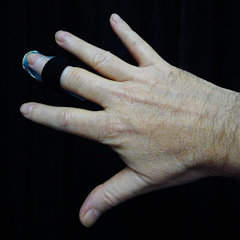
I am reading Bernard-Henri Lévy’s Who Killed Daniel Pearl?, a volume well reviewed in 2003, and shall probably go on to Robert S. Wistrich’s A Lethal Obsession: Anti-Semitism, for Antiquity to the Global Jihad, for, quite accidentally, the ease of typing faster than I can speak — about 80-WPM if hot — has been interrupted by “the most common bed-making accident”: jamming an undersized fitted sheet beneath a mattress, only finding the fist, middle finger (yes, that one) foremost, jammed between the mattress and sloping leather foot-board.
It was a postmodern accident in a way: my insurer’s “urgent care” was an hour and two counties away, much aligned that with the nation’s health care imbroglio, so I got the busted digit figured out using digital resources online. With the assistance of retired local doctors and active pharmacy clerks — while in the drugstore and on the line to Kaiser, the wait for advice alone was 30 minutes, so nix that service too — and the presence of very good comprehensive pharmacy in the vicinity, I got the skinny on 3M “micropore” waterproof tape, useful splints, and the best advice from former patients (same thing): “Six weeks, don’t monkey with it!”
It took a while for the foam bed of the splint to collapse, the tape technique to get simple, the necessity of holding that knuckle down to become clear (“Mallet Finger” it looks like, and I want the tendon — now the two parts of it to grow back long on to the shortest scar tissue possible) and am now in the “lessons learned” portion of the first phase (e.g. wear a mitten outside because the metal splint will freeze the tip of the affected finger; also type flat fingered: in fact, any curling action needed — start with lifting a frying pan — the left hand gets the work).
So I am in reading for long hours instead of hanging out here blogging or chatyping on Facebook.
This may turn out a blessing in disguise: writers need long hours, and long hours with a book becomes what reading can and should be: an alternative wakeful experience in depth.
There is nothing like it.
I may go so far as to say the sinking into long reading stands a fair chance of defragmenting my own drive and with it my approach to time and freedom.
When the splint comes off in mid-January, I’ll be back, busy, and available for editorial and research tasking.
In the meantime, I cannot tell you how much one’s hand needs one’s chief offending finger to do the simplest things . . . .
Still, it’s not like it’s the end of the world. 😉 😉
Middle East journalist Jeffrey Fleishman’s November 27 header in the Los Angeles Times has a poetry in it for the ages: “Morsi may have misjudged Egypt’s tolerance of authoritarianism.”
A moment’s reflection may remind that all regimes labeled autocratic involve by definition the imposition of power, and while there may be elections, the story will also contain some combination of reports of bribery, intimidation, suppression, theft (of whole businesses, not mere wallets), and murder.
Organizations like the “Muslim Brothers” and leaders like President Morsi waste no time in organizing their challengers and rivals for neutralization even though they may not get all they want all at once.
For Morsi specifically, the distance between inauguration and the sacking of Mubarak’s army chief Field Marshal Hussein Tantawi was one month, mid-June to mid-August, and while overhaul of the military was arguably a first order of business, Morsi would go on to conduct assaults, essentially, on Egyptian freedom of speech, human rights and rule of law, and, of course, on the courts.
“The torture process starts once a demonstrator who opposes President Mohammed Morsi is arrested in the clashes or is suspected after the clashes end, and the CSF separate Morsi’s supporters from his opponents. Then, the group members trade off punching, kicking and beating him with a stick on the face and all over his body. They tear off his clothes and take him to the nearest secondary torture chamber, from which CSF personnel, members of the Interior Ministry and the State Security Investigations Services (SSIS) are absent.”
The revelation and publicity may have been developed as a message to intimidate Egyptians who had believed they had a shot at freedom and modernity.
The truth is Egyptians have to find their own way out of the darkness and hell in which despots and thugs keep from them the freedom to inquire and speak broadly and openly about many things, to have recourse to court and security systems that are truly their own and working for them equally, and far more than either of those paths toward freedom and security, to choose for themselves between what is balanced, good, and kind, and what is cruel, dangerous, inhuman, and mad.
If it stinks too much for “Jimmuh” and his outfit, imagine, but one need not leave judgment with notice of the Carter Center’s disinterest in monitoring a state-defining referendum: today, The Algemeiner reported that since early 2011, more than 100,000 Egyptians have sought asylum in the United States.
Reference Update
I’ve gone loosely chronological with this listing as I track but don’t plug stories on a daily basis. In a way, reading down the headlines tells the story. This set starts, close enough, with “Morsi may have misjudged Egypt’s tolerance of authoritarianism” and ends (close enough — I revise as I go) with “Al-Masry Al-Youm Reports on Brotherhood Torture Chambers.” Think about that.
Friedman, Thomas L. “Can God Save Egypt?” The New York Times, December 11, 2012: “What has brought hundreds of thousands of Egyptians back into the streets, many of them first-time protesters, is the fear that autocracy is returning to Egypt under the guise of Islam. The real fight here is about freedom, not religion.
“All 49 captives had been beaten, Mr. Khater wrote, and they said members of the Muslim Brotherhood had tried to coerce them into confessing that they had taken money to commit violence. But prosecutors found no evidence that they had done so.
“Even so, Mr. Morsi declared in a televised speech later that night that prosecutors had obtained confessions.”
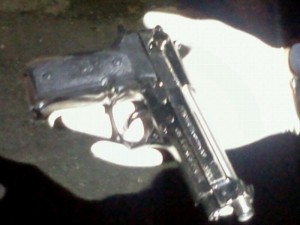
Yesterday, Mohammed Salayma, 16 or 17 years old and in the vicinity of the Cave of the Patriarchs in Hebron, took the pistol pictured to the left and raised it to the face of an Israeli border guard. A fellow officer drew her service weapon and shot Salayma three times, killing him.
Salayma’s gun turned out a replica.
Out in the wild, the sale and manufacture of replica guns serve interests from children’s toys to theatrical productions. In the post-Stalinist, post-Soviet drama in which “actions” are planned for effect — or perhaps they just happen that way (sure they do) — perhaps someone had written the headline before arming or criminally failing to educate the victim. As much seems suggested by the above gun replica.
Do your own Googling if the subject interests you.
The Royal Canadian Mounted Police define a replica as “a device that is not a real firearm, but that was designed to look exactly or almost exactly like a real firearm.”
Look again at that photograph of the pistol that was raised to a guard’s face in the middle east conflict zone.
Suicide-by-cop or just plain awesome stupidity (or communal or lonesome but in any case vicious and unscrupulous political ambition), the story will come out as to what directly motivated Mohammed Salayma, an older teenager, to walk up to to a military guard, stick a fake gun in his face, and thereby draw fire.
Salayma’s death alone would be a tragedy, albeit not one unfamiliar to armed conflicts, but in the middle east conflict, riots and worse come from such sparks.
Ma’an News Agency, ever reluctant to put a whole truth (remember: clear, accurate, complete) up top in its articles (here’s the prosaic lead: “An Israeli border guard officer on Wednesday shot dead a Palestinian teenager in Hebron’s Old City in the southern West Bank”), nonetheless winds around to quoting Israel police: “Initial findings are that he had a fake pistol that he pointed at the officers at the time of the incident.” I’ll call that middle-of-the-clip effort a kind of balanced reporting. (Ma’an News Agency. “Israeli forces shoot, kill Hebron teenager”).

 BackChannels