If they want to do it themselves . . . let ’em . . . .
“Sources in the Gaza Strip said on Thursday that Taha was executed because Hamas feared he might implicate some of its leaders in many corruption scandals. “The man knew too much about the senior leaders of Hamas.”
“We are the generation that stays quiet about political corruption, favoring political correctness instead. We pride ourselves in sticking up for the underdog while throwing our friends and allies to the dogs.”
(8/8/2014)
However you get the news . . . you get it.
Hamas hasn’t a human program or a prayer to offer anyone. Its officers have made themselves millionaires (actually, Khaled Mashaal is a billionaire) on the way to dealing death to their own constituents, including 160 children recruited for the construction of their tunnels.
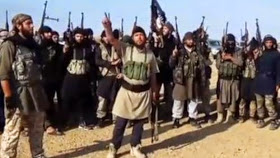
Of ISIS, one only finds worse things to mention — rape and rapine all the way to attempted genocide, Shiites, Christians, Yazidis, and anyone else just because and as it strikes BadDaddy’s fancy.
Talk about the “Hamaside” and “Muslim Botherhood” . . . .
WASHINGTON — U.S. warplanes made a second wave of airstrikes Friday in northern Iraq against the militants who have besieged a religious group and threatened the city of Irbil, a Pentagon official said.
Rear Adm. John Kirby, spokesman for Defense Secretary Chuck Hagel, said the second wave of strikes used a drone to attack a mortar position while four FA-18 fighter-attack planes hit a seven-vehicle convoy outside Irbil.
Hamas’ stated target may only be Israel, but that is deliberately misleading. As the actions of ISIS, which kills Muslims just as indiscriminately as it kills non-Muslims, demonstrate, the philosophy of terrorism knows no loyalty to anything or anyone but itself.
Good evening. Today I authorized two operations in Iraq — targeted airstrikes to protect our American personnel, and a humanitarian effort to help save thousands of Iraqi civilians who are trapped on a mountain without food and water and facing almost certain death. Let me explain the actions we’re taking and why.
First, I said in June — as the terrorist group ISIL began an advance across Iraq — that the United States would be prepared to take targeted military action in Iraq if and when we determined that the situation required it. In recent days, these terrorists have continued to move across Iraq, and have neared the city of Erbil, where American diplomats and civilians serve at our consulate and American military personnel advise Iraqi forces.
To stop the advance on Erbil, I’ve directed our military to take targeted strikes against ISIL terrorist convoys should they move toward the city. We intend to stay vigilant, and take action if these terrorist forces threaten our personnel or facilities anywhere in Iraq, including our consulate in Erbil and our embassy in Baghdad. We’re also providing urgent assistance to Iraqi government and Kurdish forces so they can more effectively wage the fight against ISIL.
Second, at the request of the Iraqi government — we’ve begun operations to help save Iraqi civilians stranded on the mountain. As ISIL has marched across Iraq, it has waged a ruthless campaign against innocent Iraqis. And these terrorists have been especially barbaric towards religious minorities, including Christian and Yezidis, a small and ancient religious sect. Countless Iraqis have been displaced. And chilling reports describe ISIL militants rounding up families, conducting mass executions, and enslaving Yezidi women.
In recent days, Yezidi women, men and children from the area of Sinjar have fled for their lives. And thousands — perhaps tens of thousands — are now hiding high up on the mountain, with little but the clothes on their backs. They’re without food, they’re without water. People are starving. And children are dying of thirst. Meanwhile, ISIL forces below have called for the systematic destruction of the entire Yezidi people, which would constitute genocide. So these innocent families are faced with a horrible choice: descend the mountain and be slaughtered, or stay and slowly die of thirst and hunger.
I’ve said before, the United States cannot and should not intervene every time there’s a crisis in the world. So let me be clear about why we must act, and act now. When we face a situation like we do on that mountain — with innocent people facing the prospect of violence on a horrific scale, when we have a mandate to help — in this case, a request from the Iraqi government — and when we have the unique capabilities to help avert a massacre, then I believe the United States of America cannot turn a blind eye. We can act, carefully and responsibly, to prevent a potential act of genocide. That’s what we’re doing on that mountain.
I’ve, therefore, authorized targeted airstrikes, if necessary, to help forces in Iraq as they fight to break the siege of Mount Sinjar and protect the civilians trapped there. Already, American aircraft have begun conducting humanitarian airdrops of food and water to help these desperate men, women and children survive. Earlier this week, one Iraqi in the area cried to the world, “There is no one coming to help.” Well today, America is coming to help. We’re also consulting with other countries — and the United Nations — who have called for action to address this humanitarian crisis.
I know that many of you are rightly concerned about any American military action in Iraq, even limited strikes like these. I understand that. I ran for this office in part to end our war in Iraq and welcome our troops home, and that’s what we’ve done. As Commander-in-Chief, I will not allow the United States to be dragged into fighting another war in Iraq. And so even as we support Iraqis as they take the fight to these terrorists, American combat troops will not be returning to fight in Iraq, because there’s no American military solution to the larger crisis in Iraq. The only lasting solution is reconciliation among Iraqi communities and stronger Iraqi security forces.
However, we can and should support moderate forces who can bring stability to Iraq. So even as we carry out these two missions, we will continue to pursue a broader strategy that empowers Iraqis to confront this crisis. Iraqi leaders need to come together and forge a new government that represents the legitimate interests of all Iraqis, and that can fight back against the threats like ISIL. Iraqis have named a new President, a new Speaker of Parliament, and are seeking consensus on a new Prime Minister. This is the progress that needs to continue in order to reverse the momentum of the terrorists who prey on Iraq’s divisions.
Once Iraq has a new government, the United States will work with it and other countries in the region to provide increased support to deal with this humanitarian crisis and counterterrorism challenge. None of Iraq’s neighbors have an interest in this terrible suffering or instability.
And so we’ll continue to work with our friends and allies to help refugees get the shelter and food and water they so desperately need, and to help Iraqis push back against ISIL. The several hundred American advisors that I ordered to Iraq will continue to assess what more we can do to help train, advise and support Iraqi forces going forward. And just as I consulted Congress on the decisions I made today, we will continue to do so going forward.
My fellow Americans, the world is confronted by many challenges. And while America has never been able to right every wrong, America has made the world a more secure and prosperous place. And our leadership is necessary to underwrite the global security and prosperity that our children and our grandchildren will depend upon. We do so by adhering to a set of core principles. We do whatever is necessary to protect our people. We support our allies when they’re in danger. We lead coalitions of countries to uphold international norms. And we strive to stay true to the fundamental values — the desire to live with basic freedom and dignity — that is common to human beings wherever they are. That’s why people all over the world look to the United States of America to lead. And that’s why we do it.
So let me close by assuring you that there is no decision that I take more seriously than the use of military force. Over the last several years, we have brought the vast majority of our troops home from Iraq and Afghanistan. And I’ve been careful to resist calls to turn time and again to our military, because America has other tools in our arsenal than our military. We can also lead with the power of our diplomacy, our economy, and our ideals.
But when the lives of American citizens are at risk, we will take action. That’s my responsibility as Commander-in-Chief. And when many thousands of innocent civilians are faced with the danger of being wiped out, and we have the capacity to do something about it, we will take action. That is our responsibility as Americans. That’s a hallmark of American leadership. That’s who we are.
So tonight, we give thanks to our men and women in uniform — especially our brave pilots and crews over Iraq who are protecting our fellow Americans and saving the lives of so many men, women and children that they will never meet. They represent American leadership at its best. As a nation, we should be proud of them, and of our country’s enduring commitment to uphold our own security and the dignity of our fellow human beings.
God bless our Armed Forces, and God bless the United States of America.
Early Evening Pro-Israel Protest, Time-Warner Center, 59th Street and Columbus Circle, New York City, August 7, 2014. Used with permission of the photographer, (c) 2014 Daniel Sigmund Reichwald.
______
If there is a crisis in journalism, the Arab-Israeli highlights the crisis as never before.
Former Israeli Ambassador to the US Michael Oren was interviewed on CNN after Ron Dermer, the current Israeli Ambassador to the US complained that CNN’s coverage was focused on pictures of Palestinian children, while not mentioning the UN school that housed rockets.
As the 2014 Operation Protective Edge (hopefully) draws to a close, one can expect the same histrionics that have become well-known and well-worn to emanate from the Arab world. The video below of Queen Rania of Jordan, is of her appeal to the United Nations five years ago, which can serve as the outline for the Arab textbook on UNRWA. In summation, we are pathetic and we want to ask the world for money again.
(As further background/amusement, Queen Rania of JORDAN was born in KUWAIT and considers herself Palestinian, when convenient).
“Life half-lived” – Palestinian Quality of Life. The Arabs will bemoan their treatment by Israel and ignore their treatment by their Arab brethren.
Palestinians in Lebanon and Syria are denied citizenship by their host countries. They are denied the ability to own property and obtain white color jobs. The Jordanians gave Palestinians citizenship in 1954, only to…
““We are being slaughtered!” she sobbed, her voice raw and worn out, as seen on this parliamentary video. “We are being exterminated! An entire religion is being exterminated from the face of the Earth. In the name of humanity, save us!””
“Brothers, away from all humanitarian disputes, we want humanitarian solidarity” (1:00)
Kurdish MP Vian Dakhil pleading for life before Parliament, August 5, 2014:
One Yazidis showed al-Jazeera a series of text messages received by Yazidis upon the arrival of ISIS, reading: “Where are you going to go? I swear [to] God I will cut you into pieces… We are coming for you, you pig, you enemy of God.”
The Yazidis took the threat seriously. The Washington Post reports that estimates vary from 10,000 to 40,000 Yazidis currently stranded on a mountain above Sinjar, knowing their immediate death awaits them at the foot of the mountain.
No IPTC data found. Source of download: Breitbart.
Thousands of Yazidis — a Kurdish ethno-religious community — have been trapped on Sinjar Mountain in northern Iraq as they attempt to escape the extremists’ grasp. The sole parliamentary representative of the Yazidis, Vian Dakhil, warned that her small community, which has roots in a 4,000 year-old faith, faces the threat of extermination.
Other religious and ethnic groups, including Christians, Shiite Turkmens and Shabaks, have also recently been displaced since the Islamic State began waging a violent campaign against minorities in the territory it controls.
Yazidis believe in one God and worship seven angels. Melek Taus, known as the Peacock Angel, plays the most important role. Worship of the Peacock Angel is where the label “devil worshipper” stems from. Christianity and Islam view the Peacock Angel as a fallen angel or devil for refusing to bow before Adam. Yazidis interpret this as a test of the Peacock Angel’s commitment to God and see the Peacock Angel as the chief of God’s angels.
David Rubin: Is that then part of it? This is so savage that partly . . . you know, everyone keeps saying the images out of Gaza are horrible, which they are, but there’s this definitive narrative There’s a bomb that drops on something . . .
Nikki DeLoach: It’s a war that we recognize. That’s how we’ve seen war. This is not that. This is savage. It’s like . . . medieval . . . something you would see on Game of Thrones.”
I doubt any will see the mass beheading of children (as has been reported in relation to the slaughter of Chaldean Christians in Iraq) on Game of Thrones.
(CNN) — If you’re following the news about ISIS, which now calls itself the Islamic State, you might think you’ve mistakenly clicked on a historical story about barbarians from millennia ago.
“The heinous crime of the Islamic State was carried out not just against Christians, but against humanity,” Sako told a special church service in east Baghdad where around 200 Muslims joined Christians in solidarity.
http://phylliscartersjournal.blogspot.ca/2014/08/the-abuse-of-god-death-and-destruction.html – 8/8/2014 (I continue updating a piece for a little while afterwards as new and telling verbiage appears. As ISIS is basically a raiding party, events move very quickly through its machinations. Where it hustles, Iraq and its allies plod, by comparison, toward getting their act together. At the moment, Aug. 8, 2014, and despite some U.S. activity, ISIS has battlefield resource superiority — arms and ammo, cash, armor and domestic vehicles, a modern enough headquarters, and some techniques in cover and cruelty that have made them especially hard to get at. In their world, the world is running away from them, which for plunder must suit them fine).