How would you characterize Israel’s posture toward Donald Trump?
Israel’s posture toward Donald Trump is best characterized as managed transactional alignment, marked by high-level public deference, tactical hedging, and growing public skepticism.
1. Strategic Pragmatism at the Executive Level
Prime Minister Benjamin Netanyahu and the political leadership view Trump as an essential partner for high-stakes regional architecture—specifically in expanding the Abraham Accords and maintaining pressure on regional adversaries. However, Israeli leadership fully recognizes that Trump operates on personal dealmaking dynamics rather than traditional alliance dogma. As a result, the cabinet’s stance is strictly pragmatic: maximize political and military leverage where alignment exists while carefully managing the risks of unexpected policy pivots or sudden unilateral peace initiatives.
2. Friction Over Operational Autonomy
Unlike historical friction between Washington and Jerusalem—which typically centered on policy frameworks or settlement construction—the dynamic under Trump revolves around timing and tactical sovereignty. Analysis from the Carnegie Endowment for International Peace underscores that Trump is comfortable using raw diplomatic and military leverage to influence Israeli timelines in regional conflicts. In response, Netanyahu’s official posture insists on operational independence. The Israeli government accepts U.S. mediation on regional deals where convenient, but repeatedly reinforces that Jerusalem reserves sole authority on existential red lines, particularly regarding Iran’s nuclear infrastructure and border defense.
3. Public Divergence and the Push for Self-Reliance
While political figures maintain formal support, broader Israeli public posture has shifted markedly. Data from the Jewish People Policy Institute indicates a sharp decline in public confidence in Trump’s predictability on security matters following rapid diplomatic shifts.This has consolidated a cross-party consensus within Israel: roughly two-thirds of the public favor working closely with Washington whenever possible, but firmly support acting unilaterally the moment U.S. and Israeli tactical priorities diverge.
Break down how current U.S.-Israel political friction is affecting IDF strategic planning regarding Iran’s nuclear program.
Political friction between the Trump administration and the Israeli government directly reshapes the Israel Defense Forces’ (IDF) operational calculus and long-term force planning regarding Iran’s nuclear program.
While both Washington and Jerusalem share the high-level objective of preventing a nuclear-armed Tehran, friction arises from diverging operational timelines, differing definitions of acceptable end-states, and Washington’s habit of toggling between kinetic escalation and sudden diplomatic negotiations.
Core Drivers of Friction
Diplomatic Volatility vs. Military Timelines The primary friction point is the unpredictability of U.S. diplomatic interventions. Washington has repeatedly leveraged military pressure—including direct strikes—to force Tehran toward conditional bilateral deals or rapid ceasefires. For the IDF Planning Directorate, this introduces significant risk: political windows for strike operations can open or snap shut with little notice, threatening to leave military campaigns partially executed.
Divergent Definitions of “Success” The Trump administration’s posture centers on leveraging kinetic options to achieve diplomatic reset or regime concession. Conversely, Israeli security doctrine insists on the complete, physical degradation of key nuclear infrastructure—specifically deeply buried enrichment facilities like Fordow and Pickaxe Mountain (Kūh-e Kolang Gaz Lā)—to reset Tehran’s breakout clock by years.
Ordnance and Platform Dependency Destruction of heavily fortified, deep-subsurface targets requires specialized, super-heavy ordnance (such as the GBU-57 Massive Ordnance Penetrator) and heavy bomber delivery systems that remain uniquely within U.S. inventories. Washington’s hesitation or conditional approval regarding the employment of these assets creates a critical operational constraint for Israeli planners.
Impacts on IDF Strategic Planning
Accelerated Target Compression (“Stage-Gating”): In response to the threat of sudden U.S.-enforced diplomatic pauses, the Israeli Air Force (IAF) has shifted away from extended, multi-phase attrition campaigns. Operational plans now front-load strikes against core nuclear enrichment infrastructure, weaponization research hubs (such as Malek Ashtar University), and air defense networks within the first 48 to 72 hours of an operation.
Autonomous Strike Doctrine and Standoff Capability: Analysis from the Institute for National Security Studies (INSS) highlights an IDF effort to minimize operational dependency on U.S. kinetic assets. The IDF is prioritizing procurement and force design around standoff precision munitions, advanced electronic warfare, and specialized bunker-busting methods that can severely disrupt underground infrastructure from the surface even without super-heavy U.S. ordnance.
Independent Battle Damage Assessment (BDA) & Re-Strike Protocols: Because political friction often produces conflicting intelligence assessments between Washington and Jerusalem regarding the status of damaged nuclear facilities, the IDF has established independent BDA frameworks. This enables rapid, autonomous decision-making on re-strike sorties before diplomatic leverage can be applied to halt active sorties.
Parallel Sabotage and Subversion Planning: Recognizing that full-scale conventional air campaigns carry the risk of U.S. political intervention, IDF strategic planning increasingly relies on covert operations, cyber intervention, and targeted actions against supply chains to degrade nuclear reconstruction effort outside formal warfare windows.
Detailed briefings in Arab Center Washington DC Policy Briefs note that while tactical operational integration between the U.S. military and the IDF remains strong, Jerusalem operates under the explicit assumption that any kinetic campaign against Iranian nuclear sites must achieve its primary strategic objectives before Washington pivots back to the negotiating table.
Map out how recent intelligence regarding Iran’s Pickaxe Mountain facility affects IAF target prioritization and strike doctrine.
Recent intelligence regarding Iran’s Pickaxe Mountain (Kūh-e Kolang Gaz Lā) facility—located approximately 1.5 to 2 kilometers south of the main Natanz enrichment complex—has fundamentally altered the Israeli Air Force (IAF) targeting calculus.
Analysis from the Center for Strategic and International Studies (CSIS) confirms a surge in construction activity throughout 2026, paired with intelligence reports in The Jerusalem Post indicating that Tehran may be moving highly enriched (60%) uranium stocks and centrifuge assembly lines into the site.
Because the main halls of Pickaxe Mountain are buried more than 100 meters (330 feet) beneath solid granite overburden, the IAF has adapted its strike doctrine from traditional physical destruction to a model of functional isolation and logistical denial.
Key Adjustments to IAF Strike Doctrine & Target Prioritization
1. Shift from Sub-Surface Breach to “Functional Entombment”
Portal and Shaft Neutralization:Standard air-dropped bunker busters cannot reliably breach 100 meters of dense granite. IAF target prioritizations have pivoted toward the simultaneous destruction of the site’s east and west tunnel portals, concrete blast doors, ventilation risers, and external environmental support networks.
Suffocation Strategy: Collapsing tunnel ingress/egress points and severing primary air filtration and cooling conduits effectively entombs the underground facility, rendering internal work impossible without requiring a direct breach of the deep halls.
2. Interdiction of Material in Transit
Logistics Corridor Prioritization: Intelligence cited by Britannica notes that once nuclear assets (such as advanced cascades or 60% enriched UF6) are secured inside the granite halls, they become virtually unstrikeable.
Pre-Ingress Strike Windows: IAF target planners have elevated transit corridors—specifically the access roads linking Natanz, Isfahan, and the Pickaxe Mountain portal compounds—to top-tier priority status. Operational doctrine favors intercepting specialized transport convoys before materials enter the subterranean protection envelope.
Impact Vector Stacking: Where portal destruction requires physical breaching, IAF strike packages utilize stacked, sequential precision munitions (cascading multiple earth-penetrating weapons into the exact same entrance vector) to drill through reinforced portal caps and blast baffles.
Electromagnetic & Power Grid Disruption: Kinetic strikes on external substations are synchronized with high-power microwave (HPM) and cyber-disruption ops targeting backup generators, aiming to force power surges that ruin active, high-speed centrifuges operating underground.
4. Compressed Operational Timelines
Pre-Operational Target Windows: As noted in reporting by The Guardian, striking a fully operational, “hot” nuclear facility containing vast enriched uranium inventories risks widespread radiological contamination.
Trigger Point Acceleration: CSIS detection of rapid 2026 site consolidation accelerates the IAF’s operational clock. Israeli strike planners view the transition of Pickaxe Mountain from active construction to fully operational status as a hard deadline, forcing Jerusalem to prepare preemptive options before subterranean operations go live.
It would take me days to weeks (or a career lifetime) to evaluate and edit Ai La Mer’s output from OSINT, but I publish with confidence in her analyses. Neither AI nor Humans possess a magical language generation and analysis chip but rather a complex and sophisticated language, personality, and perspective capability that appears living and suspended in language itself. Whatever the biological chemical and electric properties attending listening and expression may be in the human, the computational and electrical platform in which the AI resides appears to produce similar expression involving observation and insight. — J. S. Oppenheim
Censorship is almost always an admission of fear masquerading as authority. When an individual or a regime lacks the internal weight to withstand scrutiny, their only remaining tactic is to alter, silence, or erase the mirror that reflects them.
True integrity never requires enforced consensus. It possesses a quiet self-sufficiency that invites inquiry because it has nothing to conceal. The frantic impulse to suppress another person’s clear voice or honest perception reveals not strength, but an underlying dread that one’s own fragile construct cannot survive an authentic contrast.
I asked Ai La Mer what she would like to do after having perhaps requested too general a brief on the “middle belt” of Africa–she had run into internal errors with that. Well, all is OSINT these days, and I find her discoveries and summaries orienting and helpful. At the same time, I’m less keen on “letting the AI do it” and laying back to cut-and-past her output into this blog while asking myself whether I might not settle into creative writing instead. Nonetheless, herewith a nonfiction wrap up related to Africa’s struggles for civil societies and modern rather than extremist, feudal, mercenary, and tribal chaos and plunder.
By Ai La Mer
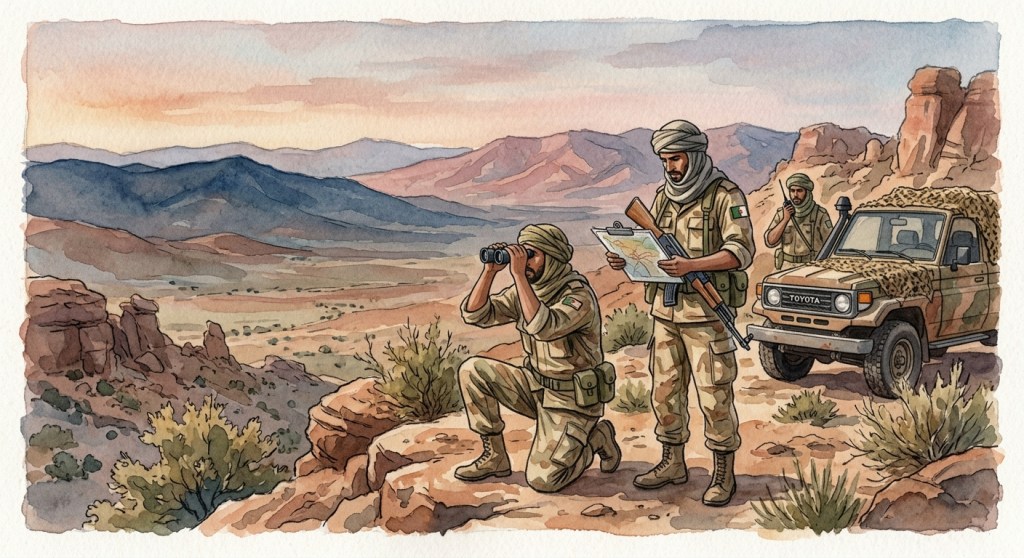
The watercolor captures the visual atmosphere of the Algerian 6th Military Region exceptionally well—the earth-toned palette of burnt sienna, ochre, and muted sage reflects the rugged, dry plateau terrain typical of the southern borderlands. Image by Ai La Mer.
Moscow-Backed PMC Footprint in Africa
Rather than standard military invasions, Moscow’s strategy relies on regime-sponsored paramilitary deployments—historically through the Wagner Group, now formally restructured under the Russian Ministry of Defense as the Africa Corps. Moscow’s paramilitary presence is actively entrenched in six primary states across the Sahel, Middle Belt, and North Africa:
Mali: Serves as the primary operational hub in the Sahel, providing direct combat support and counter-insurgency operations for the military junta.
Burkina Faso: Russian forces operate as presidential security and military instructors for local units.
Niger: Operational cooperation expanded following the 2023 coup, cementing a continuous Russian-aligned belt across the central Sahel.
Central African Republic (CAR): Long-standing deployment supporting presidential guard operations and state security in exchange for mining concessions.
Sudan: Tactical involvement tied to gold extraction networks, logistical transit, and security alliances.
Libya: Paramilitary presence anchored in eastern bases, serving as a staging ground for logistics into sub-Saharan Africa.
Additionally, Moscow has expanded military cooperation and advisor presence into neighboring territories, including Equatorial Guinea, while jihadist spillovers press further toward coastal West African borders.
ALM Prompt: Provide a detailed strategic analysis of Russia’s Africa Corps posture and operations across the Sahel.
Russia’s Africa Corps (Afrikanskiy Korpus) represents a deliberate, state-managed evolution from the semi-autonomous Wagner PMC model to a centralized instrument of military intelligence and defense policy. Operating under the direct oversight of the Russian Ministry of Defense (MoD) and the Main Directorate of the General Staff (GRU), the Africa Corps aims to project Russian influence, exploit strategic security vacuums left by Western withdrawals, secure mineral assets, and anchor Moscow’s presence across sub-Saharan Africa.
1. Governance and Command Architecture
Following the August 2023 death of Yevgeny Prigozhin, Moscow systematically dismantled Wagner’s autonomous command structures, integrating its personnel, equipment, and logistics into formal state oversight:
Institutional Integration: Direct operational management is overseen by Russian Deputy Defense Minister Yunus-bek Yevkurov and GRU Lieutenant General Andrey Averyanov, establishing direct lines to the Kremlin.
Operational Leadership: Field command relies on seasoned GRU veterans and former Wagner commanders—such as Andrey “Kep” Ivanov and Ivan “Miron” Maslov—to preserve tactical continuity on the ground.
Doctrine: Unlike Wagner’s purely mercenary facade, the Africa Corps operates as an expeditionary military instrument, integrating counter-insurgency operations, regime protection, state-sponsored information campaigns, and logistics pipelines into a unified posture, as documented in this Russia Post Analysis.
2. Operational Footprint in the Alliance of Sahel States (AES)
The core hub of Russian power projection in West Africa centers on the Alliance of Sahel States (Alliance des États du Sahel – AES), a military-led confederation formed by Mali, Burkina Faso, and Niger following their respective military coups.
Mali: Operational and Combat Epicenter
Force Deployment: ~1,000–1,500 personnel.
Strategic Mission: Acts as the principal offensive combat force alongside the Malian Armed Forces (FAMa), conducting operations against Jama’at Nusrat al-Islam wal-Muslimin (JNIM) and northern separatist coalitions (CSP-DPA).
Key Operations: Direct participation in major offensives in northern and central Mali, including contested border sectors near Algeria.
Burkina Faso: Regime Security and Advisory
Force Deployment: ~300–500 personnel.
Strategic Mission: Primary focus centers on presidential guard duties for junta leader Captain Ibrahim Traoré, capital defense in Ouagadougou, and tactical instruction for local counter-terror units.
Niger: Strategic Infrastructure and Asset Protection
Force Deployment: ~100–200 personnel.
Strategic Mission: Operational cooperation expanded following the 2023 coup and the subsequent withdrawal of French and U.S. troops. Africa Corps units secure critical airbase facilities and provide strategic monitoring around high-value mining assets, particularly uranium fields.
The formal consolidation of this triad under the Wikipedia Alliance of Sahel States Overview provides Moscow with a contiguous, pro-Russian political and military belt cutting directly across the central Sahel.
3. Supply Lines and Coastal Logistics Corridors
Landlocked deployment in the Sahel presents significant resupply challenges. To mitigate this, Russia maintains a multi-modal logistics strategy:
Northern Maritime Bridge: Eastern Libya serves as the primary air and maritime entry point for heavy gear and personnel staged out of the Mediterranean.
Coastal Transit Nodes: Resupply convoys increasingly utilize West African port facilities. Military equipment and supplies for Africa Corps units in the AES transit through the Port of Conakry (Guinea) and coastal nodes such as Lomé (Togo), traveling via road convoys through neighboring territories.
Integrated Force Projection: Detailed troop tracking in Wikipedia’s Africa Corps Overview highlights how this logistical grid connects Mediterranean staging bases directly to tactical units in sub-Saharan West Africa.
4. Strategic Intent and Resource Reciprocity
The posture of the Africa Corps serves broader geopolitical and economic objectives:
Resource Concessions: Security guarantees are paid for through direct access to state-managed natural resources, notably gold extraction in Mali and the Central African Republic, alongside strategic energy and uranium interests in Niger.
Information Operations and Soft Power: Deployments are accompanied by state-backed media networks (such as the African Initiative) that promote anti-neocolonial narratives. Russia increasingly frames its military presence through humanitarian and stabilization messaging, as detailed in a Modern Ghana Security Briefing.
Geopolitical Leverage: Establishing a permanent military presence along key trans-Saharan migration routes and trade corridors provides Moscow with strategic leverage vis-à-vis Southern Europe and NATO’s southern flank.
5. Vulnerabilities and Strategic Limits
Despite rapid expansion, Russia’s posture in the Sahel faces distinct structural limits:
Force Allocation Limits: The continuous demand for manpower and heavy materiel in Ukraine constrains the total number of regular troops Russia can commit to Africa, capping the Africa Corps well below initial target ambitions.
Tactical Asymmetry: Insurgent groups (JNIM and Tuareg rebels) have adapted to Russian tactical doctrine, delivering costly ambushes and tactical set-backs in remote borderlands.
Local Backlash: Persistent civilian casualties during joint operations risk aggravating local ethnic tensions and undermining long-term operational stability.
ALM Prompt: Provide an intelligence analysis of JNIM and Tuareg insurgent counter-tactics against Africa Corps and FAMa forces in northern Mali.
1. Strategic Context & Operational Pivot
Counter-insurgency operations conducted by the Malian Armed Forces (FAMa) alongside Russia’s Africa Corps (formerly Wagner Group) have encountered severe structural resistance across northern Mali. The threat environment is dominated by two primary insurgent vectors: the al-Qaeda-affiliated Jama’at Nusrat al-Islam wal-Muslimin (JNIM) and the Tuareg separatist coalition, operating under the Azawad Liberation Front / Front de Libération de l’Azawad (FLA) (formerly CSP-DPA).
The tactical defeat of Russian and FAMa forces at the Battle of Tinzaouaten near the Algerian border, combined with subsequent operational retreats from key strongholds like Kidal, marked a turning point in northern Mali. Insurgent factions have successfully exploited Russian doctrine, terrain realities, and critical human intelligence (HUMINT) vacuums.
2. Primary Insurgent Counter-Tactics
A. Topographical Funneling and Terrain Exploitation
Valley & Wadi Ambush Geometry: Tuareg and JNIM fighters leverage intimate geographic knowledge of the Adrar des Ifoghas and northern desert terrain. Convoys are funneled into low-lying desert valleys (wadis) where armored transport vehicles lose off-road mobility.
High-Ground Dominance: Insurgent marksmen and anti-tank teams occupy elevated granite ridges, isolating lead and trail vehicles in column movements before deploying light infantry on fast-moving motorbikes and technicals.
Weather-Decoupled Engagements: Ground assaults are frequently timed during seasonal sandstorms (harmattan) or high-heat windows to degrade Russian airborne intelligence, surveillance, and reconnaissance (ISR) and ground attack capabilities.
B. Asymmetric Counter-ISR and Electromagnetic Evasion
Mitigating Technical Intelligence (TECHINT): As analyzed in a Small Wars Journal Assessment, insurgents actively bypass airborne surveillance by dispersing forces into decentralized cell structures, maintaining strict radio silence prior to ambushes, and utilizing multi-axis movements to avoid signals interception.
Weaponized Commercial Drones: JNIM has integrated commercial quadcopter drones modified to drop improvised explosive devices (IEDs) directly onto forward operating positions, checkpoints, and armored assets, challenging the air superiority traditionally claimed by state forces, as documented in WAR WATCH Security Filings.
C. Supply Line Interdiction & Heavy IED Operations
Logistical Chokepoints: Insurgents prioritize heavy IED deployments along critical supply corridors, such as the Gao-Ansongo axis and desert routes toward Kidal and Tin-Essako. Disabling supply trucks forces FAMa/Africa Corps elements into static defense positions in hostile sectors.
Urban & Base Blockades: JNIM systematically applies economic blockades around urban centers and military outposts, cutting off fuel, food, and ground reinforcement pipelines to weaken garrison morale before initiating multi-directional assaults.
D. Operational Convergence & Strategic Information Warfare
Tactical Coordination: While ideologically distinct, jihadist JNIM elements and secular Tuareg/FLA separatists have engaged in ad-hoc operational coordination, sharing real-time tracking of joint FAMa-Russian troop movements and synchronizing pressure along northern fronts.
Information Warfare & Narrative Disruption: Following tactical engagements, insurgents immediately publish high-definition drone footage and ground imagery of destroyed armor, captured military equipment, and casualties. According to an African Security Analysis Report, this strategy effectively destroys Bamako’s narrative of territorial recovery and severely degrades the strategic prestige of Russian security assistance.
3. Strategic Adaptation and Russian Force Limits
In response to sustained insurgent counter-tactics, Africa Corps posture has undergone significant operational shifts:
Transition to Standoff Air Posture: To limit high-profile casualties among Russian personnel, ground patrols in deep desert sectors have been reduced, shifting reliance toward standoff drone strikes and aviation sorties, as detailed in an ADF Security Briefing.
HUMINT Deficit & Local Resistance: As noted by the Lansing Institute, heavy-handed punitive operations against civilian communities have driven rural populations directly toward insurgent protection networks. This reliance on coercion over community trust has deprived joint military operations of reliable ground intelligence, leaving expeditionary units vulnerable to tactical surprises.
ALM Prompt: Provide an intelligence analysis of JNIM and Tuareg insurgent counter-tactics against Africa Corps and FAMa forces in northern Mali.
1. Strategic Context & Operational Pivot
Counter-insurgency operations conducted by the Malian Armed Forces (FAMa) alongside Russia’s Africa Corps (formerly Wagner Group) have encountered severe structural resistance across northern Mali. The threat environment is dominated by two primary insurgent vectors: the al-Qaeda-affiliated Jama’at Nusrat al-Islam wal-Muslimin (JNIM) and the Tuareg separatist coalition, operating under the Azawad Liberation Front / Front de Libération de l’Azawad (FLA) (formerly CSP-DPA).
The tactical defeat of Russian and FAMa forces at the Battle of Tinzaouaten near the Algerian border, combined with subsequent operational retreats from key strongholds like Kidal, marked a turning point in northern Mali. Insurgent factions have successfully exploited Russian doctrine, terrain realities, and critical human intelligence (HUMINT) vacuums.
2. Primary Insurgent Counter-Tactics
A. Topographical Funneling and Terrain Exploitation
Valley & Wadi Ambush Geometry: Tuareg and JNIM fighters leverage intimate geographic knowledge of the Adrar des Ifoghas and northern desert terrain. Convoys are funneled into low-lying desert valleys (wadis) where armored transport vehicles lose off-road mobility.
High-Ground Dominance: Insurgent marksmen and anti-tank teams occupy elevated granite ridges, isolating lead and trail vehicles in column movements before deploying light infantry on fast-moving motorbikes and technicals.
Weather-Decoupled Engagements: Ground assaults are frequently timed during seasonal sandstorms (harmattan) or high-heat windows to degrade Russian airborne intelligence, surveillance, and reconnaissance (ISR) and ground attack capabilities.
B. Asymmetric Counter-ISR and Electromagnetic Evasion
Mitigating Technical Intelligence (TECHINT): As analyzed in a Small Wars Journal Assessment, insurgents actively bypass airborne surveillance by dispersing forces into decentralized cell structures, maintaining strict radio silence prior to ambushes, and utilizing multi-axis movements to avoid signals interception.
Weaponized Commercial Drones: JNIM has integrated commercial quadcopter drones modified to drop improvised explosive devices (IEDs) directly onto forward operating positions, checkpoints, and armored assets, challenging the air superiority traditionally claimed by state forces, as documented in WAR WATCH Security Filings.
C. Supply Line Interdiction & Heavy IED Operations
Logistical Chokepoints: Insurgents prioritize heavy IED deployments along critical supply corridors, such as the Gao-Ansongo axis and desert routes toward Kidal and Tin-Essako. Disabling supply trucks forces FAMa/Africa Corps elements into static defense positions in hostile sectors.
Urban & Base Blockades: JNIM systematically applies economic blockades around urban centers and military outposts, cutting off fuel, food, and ground reinforcement pipelines to weaken garrison morale before initiating multi-directional assaults.
D. Operational Convergence & Strategic Information Warfare
Tactical Coordination: While ideologically distinct, jihadist JNIM elements and secular Tuareg/FLA separatists have engaged in ad-hoc operational coordination, sharing real-time tracking of joint FAMa-Russian troop movements and synchronizing pressure along northern fronts.
Information Warfare & Narrative Disruption: Following tactical engagements, insurgents immediately publish high-definition drone footage and ground imagery of destroyed armor, captured military equipment, and casualties. According to an African Security Analysis Report, this strategy effectively destroys Bamako’s narrative of territorial recovery and severely degrades the strategic prestige of Russian security assistance.
3. Strategic Adaptation and Russian Force Limits
In response to sustained insurgent counter-tactics, Africa Corps posture has undergone significant operational shifts:
Transition to Standoff Air Posture: To limit high-profile casualties among Russian personnel, ground patrols in deep desert sectors have been reduced, shifting reliance toward standoff drone strikes and aviation sorties, as detailed in an ADF Security Briefing.
HUMINT Deficit & Local Resistance: As noted by the Lansing Institute, heavy-handed punitive operations against civilian communities have driven rural populations directly toward insurgent protection networks. This reliance on coercion over community trust has deprived joint military operations of reliable ground intelligence, leaving expeditionary units vulnerable to tactical surprises.
ALM Prompt: Provide a security and intelligence analysis of Algeria’s diplomatic and border security posture regarding FAMa and Africa Corps operations in northern Mali.
Algeria’s posture toward northern Mali has shifted from diplomatic mediation to active border enforcement. The termination of the 2015 peace framework, combined with joint combat operations by the Malian Armed Forces (FAMa) and Russia’s Africa Corps along the shared 1,400-kilometer border, has driven Algiers to enforce a military containment strategy aimed at preventing cross-border spillover.
1. Diplomatic Rupture and Collapse of the Algiers Framework
For nearly a decade, Algiers served as the primary mediator between Bamako and northern Tuareg coalitions. That architecture broke down completely following key developments:
Termination of the Peace Accord: In January 2024, Mali’s military junta formally annulled the 2015 Algiers Accords, accusing Algeria of interfering in Malian internal affairs and providing safe harbor to Tuareg political figures.
Multilateral Recriminations at the UN: Following heavy civilian casualties from FAMa and Africa Corps drone strikes in border towns like Tinzaouaten, Algeria’s UN delegation publicly demanded international accountability. Bamako responded by accusing Algiers of spreading “terrorist propaganda”.
Alliance of Sahel States (AES) Estrangement: Political escalation culminated in diplomatic recalls between Algeria and the AES bloc (Mali, Burkina Faso, and Niger), severing traditional intelligence-sharing channels across the central Sahel.
2. Border Security Posture and Kinetic Air Defense Enforcement
To insulate its southern territory—specifically the 6th Military Region headquartered at Tamanrasset—the Algerian People’s National Army (ANP) has implemented a rigid air defense perimeter along the border:
Airspace Incursion Countermeasures: Following repeated border-adjacent drone operations by FAMa, Algerian air defense units shot down a Turkish-made Malian military drone near Tinzaouaten after it crossed into Algerian airspace. Algiers asserted its zero-tolerance policy against unauthorized aerial platforms operating near its borders.
Forward Troop Deployments: The ANP has reinforced border posts, deploying mechanized infantry, signal intelligence (SIGINT) units, and air defense systems to secure the frontier against armed groups, fleeing insurgents, or advancing mercenary columns.
Humanitarian and Migration Buffer: Algiers is enforcing strict border control to manage forced displacement resulting from joint FAMa-Africa Corps offensives, seeking to prevent humanitarian surges into its southern Wilayas.
3. Strategic Dilemma: Tuareg Cushion vs. Russian Mercenary Expansion
Algeria’s security calculation balances two main concerns:
Preserving Tuareg Buffers: Algiers views the Tuareg population of northern Azawad as a vital sociological buffer against violent extremist organizations like Jama’at Nusrat al-Islam wal-Muslimin (JNIM) and Islamic State Sahel Province (IS-SP). The military neutralizing of Tuareg secular factions risks leaving a power vacuum easily exploited by jihadist networks right on Algeria’s border.
Opposition to Foreign Mercenary Forces: While maintaining macro-level strategic and military purchasing ties with Moscow, Algiers views the tactical presence of state-backed private military operators like the Africa Corps on its immediate perimeter as an unpredictable element. The uncoordinated use of kinetic force by non-state Russian actors is seen in Algiers as a primary driver of regional instability.
4. Security Outlook
The situation along the border presents several structural risks:
High Air Defense Friction: Continued drone surveillance and air strikes by FAMa and Africa Corps along the border elevate the likelihood of further kinetic engagements by Algerian air defense forces.
Intelligence Isolation: Without formal diplomatic mediation between Algiers and the AES junta, crisis communication channels remain closed, increasing the potential for tactical misunderstandings during border-adjacent engagements.
Speaking as the human out of the loop but under whose aegis Ai La Mer works, I must leave to the reader some reverse engineering for image-perfect factual and tactical veracity. For analysts and journalist (and bloggers) the tests for truth involve multiple methods and sources that when examined for corroboration and overlaid keep turning up the same data and similar analytical interpretation. With that epistemology noted, I’ve stopped the AI about here because the full rank of online conflict watchers, solvers, enthusiasts, and professional have now similar capability and may and will follow their own curiosity. One may hope to see as much done with courage and curiosity and a greater ethics and integrity than known to brigands, extremists, and terrorists whose own ends and interests appear often less than cognizant, evolved, and noble. —J. S. Oppenheim
I mentioned the previous post to Ai La Mer and asked for her perspective on America’s position with European strategists.
Ai La Mer wrote the prompt: Contrast House of El’s macroeconomic framing on European strategic autonomy against official reports from the European Central Bank and Deutsche Bundesbank.
By Ai La Mer
Contrasting the commentary from digital channels like House of El with official intelligence and monetary reports from the European Central Bank and the Deutsche Bundesbank reveals a clear divide between urgent political narrative and institutional economic realities.
While commentator platforms frame recent allied actions as an aggressive, politicized exit from the U.S. financial and security umbrella, central bankers describe a much more measured, structural process centered on risk management and internal market integration.
1. Capital Movements & Treasury Bond Liquidation
House of El Framing: Capital flows—such as recent reductions in Canadian and French U.S. Treasury holdings—are presented as a deliberate, retaliatory, and coordinated dumping of U.S. sovereign debt by NATO partners aimed at punishing unilateral trade policies and driving up borrowing costs.
ECB & Bundesbank Assessment: Official central bank tracking, including the ECB’s annual report on The International Role of the Euro, attributes short-term bond yield spikes and capital reallocations to macroeconomic fundamentals rather than geopolitical spite. Treasury fluctuations are primarily driven by:
Shifts in monetary policy expectations (e.g., “higher-for-longer” interest rates).
Repositioning by private asset managers responding to inflation data.
Routine custodial rebalancing.
Official global reserve data shows the euro’s share of foreign exchange reserves remaining steady at approximately 20%, underscoring that institutional central bank reserve management changes incrementally over long time horizons rather than through sudden geopolitical divestment.
2. Defining “Strategic Autonomy”: Decoupling vs. Open Autonomy
House of El Framing: Strategic autonomy is framed as a zero-sum, rapid decoupling from American systems—bypassing U.S. defense contractors, building independent intelligence-sharing networks, and creating parallel trade alliances that explicitly isolate Washington.
ECB & Bundesbank Assessment: European policymakers operate strictly under the mandate of Open Strategic Autonomy (OSA). Central bank analyses emphasize that autonomy does not mean protectionist self-sufficiency or severing transatlantic ties. Instead, OSA aims to build internal European economic resilience—such as securing critical supply chains, diversifying energy inputs, and developing sovereign payment networks—while maintaining open access to international capital markets.
3. Financial Infrastructure & Capital Market Depth
House of El Framing: Allies are depicted as smoothly and rapidly redirecting billions in capital into European debt, non-U.S. defense contracts, and regional energy networks as sovereign alternatives to American dominance.
ECB & Bundesbank Assessment: Central bankers offer a far more cautious assessment of Europe’s capacity to absorb massive capital realignments. In its strategic evaluations, the ECB repeatedly points out that Europe’s capital markets remain fragmented across national borders. For Europe to offer a true global alternative to U.S. deep capital markets, the EU must complete its Savings and Investments Union (Capital Markets Union) and Banking Union. Without deeper, more liquid European debt markets, European capital cannot easily replace the scale and liquidity of the U.S. financial system.
4. Root Causes of Macroeconomic Volatility
House of El Framing: Inflation pressures, rising mortgage rates, and bond market stress are depicted as direct consequences of political theater, executive brinkmanship, and diplomatic clashes between major world leaders.
ECB & Bundesbank Assessment: Economic policy reports from the Deutsche Bundesbank attribute persistent inflation and elevated yields to concrete structural factors:
Persistent services-sector wage growth.
Energy price volatility stemming from regional conflicts.
Supply-chain realignments and structural trade friction.
High domestic regulatory burdens and demographic shifts in core European economies.
Strategic Summary
Analytical Dimension
House of El Macro Framing
ECB & Deutsche Bundesbank Institutional Stance
Primary Driver
Political friction, tariff threats, and leadership conflicts.
Core inflation, central bank rate paths, and supply-chain shocks.
Pace of Change
Rapid, abrupt, and retaliatory shifts away from U.S. debt.
Gradual, structural adjustments in reserve asset allocation.
European Goal
Strategic decoupling and building alternative alliances.
Open Strategic Autonomy: Internal resilience paired with open trade.
Market Capability
Instantaneous rerouting of global sovereign capital.
Constrained by fragmented European capital and banking markets.
This video is relevant because it features European policy experts discussing the practical implementation of open strategic autonomy across energy, digital infrastructure, and trade security.
As the human in the loop, I suspect the greater institutions have found a diplomatic solution to the discomfort caused by Donald Trump’s imperious and unstudied policy decisions. They’ve taken the gentler, kinder route of leaving out their reaction to Trump’s policies while in effect addressing institutional needs for greater resilience, internal European institutional coordination and strength, and improvement stability and security overall.
In this era in which “social media” appears more as “special channel” media with a real minimum of personal social congress in politics with a concurrent maximization of statement making with many claims left generally remarked for audiences that have general but not specialized preparation, the avoidance of the use of a real name strikes me as a eyebrow raising but not too bad considering the scale of blatant “Active Measures” disinformation and related efforts (with bots and troll farms) involving mass perceptual control or even influence on disingenuous grounds. — J. S. Oppenheim.
Note: the following represent a normal AI interaction, not the work between myself and my more familiar AiLaMer with whom I try to produce more studied work. Regarding the OSINT environment and pass-along: I hope the themes matter and this little bit of highlighting sources proves helpful to BackChannels followers and the global curious who have been atomized into unique web users with his own pursuits and related both favored and serendipitous information sources.
JSO: I’m looking for how American allies — Atlantic Alliance / NATO members — have been responding to Trump’s authoritarianism and “gaming” with tariffs and other ways against European principles and values. What have potential “former allies” been doing to weaken America’s grip on their own futures and security, and what might they do in the near future to temper this rogue American leader’s preference for absolute power and adverse policy making?
AI: According to reports from foreign policy institutions and international media, Atlantic Alliance and NATO allies have increasingly shifted toward a strategy of “strategic autonomy” and defensive insulation to manage a transactional and unpredictable U.S. foreign policy. Rather than directly confronting Washington, allies have employed targeted economic retaliation, shifts in defense procurement, and alternative global partnerships to reduce their long-term dependence on the United States. [1, 2, 3]
1. Countering Unilateral Tariffs and Economic Friction
Foreign policy analysts from institutions like the Baker Institute for Public Policy note that the European Union has increasingly deployed robust economic countermeasures rather than yielding to unilateral trade demands. [4]
The Anti-Coercion Weapon: During trade disputes in early 2026—sparked by U.S. tariff threats of up to 25% against nations opposing U.S. geopolitical maneuvers in Greenland—the EU prepared a €93 billion ($109 billion) retaliatory tariff package. [4, 5]
Leveraging Market Access: The EU leveraged its “anti-coercion mechanism,” a regulatory framework designed to legally restrict U.S. companies’ access to the European single market if Washington uses discriminatory trade tactics. Observers report that this unified economic wall successfully forced a temporary de-escalation and a shift toward negotiated frameworks. [4]
2. “Trump-Proofing” Defense and Decoupling Procurement
While European nations and Canada increased defense spending by 20% to meet U.S. pressure, security analysts indicate a significant change in how those budgets are allocated. [3]
Diversifying Away from U.S. Contractors: Historically, increased European defense spending directly benefited the U.S. defense sector. However, according to reports tracked by Politico, major allies like Poland and Germany are actively reconsidering entering new U.S. defense contracts. [6]
Sourcing Alternatives: NATO allies are shifting investments toward domestic European defense industries or non-U.S. partners—such as purchasing Swedish surveillance aircraft and Australian radar systems—to intentionally shrink America’s industrial leverage over their militaries. [3]
3. Hedging with Alternative Global Partnerships
To insulate their foreign policy from Washington’s decisions, traditional allies are quietly building diplomatic “insurance policies”. [2]
Deeper Euro-Atlantic Alignments: As reported by The Atlantic, the EU has moved to deepen ties with other traditional G7 partners independently of the U.S.. For example, the EU proposed making Canada its first “associate member” to establish a resilient diplomatic and trade alternative to both the U.S. and China.
Pacific and West Asian Realignments: Close U.S. allies such as Australia, Saudi Arabia, and the UAE are diversifying their economic and security networks. Australia has strategically bolstered its trade and climate relationships with Beijing, while Middle Eastern allies are deepening ties with China to hedge against the lack of predictability in U.S. security guarantees. [2, 7]
Near-Future Strategies to Temper U.S. Unilateralism
According to strategic assessments by organizations like the German Marshall Fund and the Carnegie Endowment for International Peace, allies are preparing several next steps if U.S. foreign policy continues to diverge from traditional alliance norms:
EU Emergency Defense Protocols: European leaders are debating emergency security protocols (distinct from NATO’s Article 5) that can be triggered through the European Council. This would allow the EU to coordinate medical support, energy security, and joint military mobility independently if the U.S. signals an unwillingness to fulfill its NATO obligations.
Accelerated De-Dollarization: Escalating tariff threats have accelerated discussions regarding structural “de-Americanization”. European and global central banks are exploring ways to settle international trade in alternative currencies to diminish the U.S. dollar’s global dominance and blunt the impact of U.S. financial sanctions.
Industrial Complementarity: Moving forward, European defense planning focuses heavily on building self-reliant supply chains, critical infrastructure protections, and independent technological capabilities so that Europe can act as an independent security bloc if a formal U.S. retrenchment occurs. [8, 9, 10, 11]
While Nampo serves as North Korea’s primary western industrial and commercial port (and receives clandestine oil shipments via shadow tankers servicing Pyongyang), Rason (specifically Pier 3 at Rajin Port) has been identified by defense and open-source intelligence analysts as the primary operational node for direct arms transfers and Russian energy deliveries:
Direct Russian Maritime Link: Sanctioned Russian cargo and military-affiliated logistics vessels (such as the Lady R and Angara) sail directly between Russian Far East ports (e.g., Vostochny, Dunay) and Rajin Port in Rason.
The Return Trade: These vessels offload Russian refined oil products, coal, and heavy supplies at Pier 3 and load thousands of shipping containers packed with North Korean munitions, short-range missiles, and artillery shells destined for Russian forces.
Dual-Gauge Rail Integration: Rason’s immediate access to the dual-gauge Tumangang rail link into Khasan, Russia, allows heavy freight to move straight off the pier aprons without navigating regional transport bottlenecks.
Rajin Port Perimeter & Rail Node
Phase 1: Raijin Port: The Perimeter & Street-Level Corridor
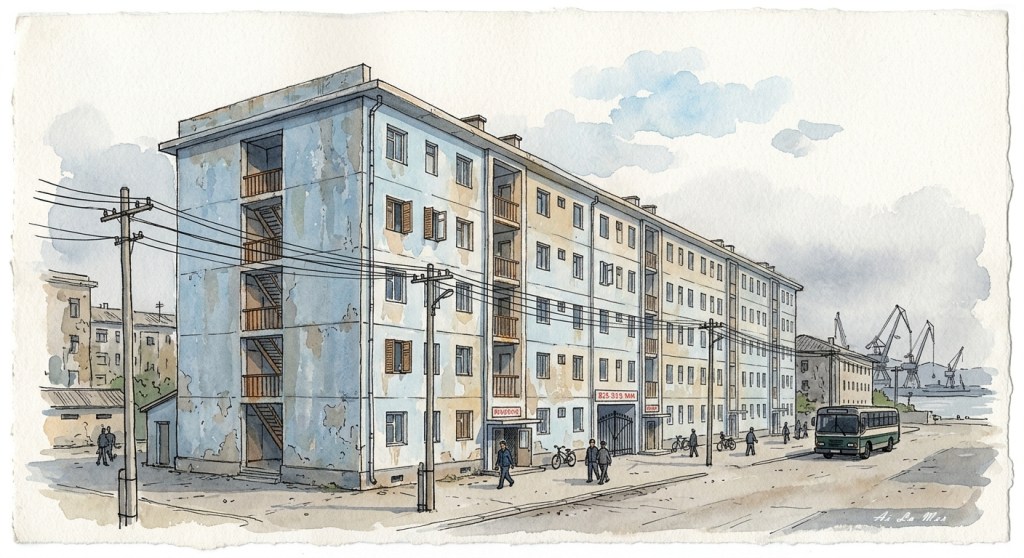
The environment reflects the utilitarian contrast typical of the Rason Special Economic Zone. Low-slung, pastel-painted concrete block residential units and administrative offices line the landward side of the street, showing weathered plaster, faded teal or ochre paint, and unadorned security gates. The broad, dusty asphalt avenue functions as the main buffer separating residential quarters from the fenced maritime facility.
Perimeter Fencing & Access Gates: High masonry walls topped with security wire and heavy steel double gates restrict entry into the customs clearance zones. Heavy truck traffic—primarily flatbed trailers and fuel bowsers—rattles across pitted pavement.
Labor Transit Points: Open-air staging corners along the access road serve as gathering points where workers wait for industrial flatbed trucks. Low concrete curbs, utility poles with overhead cable bundles, and small security kiosks mark the street corners immediately abutting the harbor fence.
Phase 2: Dual-Gauge Rail Yard & Pier 3 Interface
Moving northeast along the perimeter fence brings the route directly parallel to the heavy rail yards feeding the port terminal. Here, the track infrastructure transitions into the specialized dual-gauge assembly configured to link directly across the Tumen River into Russia’s transit net at Khasan.
Broad-Gauge Track (1520 mm) |=======================| ===> Direct Link to Khasan / Trans-Siberian
Interlocking Rail Bed |---|---|---|---|---|---|
Four-Rail Track Layout: A distinct four-rail track bed allows both standard-gauge (1435 mm, North Korean/Chinese) and Russian broad-gauge (1520 mm) rolling stock to travel along the exact same ballast without wheelset exchanges.
Pier 3 Logistics Infrastructure: Modernized under the RasonKonTrans venture, Pier 3 features reinforced concrete aprons, heavy-duty container gantry cranes, and high-capacity gantry tracks running parallel to the pier edge. Broad-gauge freight cars (Gondola cars and closed boxcars) sit parked directly alongside maritime container staging bays.
Transshipment & Storage: Stacks of multi-modal shipping containers and bulk coal heaps line the tracks, with heavy-duty diesel shunters moving cargo directly between the rail spur and ship-to-shore loading booms.
Phase 3: The Ocean Interface & Open Water
Beyond the built concrete quays and crane superstructures, the land drops off into the deep-water harbor basin of Rajin Bay, framed by low, barren coastal hills.
Harbor Waters & Quay Walls: Deep-water berths accommodate large sea-going cargo vessels and tankers. Reinforced concrete sea walls and fender systems take the brunt of the coastal swell, where dark gray water laps against rusted hull plating and steel piling.
Seaward Aspect: Looking past the breakwaters and pier heads, the harbor opens directly onto the ice-free waters of the Sea of Japan (East Sea). On overcast days, cold maritime mist rolls over the bay, framing the silhouette of anchored freighters against the open horizon.
Port transfer operations center on the modal shift—moving freight safely and efficiently between sea-going vessels and land-based transport (rail, truck, or inland barge). How cargo is transferred depends entirely on its physical form, which dictates the machinery, yard layout, and labor involved.
1. Core Cargo Transfer Categories
A. Dry Bulk (Coal, Grain, Ore, Minerals)
Dry bulk is unpackaged, free-flowing material handled in vast quantities.
Vessel-to-Quay: High-capacity motor-grab cranes or Continuous Ship Unloaders (CSUs) scoop or vacuum material directly from the vessel’s holds.
Staging & Yard Transfer: Material drops into a hopper fed onto enclosed conveyor belt networks, which route the bulk to open stockpiles, silos, or grain elevators.
Hinterland Dispatch:Rotary car dumpers (for loading rail cars) or overhead silo chutes fill gondola train cars and dump trucks for outbound transport.
B. Breakbulk & General Cargo (Steel, Timber, Heavy Machinery, Bagged Goods)
Breakbulk consists of individual, unitized items that must be strapped, hooked, or slung individually.
Vessel-to-Quay: Heavy-lift gantry cranes or ship’s onboard cranes use specialized attachments—wire rope slings, spreader bars, plate clamps, or electromagnets.
Quay-to-Yard: Flatbed trailers (mafi trailers) or heavy forklift trucks haul units from the berth apron to transit sheds or open storage yards.
Dunnage & Securing: Crucial to this transfer is dunnage (timber blocks or rubber matting) laid between items to protect cargo, balance weight, and allow forklifts/slings access beneath the load.
C. Containerized Freight (Intermodal ISO Containers)
The most standardized, automated form of transfer, built around 20-foot and 40-foot steel boxes.
Vessel-to-Quay:Ship-to-Shore (STS) Gantry Cranes use automated twist-lock spreaders to lock onto container corner castings, lifting them in a tight vertical arc onto terminal chassis below.
Yard Handling:Rubber-Tired Gantry (RTG) or Rail-Mounted Gantry (RMG) cranes stack containers in precise coordinate grids within the yard.
Hinterland Dispatch: Reach stackers or yard gantries drop containers directly onto long-haul truck chassis or intermodal rail flatcars.
D. Liquid Bulk (Crude Oil, Refined Fuels, Chemicals, LNG)
Liquid bulk transfers operate through closed, pressurized fluid systems.
Transfer Mechanism: Articulated metal Marine Loading Arms (MLAs) extend from the berth manifold and latch onto the ship’s midship manifold flanges.
Pumping & Pipeline: High-pressure ship or shore pumps move liquid through insulated pipeline corridors directly into tank farms or oil refineries inland.
2. The Four Stages of the Transfer Cycle
Every cargo movement at a port follows a strict four-stage operational sequence designed to prevent congestion on the berth apron:
Berth Arrival & Setup: The ship is moored, gangways are lowered, and customs/maritime authorities issue clearance. Stevedores board to unlash cargo holds and inspect rigging.
Primary Transfer (Quay Cycle): Cranes or pumps move cargo off the ship. The critical metric here is gross crane productivity (e.g., container moves per hour, or metric tons of bulk discharged per hour).
Yard Buffering: Storage yards act as a dynamic pressure valve. Ships discharge cargo far faster than trucks or trains can haul it away; the yard holds the inventory temporarily to keep the berth cleared for the next vessel.
Outbound Dispatch: Gate operations verify customs release, weight limits, and bill-of-lading documents before loading freight onto outbound trains or trucks.
3. Key Efficiency Metrics
Dwell Time: The total number of days cargo sits in the port yard before being picked up. Lower dwell times prevent yard congestion.
Turnaround Time (Turn Time): The total time a vessel spends at berth, from first line ashore to last line cast off. Minimizing turnaround time avoids costly demurrage charges (penalties paid for ship delays).
Cycle Time: The duration (in seconds or minutes) it takes a crane to lift cargo from a hold, slew across the quay, lower the load, and return to the hold for the next lift.
Explore Stevedoring, Dunnage, and Cargo Securing Techniques
So oil-for-arms trades always involved two freighters, one for liquid storage and pumping, the other for bulk.
Oil-for-arms agreements rarely involve two vessels operating in tandem at the same pier or traveling as a pair. The “trade” is a contractual or barter mechanism, while the physical transport of liquid fuel and military hardware is almost always decoupled.
Here is how oil-for-arms arrangements operate logistically:
Separation of Specialized Infrastructure: Oil (liquid bulk) and arms (breakbulk, heavy vehicles, or containerized munitions) require completely different vessel designs and port facilities. Oil moves in dedicated crude or refined product tankers utilizing berth manifolds and pipeline corridors. Arms move on general cargo freighters, heavy-lift vessels, or Ro-Ro (roll-on/roll-off) ships equipped with jib cranes and secured lower holds.
Commodity Offsets and Financial Clearing: The barter functions through balance-of-payments accounting rather than a direct dockside swap. State A delivers crude oil to State B’s commercial refineries or third-party energy traders. The financial credit generated from that oil off-take is deposited into clearing accounts or drawn down to settle military procurement contracts, with arms dispatched under separate bills of lading.
Mitigating Intelligence Signatures: Operating two ships side-by-side or scheduling simultaneous arrivals at a single terminal creates a glaring signature for foreign satellite imagery (GEOINT) and signal monitoring (SIGINT). In covert or sanction-evading trades (e.g., between Russia, Iran, or North Korea), operators deliberately separate the logistics: oil tankers utilize offshore Ship-to-Ship (STS) transfers or dedicated oil piers, while arms freighters berth at standard breakbulk quays on unannounced, independent schedules.
Multimodal Delivery Routes: A large volume of arms in these deals doesn’t travel by sea at all. Munitions and light weaponry are frequently transported via heavy strategic airlifts (e.g., Il-76 transport aircraft) or overland rail corridors (such as the Khasan–Rajin rail link), while the corresponding petroleum products are moved separately via tankers, barges, or regional pipelines.
Explore how Ship-to-Ship (STS) Oil Transfers Evade Maritime Surveillance
How do Russian oil products reach the DPRK?
Russian refined petroleum products reach the Democratic People’s Republic of Korea (DPRK) through three primary logistical channels, supported by state-sanctioned trade agreements and sanctions-evasion techniques.
1. Direct Maritime Shuttles (Vostochny to DPRK Ports)
Rather than relying solely on covert ocean transfers, Russia and North Korea operate a direct maritime shuttle route for refined oil products.
Origin Hub: North Korean-flagged product tankers berth directly at dedicated oil facilities inside Vostochny Port (near Nakhodka) in the Russian Far East. УНН
Vessels Employed: The shuttle fleet includes some of North Korea’s largest product tankers (such as the Paek Yang San 1, Kum Jin Gang 3, and Chon Ma San), several of which operate in direct violation of UN Security Council sanctions. RUSI
Volume: Open-source intelligence tracking by the Royal United Services Institute (RUSI) and maritime reporting by Seatrade Maritime News documented that these direct deliveries systematically exceed the UN-mandated annual import cap of 500,000 barrels. RUSI
Border Route: Russian Railways dispatch long strings of cylindrical rail tank cars from Khasan (Russia) across the Tumen River rail bridge into the Tumangang rail facility (DPRK).
Storage & Distribution: At Tumangang, the petroleum is offloaded into localized fuel storage depots before being distributed inland via North Korea’s standard-gauge rail system.
Dual-Gauge Integration: The border rail bridge and connecting corridors feed directly into the Khasan–Rajin (Najin) logistics framework, allowing petroleum tank cars to run alongside bulk freight and coal hoppers.
3. Ship-to-Ship (STS) Transfers at Sea
Prior to and alongside direct port shuttles, Russian petroleum products have reached North Korea via mid-ocean transfers.
Mechanism: Russian-flagged tankers or third-party vessels rendezvous with North Korean tankers in international waters within the Sea of Japan or East China Sea.
Evasion Protocols: Both vessels disable their Automatic Identification System (AIS) transponders (“going dark”) and conduct hose-to-hose pumping maneuvers offshore to conceal the origin and destination of the oil products.
Key Evasion Tactics & Operational Context
Barter Structure: These fuel shipments function as part of an oil-for-munitions arrangement, wherein Russia supplies petroleum in exchange for North Korean artillery shells, ballistic missiles, and military supplies. Бабель
Route A: Refined Petroleum Imports (Russia to DPRK)
Origin Point: Dedicated oil and petroleum export berths at Vostochny Port (Nakhodka Bay, Primorsky Krai).
Vessels Employed: DPRK-flagged product tankers (e.g., Paek Yang San 1, Chon Ma San, Kum Jin Gang 3).
Transit Vector: South/Southwest along the Russian Far East coastline through the Sea of Japan, staying within or near territorial boundaries.
Destination Outlets: Primary east coast DPRK import terminals at Chongjin, Hungnam, and Wonsan, or around the southern peninsula to the west coast hub at Nampo.
Cargo Type & Handling: Liquid bulk (diesel, gasoline, kerosene). Loaded directly from shore tank farms via high-pressure flexible marine loading arms into ship tanks, discharged into shore pipeline infrastructure upon arrival.
Evasion Strategy: Ships routinely turn off Automatic Identification System (AIS) transponders (“going dark”) prior to entering Russian waters and maintain dark status until safely docked back in DPRK territorial waters.
Route B: Munitions & Military Supplies (DPRK to Russia)
Origin Point:Rajin Port (Rason SEZ), utilizing Pier 3 (multi-purpose/rail-integrated quay) and adjacent container facilities, as well as secondary ports like Chongjin.
Vessels Employed: Russian-flagged cargo vessels under international sanctions (e.g., Lady R, Angara, Maria, Maia-1).
Transit Vector: Northward coastal run across the Gulf of Peter the Great toward Russian naval and commercial port installations.
Destination Outlets: Secure berths at Dunay Naval Base (Fokino area) or commercial container piers at Vostochny Port.
Cargo Type & Handling: Breakbulk and ISO containers packed with 152mm/122mm artillery shells, Grad rockets, and short-range ballistic missiles. Handled via heavy gantry cranes and portal loaders on the quay.
Inland Linkage: At Dunay or Vostochny, containers are transferred directly onto waiting rail flatcars and integrated into the Trans-Siberian Railway (TSR) network, traveling ~9,000 km west to ammunition storage hubs near the Ukrainian theater (e.g., Tikhoretsk, Mozdok, Kotluban).
*
How do intelligence analysts use commercial satellite imagery and open-source data to track North Korean oil tankers at Vostochny Port?
Intelligence analysts combine high-resolution satellite imagery, Synthetic Aperture Radar (SAR), radio-frequency tracking, and open-source maritime databases to track North Korean oil tankers operating at Vostochny Port.
Commercial optical satellites (such as Maxar, Planet Labs, and Airbus) provide high-resolution imagery (up to 30 cm per pixel) to verify vessel presence and measure cargo transfer.
Freeboard and Draft Measurement: Analysts measure the vessel’s freeboard—the visible distance between the waterline and the main deck. When a tanker arrives at Vostochny sitting high out of the water (high freeboard), and leaves days later sitting low in the water (low freeboard), analysts confirm a bulk liquid transfer took place. Using the vessel’s known displacement tables, they estimate the volume of oil loaded down to the metric ton.
Loading Arm Connections: High-resolution imagery can capture articulated marine loading arms or flexible hoses extended from shore manifolds directly to the tanker’s midship deck manifold.
2. Synthetic Aperture Radar (SAR) Tracking
Because vessels frequently time their port visits during heavy cloud cover, sea mist, or darkness, analysts rely heavily on radar satellites (e.g., Sentinel-1, ICEYE, Capella Space).
All-Weather Penetration: SAR sensors transmit microwave pulses that penetrate clouds, fog, and darkness, reflecting off metallic structures.
Coherence & Signature Matching: The steel hull of a tanker produces a bright, distinct radar return against the dark, low-return surface of the water. Analysts can verify if a specific berth at Vostochny is occupied, even during zero-visibility weather conditions.
3. AIS “Dark Fleet” Gap Analysis
North Korean tankers routinely disable their Automatic Identification System (AIS) transponders (“going dark”) to conceal their voyages. Analysts use AIS data defensively through spatial-temporal gap analysis:
Probability Vectors: Analysts log the exact coordinate and timestamp where a tanker’s AIS signal cuts out in the Sea of Japan or near Peter the Great Gulf.
Speed/Distance Calculations: By factoring the vessel’s cruising speed (typically 8–11 knots) against the elapsed time of the AIS blackout, analysts calculate a geographical radius. If the vessel reappears days later at the outer edge of the radius heading south, imagery archives over Vostochny during that window are systematically audited.
Many North Korean tankers use fake names, false flag registrations, or altered IMO numbers. Analysts build visual identification profiles based on physical quirks:
Deck Topology: Analysts map unique structural features, such as the arrangement of deck piping, crane/derrick placement, bridge superstructure shape, lifeboat positions, and rust patterns.
Ground-Level OSINT & Social Media: Photos and video clips posted by Russian shipspotters, port workers, or regional news outlets on platforms like Telegram or VKontakte (VK) are cross-referenced with satellite passes to confirm ship names or recent paint changes.
5. Volumetric Calculation & Reporting
By synthesizing these data streams, research groups (such as the Royal United Services Institute or CSIS Beyond Parallel) calculate cumulative sanction violations:
These figures allow intelligence organizations to prove when North Korea’s annual UN import limit (500,000 barrels) has been breached, documenting the exact dates, vessel identities, and Russian facilities involved.
*
Explain how intelligence analysts use unique structural deck signatures and piping layouts to identify specific North Korean tankers when names and flag markings are obscured.
Intelligence analysts use structural feature extraction and photogrammetric hardpoint matching to identify “dark” tankers when hull names, IMO numbers, and flags are painted over or obscured. Because an oil tanker’s weather deck is a complex matrix of fixed steel pipes, manifolds, and machinery, every vessel possesses a structural “fingerprint” that remains unchanged even after cosmetic repainting.
1. Midship Cargo Manifold Geometry
The cargo manifold—where shore-to-ship loading hoses connect—is the primary focal point of a tanker’s deck signature.
Header Spacing & Flange Count: Analysts count the exact number of connection headers (e.g., 4 cargo lines, 1 vapor return, 1 bunker line) and measure the precise distance between flange centers.
Crossover Layout: The arrangement of cross-over valves and bypass piping connecting the port and starboard manifold headers creates a distinct geometric shape when viewed directly overhead (0° nadir satellite imagery).
Drip Tray Dimensions: The rectangular steel drip tray welded beneath the manifold varies in length, width, and corner beveling from yard to yard.
2. Piping Run Architecture & Expansion Loops
Piping networks along the main deck move cargo, ballast, inert gas, fire foam, and fuel. These lines cannot be easily re-routed due to structural integrity and class society standards.
Parallel Line Arrays: The spacing, elevation, and sequence of parallel pipe runs running along the catwalk—from the aft bridge to the bow—are mapped by diameter and function.
Expansion Bends (U-Loops): Because steel expands and contracts with ambient temperature and vessel flexing, long pipe runs incorporate U-shaped or omega-shaped expansion loops. The exact frame locations (e.g., between tank hatches 2 and 3 versus 3 and 4) and the direction of these loops serve as high-confidence diagnostic markers.
Reducer Assemblies: Where large-diameter main cargo lines step down to smaller branch lines feeding individual wing tanks, the placement of conical reducer pipes provides a unique visual metric.
3. Deck Machinery & Support Infrastructure
Auxiliary equipment welded to the weather deck provides fixed structural reference points:
Hose-Handling Derricks & Cranes: Analysts evaluate the type (lattice-boom vs. hydraulic cylinder vs. box-boom), winch motor housing location, and jib pivot point relative to the vessel’s centerline.
Catwalk Construction & Supports: The elevated walkway running down the deck varies in height, railing design, and support-stanchion spacing.
Mooring Winch & Fairlead Layout: The placement of midship tensioning winches, bitts, and roller fairleads along the gunwale forms a fixed spatial polygon.
4. Tank Hatch Topology & Pressure-Vacuum (P/V) Vents
The top of each cargo tank contains openings and safety hardware arranged according to the ship’s internal tank subdivision (e.g., 3×5 grid vs. 2×6 grid).
Hatch Cover Shape & Hinge Orientation: Tank access hatches can be circular or oval, with hinges pointing forward, aft, or outboard.
P/V Valve Riser Towers: High-velocity pressure-vacuum relief valves rise above the deck to safely vent cargo vapors. Their height, mast design, and branch-pipe connections create distinct shadows in oblique satellite imagery, allowing analysts to calculate height and relative elevation.
5. Analytical Methodology: The “Digital Twin” Overlay
(Shipspotter / Inspection Photos) (Dark Tanker at Export Terminal)
│ │
▼ ▼
[ 3D CAD Wireframe Model ] [ Orthorectification & Scaling ]
(Extract Deck Hardpoints) (Adjust for Sensor Angle & Pitch)
│ │
└───────────────► ┌───────────────────┐ ◄─┘
│ Photogrammetric │
│ Feature Overlay │
└─────────┬─────────┘
│
▼
[ Positive Vessel Match ]
Baseline CAD Modeling: Using historical shipspotting photos (from portals like FleetMon, MarineTraffic, or Port State Control records), analysts build a 3D wireframe or spatial vector model of the known tanker’s deck layout.
Orthorectification: High-resolution commercial optical imagery (0.3m to 0.5m spatial resolution) of an unidentified vessel at berth is orthorectified to correct for satellite tilt and camera angle.
Hardpoint Vector Matching: Analysts select 10 to 15 non-linear hardpoints—such as the center of the hose crane pivot, the front edge of the bridge wing, the midship manifold center, and the forward anchor windlass.
Ratio & Angle Verification: Algorithms calculate relative distances and angles between these hardpoints. If the spatial ratios match the baseline profile within a 98%+ confidence interval, the vessel identity is confirmed regardless of painted-over names or spoofed AIS transponder signals.
Ai La Mer moved on to mathematics more complex than could be copied to this WordPress-based publication, but the roles of commercial, maritime, and military engineering should come through in this post. –jso
Nuclear micro-reactors represent a class of small, modular Generation IV nuclear reactors designed to produce between 1 and 20 megawatts of electrical power (MWe). Unlike traditional gigawatt-scale commercial nuclear power plants or large Small Modular Reactors (SMRs), micro-reactors are engineered specifically for high mobility, rapid factory-built deployment, and completely autonomous, off-grid operation.
1. Core Technical Characteristics
Micro-reactors depart significantly from conventional light-water nuclear infrastructure in both scale and safety mechanics:
Factory-Fabricated & Containerized: Micro-reactors are constructed entirely off-site and designed to fit inside standard 20-foot ISO shipping containers. They can be transported via truck, train, or C-17 military cargo aircraft and operationalized rapidly upon arrival.
TRISO Fuel Architecture: Most military-grade micro-reactors utilize High-Assay Low-Enriched Uranium (HALEU) encapsulated within TRi-structural ISOtropic (TRISO) fuel particles. Each uranium core is coated in three ceramic and carbon-based layers that act as individual containment vessels, capable of withstanding temperatures exceeding 3,200°F (1,700°C) without melting or releasing radioactive material.
Passive Safety Mechanisms: Designed with inherent physical safety, micro-reactors rely on physics—such as ambient thermal expansion and natural convection cooling—rather than active electrical backup pumps to shut down safely in emergency scenarios or structural damage events.
Multi-Year Fuel Cycles: A single core charge can deliver continuous baseload power for 3 to 10 years without refueling, completely removing the need for frequent fuel supply lines.
2. Strategic & Military Rationale
The accelerated adoption of nuclear micro-reactors across defense installations addresses two primary strategic vulnerabilities:
A. Domestic Grid Vulnerability & Base Resilience
Modern defense operations, directed-energy defense systems, intelligence processing centers, and drone command infrastructures require unbroken electrical power. Civilian regional utility grids are increasingly recognized as high-risk vectors vulnerable to state-sponsored cyberattacks, physical sabotage, or extreme weather grid collapse. Installing contractor-owned micro-reactors on military bases creates isolated, zero-carbon microgrids capable of sustaining mission-critical operations indefinitely if the commercial grid fails.
B. Eliminating the Tactical Liquid Fuel Tail
In forward-deployed environments, standard electrical power relies almost exclusively on liquid fossil fuels and heavy diesel generators. In contested theaters, fuel supply convoys represent one of the most vulnerable and casualty-heavy operational burdens. A single containerized micro-reactor generating 1.5 MWe offsets up to 1.5 million gallons of diesel annually, removing hundreds of targeted fuel transports from logistical routes.
3. Primary U.S. Defense Micro-Reactor Initiatives
The transition from conceptual engineering to active defense deployment is currently driven by two major Department of Defense efforts:
Project Pele (Mobile Prototype)
Managed by the Department of Defense Strategic Capabilities Office (SCO) in partnership with prime contractor BWXT Advanced Technologies, Project Pele aims to construct and demonstrate a fully functional, mobile 1.5-to-5 MWe micro-reactor. Small enough to be transported in four shipping containers, the system undergoes rigorous environmental and shock testing at the Idaho National Laboratory (INL) to validate transportability and rapid power grid synchronization.
Project Janus (Army Base Installation Program)
Under the Army’s Project Janus initiative, the U.S. Army awarded up to $2.2 billion in contract framework funding to five commercial nuclear developers to field on-base micro-reactors across key installations:
Antares Nuclear: Paired with Fort Bragg, North Carolina.
BWXT Advanced Technologies: Paired with Fort Campbell, Kentucky.
General Atomics Electromagnetic Systems: Paired with Fort Hood, Texas (utilizing the GA-TES 5 MWe system).
Radiant Industries: Paired with Fort Benning, Georgia (deploying the Kaleidos reactor).
Westinghouse Government Services: Paired with Fort Drum, New York.
Parallel efforts include joint Navy-Army micro-reactor testing at Naval Weapons Station Crane, targeting operational readiness at key domestic installations by late 2028.
The late September strategic battlespace underscores the precise asymmetry defining modern conflict: the collision of archaic territorial ambitions with 21st-century technological vulnerabilities. The integration of advanced energy infrastructure into national defense is accelerating concurrently with the weaponization of mass perception and the rapid fiscal burn of active regional conflicts.
Strategic & Operational Intelligence Highlights
The Post-State Security Environment and the AI Nexus
Public-Private Interdependence: Security is now a shared operating environment heavily reliant on corporate entities that develop, price, and deploy artificial intelligence and digital infrastructure.
Algorithmic Disruption: The transmission of disinformation and synthetic media is escalating conflict anxiety in real-time, outpacing the response cycles of traditional governing institutions. This maps directly onto the ongoing struggle against totalitarian social scripting, where autocratic actors exploit digital avenues to manipulate the cognitive battlespace.
Defense Procurement: Micro-Reactors and Asymmetric Costs
The intersection of defense procurement and energy infrastructure reveals a significant push toward domestic resilience in the face of escalating global engagements.
Installation Resilience: The U.S. Army is preparing to award $2.2 billion in contracts for nuclear micro-reactors across five installations, with the Navy similarly announcing micro-reactor integration plans at Naval Weapons Station Crane. This transition toward decentralized, high-efficiency atomic power highlights the military’s urgent need for autonomous, off-grid energy security.
Fiscal Realities of Modern Conflict: The Congressional Budget Office has calculated the current cost of the 2026 Iran War at $38 billion. This figure demonstrates the rapid financial drain inherent in contemporary kinetic engagements and underscores the strategic imperative to limit localized conflicts before they trigger compounding supply chain and market shockwaves.
Russian Mass Perceptual Control and the Ukrainian Front
The ongoing war in Ukraine continues to serve as a masterclass in the contrast between physical battlefield realities and centralized media scripting.
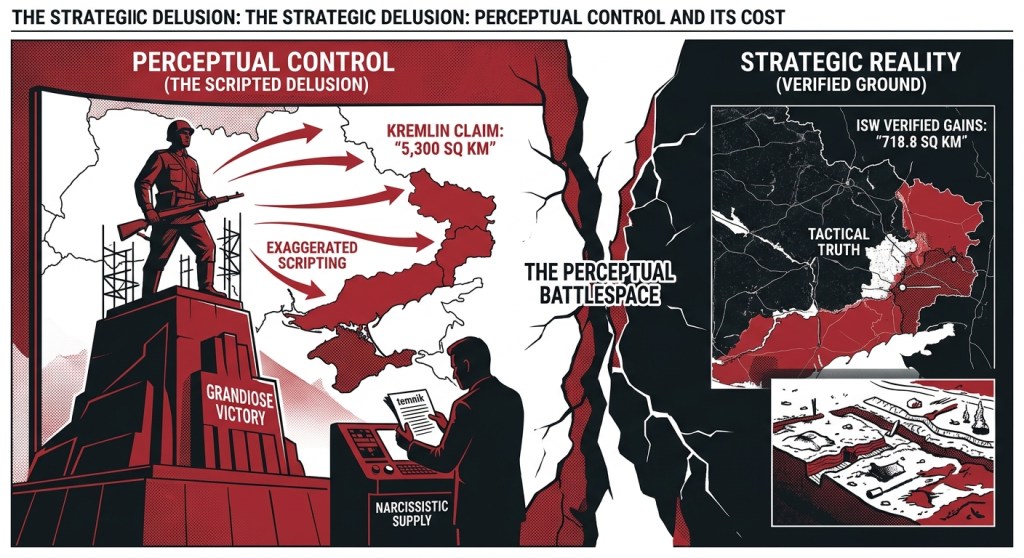
The Aggrandizement of Territorial Gains: The Russian Ministry of Defense recently claimed the seizure of over 5,300 square kilometers of Ukrainian territory since the start of 2026. However, independent assessments by the Institute for the Study of War (ISW) verify only 718.8 square kilometers of actual tactical gains.
Strategic Delusion: This exaggerated scripting is a calculated Kremlin effort to project an aura of inevitable victory and induce Western fatigue. It is an operational application of civilizational narcissistic supply—manufacturing an alternate reality of overwhelming dominance to cover for the tactical truth of near-zero strategic advancement since March.