A despicable assault on free speech in Germany; a fair example of how creeps — just the right word on this story — initiate a program of social intimidation.
If this happened in the U.S., in addition to challenging First Amendment prerogatives, it would have the effect also of transforming floor or line-level workers into voiceless slaves, and it would then chill labor and management all the way up the ladder.
For international readers, the American social process may be summed as “be free to speak, but don’t expect to be loved for everything you have to say.”
Reader Comment: “What if the comments had been anti-Semitic?”
In Germany, not good, but is there a Jewish organization in Germany combing Facebook, as part of its operations, to locate anti-Semites and tell their employers that so-and-so has been a bad boy or girl?
In the U.S., Americans live with a host of bigots, tolerate their rants, and casually, as opposed to by law, marginalize them or argue with them or stay away from them, but we generally don’t seek to have the same fired from their jobs.
______
For readers elsewhere and wrestling with America’s free speech concept and the character of the First Amendment: the purpose was not to protect pleasant or popular expression but opposite: to defend unpleasant and unpopular expression on the basis that what was said might be true and in need of hearing.
On the other hand, free speech does not protect libel and slander, incitement, criminal conspiracy, and sedition, although the latter has been so toothless as to allow the broadest sweeps of anti-American claims and rants in the open press.
From the originating report published in The Buffalo News, September 4, 2013:
A Facebook rant about Muslims by an employee of a Walmart store in Hamburg has prompted the retail giant to fire the man.
The derogatory posting on Friday morning was brought to the attention of Wal-Mart Stores executives by a member of the local Muslim community and by a national Muslim advocacy organization.
Hours before his arrest, Abdelke had signed a petition that averred (here’s where Chrome’s translate option comes in handy) “support to the forces of the revolution who advocate the establishment of a pluralistic democracy” and “desire for a peaceful solution to stop the bloodshed and to preserve national unity and territorial integrity, which involves the departure of Bashar al-Assad and pillars of his regime.
Youssef Abdelke — never hard of him before two minutes ago — but as one who has learned the ways of the World Wide Web, the third minute opens on eternity.
(Reuters) – Syrian government forces have detained a dissident left-wing painter in a new wave of arrests of non-violent critics of President Bashar al-Assad, opposition groups said on Friday.
“A place to share art, uninhibited without a bunch of stupid ass rules. A place to help your fellow page owners grow and succeed. A group to have fun with no dictator shoving shit down your throat and bowing down. A group to be FREE to help as you see fit. A group to rock the fuck on!”
It’s a closed Facebook group, one to which I would apply if I were shooting the local downtrodden as opposed, say, to the leisured, business, and community development classes.
Nonetheless, “Art and FREEDOM”, my soul is with you and your author, Youssef Abdelke.
* * *
I really don’t know why Putin darkens his role in history by keeping in his hand with the Ayatollah’s Iran and the Assad’s Syria.
* * *
Novelist Daniel Silva has a great deal of fun with the “Russian President” — in fiction, merely a character, never named, nothing more than coincidental with anything or anyone in reality, in his latest best seller The English Girl.
As a fiction writer, Silva’s actually, probably, one of the very best political analysts on the international stage, and while playing that role through his characters and plots, the Russian President looms large and rightly so for the behind-the-curtain strategy pursued by the post-Soviet oligarchs of the Latest and Greatest in Russian States.
As we know about narcissists and narcissistic hunger and supply, they are ultimately about themselves, and whatever their charms, political and social, may be. Not that Bashir Assad has enjoyed abundance in dimension, but it’s the Russian President who has been most quiet on the obscenity of a state that deploys jets to suppress, at first, a small challenge to its authority.
While the Syria of 2010 has been destroyed, culturally, socially, structurally, one might note that Russia, in her defense, has ferried both the larger part of its civilian and military presence out of the country — not exactly a show of confidence, that, but not exactly either a show of humanist resolve.
The world wonders at the conundrum that has pit a brutal dictatorship against partially but deeply virulent Islamist forces. There is in that aspect of Syria’s agony the “no good dog in the fight” and the “black hole” of the Islamic Small Wars constructed of a contempt, hatred, and self-contempt in the inhumanity that draws in military energy and burns without end.
Nearly one hundred thousand dead and four million displaced in Syria’s furnace and neither of two of the most powerful statesmen of our era either cares to or knows how to shut it down.
Instead of the kumbaya “reset” between the states and the federation (how young is Obama?), Putin appears to be draining the former plus NATO by keeping the oven hot while avoiding, rightly, the imposition of another Chechnya in its sphere of influence. And yet . . . the Assad regime was the Soviet’s monster, and one would think that after 1991 the state would have been concerned with other than filling its pockets in collusion with it for another 22 years.
But that perhaps would have been too caring, too ethical.
Too English.
* * *
While the superpowers dick around with trivial issues like Snowden, Syria, in part, draws to it the “worst of the worst” — or just the most spirited — of fighters representing Shiite and Sunni Islam, those two angry wasps someone left in a bell jar separating their concerns from the much, much greater world surrounding.
On a portion of that, I would blame the west.
We’ve done business, haven’t we, for how many years?
And barely a word, most certainly few, if any, of outrage in regard to humanity and human rights in the contained but also dark medieval quarters of the globe.
So why not leave them — today in Syria, tomorrow perhaps in Egypt or somewhere else — in their own mess?
Whether the President of the Free World or that of the Russian Empire, is it incumbent on either to reorganize a middle east state as a pet humanitarian project?
There are, of course, other ambitions in the mix, much including Iran’s and Qatar’s, but one may one wonder between them whether either will wake up from their dream or with history pass away into it.
* * *
Prestige matters.
As a Jew, I may wonder how global memory will treat of today’s powerful in the days beyond their reclamation by the earth.
Abu al-Khair said that the judge sentenced Badawi to five years in prison for insulting Islam and violating provisions of Saudi Arabia’s 2007 anti-cybercrime law through his liberal website, affirming that liberalism is akin to unbelief.
I have to wonder what Raif Badawi wrote or otherwise said that may have been so egregious in the Kingdom of Saudi Arabia as to have the kingdom throw him in jail and the court sentence him to seven years in prison plus 600 lashes.
While the kingdom modernizes — “Related Stories” dredged up on the New York Daily News page include such titles as “Saudi Arabia’s King Abdullah grants women seats on the nation’s top advisory council” and “King Abdullah: Saudi Arabia women can vote, hold elected office” — the persistent throttling of expression, the disproportionate sentencing, and the medieval cruelty of lashing to boot (imagine having that to look forward to each week for, say, 30 weeks) tell of a willful egomania thundering atop a fragile surface of faith.
Every tyrants first concern in power has to do with making a convincing case for authority and maintaining it.
Perhaps with that in mind, we say in the United States with regard to the famous Freedom of Speech principle, “Without the First Amendment, all of the others are worthless.”
The Mellow Jihadi reports, “Raif’s site discussed the role of religion in Saudi Arabia, and he has been held since June 2012 on charges of cyber crime and disobeying his father – a crime in the conservative kingdom.“
About eight months ago, Reuters reporting on the Raif Badawi case noted, “Judges base their decisions on their own interpretation of religious law rather than on a written legal code or on precedent.” That is, if I may interpret, responsibility for this ethical and moral confusion may not rest so much with King Abdullah as with an archaic clerical class, but also, alas, that which doubtlessly supports his authority.
Following Reuter’s latest on the case (published two hours ago) back to Human Rights Watch, this wrap may sum the Saudi state of mind:
Abu al-Khair said that the judge sentenced Badawi to five years in prison for insulting Islam and violating provisions of Saudi Arabia’s 2007 anti-cybercrime law through his liberal website, affirming that liberalism is akin to unbelief. The judge ordered the closure of the website and added two years to Badawi’s sentence for insulting both Islam and Saudi Arabia’s Committee for the Promotion of Virtue and Prevention of Vice, or religious police, in comments during television interviews.
Even while King Abdullah presses for reforms and aspects of modernity course through or make their way into the cultures of the Arabian Peninsula, the Anachronisms cling to a power today deeply mocked and reviled among the educated worldwide, and whether by way of “listening posts” or the perhaps guilty indulgence of going solo online, one by one, logged on and searching the world’s largest information mirror, that is how they will see themselves.
By way of the design in human nature, for which one might credit God, God being God, what Saudi Arabia’s most dogmatic clerics and judges had wished to avoid for want of pride has become precisely that which they must encounter in the feedback supplied by the World Wide Web.
For the biggest form of blasphemy that we all almost always commit is to force another to live in fear for believing, speaking, thinking and sometimes even existing, as we justify it in the name of our faith or stand silent as we bear witness.
No videos, sketches or hate speeches have hurt Islam more than the reckless army of blood thirsty goons justifying vandalism in the name of religion.
As I have said in previous articles, a devout government must always support such principles as libertarianism, modernity and valuing women, beauty, art and science. It must not allow the slightest pressure or measure or reference reminiscent of pressure. It must turn its back on the possibility of radicalism and, as a “devout” administration, must apply democracy in the most perfect manner. We must admit that Mohamed Morsi and Recep Tayyip Erdogan have made errors on this.
The World Wide Web has turned out a global mirror. Signal sent — signal returned: in language, we see ourselves as others (not always remote) may see us.
If the latest sentiments out of Pakistan and Turkey prove sustained, that thing called “The West” may have to resign itself to following rather than leading in the realm of ethical and moral investigation and righteousness, no doubt, however, while welcoming the competition.
Tom Hundley, the Pulitzer Center’s senior editor and a former foreign correspondent for the Chicago Tribune, is more blunt: “This great mass of freelancers who are depending on grants from us and working on pitiful fees from brand-name outlets—I mean, this just isn’t going to work.”
To teach well or learn, one asks not for flattery but rather to hear the worst from one’s critics.
I’ve quoted myself recasting an ancient commonplace, but not that I’m stuck on myself: there’s plenty to be quoted from others in relation to the above trope.
With friends like Melanie Phillips, who needs enemies? Articulate and useless.
Melanie Phillips writes in her latest column, entitled The British government’s jihad against free thought, “I do not support the approach taken by either Geller or Spencer to the problem of Islamic extremism. Both have endorsed groups such as the EDL and others which at best do not deal with the thuggish elements in their ranks and at worst are truly racist or xenophobic.”
PVV: England once again pleases Islam by silencing its critics
The British government shows itself once again to be made up of Islamophiles by objecting to speech by critics of Islam. It shows the weak knees it showed in 2009 when turning down Geert Wilders for entry into England; this time, the U.S. critics of Islam Pamela Geller and Robert Spencer are banned.
Indeed, the British nanny state seems quite unconcerned with stepping in to “protect” its children’s ears and minds from comprehending a broad and complete argument.
One understands this process.
Maybe.
In deference to my Muslim friends on Facebook, I have judiciously (but not consistently with others) restrained myself from sending a friend request to Tom Trento, thereby forestalling my endorsement of his Christian agenda. Nonetheless, he’s a well studied critic of Islam armed with points difficult to dislodge and impervious to ad hominem attack.
* * *
So let’s recap: Geller and Spencer banned for blogging critically about Islam. Al-Suleiman and Al-Arifi given free passage despite actively fomenting sectarian divisions and endorsing terrorism.
Considering the conclusion drawn by “Media Hawk”, one might find the backstabbing dismissals preceding it both absurd and compromising, as from the top, Hawk states, “Let me clarify something from the outset of this blog, so you are not confused by what I am about to say. I am no fan of Pamela Geller (Sorry Pam).”
Indeed, Melanie Phillips does the same thing when she too rises above it all with, as quoted above by Geller, “Both have endorsed groups such as the EDL and others which at best do not deal with the thuggish elements in their ranks and at worst are truly racist or xenophobic” (Phillips, Melanie, “The British government’s jihad against free thought,” blog, June 27, 2013).
* * *
For the record, I endorse both Pamela Geller and Robert Spencer for their possession of a great ethical and moral center and vision in relation to their critiques of Islam. Where I differ involves the political topology involved, and the significance of the presence of my Muslim friends who repudiate Osama Bin Laden and the Taliban and all similar others, as they often do and with passion.
When the same promote out of their own soulful existence a contemporary Islamic humanism, I believe them.
The want to trim away “extremist elements” all around, whether those bloodying the Ummah with anti-western swagger and sectarian violence, or those espousing an absolute stance in the west (by typing a few hours about Islamic extremism and, perhaps, going out for lunch afterward) runs headlong into the absurdity just implied (in the preceding parenthesis) on three counts: 1) the “extremist” critics have something of merit to discuss, 2) do not incite or promote violence — neither Geller nor Spencer should be backward-linked to yobs who brings themselves to political movements of every kind — and 3) they might be right.
Fear of the argument — fear of criticism — produces the muzzling that has today degraded British expectations about what may be said and discussed in public.
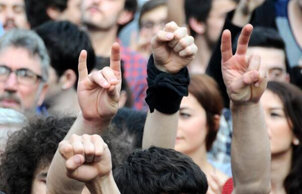
Four protesters and one police officer have been killed during the protests and Turkey’s doctors association said an investigation was underway into the death of a fifth protester who was exposed to tear gas. More than 7,800 people have been injured; six remain in critical condition and 11 people have lost their eyesight after being hit by flying objects.
Last week’s unrest, only quelled this week, has left Turkey a divided nation with President Erdogan’s voting majority AKP jubilant in its denial of its impact on all others. With so many business and political rivals neutralized, generals sacked, and journalists jailed, Erdogan has proven he can muscle up an adoring crowd while his police go about battering and blinding those who dissent.
Here was a bellicose leader who dismissed overwhelmingly peaceful demonstrators as “looters” and “terrorists”, who railed against international media for their “disinformation” campaigns, and who criticised volunteer medics for treating injured protesters.
“The big loser (in the crisis), is the prime minister who is fighting for his political survival,” said Cengiz Aktar, a political science professor at Istanbul’s Bahcesehir university.
Here in my “Second Row Seat to History”, I am not part of any media conspiracy, government agency, anti-government organization, or strident political or religious movement.
I have only watched the footage.
“Unfortunately, we have been witnessing undesired attacks and provocations over the past few days. We are once again experiencing the traps that were set in the past to threaten governments and create chaotic scenes to pave the way for interventions against democracy.”
Whose past, Mr. Erdogan?
To whose “interventions against democracy” have you referred?
May the reader wrap his mind around the Turkish President’s Orwellian rhetoric.
The open democracies of the other NATO states reject the tyranny of the majority, the state’s suppression of media and of the earnest and responsible journalists on whose mantles rest decency and integrity in reporting, and, every single one of them, deeply rejects the rejection of the popular criticism of ordinary constituents, whether aligned with a majority part or distant from it.
Protesters have accused Erdogan, who has been in power for a decade, of taking Turkey down the road of authoritarian and Islamist rule. Erdogan, who has triumphed with wide electoral majorities, has dismissed the protesters as militants and losers.
What they’re ignoring is that this is actually how democracy works. Even in a free society, the state has to have some secrets. The means and methods by which it tracks terrorists should, I’d suggest, be one of them. Should those means and methods be subject to scrutiny? Yes. Should that scrutiny come from our democratically elected representatives? Yes. Should the powers being scrutinised also be the subject of checks and balances from the courts? Yes. In other words, precisely what has been happening with Prism.
Jeffrey Toobin posting on The New Yorker’s web site: “Indeed, Snowden was so irresponsible in what he gave the Guardian and the Postthat even these institutions thought some of it should not be disseminated to the public. The Postdecided to publish only four of the forty-one slides that Snowden provided. Its exercise of judgment suggests the absence of Snowden’s.”
Toobin’s colleague John Cassidy provides counterpoint: “He is a hero. (My colleague Jeffrey Toobin disagrees.) In revealing the colossal scale of the U.S. government’s eavesdropping on Americans and other people around the world, he has performed a great public service that more than outweighs any breach of trust he may have committed.”
In Politico, Tal Kopan has worked up a scathing indictment of Snowden’s character founded on the slant of the details, from Snowden’s dropping out of high school, albeit completing his GED coursework in the community college system, to the stickers on his laptop: “4.His laptop stickers reveal his beliefs. Stickers on Snowden’s laptop express support for Internet freedom, The Guardian said. One reads, “I support Online Rights: Electronic Frontier Foundation,” and another is for the Tor Project, an online anonymity software.”
“The main stipulation for seeking asylum in Iceland would be that the person must be in Iceland to start the process,” said Johannes Tomasson, the chief spokesman for Iceland’s Ministry of Interior in Reykjavik. “That would be the ground rule No. 1.”
Google, Microsoft, Yahoo, Facebook, Apple, AOL and Paltalk erected what the New York Timesdescribes as “locked mailboxes” in which to place data on suspicious persons requested by the government under the Foreign Intelligence Surveillance Act, or FISA. The Times’ description, published Saturday, used unnamed sources.
Basically, it looks like the post-911 Bush Administration launched a broad and comprehensive effort to detect terrorists and their operations (apparently, ignoring plain old gumshoe Russian intelligence sharing prior to the Boston Marathon bombing shouldn’t be mixed in with this NSA story), and, legally, Congress-approved, by law, Obama has sustained the Bush Administration plan.
This is for my paranoids — it’s at least four years old, has been viewed more than 57,000 times, and it will take you where you want to go.
God has not exempted geeks from having their own character and personality issues, so here I may lump Assange, the Wikileaks guy (click for the latest on that), and Snowden together — birds of similar feather, says I, and asylum, indeed, is what they have needed.

 BackChannels