
• Home
  • About
  • Concepts, Coins, and Terms
    • Anthropolitical Psychology
      • Civilizational Narcissism
      • Conflict – Language Uptake – Social Programming and Scripting – A Suggestion
        • Language Uptake – Programming – On Learning to Listen
        • Mouth –> Ear –> Mind –> Heart System
        • Social Grammar
      • Facsimile Bipolar Political Sociopathy
      • Malignant Narcissism
      • Narcissistic Scripting
      • Normative Remirroring
      • Paranoid Delusional Narcissistic Reflection of Motivation
    • FTAC – “From The Awesome Conversation”
    • God Mob
    • Intellectual Battlespace
    • Islamic Small Wars
    • New Old Now Old Far Out and Lost Left
    • Political Spychology
    • Shimmer
  • Library
    • About Language
    • Russian Section
  • Comments and Contact

BackChannels

~ Conflict, Culture, Language, Psychology

BackChannels

Category Archives: Asia

Turkey – A Fissure Has Opened in the Political Body

18 Tuesday Jun 2013

Posted by commart in Conflict - Culture - Language - Psychology, Free Speech, Politics, Turkey

≈ Leave a comment

Tags

conflict, Erdogan, language, political, totalitarian, Turkey

Four protesters and one police officer have been killed during the protests and Turkey’s doctors association said an investigation was underway into the death of a fifth protester who was exposed to tear gas. More than 7,800 people have been injured; six remain in critical condition and 11 people have lost their eyesight after being hit by flying objects.

AP. “Turkey’s Erdogan vows to strengthen police powers as dozens detained in raids.”  The Washington Post, June 18, 2013.

Last week’s unrest, only quelled this week, has left Turkey a divided nation with President Erdogan’s voting majority AKP jubilant in its denial of its impact on all others.  With so many business and political rivals neutralized, generals sacked, and journalists jailed, Erdogan has proven he can muscle up an adoring crowd while his police go about battering and blinding those who dissent.

Here was a bellicose leader who dismissed overwhelmingly peaceful demonstrators as “looters” and “terrorists”, who railed against international media for their “disinformation” campaigns, and who criticised volunteer medics for treating injured protesters.

“The big loser (in the crisis), is the prime minister who is fighting for his political survival,” said Cengiz Aktar, a political science professor at Istanbul’s Bahcesehir university.

ZeeNews.  “Turkey PM risks political fallout after Gezi Park.”  June 18, 2013.

Here in my “Second Row Seat to History”, I am not part of any media conspiracy, government agency, anti-government organization, or strident political or religious movement.

I have only watched the footage.

“Unfortunately, we have been witnessing undesired attacks and provocations over the past few days.  We are once again experiencing the traps that were set in the past to threaten governments and create chaotic scenes to pave the way for interventions against democracy.”

Whose past, Mr. Erdogan?

To whose “interventions against democracy” have you referred?

May the reader wrap his mind around the Turkish President’s Orwellian rhetoric.

The open democracies of the other NATO states reject the tyranny of the majority, the state’s suppression of media and of the earnest and responsible journalists on whose mantles rest decency and integrity in reporting, and, every single one of them, deeply rejects the rejection of the popular criticism of ordinary constituents, whether aligned with a majority part or distant from it.

Protesters have accused Erdogan, who has been in power for a decade, of taking Turkey down the road of authoritarian and Islamist rule. Erdogan, who has triumphed with wide electoral majorities, has dismissed the protesters as militants and losers.

Johnson, Glen.  “Protester reported killed in Turkey amid days of unrest.”  The Los Angeles Times, June 3, 2013.

Last week, the Ataturk Society UK reported three dead, 4,785 injured.

President Erdogan’s own ham-handed behaviors in office have inspired the opening of a fissure in Turkey’s body politic, and it will not close.

From the album online, “Heartwarming Images from the Turkish Resistance (created two weeks ago)“.
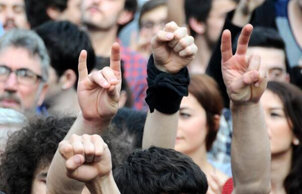
"Three different ideologies side by side" (photographer unknown).

“Three different ideologies side by side” (photographer unknown).

Two weeks ago?

Has it been that long?

The Wikipedia entry “2013 Protests in Turkey” says it has (initial protest: May 28, 2013).

It feels like forever.

ISW – Comment on Saudi Arabia’s Heightened Profile in the Syrian Theater

17 Monday Jun 2013

Posted by commart in Asia, Conflict - Culture - Language - Psychology, Eurasia, Iran, Islamic Small Wars, Israel, Middle East, Qatar, Regions, Religion, Russia, Saudi Arabia, Syria, Turkey

≈ Leave a comment

Tags

conflict, dignity, governance, government, humanity, Islamic Small Wars, King Adullah, liberty, NATO, political, politics, Putin, religion, rivalries, Saudi Arabia, Syria, war

(Reuters) – Saudi Arabia, a staunch opponent of President Bashar al-Assad since early in Syria’s conflict, began supplying anti-aircraft missiles to rebels “on a small scale” about two months ago, a Gulf source said on Monday.

Bakr, Amena.  “Saudi supplying missiles to Syria rebels: Gulf source.”  Reuters, June 17, 2013.

For those who value stability in the middle east, the least honest and most ruthless appear to be winning.

As the above quote suggests, Big Sunni Money plus the cultivation across many years of strategic and trade relationships in Great Britain, Europe, and the United States have put King Abdullah of Saudi Arabia not only into the fight in Syria but remarkably behind the NATO wheel.

Of course, this recent news (surfacing in the news) isn’t news at all to the businesses and states involved in Syria’s civil war, and it should be apparent to all onlookers that this double-track, double-story business of telling the public one story while facilitating another in private has brought us to the brink of a NATO vs. Russia confrontation in which Russia may now present a devilish gambit: better Assad and the continuing misery to be imposed by the dictatorship than the expansion of either Al Qaeda or Wahhabi Islam and the certain diminishing of nascent democracy, human dignity, and secular values in Syria accompanied by the heightening of tensions in Lebanon and,somewhere in the future, with Israel and the Jewish People.

To offset that impression, King Abdullah may have to back up the money with some combination of reassuring mouth and evidence of cultural and social evolution toward the contemporary in the Kingdom, certain injunctions of the Quran either notwithstanding or interpreted or aligned with a more free and liberal and greater western world.

Outlook

For the moment, if Iran’s nuclear program and global ambitions are the true target of the conflict in Syria, then the conflict and the human suffering plus political confusion driven by it, have yet some months to years to go.

In fact, the focusing of issues in the Syrian theater of a great portion of the drivers of the Islamic Small Wars  — i.e., rivalries of various sort: Al Qaeda and Wahhabi Islam; Sunni and Shiite Islam; democracy, secular dictatorship and theocracy; Iranian and Saudi Arabian competition for greater spheres of influence; even Putin’s possible issues with aggrandizement, control, and wealth on one hand and his own humanity, moderation, and strength in restraint on the other– bodes ill for constituents — worldwide — whose concerns may be more with family, security, and employment scaled down to a common denominator in the common humanity than with the triumph of a king or an ayatollah.  

It has been said that with the onset of war, nobody wins, and nowhere else across the killing fields of the Islamic Small Wars does that cynical sentiment seem more likely to be proven true than in Syria this day.

Reference

Al Arabiya.  “Saudi King Abdullah cuts holiday short due to ‘events in the region’.”  June 15, 2013.

Chulov, Martin.  “Threat of sectarian war grows in Syria as jihadists get anti-aircraft missiles.”  The Guardian, June 15, 2013.

Deasy, Kristin.  “Al Qaeda in Iraq defies global leader over relationship with Syria’s Al Nusra: Reports.” Global Post, June 15, 2013.

Henderson, Simon.  “Bahrain Rounds Up Organizers of Antigovernment Violence.”  Policy Alert, The Washington Institute for Near East Policy, June 14, 2013:

Initially emulating uprisings elsewhere in the Arab world, the protests quickly divided along sectarian lines, pitting members of the majority Shiite population against the Sunni ruling family’s security forces. Since then, February 14 members have apparently engaged in near-nightly clashes with police, resulting in more than 100 dead and 2,000 injured among civilians and security personnel.

Osborn, Andrew and Amena Bakr.  “Putin, Obama face off over Syria; rebels get Saudi missiles.”  Reuters, June 17, 2013.

Reuters.  “Russia says it will not allow Syria no-fly zones.”  June 17, 2013.

Starr, Barbara, Holly Yan, Chelsea J. Carter.  “Analyst: Al Qaeda affiliate in Syria now best-equipped of the group.”  CNN, June 17, 2013.

Wintour, Patrick.  “Syria: Putin backs Assad and berates west over proposal to arm rebels.”  The Guardian, June 16, 2013.

FNS – Erdogan and Demonstrations – Update

17 Monday Jun 2013

Posted by commart in Asia, Conflict - Culture - Language - Psychology, Fast News Share, Politics, Regions, Turkey

≈ Leave a comment

Tags

demonstrations, Erdogan, Turkey

After night fell, his security forces put these words into force. They used bulldozers to clear out Gezi Park, which had become a symbol of the resistance in recent days. They chased protesters and beat them down with clubs, and they shot tear gas into cafes and hotels as the people fled. Doctors who treated the wounded were arrested.

Popp, Maximilian and Mirjam Schmitt.  “‘Hateful’ Speech in Istanbul: Erdogan Throws Fuel on Flames.  Spiegel Online, June 17, 2013.

President Erdogan may mount pro-government demonstrations, but he has a way to go with regard to quelling anti-government unrest, and to judge both by the article in Spiegal Online and the balanced footage above, he’s inclined to do it with the heavy hand of a dictator.

The orchestration of his own AKP pro-government demonstration, which included busing fans to the location, while at the same time suppressing Taksim Square activity by clearing the streets with force and closing routes into the city reflects well the autocrat’s want to control without a lot of back and forth in the conference room or negotiating table.

Add:

  • Deflection of responsibility for his state’s spontaneous demonstrations to foreign influence (of some kind) and the international press;
  • Detention of lawyers sympathetic with demonstrators and the alleged arrests of doctors — that detail seems to be in the news today — attending those injured by government forces.

If preventing attention to the injured is a part of the governing ethic “over there”, that too speaks of the barbarian within and a reigning mentality not much different than that which has made a mess of Damascus.  The process doesn’t change: the greater and more extensive the repression, the more amplified the resentments and, when those surface, the response.

Describing Erdogan’s government as “despotic,” two main union blocs say they plan to march to Istanbul’s Taksim Square, which has been at the heart of more than two weeks of protests. It is the second time unions have called a strike to support the protest movement.

Penhaul, Karl, Ian Lee, Gul Tuysuz.  “Turkish unions call strike after weekend of street clashes.”  CNN, June 17, 2013.

Al Jazeera reports, “Labour groups representing doctors, engineers and dentists are also said to have joined the strike on Monday. The striking groups represent about 800,000 workers” (“Turkey threatens to deploy army to end unrest.”  June 17, 2013).

Reuters reports today 441 persons detained in Istanbul on Sunday, 56 in Ankara, and 5,000 injured and four dead over the span of the unrest.

Additional Reference

Burch, Jonathan and Daren Butler.  “Striking workers face off with police in Turkish capital.”  Reuters, June 17, 2013.

Letsch, Constanze and Ian Traynor.  “Turkey unrest: violent clashes in Istanbul as Erdoğan holds rally.”  The Guardian, June 16, 2013:

Erdogan inveighed against the international media, blaming the BBC and CNN for distorting the drama of the past three weeks in what he repeatedly alleged was an international plot to divide and diminish Turkey.

“You will make your voice heard so anyone conspiring against Turkey will shiver,” he told the crowd. “Turkey is not a country that international media can play games on.”

Waldman, Simon A. and Emre Caliskan.  “Erdogan’s aim: Suffocate the right to protest in Turkey.”  Haaretz, June 5, 2013.

CNN.  “Demonstrations in Turkey.”  Retrospective slideshow.  June 16, 2013.

Michaels, Sean.  “Turkish police confiscate piano used to serenade Taksim Square protesters.”  The Guardian, June 17, 2013.

Peterson, Scott.  “Erdogan’s supporters rally, dismissing Turkish protests as a ‘big game’ (+video).”  The Christian Science Monitor, June 16, 2013:

Using language that belittled the protesters as disrespectful and irrelevant, Erdogan appeared to point the finger of blame at everyone except himself and his ruling Justice and Development Party (AKP), citing instead the party’s economic triumphs and democratic reforms.

While the title includes the term “video”, when I viewed the piece at about 9:17 a.m. EDT, there was none.

Reuters.  “Hundreds of thousands rally in Turkey for Erdogan.”  June 16 2013.

Sky News.  “Turkey: Erdogan Supporters Rally in Istanbul.”  June 17, 2013.

The Guardian.  “Taksim square: riot police evict protesters in Istanbul – video.”  June 16, 2013.

Reflection

Political cartooning has gotten an update in recent years (or days, considering the pace of media technology development and its broad distribution.  I thought this piece catchy (yes, I am chatyping like the old man I’ve become here) and while it doesn’t reflect my thoughts, which are so much more sober, the presentation would seem part of the zeitgeist of a dawning political era.

Referral

Al Jazeera’s running a “live blog” — sure glad it’s not a dead one — on Turkey’s unrest: http://blogs.aljazeera.com/liveblog/topic/turkey-protests-20176

Turkey’s ‘Woodstock’ Moment – A Concert at Taksim Square

13 Thursday Jun 2013

Posted by commart in Asia, Conflict - Culture - Language - Psychology, Politics, Regions, Turkey

≈ Leave a comment

Tags

Taksim Square, Turkey, Woodstock

Riot police looked on from the fringes as crowds mingled late into the night, some protesters chanting and dancing, others applauding a concert pianist who took up residence with a grand piano in the middle of the square.

Tattersall, Nick and Jonathon Burch.  “Turkish protesters party in square despite ruling party call.”  Reuters, June 12, 2013.

From the same article: “Erdogan has accused foreign forces, international media and market speculators of stoking conflict and trying to undermine the economy of the only largely Muslim NATO state.”

Setting aside that mouthful I call “Facsimile Bipolar Political Sociopathy (FBPS)”, which may deal too much with motivation and personality and too little with “cognitive style” I’m starting to think autocrats internally muddled, unable to deal with criticism, open processes — including for Taksim Square specifically, urban development and land use planning — and the possibility that they themselves are a little bit a part of larger political and social issues.

American analog – Erdogan / Taksim: Nixon / Woodstock.

The Turkish youth are okay, and perhaps so is the state’s middle class.

Additional Reference

BBC.  “Turkey protests: Erdogan in ‘final’ warning.”  June 13, 2013.

Hacaoglu, Selcan and Ben Holland.  “Istanbul Protesters Hear Piano Concert as Calm Returns.”  Bloomberg Business Week, June 13, 2012.

Odds-N-Ends: Iran’s Upcoming Election

12 Wednesday Jun 2013

Posted by commart in Asia, Conflict - Culture - Language - Psychology, Fast News Share, Iran, Regions

≈ Leave a comment

Tags

autocracy, elections, Iran, narcissism, politics

“Any one of these men picked by Khamenei will execute his orders,” the 80-year-old said in an interview in his house near Paris, where he has been exiled since 1981.

“The Republic is erasing itself in the face of the Leader.”

Reuters.  “Iran’s former president: Khamenei erasing elections.”  The Jerusalem Post, June 12, 2013.

A man who isolates himself seeks his own desire;
He rages against all wise judgment . . .

Before destruction the heart of a man is haughty,
And before honor is humility.

Proverbs 18:1 and 12, Bible Gateway.

Who in Iran will vote against their own will, against their own interests, against themselves?

Perhaps a few Iranians are mulling that question as I type.

Al Arabiya asks in its related header (June 11, 2013), “Does the president even matter?”

The article will go on to answer the question it has posed.

It seems there are nuts and bolts issues to be tackled by an Iranian president — inflation and unemployment, at least — but power ultimately resides with Ayatollah Khamenei by divine right.

From Washington, Iran Election Watch notably covers the candidates on their positions having to do with Iran’s nuclear programs (June 12, 2013): “Nuclear Issue Provokes Strong Reactions in Presidential Debate.”  The article quotes candidate Ali Akbar Velayati as saying, “We need to insist on our right to enrich uranium and at the same time act cleverly and avoid being perceived as whimpering by other countries.”

Perhaps its that “act cleverly” part that will spur some Iranians more concerned with inflation and unemployment to vote for other than Velayati.

Reporters Without Borders condemns an increase in the Iranian government’s harassment of Iranian journalists in the final days before the 14 June presidential election and the restrictions imposed on the few foreign journalists allowed into the country to cover it.

Reporters Without Borders (RWB).  “Harassment, Restrictions and Censorship Limit Election Coverage.”  June 12, 2013.

Manipulating elections neither fair nor free nor open, the Grand Peacock has perhaps exerted sufficient control over elections — by approving only a narrowed field of candidates and by managing the “Iran Curtain” to slow Internet traffic and reduce domestic and foreign media criticism and impact, which management seems to have included already the arrests of two domestic journalists (Omid Abdolvahabi and Hesamaldin Eslamlo, according to the RWB page cited) — to keep himself feeling good about himself.

Reporters Without Borders goes on to note, “Today is the second anniversary of Iran-e-Farda journalist Hoda Saber’s death in detention, 11 days after journalist and women’s rights activist Haleh Sahabi died as a result of the beating she received at her father’s funeral. No one has been arrested or tried for either of these deaths.”

In the atmosphere of such governance and unsolved political crime, one might ask Persians who intend to vote whether they mean to express preference at the polling stations or general approval of their country’s state of affairs.

# # #

A Glance at RT’s Coverage of Turkish Protests

12 Wednesday Jun 2013

Posted by commart in Asia, Conflict - Culture - Language - Psychology, Regions, Turkey

≈ Leave a comment

Tags

autocracy, influence, protests, RT, Russia, Turkey, Turkish

“We were patient, we will be patient, but there is an end to patience, and those who play politics by hiding behind the protesters should first learn what politics means,” Erdogan said.

Protesters have accused Erdogan of becoming authoritarian during his 10 years in power and attempting to impose the Islamization of Turkey, which is currently governed by secular laws. Erdogan brushed off the accusations, calling himself a “servant” of his people.

RT.  “Turkey police crush protests, govt refuses to resign (PHOTOS, VIDEO)”.  June 10, 2013.

For his post-Kamalist autocratic methods, Erdogan makes an easy foil for the political opposition not only in Turkey but, opposite NATO (over Syria, lately), in Russia too.

As popular demonstrations attract everyone with a political bone to pick — or youthful and wild energy to expend — they can get out of hand to the point where authority (of any kind) must intervene with force.  So here one may ask: apart from the Turkish middle class and whatever known fringes may be familiar to the Turkish political scene, who else may have been in that crowd?

And who put them there?

Ah, the gate opens to wild speculations.

To trim that some, I thought we might look together at RT‘s coverage of the story.

“There is now a menace which is called Twitter,” Erdogan said on Sunday, dismissing the protests as organized by extreme elements. “The best examples of lies can be found there. To me, social media is the worst menace to society.”

RT.  “Turkish activists rail against media for ignoring protests, police brutality.”  June 5, 2011.

Turkish police have taken several dozen lawyers into custody for joining the ongoing protests. The arrests in Istanbul come as police launched a crackdown on protesters in the city’s Taksim Square.

RT. “Turkish police ‘attack’ protesting lawyers at courthouse, many arrests (VIDEO).”  June 11, 2013.

If you were the Russian autocrat, would you not wish to fan the flames beating at the bottom of the Turkish one?

Perhaps “yes”, but I’m not certain I would have to work hard, or even at all, to play up the drama, disrupt Erdogan’s Administration, and, just a jogging bit, shake the NATO tree.

RT has put up a live updates pate on the Turkish protests, but this last seems to feature the same timbre in headlining that seems to me also . . . fair:

“There are serious clashes in the small streets surrounding the square. They are running after each other tossing stones, bottles and smoke grenades there. It’s a real meat grinder in there,” reports RT’s Ashraf El Sabbagh.

RT.  “Turkish police oust Taksim protesters with tear gas as Erdogan cheers removal of ‘rags’.”  June 11, 2013.

Is the statement embedded in the RT article inflammatory or just plain good dramatic reporting?

My call: the latter.

Autocratic regimes or ones drifting in that direction — I would not write differently about Putin’s — do it to themselves.  The more they feel they control in their spheres — and control is what autocrats and “malignant narcissists” are all about, that plus themselves, their image, their glory — and the more they extend that control into the reasonable provinces of constituent life, the more resentment they sow and, over time, the more chaos too when those resentments surface from multiple constituencies, including those with whom they have dealt with a heavy hand.

Frankly, the story more prevalent in the news I’ve been encountering along the way seems to be the Turkish media’s blackout on the protests.

Additional Reference

Al Jazeera English.  “Turkey’s media: Caught in the wheels of power?”  June 8, 2013.

Oktem, Kerem.  “Why Turkey’s mainstream media chose to show penguins rather than protests.”  The Guardian, June 9, 2013.

The Voice of Russia.  “Turkey unrest: ‘Turkish spring’ or just a seasonal storm?”  June 2, 2013:

Tarasov also names the government-led soft Islamization as a possible reason. Some people didn’t like plans to demolish the Ataturk Cultural Center and build a mosque at the site, thus neglecting the heritage and legacy of the first President of Turkey Kemal Ataturk.

Remember: It’s Never the Narcissist: Erdogan Blames Woes on “Vandals and Terrorist Elements”

11 Tuesday Jun 2013

Posted by commart in Asia, Conflict - Culture - Language - Psychology, Regions, Turkey

≈ 1 Comment

Tags

dictator, Erdogan, narcissism, political, politics, protests, Turkey

Reference for the partial quotation in the above title:  Tattersall, Nick and Ayla Jean Yackley.  “Turkish riot police fire tear gas at Istanbul protest.”  Reuters, June 11, 2013.

*****

*****

Erdogan’s in moral and psychological trouble, and that trouble starts with denial and the convenient pointing of the finger elsewhere, but by the numbers, he’s not in political trouble.

The opposition currently appears too weak to play a significant role. The Republic People’s Party (CHP) of Kilicdaroglu is not expected to total more than 25 percent of the vote; the ultra-nationalist ‘Grey Wolves’ of the Nationalist Movement Party (MHP) are estimated at around 10 percent while the Kurdish Peace and Democracy Party will probably total 6 percent of votes.

ANSAmed.  “Turkey: Erdogan has no rivals in 2014 presidential vote.”  July 17, 2013.

While I feel Erodan’s right to suggest protesters meet him at the ballot box, God knows how the autocrat has been working the ropes to rig them. He’s ditched a class of career military men and jailed or harassed publishers and journalists, for a start.

Ben Caspit writing for Al Monitor (“Erdogan’s Sin of Hubris”) last week noted the following:

Erdogan’s growing appetite has become truly swinish and planted in him the messianic belief that he was sent directly by the Divine Presence to return Turkey to its days of glory and rebuild the Ottoman Empire. This was viewed by many as the main source of Erdogan’s megalomania that is now absorbing a strong, unexpected blow from the masses in Istanbul’s squares, who call him “tyrant” and “dictator.”

Five days ago from Haberler.com:

Erdogan is no creator, nor a prophet, and has not been in heaven – only in North Africa here on earth. But he should take advantage of the deep faith of many Muslims and turn away from his intransigence against those who disagree with him, against awkward media and against his critics in Turkish society. Gül und Arinc have prepared the way. This is Erdogan’s last chance to break from his harsh policy.

Haberler.  “Opinion: Erdogan’s Last Chance.”  EN.Haberler.Com, June 6, 2013.

Does Erdogan read?

Does he know what he looks like to the free world — the world that hosts the United Nations, the Center for the Protection of Journalists, The Guardian, The Wall Street Journal, and Haaretz?

Soon the square, home to days of protests over what demonstrators call an increasingly authoritarian government, was filed with chaos. Hugely loud bangs echoed through the area — likely the result of stun grenades. Thousands packed back into Taksim Square, surrounding a large bonfire that they were fueling with whatever they could pick ups.

Walsh, Nick Paton, Arwa Damon, and Gul Tuysuz.  “Tear gas, stun grenades, fire: Chaos overtakes Istanbul protests.”  CNN, June 11, 2013.

Once again, but differently then when the oldsters here first heard this chant: “The whole world is watching!”

******

*****

*****

Slideshow: “Photos: Anti-government protests in Turkey.”  CNN, June 11, 2013.

You get the idea:  ” . . . vandals and terrorists . . . .” say the dictators, chief themselves among Vandals and terrorists.

(And sorry for putting up the Bobbies as Turkish footage — I need more powerful coffee to catch some who post footage from one context and past over it some immediately relevant headline.  That clip is gone, and all else seems to have come from Turkey in the last 24 hours or so).

# # #

FTAC – Paul Watson’s Passage – How Mullah Omar Got His Start

31 Friday May 2013

Posted by commart in Afghanistan, Asia, Conflict - Culture - Language - Psychology, FTAC - From The Awesome Conversation, Pakistan, Regions

≈ Leave a comment

Tags

anecdote, history, Mullah Omar, Paul Watson, post-Soviet, Taliban

“Talib” means student.

I’ve gone to the trouble to look this up, so I’m going to share it with you:

“After U.S.-backed mujahideen forced Soviet troops to end their almost decade-long occupation in 1989, Washington turned its back on Afghanistan as it collapsed into a ferocious civil war. Five years later, as local legend has it, members of a warlord’s militia kidnapped and gang-raped two teenaged girls at a checkpoint in his home village of Singesar, in the dust-blown badlands an hour’s drive from the southern city of Kandahar. It was a common crime, one that normally would have faded into the brutal monotony of violence that was strangling Afghanistan in 1994. but this time the atrocity changed the destiny not only of a country, but the world.

Mullah Mohammed Omar, an obscure country cleric and mujahideen veteran who lost an eye to shrapnel during the war against the Soviets, decided he had had enough. He mustered a small group of fighters, attacked the checkpoint, and then hanged the militia commander from a tank barrel. He then fled across the Pakistan border to the province of Baluchistan, where with the help of military intelligence, he recruited fighters fired up for a new jihad by the puritanical Wahabi theology exported from Saudi Arabia and taught in hundreds of Pakistan’s madrassas, or Koranic schools.”

_Watson, Paul. _Where War Lives_. 167-168. Toronto, Ontario: McClelland & Stewart, 2007

Does that legend not fit with the assortment of bits and pieces everyone here knows?

While it would seem perfectly rational of me to have become computer literate — I was probably the last graduate student to run an 80-column card set through the Univac at the University of Maryland — to keep up with computers, to acquire broadband, to leave the virtual shore by exploring foreign news on English-language web sites (first stop: Somalia; second: Pakistan), to become involved with blogging (first), and to open a Facebook account (second), there is nothing rational about my sharing the curiosity of 2007 and a book purchased then with virtual friends on a growing forum in Islamabad.

Watson, Paul. _Where War Lives_. 167-168. Toronto, Ontario: McClelland & Stewart, 2007.

For years I have remembered the story but not whether it was written by Paul Watson, the Pulitzer-Prize-winning photojournalist, or Dexter Filkins, who most certainly ranks among the best war journalists ever.

What I wonder about today is not what motivated Mullah Omar, of course, of what the movement has led to in Afghanistan and Pakistan and in the world itself, but rather what possessed the warlord and his crowd to rape two village girls: from whence came that evil?

The “heavy half” of readers seem most often to want to get their eyes on the latest first edition, but I cannot too highly recommend revisiting Paul Watson’s 2007 reflection and remembrance of the wars he had covered to that time — and God has blessed him: he is still out in the field.

# # #

← Older posts
Newer posts →
  • Compassion
  • Empathy
  • Justice
  • Humility
  • Inclusion
  • Integrity
____________

Caution: The possession of anti-Semitic / anti-Zionist thought may be the measure of the owner's own enslavement to criminal and medieval absolute power.
___________

Recent Posts

  • The Destructive Power of Lies: Active Measures and Destabilization and Influence Operations
  • East-West Rivalry: Trump-Putin Divide the World
  • AI: Russia Increases Sale of Gold Reserves
  • America: No Kings
  • On X: About Donald Trump’s State Capture & State Piracy
  • An Untrustworthy and Vile Ignoramus

Categories

  • 21st Century Feudal
  • 21st Century Modern
  • A Little Wisdom
  • Also in Media
  • American Domestic Affairs
  • Anti-Semitism
  • Asides
  • BCND – BackChannels News Day
  • Books
  • Conflict – Culture – Language – Psychology
  • COVID-19
  • Epistemology
  • Events and Other PSA's
  • Extreme Brown vs Red-Green
  • Fast News Share
  • foreign aid
  • Free Speech
  • FTAC
  • FTAC – From The Awesome Conversation
  • International Development
  • IRT Images Research Tropes
  • Islamic Small Wars
    • Gaza Suzerain
  • Journal
    • Library
  • Journalism
  • Links
  • Notes On Reading BackChannels
  • OnX
  • Philology
  • Philosophy
  • Poetry
  • Political Psychology
  • Political Spychology
  • Politics
  • Psychology
    • Facsimile Bipolar Political Sociopathy
  • Qualities of Living (QOL)
  • Referral
  • Regions
    • Africa
      • Central African Republic
      • Guinea
      • Kenya
      • Libya
      • Mali
      • Morocco
      • Nigeria
      • South Africa
      • Sudan
      • Tunisia
      • Zimbabwe
    • Asia
      • Afghanistan
      • Burma
      • China
      • India
      • Myanmar
      • North Korea
      • Pakistan
      • Turkey
    • Caribbean Basin
      • Cuba
    • Central America
      • El Salvador
      • Guatemala
      • Honduras
      • Mexico
    • Eastern Europe
      • Serbia
    • Eurasia
      • Armenia
      • Azerbaijan
      • Russia
      • Ukrain
      • Ukraine
    • Europe
      • France
      • Germany
      • Hungary
      • Poland
    • Great Britain and United Kingdom
    • Iberian Peninsula
    • Middle East
      • Egypt
      • Gaza
      • Iran
      • Iraq
      • Israel
        • Palestinia
      • Jordan
      • Kurdistan
      • Lebanon
      • Palestinian Territories
      • Qatar
      • Saudi Arabia
      • Syria
      • United Arab Emirates
      • Yemen
    • North America
      • Canada
      • United States of America
    • Norther Europe
    • Northern Europe
      • Sweden
    • South America
      • Argentina
      • Brazil
      • Columbia
      • Ecuador
      • Venezuela
    • South Pacific
      • Australia
      • New Zealand
      • Papua New Guinea
      • West Papua
  • Religion
  • Spain
  • Syndicate Red Brown Green
  • transnational crime
  • Uncategorized
  • Visual Data

Europe

  • Defending History
  • Hungarian Spectrum
  • Yanukovych Leaks

Great Britain

  • Stand for Peace

Israeli and Jewish Affairs

  • Chloe Simone Valdary

Journals

  • Amil Imani
  • New Age Islam

Middle East

  • Human Rights & Democracy for Iran
  • Middle East Research and Information Project

Organizations

  • Anti-Slavery
  • Atlantic Council
  • Fight Hatred
  • Human Rights First Society
  • International Network Against Cyberhate
  • The Center for Victims of Torture

Meta

  • Create account
  • Log in
  • Entries feed
  • Comments feed
  • WordPress.com

Epigram

Hillel the Elder

"That which is distasteful to thee do not do to another. That is the whole of Torah. The rest is commentary. Now go and study."

"If I am not for myself, who will be for me? If I am not for others, what am I? If not now, when?"

"Whosoever destroys a soul, it is considered as if he destroyed an entire world. And whosoever that saves a life, it is considered as if he saved an entire world."

Oriana Fallaci
"Whether it comes from a despotic sovereign or an elected president, from a murderous general or a beloved leader, I see power as an inhuman and hateful phenomenon...I have always looked on disobedience toward the oppressive as the only way to use the miracle of having been born."

Talmud 7:16 as Quoted by Rishon Rishon in 2004
Qohelet Raba, 7:16

אכזרי סוף שנעשה אכזרי במקום רחמן

Kol mi shena`asa rahaman bimqom akhzari Sof shena`asa akhzari bimqom rahaman

All who are made to be compassionate in the place of the cruel In the end are made to be cruel in the place of the compassionate.

More colloquially translated: "Those who are kind to the cruel, in the end will be cruel to the kind."

Online Source: http://www.rishon-rishon.com/archives/044412.php

Abraham Isaac Kook

"The purely righteous do not complain about evil, rather they add justice.They do not complain about heresy, rather they add faith.They do not complain about ignorance, rather they add wisdom." From the pages of Arpilei Tohar.

Heinrich Heine
"Where books are burned, in the end people will be burned." -- From Almansor: A Tragedy (1823).

Simon Wiesenthal
Remark Made in the Ballroom of the Imperial Hotel, Vienna, Austria on the occasion of His 90th Birthday: "The Nazis are no more, but we are still here, singing and dancing."

Maimonides
"Truth does not become more true if the whole world were to accept it; nor does it become less true if the whole world were to reject it."

"The risk of a wrong decision is preferable to the terror of indecision."

Douglas Adams
"Isn't it enough to see that a garden is beautiful without having to believe that there are fairies at the bottom of it too?" Epigram appearing in the dedication of Richard Dawkins' The GOD Delusion.

Thucydides
"The Nation that makes a great distinction between its scholars and its warriors will have its thinking done by cowards and its fighting done by fools."

Milan Kundera
"The struggle of man against power is the struggle of memory against forgetting."

Malala Yousafzai
“The terrorists thought that they would change our aims and stop our ambitions but nothing changed in my life except this: weakness, fear and hopelessness died. Strength, power and courage was born.”

Tanit Nima Tinat
"Who could die of love?"

What I Have Said About the Jews

My people, not that I speak for them, I nonetheless describe as a "global ethnic commune with its heart in Jerusalem and soul in the Land of Israel."

We have never given up on God, nor have we ever given up on one another.

Many things we have given up, but no one misses, say, animal sacrifice, and as many things we have kept, so we have still to welcome our Sabbath on Friday at sunset and to rest all of Saturday until three stars appear in the sky.

Most of all, through 5,773 years, wherever life has taken us, through the greatest triumphs and the most awful tragedies, we have preserved our tribal identity and soul, and so shall we continue eternally.

Anti-Semitism / Anti-Zionism = Signal of Fascism

I may suggest that anti-Zionism / anti-Semitism are signal (a little bit) of fascist urges, and the Left -- I'm an old liberal: I know my heart -- has been vulnerable to manipulation by what appears to me as a "Red Brown Green Alliance" driven by a handful of powerful autocrats intent on sustaining a medieval worldview in service to their own glorification. (And there I will stop).
One hopes for knowledge to allay fear; one hopes for love to overmatch hate.

Too often, the security found in the parroting of a loyal lie outweighs the integrity to be earned in confronting and voicing an uncomfortable truth.

Those who make their followers believe absurdities may also make them commit atrocities.

Positively Orwellian: Comment Responding to Claim that the Arab Assault on Israel in 1948 Had Not Intended Annihilation

“Revisionism” is the most contemptible path that power takes to abet theft and hide shame by attempting to alter public perception of past events.

On Press Freedom, Commentary, and Journalism

In the free world, talent -- editors, graphic artists, researchers, writers -- gravitate toward the organizations that suit their interests and values. The result: high integrity and highly reliable reportage and both responsible and thoughtful reasoning.

This is not to suggest that partisan presses don't exist or that propaganda doesn't exist in the west, but any reader possessed of critical thinking ability and genuine independence -- not bought, not programmed -- is certainly free to evaluate the works of earnest reporters and scholars.

Archives

Blog at WordPress.com.

  • Subscribe Subscribed
    • BackChannels
    • Join 356 other subscribers
    • Already have a WordPress.com account? Log in now.
    • BackChannels
    • Subscribe Subscribed
    • Sign up
    • Log in
    • Report this content
    • View site in Reader
    • Manage subscriptions
    • Collapse this bar