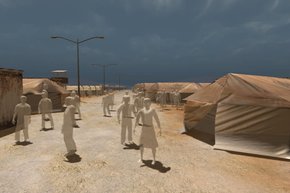
How to Brew a Conflict and Expand Political Enterprise in Ten Easy Steps

Tags

, , , ,

  1. Gather one’s thugs.
  2. Create (false flag) or take advantage of an incident that may be attributed to one’s chosen enemy.
  3. Repeat.
  4. Repeat.
  5. As often as necessary until the air is filled with “you people” accompanied by the denouncing and demonizing of the same.
  6. Form up and deploy additional gangs who have as their reason for being the mounting of “extremist” assaults.
  7. When the The Enemy has responded with gangs of its own and produced sufficiently brutal atrocities in the process of addressing the provocations designed for it, then by way of the world’s more gentle hearts and the melange of motivations bouncing around inside the UN, cry, complain, and whine about the awful things being done to one’s own.
  8. Finally, align one’s other assets — financial and political clout, defense purchasing power and related military — to draw the conflict (now created and burning well) toward one’s middle objectives.
  9. With the world’s change of heart, it’s love and sympathy — its essential buy-in — expand and relax.
  10. Job well done.  Prepare the next front.

I don’t know if it’s true, but some things seem to work along these lines.

I do believe in the idea of expanding incitement in conflict, i.e., start with a fairly healthy society and do it some damage of a type associated with discrimination.  Call that a dent and watch the dent become a hairline crack, a fissure, a fracture, a great rending of the social fabric, and continue to play the conflict — after all: you started it, it’s your game — until it comes to you for a moderated peace beneath the understanding aegis of your own capacious robes.

# # #

FTAC – Burma – Rakhine vs Rohingya – Mirrored Amplification in Islam-Related Conflict – A Note

Tags

, , , ,

It was a rape (perpetrated on the Rohingya side) that set off this escalated vendetta. In a healthier society, imho, or one with an active and responsive government, a crime is a crime and not only treated with our kit of measures rapidly advanced in the common — investigation, arrest, trial, etc.– but protected from public emotion too: no lynching. However . . . that’s civilization.

The wild is different, and Burma has been that for a long time.

I tend to view the conflict as tribal warfare conflated with religious animus, but perhaps that’s the way I would rather feel.

http://en.wikipedia.org/wiki/2012_Rakhine_State_riots

In that the Central African Republic has been experiencing similar tribal driven warfare with a distinctly religious cast, the phenomenon becomes a template or pattern.

It doesn’t matter that most on either side would rather not be bothered, for the character of the fighting is never confined to fighters or consigned to politics: what starts as a dent in community relations becomes a hairline crack, a fissure, and as atrocity escalates, a fracture, a Great Divide.

There may be “hidden hands” in setting one against another (certainly, the images I posted from the Rohingya experience were compelling and visceral — and I’ve since removed them from display on my blog); there may be great wealth in the offing, no pun intended; but that the center does not hold in any of the Islamic Small Wars may tell something about the character of the places involved (I like to note that Assad had an army and al-Nusra et al were armies of a sort, but the main constituency of Syria had NOTHING for its defense from any violent actor) and the character of the process that heightens long-overlooked differences in communities and moves from incident (all are like blasting caps in these wars) to feud to open conflict to genocidal putsch. To arrest that process, it has to be stopped in the “mouth-ear-mind-heart system” all around. That might take place if the “mild, moderate, and middle” (I’ve a lot of tropes for this stuff) can get its act together and restore civil society (that’s Iraq’s Sunni-Shiite-in-it-together challenge today), but if they can’t, it gets worse x distribution x intensity x sadism.

______

In the 20th Century, generals and politicians certainly understood bad mouthing, pushing and shoving, dirty tricks, and ambush (and blitzkrieg); in this one, I’m not sure whether those being swept up into animus- and conflict-producing processes understand how they are being manipulated to increase their own tendency toward violence and decrease their ability to observe, reason, and weigh essential criminal acts.

Whether it starts with the massive lying generated by Hamas and the increasingly and morally lost “Palestinian Cause” or a few words over the radio in Rwanda, the pathway — etiological, just like disease — becomes clear, and the wholesale destruction of the innocent plus whatever comprises humanity within the perpetrators (what do you think of Bashar al-Assad now?) is where it ends.

Senseless slaughter.

______

With a hazy sense of the conflict, I mentioned as analog the fighting in the Central African Republic.  Conveniently found in the web (this kind of look-up takes less than four seconds, and the keyboard operator uses up 3.5 second or so of those):

“Ndele isn’t far away” is the wishful name of a small Islamic shop selling prayer beads and copies of the Koran in Miskine, a bustling district in the Central African Republic’s capital Bangui. Ndele, in the country’s north, some 650 kilometers (400 miles) from Bangui, was the first city captured by the Seleka, an alliance of various Muslim rebel groups. In March, they marched into the capital, overthrowing the government.

Miskine has traditionally been the Muslim district in the predominantly Catholic capital. Before the coup, Muslims used to live in peace alongside Christians, with their giant mosque standing alongside three churches. Today, it is the scene of a civil war, with Christian militias fighting to the death in an attempt to drive out the Muslim rebels.

http://www.dw.de/car-conflict-about-power-religion/a-17315017 – 12/21/2013.


On the other hand, if you think you have looked at (or into) something, look again:

Djotodia was the first Muslim leader of the mostly Christian CAR − Muslims account for approximately 15% of the population − and the Séléka mostly comprised of Muslims from the north, though bolstered by some Chadian and Sudanese mercenaries.

Under Djotodia, the Séléka engaged in looting, rape, and murder of civilians. In response, various communities formed self-protection brigades. These so-called anti-balaka forces are believed to be mostly Christian, but their origins and leadership are largely unknown − some speculate that former president Bozizé and his supporters control more than half the forces.

http://thinkafricapress.com/central-african-republic/identity-politics-coding-religion – 2/26/2014.

______

For BackChannels, I suggest the Islamic Small Wars (well, Islam’s the world that’s hosting or involved in most of the open conflict and conflict-drive on the planet at the moment) have to do with personality (of dictators — and the psychology of dictatorship distilled, somewhat, to “malignant narcissism“).  The way that works, however, may be akin to how a part of Hollywood works: the place needs showoffs!  It breeds them, draws them, encourages them (I’ve rather been one of them myself in spirit).

And in Hollywood, it’s not so bad.

Mel Gibson may do some damage, but compared to, say Russia’s President Putin or Syria’s Bashar al-Assad (or “the dictator Putin-Assad-Khamenei”), Mel’s okeydokey with just about whatever he does.

In other realms, one might get a flamboyant but egalitarian, just, and thoughtful president – or a tyrannical king.

This theme, small time thug to mafia don to president of a nuclear state, runs all the way up and down the line.  Where it doesn’t, where it won’t work, is where something central in the character of the humanity of the place — or the surrounding humanity if “containment has become an objective — keeps it caged and makes it smaller.

And smaller.

Until it’s gone.

And elected lawmakers, disciplined police, and open courts remain to handle the leftovers of their societies’ violent fringes.

It may just be me who sees personality and psychological issues where others see political ones, often related to resources; nonetheless, I would submit that while the wealth in the ground or in the labor may be a prize, the malignant have interest in the control of others in the process of dealing themselves “narcissistic supply” — they’re not playing just for gold or oil or their political survival or the welfare of their people: they’re out to steal the dignity, freedom, and good spirit of their adversaries, and those — that’s the whole world (whether it likes it or not).

That kind of poisoned drive destroys communities and deadens the souls across which it sweeps its black angel’s wings.

# # #

Israel lends a hand. Will it be offered one as well?

First.One.Through's avatarFirst One Through

In May, Israel joined the US, Canada, France and England in providing support to Nigeria in its efforts to find the over 200 teenaged girls abducted by Boko Haram. “Israel expresses deep shock at the crime against the girls,” Netanyahu told the Nigerian president, “We are ready to help in finding the girls and fighting the cruel terrorism inflicted on you.”

Israel has a long history of providing aid to countries in trouble – even those where it does not have diplomatic relations, as seen in the video below.

It will be interesting to see if the world exerts pressure on, and withholds aid to the new Palestinian government, in light of the recent abduction of three Israeli teenagers. However, when one considers that only five of the 193 UN countries are helping Nigeria, one should temper expectations.

https://www.youtube.com/watch?v=mau1uaIGLo8

View original post

Aside

Tags

, ,

Compiled Fast Reference: ISIS: 6/19/2014

______

ISIS, wild and cruel, has proven through its criminality and inhumanity incapable of governance except through continued sadism.  Call it deeply intoxicated by brute power, it is as it displays itself.

______

Although the Islamic State of Iraq and Syria (ISIS) — a marauding army of Sunni Muslim jihadists — has turned south toward Baghdad, Kurds in the semi-autonomous oil-rich northeast expect that they may have to face their fellow Sunnis, who left a trail of death and destruction in overrunning the Iraqi army in taking the cities of Tikrit and Mosul.

http://www.foxnews.com/world/2014/06/19/kurds-outgunned-by-fanatical-isis-hope-looming-baghdad-battle-buys-time-for/ 6/6/2014.


The crisis caused by the sudden advance of the Isis insurgents has driven world crude prices past $114 a barrel in recent days and led to warnings of shortages from industry experts.

http://www.theguardian.com/world/2014/jun/18/dwindling-iraq-oil-reserves-cause-price-spike 6/18/2014.


. . .  nearly 100 militants had been killed as his forces repelled wave after wave of attacks since Tuesday.

http://www.foxnews.com/world/2014/06/19/witness-claims-isis-flag-flies-over-key-iraq-refinery-baghdad-says-soldiers/ 6/19/2014.


 . . . a stark illustration of one of the most alarming aspects of ISIS’s rise: the group’s growing ability to fund its own operations through bank heists, extortion, kidnappings, and other tactics more commonly associated with the mob than with violent Islamist extremists.

http://complex.foreignpolicy.com/posts/2014/06/16/isis_uses_mafia_tactics_to_fund_its_own_operations_without_help_from_persian_gulf_d 6/16/2014.


ISIS appears to be as well-endowed economically as any such group can be endowed by conquest, by plunder and by voluntary contributions. How do they make their money?

http://wlrn.org/post/how-isis-endowed-conquest-stocks-its-war-chest 6/18/2014.

# # #

Proposed: A Great Conversation About Power

Tags

, , , , , ,

Pharaoh to Hitler to Assad to ISIS: let’s have our talk about power, personality, and politics.

Now.


I don’t know what metaphor suits that concept that is time when it is time for one to seal off a section of history, to have arrived at the end of a chapter of one’s own story, and to have to look across a river (in time) or desert (in time — add the biblical term of forty years for wandering lost in the foyer to the future) — and to leave one bank (in time) to wade, swim, or bridge and walk to that other shoreline.

Is there parochial time?

Is there universal time that contains parochial time?


I feel that with the destruction of Syria, which carnage has exceeded that involved in the Destruction of Jerusalem by Titus (70 CE) and the challenge posed today by ISIS in Iraq, some Islamic introspection and review of Sunni-Shiite rivalry (throw in Arab anti-Semitism while at it) might be helpful.

Iraq is a test: will parochialism seek through blood letting a nation divided by sectarian identification that guarantees perpetual war — or will the middle, mild, and moderate of Sunni and Shiite humanity recognize ISIS as an alien force inimical to the survival of either and therefore band together to eject and destroy it?

What is the timeline for the development of either path?

The world would seem to have all of the time in the world for this conflict between (BackChannel’s trope coming right here) “two mad wasps in a bell jar”.


There’s a terrific political cartoon by artist Talal Nayer at this location: http://tnayer.blogspot.com/2014/01/sunni-vs-shiite.html.

Irshad Manji has featured the same on her Facebook fan page, and it has been shared about 500 times, a good indicator that others are seeing the same thing.


Power.

I think the Jews — because our stories compel us to argue about these things and one may have opinions — took the monotheist power represented by Pharaoh and threw it out into the universe — and beyond the universe — to an abstract conception of God (“King of the Universe”) — and that was that for the people who walked away from what Pharaoh represented as a power unto himself.


# # #

Project Syria

politickerlondon's avatarPOLITICKER LONDON

Syria

 What: Special Events

When: Wed 18 June 2014 –Sun 22 June 2014

Where: Victoria & Albert Museum, London.  Tapestries, Room 94


 INSTALLATION

Put on a headset to ‘walk’ the streets of Aleppo and enter a refugee camp full of children, as real events occur. The ongoing war in Syria has displaced nearly a third of the population; a terrible truth that can be hard to grasp at a distance and put you on scene as a witness to the unfolding events. Project Syria uses cutting-edge virtual reality technology to remove that distance.

V&A Director Dr Martin Roth has been instrumental in making sure Project Syria is hosted at the V&A during International Refugee Week 2014.  Dr Roth clarifies that the V&A is a historic institution with a radical mission: to bring art and design to all. Prince Albert, its founder, was inspired by the work of Gottfried Semper…

View original post 396 more words