
• Home
  • About
  • Concepts, Coins, and Terms
    • Anthropolitical Psychology
      • Civilizational Narcissism
      • Conflict – Language Uptake – Social Programming and Scripting – A Suggestion
        • Language Uptake – Programming – On Learning to Listen
        • Mouth –> Ear –> Mind –> Heart System
        • Social Grammar
      • Facsimile Bipolar Political Sociopathy
      • Malignant Narcissism
      • Narcissistic Scripting
      • Normative Remirroring
      • Paranoid Delusional Narcissistic Reflection of Motivation
    • FTAC – “From The Awesome Conversation”
    • God Mob
    • Intellectual Battlespace
    • Islamic Small Wars
    • New Old Now Old Far Out and Lost Left
    • Political Spychology
    • Shimmer
  • Library
    • About Language
    • Russian Section
  • Comments and Contact

BackChannels

~ Conflict, Culture, Language, Psychology

BackChannels

Tag Archives: conflict

Turkey – A Fissure Has Opened in the Political Body

18 Tuesday Jun 2013

Posted by commart in Conflict - Culture - Language - Psychology, Free Speech, Politics, Turkey

≈ Leave a comment

Tags

conflict, Erdogan, language, political, totalitarian, Turkey

Four protesters and one police officer have been killed during the protests and Turkey’s doctors association said an investigation was underway into the death of a fifth protester who was exposed to tear gas. More than 7,800 people have been injured; six remain in critical condition and 11 people have lost their eyesight after being hit by flying objects.

AP. “Turkey’s Erdogan vows to strengthen police powers as dozens detained in raids.”  The Washington Post, June 18, 2013.

Last week’s unrest, only quelled this week, has left Turkey a divided nation with President Erdogan’s voting majority AKP jubilant in its denial of its impact on all others.  With so many business and political rivals neutralized, generals sacked, and journalists jailed, Erdogan has proven he can muscle up an adoring crowd while his police go about battering and blinding those who dissent.

Here was a bellicose leader who dismissed overwhelmingly peaceful demonstrators as “looters” and “terrorists”, who railed against international media for their “disinformation” campaigns, and who criticised volunteer medics for treating injured protesters.

“The big loser (in the crisis), is the prime minister who is fighting for his political survival,” said Cengiz Aktar, a political science professor at Istanbul’s Bahcesehir university.

ZeeNews.  “Turkey PM risks political fallout after Gezi Park.”  June 18, 2013.

Here in my “Second Row Seat to History”, I am not part of any media conspiracy, government agency, anti-government organization, or strident political or religious movement.

I have only watched the footage.

“Unfortunately, we have been witnessing undesired attacks and provocations over the past few days.  We are once again experiencing the traps that were set in the past to threaten governments and create chaotic scenes to pave the way for interventions against democracy.”

Whose past, Mr. Erdogan?

To whose “interventions against democracy” have you referred?

May the reader wrap his mind around the Turkish President’s Orwellian rhetoric.

The open democracies of the other NATO states reject the tyranny of the majority, the state’s suppression of media and of the earnest and responsible journalists on whose mantles rest decency and integrity in reporting, and, every single one of them, deeply rejects the rejection of the popular criticism of ordinary constituents, whether aligned with a majority part or distant from it.

Protesters have accused Erdogan, who has been in power for a decade, of taking Turkey down the road of authoritarian and Islamist rule. Erdogan, who has triumphed with wide electoral majorities, has dismissed the protesters as militants and losers.

Johnson, Glen.  “Protester reported killed in Turkey amid days of unrest.”  The Los Angeles Times, June 3, 2013.

Last week, the Ataturk Society UK reported three dead, 4,785 injured.

President Erdogan’s own ham-handed behaviors in office have inspired the opening of a fissure in Turkey’s body politic, and it will not close.

From the album online, “Heartwarming Images from the Turkish Resistance (created two weeks ago)“.
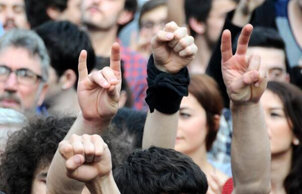
"Three different ideologies side by side" (photographer unknown).

“Three different ideologies side by side” (photographer unknown).

Two weeks ago?

Has it been that long?

The Wikipedia entry “2013 Protests in Turkey” says it has (initial protest: May 28, 2013).

It feels like forever.

ISW – Comment on Saudi Arabia’s Heightened Profile in the Syrian Theater

17 Monday Jun 2013

Posted by commart in Asia, Conflict - Culture - Language - Psychology, Eurasia, Iran, Islamic Small Wars, Israel, Middle East, Qatar, Regions, Religion, Russia, Saudi Arabia, Syria, Turkey

≈ Leave a comment

Tags

conflict, dignity, governance, government, humanity, Islamic Small Wars, King Adullah, liberty, NATO, political, politics, Putin, religion, rivalries, Saudi Arabia, Syria, war

(Reuters) – Saudi Arabia, a staunch opponent of President Bashar al-Assad since early in Syria’s conflict, began supplying anti-aircraft missiles to rebels “on a small scale” about two months ago, a Gulf source said on Monday.

Bakr, Amena.  “Saudi supplying missiles to Syria rebels: Gulf source.”  Reuters, June 17, 2013.

For those who value stability in the middle east, the least honest and most ruthless appear to be winning.

As the above quote suggests, Big Sunni Money plus the cultivation across many years of strategic and trade relationships in Great Britain, Europe, and the United States have put King Abdullah of Saudi Arabia not only into the fight in Syria but remarkably behind the NATO wheel.

Of course, this recent news (surfacing in the news) isn’t news at all to the businesses and states involved in Syria’s civil war, and it should be apparent to all onlookers that this double-track, double-story business of telling the public one story while facilitating another in private has brought us to the brink of a NATO vs. Russia confrontation in which Russia may now present a devilish gambit: better Assad and the continuing misery to be imposed by the dictatorship than the expansion of either Al Qaeda or Wahhabi Islam and the certain diminishing of nascent democracy, human dignity, and secular values in Syria accompanied by the heightening of tensions in Lebanon and,somewhere in the future, with Israel and the Jewish People.

To offset that impression, King Abdullah may have to back up the money with some combination of reassuring mouth and evidence of cultural and social evolution toward the contemporary in the Kingdom, certain injunctions of the Quran either notwithstanding or interpreted or aligned with a more free and liberal and greater western world.

Outlook

For the moment, if Iran’s nuclear program and global ambitions are the true target of the conflict in Syria, then the conflict and the human suffering plus political confusion driven by it, have yet some months to years to go.

In fact, the focusing of issues in the Syrian theater of a great portion of the drivers of the Islamic Small Wars  — i.e., rivalries of various sort: Al Qaeda and Wahhabi Islam; Sunni and Shiite Islam; democracy, secular dictatorship and theocracy; Iranian and Saudi Arabian competition for greater spheres of influence; even Putin’s possible issues with aggrandizement, control, and wealth on one hand and his own humanity, moderation, and strength in restraint on the other– bodes ill for constituents — worldwide — whose concerns may be more with family, security, and employment scaled down to a common denominator in the common humanity than with the triumph of a king or an ayatollah.  

It has been said that with the onset of war, nobody wins, and nowhere else across the killing fields of the Islamic Small Wars does that cynical sentiment seem more likely to be proven true than in Syria this day.

Reference

Al Arabiya.  “Saudi King Abdullah cuts holiday short due to ‘events in the region’.”  June 15, 2013.

Chulov, Martin.  “Threat of sectarian war grows in Syria as jihadists get anti-aircraft missiles.”  The Guardian, June 15, 2013.

Deasy, Kristin.  “Al Qaeda in Iraq defies global leader over relationship with Syria’s Al Nusra: Reports.” Global Post, June 15, 2013.

Henderson, Simon.  “Bahrain Rounds Up Organizers of Antigovernment Violence.”  Policy Alert, The Washington Institute for Near East Policy, June 14, 2013:

Initially emulating uprisings elsewhere in the Arab world, the protests quickly divided along sectarian lines, pitting members of the majority Shiite population against the Sunni ruling family’s security forces. Since then, February 14 members have apparently engaged in near-nightly clashes with police, resulting in more than 100 dead and 2,000 injured among civilians and security personnel.

Osborn, Andrew and Amena Bakr.  “Putin, Obama face off over Syria; rebels get Saudi missiles.”  Reuters, June 17, 2013.

Reuters.  “Russia says it will not allow Syria no-fly zones.”  June 17, 2013.

Starr, Barbara, Holly Yan, Chelsea J. Carter.  “Analyst: Al Qaeda affiliate in Syria now best-equipped of the group.”  CNN, June 17, 2013.

Wintour, Patrick.  “Syria: Putin backs Assad and berates west over proposal to arm rebels.”  The Guardian, June 16, 2013.

ISW: Children in the (War) News

11 Tuesday Jun 2013

Posted by commart in Conflict - Culture - Language - Psychology, Fast News Share

≈ 1 Comment

Tags

Afghanistan, Al Qaeda, casualties, child, children, conflict, Islam, Islamist, ISW, murders, Syria, Taliban, war

The Syrian Observatory for Human Rights, a Britain-based group opposed to the Syrian regime, says Mohammad Qataa was shot in the mouth and neck a day after being seized.

Khan, Salma Javid.  “Syrian teenager Mohammad Qataa ‘executed by islamists for blasphemy’.”  The Muslim Times, June 11, 2013.

Related Reference

BBC.  “Syrian opposition condemns killing of boy in Aleppo.”  June 22, 2013.

9 News World.  “Child executed in Syria.”  June 11, 2013:

“Where are his rights? He was a child! How could they kill him?

“They killed him right in front of my eyes … May God take revenge on them … I saw his blood streaming down,” she wailed.

Notes Continued

Kabul, Afghanistan (CNN) — Taliban militants beheaded two children in southern Afghanistan, a provincial governor’s office said.

Popaizai, Masoud and Joe Sterling.  “2 children beheaded by militants, Afghan authorities say.”  CNN, June 11, 2013.

The Taliban have denied involvement in the beheading cited in the above report, but there seems no question that the crime took place.  False flag or true deed, one would be hard pressed to find a more deliberately monstrous crime.

Contempt for an enemy’s life should have limits.

Muhammad Hassan Sultan, a slender brown-haired 12-year-old, became a postwar casualty when the shrapnel from a cluster bomb cut into his head and neck.

Slackman, Michael.  “Israeli Bomblets Plague Lebanon.”  The New York Times, October 6, 2006.

Children not only play or roam around abandoned battle space, they have a knack for getting in the way — or being placed in it.

The Bureau of Investigative Journalism features a column on its drone strike page titled “Casualty Estimates” associated with drone and covert activities, and their numbers involving children are, of course, not pretty.

The United Nations tracks the fate of children in armed conflict through the Office of the Special Representative of the Secretary-General for Children and Armed Conflict.  Here’s a paragraph of report from Central Africa:

In the Democratic Republic of the Congo, 58 children (23 girls and 35 boys between 2 and 17 years of age) were abducted by LRA in 2012. In contrast to previous years, they were used mainly as porters to carry looted goods, rather than to participate in attacks. Children continued to be victims of LRA attacks, however. In two separate LRA attacks, a girl and a boy were killed and a girl and three boys injured in Haut Uélé prefecture between January and May 2012. A case in which a girl was raped by LRA was documented in May 2012, while two other girls who escaped from the group in 2012 reported having been raped while in captivity. In total, 41 children (19 girls and 22 boys) escaped or were released from LRA during the reporting period. Between January and October 2012, LRA also attacked two health centres and three schools.

Back to Syria

This was posted by Today’s Zaman in November 2012:

Meanwhile, New York-based Human Rights Watch said that evidence has emerged that an airstrike using cluster bombs on the village of Deir al-Asafir near Damascus killed at least 11 children and wounded others on Sunday. Cluster bombs have been banned by most nations.

Yesterday’s news or today’s, the picture is more than grim, for the image of war in this dimension reflects most directly on the adults whose decisions failed to protect innocents, whether their own or others.

Syria – The Habit of War

29 Wednesday May 2013

Posted by commart in Conflict - Culture - Language - Psychology

≈ Leave a comment

Tags

conflict, organizations, process, rebels, Syria

I myself may have the “habit of war” as as I come to this blog every morning for a dose of my own “narcissistic supply” plus an update on “the latest” somewhere.

As the week’s mornings seem to be turning out more focused on Syria than elsewhere, online witness has been turning out a grim experience.

For war porn, the BBC has covered massacres and produced footage, which, if you search videos separately — string: “Baniyas massacre” — has been all over the web since it occurred in the first days of May (there’s even a Wikipedia page: “Bayda and Baniyas massacres“).

For dismal reading, I may not too highly recommend the BBC’s “Guide to the Syrian opposition.”

A long time somewhere else, I asked this question about Somalia: “If you were a fighter anywhere in Somalia and tired of fighting, to whom would you surrender?”

? ? ?

Call that condition anarchy.

In fact, civil war has brought anarchy to Syria, not only displacing more than 20 percent of the constituents whose lives were to have been secured by President Assad, but giving rise to internally riven opposition organizations: National Coalition for Syrian Revolutionary and Opposition Forces; the Syrian National Council (SNC); National Co-ordination Committee (NCC); and the Free Syrian Army (FSA), of which the BBC notes, “The FSA leadership told the UN Human Rights Council in February that commanders in the field did not receive orders from it and currently made their own rules of engagement.”

Time to get it together?

Opposed by deeply divided and incoherent forces, the Assad regime may have cause and hope for holding out; faced by the same, Senator McCain’s cheerleader appearance notwithstanding, the west has plenty of cause for doubting the wisdom of arming an increasingly Islamist revolution.

A look around the quarter — start with Egypt, move on to Libya, revisit Iraq — tells what comes into the vacuum left by a removed dictator.

It may not be all bad, but conditions in Syria as described by the mixed and adverse motivations involved in energizing the revolution and their expression through unstable organizations and poisonous personalities — this to judge by the mosaic of anti-western, anti-Israel, anti-Semitic spew boasted on some pages — e.g., “Today, the 15th of May, marks 65 years since Palestine was partitioned and Palestinians were expelled from their land in order to create a Jewish Nationalist State, thus executing the infamous Balfour Declaration. Britain must be held primarily responsible for these continuing crimes against humanity . . . .” (Syrian National Coordinating Body “Statement on the 65th anniversary of the Palestinian Nakba“) — bode ill for western do-good policy makers.

It may be one thing to give people the rope they need to hang themselves, quite another to hand some the rope they need to hang us.

While Obama and Putin move as Sumo wrestlers around it, the Assad Family’s Syria has failed, and although the family and its army may well survive with a state of some kind, it will be a long time before the scope of the tragedy as well as the  breathtaking intellectual, political, social, and spiritual disarray and misguidance throughout the battle space becomes clear — and then it will take more time to get down into the true basis for that so endlessly desperate, fracturing, heartbreaking, and reckless  condition.

Reference

Al Jazeera.  “Both sides in Syria use low-tech trackers.”  May 25, 2013.

Al Jazeera.  “Syria and Hezbollah bolster forces in Qusayr.”  May 29, 2013.

Al Jazeera.  “Syrian rebels divided in fight against Assad.”  May 28, 2013.

BBC.  “Guide to the Syrian opposition.”  May 29, 2013.

BBC.  “Syrian activists document al-Bayda and Baniyas ‘massacre’.  May 28, 2013.

BBC.  “Syria crisis: Rebels condemn opposition coalition.”  May 29, 2013.

ICG Latest Report – “Too Close for Comfort: Syrians in Lebanon”

13 Monday May 2013

Posted by commart in Conflict - Culture - Language - Psychology, Fast News Share, Israel, Middle East, Regions, Syria

≈ Leave a comment

Tags

civil war, conflict, Golan, Israel, Lebanon, refugees, satellite imagery, Syria, war

Syria’s conflict is dragging down its neighbours, none more perilously than Lebanon. Beirut’s official policy of “dissociation” – seeking, by refraining from taking sides, to keep the war at arm’s length – is right in theory but increasingly dubious in practice. Porous boundaries, weapons smuggling, deepening involvement by anti-Syrian-regime Sunni Islamists on one side and the pro-regime Hizbollah on the other, and cross-border skirmishes, all atop a massive refugee inflow, implicate Lebanon ever more deeply in the conflict next door.

http://www.crisisgroup.org/en/regions/middle-east-north-africa/egypt-syria-lebanon/lebanon/141-too-close-for-comfort-syrians-in-lebanon.aspx

Full report PDF

Also in the news this morning:

DAMASCUS — The Syrian information minister, Omran al-Zoubi, said Sunday that President Bashar Assad’s troops have the right to enter the Israeli-occupied Golan whenever they wish, a veiled threat toward Israel to stay out of Syria’s conflict.

‘‘The Golan is Syrian Arab territory and will remain so, even if the Israeli army is stationed there,’’ Zoubi said at a news conference. “We have the right to go in and out of it whenever we want and however we please,’’ he said.

Fightin’ words!

http://www.bostonglobe.com/news/world/2013/05/12/syria-warning-israel-declares-troops-have-right-enter-golan/Q9ePJVWpn6ZJpphLauzNJK/story.html

Assad has lost Syria, for these overtures signal a madness that knows it cannot do good — cannot take care of the country, the countryside, the economy, or the people — but it might feel better if it could destroy something even as it destroys itself.

With that last sentence, I have not been merely rhetorical.

On the world map, Syria remains a country. On the ground, it has devolved into a battlefield warred over by sectarian fiefdoms, guerrilla outfits, extremist militias, criminal gangs and a regime clinging grimly to its dwindling sources of power and legitimacy.

Read more: http://world.time.com/2013/03/15/the-destruction-of-a-nation-syrias-war-revealed-in-satellite-imagery/#ixzz2TC2ioknb

If you click on the above URL, you will see what war looks like on the face of the earth when viewed from outer space.  Included in the remote sensing comparisons: Damascus, Homs, Daryya, Aleppo.

Ozymandias

I met a traveller from an antique land
Who said: Two vast and trunkless legs of stone
Stand in the desart. Near them, on the sand,
Half sunk, a shattered visage lies, whose frown,
And wrinkled lip, and sneer of cold command,
Tell that its sculptor well those passions read
Which yet survive, stamped on these lifeless things,
The hand that mocked them and the heart that fed:
And on the pedestal these words appear:
“My name is Ozymandias, king of kings:
Look on my works, ye Mighty, and despair!”
Nothing beside remains. Round the decay
Of that colossal wreck, boundless and bare
The lone and level sands stretch far away.

Source: Wikipedia. “Ozmandias”.

# # #

Q&A – A Comment on Iraq by Abdelwahab Al Jaza’iri In Dubai

29 Monday Apr 2013

Posted by commart in Conflict - Culture - Language - Psychology, Iraq, Middle East

≈ Leave a comment

Tags

conflict, internecine, Iraq, politics, regional, rivalry, sectarian, Shiite, Sunni

Q: Setting aside Iranian and other outside influence, do you view Shiite-Sunni rivalry and cultural-political organization of Iraqi society as modifiable or irreparably fixed?

A: It wasn’t much of a problem in the past – there was a time when Sunni and Shia Islamists cooperated against the influence of Sunni and Shia Arab nationalists. The problem of authoritarianism inevitably exposed that Sunnis controlled the top, and the rise of Islamism region wide pushed the Shiite protesters of the 1970’s to clash with the Sunni security apparatus. (The first major clash was in 1936 during which a Shiite revolt was brutally put down). The rise of Shiite Islamism in neighbouring Iran created a collusion between Arab nationalism and Sunni Islamism that persists today. Even Lebanese and Syrian Shiites and Alawis are publicly vilified as Persians in all kinds of derogatory language. 

It is absolutely modifiable. But given the damage that’s been done, and the resilience of the forces driving it, it may well last for decades more.

Source note: I asked the question on a closed Facebook group, and the respondent, Abdelwahab Al Jaza’iri in Dubai, provided what I’ve accepted as a very good and distilled answer providing background for recent events in Iraq, and it is with his permission that I post the same here.

# # #

FTAC – A Note on Clausewitz

25 Thursday Apr 2013

Posted by commart in FTAC - From The Awesome Conversation, Islamic Small Wars

≈ Leave a comment

Tags

Clausewitz, conflict, ISW, now, war

Napoleon –> Clausewitz –> Hitler.  He was a vigorous writer, Clausewitz, but he was also of his day, and his day was between the horse and the atom bomb.  His vision was of great armies charging across great landscape, and that was far from intrastate, internecine, transnational low-intensity challenge.  Because he viewed war as a great stimulus for invention, he might understand both the world’s extensive defense research and arms industries, but, perhaps, set out in the field, he would be lost and searching the horizon hopelessly for massed cavalry.

I fear being made to go back and retrieve On War from my library (it’s around here somewhere), but I am certain of its diminished relevance as regards the Islamic Small Wars (which I now describe as “intrastate, internecine, and transnational low-intensity conflict”).  Perhaps he would be excited by the appearance of new fields with relevance to conflict studies, e.g., from psycholinguistics to robotics, and, for sure, he would be a fan of the Office of Naval Research and its counterparts worldwide, but I think he would be an office guy working up “what ifs” and gaming while the great fleets circle the glove in something like strategic balance.

Boston Bombing – Stimulus for Cloud-Based Intelligence Sharing?

24 Wednesday Apr 2013

Posted by commart in Conflict - Culture - Language - Psychology, Fast News Share

≈ Leave a comment

Tags

conflict, cooperation, foreign affairs, intelligence, international, Islamic Small Wars, ISW, sharing

The Caucasus Emirate, the largest group, denied any involvement in the bombing. Meanwhile, al Qaeda has often referenced Central Asia as an important theater for jihad. By most accounts, moreover, there were Chechens training in al Qaeda camps during the 1990s.

Helfstein, Scott.  “Intelligence Lessons from the Boston Attacks.”  Foreign Affairs, April 23, 2013.

In his article, Scott Helfstein will go on to boost greater intelligence cooperation on the part of state services addressing terrorism.

The Islamic Small Wars have provided ample stimulus for a corresponding global evolution in the political, religious, and social conceptualizing of “next societies” or the cultures to be inherited by the immediate next generations and their generations.  In fact, for most Muslims and everyone else, resurgent “Islamic Jihad” has been a powerful goad in fostering, at minimum, consideration of cooperation among the most unlikely bedfellows of politics.  That Mali, for example, has had to call on France to eject its Al Qaeda type brigands in its north tells precisely that story, as may also numerous and frequent assassinations, bombings, persecutions of minorities, and perversions of local and state laws and security arrangements  (see, for example, BBC Panorama: “Secrets of Britain’s Sharia Councils”, posted April 22, 2013) elsewhere in the world. 

An intrastate, internecine, and transnational collection of related conflicts — I call them the “Islamic Small Wars (ISW)”, noting, however, that there are other criminal (e.g., cartel, fraud, piracy, etc.), economic, and political conflicts running concomitantly, some separate, some tandem — naturally calls for a heightened level of cooperation on the part of the more entrenched and stable of states.

While most are aware of INTERPOL, which writ allows it to set its hooks into common international criminal matters, I’ve often wondered how the world’s generals and their partners in politics approach the competition for and related “divvying” of large cash, labor / employment-trade, and natural resource supply apart from longstanding commercial trade behavior.

How deeply goes the military-security aspect into political economics?

For example, I’ve been told that Putin’s sour relationship with nemesis Mikhail Khodorkovsky had to do with plans for shipping Russian oil to Chinese ports, which turns out to have been reported in The Washington Post:

Russian authorities arrested Khodorkovsky in 2003 just as his private oil company, Yukos, was completing plans for an oil pipeline across the frontier. He said the project had been endorsed by the Kremlin but may have contributed to his arrest.

Higgens, Andrew.  “Jailed Russian billionaire pioneered oil deals with China.”  December 28, 2011.

Here one may ask what behind the curtain nixed that deal?

Was it Putin’s legendary avarice and kleptocrat mania as described by Moscow journalist Masha Gessen?

Did the CIA or Diplomatic Mission of the United States with NATO support have a word with the Colonel President?

Setting aside that now famous region in thought denoted as “what we don’t know we don’t know” (reference: Landmark Education), we do know that those who appear amid others expressly to intimidate, maim, and murder — in the name of God with their own interests closely attached — have made themselves an international scourge and doubtless inspired consideration of greater intelligence service cooperation between allies and former enemies (quasi-enemies, “frenemies”) with the intent of quelling that deeply misguided and ever tumescent ambition.

As greater cooperation develops — if it does — will it have corresponding effects as regards broadened distributions of capital, freedom, productivity, trade and related improved qualities in living?

How good can the good make things for others?

How fast?

How inclusively?

← Older posts
Newer posts →
  • Compassion
  • Empathy
  • Justice
  • Humility
  • Inclusion
  • Integrity
____________

Caution: The possession of anti-Semitic / anti-Zionist thought may be the measure of the owner's own enslavement to criminal and medieval absolute power.
___________

Recent Posts

  • All At Once–War
  • On X: Final Comment on Trump-Putin
  • On X: American State of Affairs: Notes to Anders Aslund.
  • On X: Cowards and Criminals Negotiate Russia v. Ukraine
  • The Destructive Power of Lies: Active Measures and Destabilization and Influence Operations
  • East-West Rivalry: Trump-Putin Divide the World

Categories

  • 21st Century Feudal
  • 21st Century Modern
  • A Little Wisdom
  • Also in Media
  • American Domestic Affairs
  • Anti-Semitism
  • Asides
  • BCND – BackChannels News Day
  • Books
  • Conflict – Culture – Language – Psychology
  • COVID-19
  • Epistemology
  • Events and Other PSA's
  • Extreme Brown vs Red-Green
  • Fast News Share
  • foreign aid
  • Free Speech
  • FTAC
  • FTAC – From The Awesome Conversation
  • International Development
  • IRT Images Research Tropes
  • Islamic Small Wars
    • Gaza Suzerain
  • Journal
    • Library
  • Journalism
  • Links
  • Notes On Reading BackChannels
  • OnX
  • Philology
  • Philosophy
  • Poetry
  • Political Psychology
  • Political Spychology
  • Politics
  • Psychology
    • Facsimile Bipolar Political Sociopathy
  • Qualities of Living (QOL)
  • Referral
  • Regions
    • Africa
      • Central African Republic
      • Guinea
      • Kenya
      • Libya
      • Mali
      • Morocco
      • Nigeria
      • South Africa
      • Sudan
      • Tunisia
      • Zimbabwe
    • Asia
      • Afghanistan
      • Burma
      • China
      • India
      • Myanmar
      • North Korea
      • Pakistan
      • Turkey
    • Caribbean Basin
      • Cuba
    • Central America
      • El Salvador
      • Guatemala
      • Honduras
      • Mexico
    • Eastern Europe
      • Serbia
    • Eurasia
      • Armenia
      • Azerbaijan
      • Russia
      • Ukrain
      • Ukraine
    • Europe
      • France
      • Germany
      • Hungary
      • Poland
    • Great Britain and United Kingdom
    • Iberian Peninsula
    • Middle East
      • Egypt
      • Gaza
      • Iran
      • Iraq
      • Israel
        • Palestinia
      • Jordan
      • Kurdistan
      • Lebanon
      • Palestinian Territories
      • Qatar
      • Saudi Arabia
      • Syria
      • United Arab Emirates
      • Yemen
    • North America
      • Canada
      • United States of America
    • Norther Europe
    • Northern Europe
      • Sweden
    • South America
      • Argentina
      • Brazil
      • Columbia
      • Ecuador
      • Venezuela
    • South Pacific
      • Australia
      • New Zealand
      • Papua New Guinea
      • West Papua
  • Religion
  • Spain
  • Syndicate Red Brown Green
  • transnational crime
  • Uncategorized
  • Visual Data

Europe

  • Defending History
  • Hungarian Spectrum
  • Yanukovych Leaks

Great Britain

  • Stand for Peace

Israeli and Jewish Affairs

  • Chloe Simone Valdary

Journals

  • Amil Imani
  • New Age Islam

Middle East

  • Human Rights & Democracy for Iran
  • Middle East Research and Information Project

Organizations

  • Anti-Slavery
  • Atlantic Council
  • Fight Hatred
  • Human Rights First Society
  • International Network Against Cyberhate
  • The Center for Victims of Torture

Meta

  • Create account
  • Log in
  • Entries feed
  • Comments feed
  • WordPress.com

Epigram

Hillel the Elder

"That which is distasteful to thee do not do to another. That is the whole of Torah. The rest is commentary. Now go and study."

"If I am not for myself, who will be for me? If I am not for others, what am I? If not now, when?"

"Whosoever destroys a soul, it is considered as if he destroyed an entire world. And whosoever that saves a life, it is considered as if he saved an entire world."

Oriana Fallaci
"Whether it comes from a despotic sovereign or an elected president, from a murderous general or a beloved leader, I see power as an inhuman and hateful phenomenon...I have always looked on disobedience toward the oppressive as the only way to use the miracle of having been born."

Talmud 7:16 as Quoted by Rishon Rishon in 2004
Qohelet Raba, 7:16

אכזרי סוף שנעשה אכזרי במקום רחמן

Kol mi shena`asa rahaman bimqom akhzari Sof shena`asa akhzari bimqom rahaman

All who are made to be compassionate in the place of the cruel In the end are made to be cruel in the place of the compassionate.

More colloquially translated: "Those who are kind to the cruel, in the end will be cruel to the kind."

Online Source: http://www.rishon-rishon.com/archives/044412.php

Abraham Isaac Kook

"The purely righteous do not complain about evil, rather they add justice.They do not complain about heresy, rather they add faith.They do not complain about ignorance, rather they add wisdom." From the pages of Arpilei Tohar.

Heinrich Heine
"Where books are burned, in the end people will be burned." -- From Almansor: A Tragedy (1823).

Simon Wiesenthal
Remark Made in the Ballroom of the Imperial Hotel, Vienna, Austria on the occasion of His 90th Birthday: "The Nazis are no more, but we are still here, singing and dancing."

Maimonides
"Truth does not become more true if the whole world were to accept it; nor does it become less true if the whole world were to reject it."

"The risk of a wrong decision is preferable to the terror of indecision."

Douglas Adams
"Isn't it enough to see that a garden is beautiful without having to believe that there are fairies at the bottom of it too?" Epigram appearing in the dedication of Richard Dawkins' The GOD Delusion.

Thucydides
"The Nation that makes a great distinction between its scholars and its warriors will have its thinking done by cowards and its fighting done by fools."

Milan Kundera
"The struggle of man against power is the struggle of memory against forgetting."

Malala Yousafzai
“The terrorists thought that they would change our aims and stop our ambitions but nothing changed in my life except this: weakness, fear and hopelessness died. Strength, power and courage was born.”

Tanit Nima Tinat
"Who could die of love?"

What I Have Said About the Jews

My people, not that I speak for them, I nonetheless describe as a "global ethnic commune with its heart in Jerusalem and soul in the Land of Israel."

We have never given up on God, nor have we ever given up on one another.

Many things we have given up, but no one misses, say, animal sacrifice, and as many things we have kept, so we have still to welcome our Sabbath on Friday at sunset and to rest all of Saturday until three stars appear in the sky.

Most of all, through 5,773 years, wherever life has taken us, through the greatest triumphs and the most awful tragedies, we have preserved our tribal identity and soul, and so shall we continue eternally.

Anti-Semitism / Anti-Zionism = Signal of Fascism

I may suggest that anti-Zionism / anti-Semitism are signal (a little bit) of fascist urges, and the Left -- I'm an old liberal: I know my heart -- has been vulnerable to manipulation by what appears to me as a "Red Brown Green Alliance" driven by a handful of powerful autocrats intent on sustaining a medieval worldview in service to their own glorification. (And there I will stop).
One hopes for knowledge to allay fear; one hopes for love to overmatch hate.

Too often, the security found in the parroting of a loyal lie outweighs the integrity to be earned in confronting and voicing an uncomfortable truth.

Those who make their followers believe absurdities may also make them commit atrocities.

Positively Orwellian: Comment Responding to Claim that the Arab Assault on Israel in 1948 Had Not Intended Annihilation

“Revisionism” is the most contemptible path that power takes to abet theft and hide shame by attempting to alter public perception of past events.

On Press Freedom, Commentary, and Journalism

In the free world, talent -- editors, graphic artists, researchers, writers -- gravitate toward the organizations that suit their interests and values. The result: high integrity and highly reliable reportage and both responsible and thoughtful reasoning.

This is not to suggest that partisan presses don't exist or that propaganda doesn't exist in the west, but any reader possessed of critical thinking ability and genuine independence -- not bought, not programmed -- is certainly free to evaluate the works of earnest reporters and scholars.

Archives

Blog at WordPress.com.

  • Subscribe Subscribed
    • BackChannels
    • Join 356 other subscribers
    • Already have a WordPress.com account? Log in now.
    • BackChannels
    • Subscribe Subscribed
    • Sign up
    • Log in
    • Report this content
    • View site in Reader
    • Manage subscriptions
    • Collapse this bar