“The country’s humane and modern interpretation of Islam is the most crucial trump that the world has against radicalism and terrorism, which has been rapidly pervading the region.”
What troubles Western observers is not the groups’ fighting prowess, however, but their shared vision of a jihad that extends beyond Assad’s ouster. While other rebels are fighting to remove the Syrian dictator, former and current U.S. and Middle Eastern officials say, the al-Qaeda groups are transforming the conflict into a symbolic struggle against the West and Israel, using words and images that resonate with like-minded Muslims from the Arab Peninsula to Western Europe.
The United States has had limited success cutting off funding to the al Qaeda-linked fighters and foreign jihadists flowing into Syria — in part because of a lack of cooperation on the part of Middle Eastern allies, Intelligence and national security community sources say.
Less well known is the sectarian strategy pursued by Sunni extremists, particularly the ultraconservative Salafis living in the Persian Gulf, who are sending “hundreds of millions” of dollars to ensure the worst factions of the revolt are ascendant — mostly under the guise of humanitarian relief.
Over the course of the operation, Human Rights Watch says the fighters killed 190 civilians. Residents and hospital staff in Latakia, the nearest city, spoke of burned bodies, beheaded corpses and graves being dug in backyards. Two hundred people from the area remain hostage.
Two opposition groups that took part in the offensive, the Islamic State of Iraq and Sham and Jaish al-Muhajireen wal-Ansar, are still holding the hostages, the vast majority women and children. The findings strongly suggest that the killings, hostage taking, and other abuses rise to the level of war crimes and crimes against humanity, Human Rights Watch said.
“We are collecting money to buy all these weapons, so that our brothers will be victorious,” hard-core Sunni Islamist Sheikh Shafi’ Al-Ajami announced on Kuwaiti television last month, listing the black-market prices of weapons, including heat-seeking missiles, anti-aircraft guns and rocket-propelled grenades.
U.S. and Middle Eastern officials describe the money as a small portion of a vast pool of private wealth being funneled to Syria’s warring factions, mostly without strings or oversight and outside the control of governments.
Excessive license and loss of boundaries and containment have long characterized the Islamic Small Wars. One may trace that back at least as far as the slaughter of the men of the Banu Quarayza who had surrendered to Muhammad expecting to keep their lives and their community intact. Instead, so goes the legend, males with even a single pubic hair for signal were beheaded and the wives, daughters, and sons taken as war booty. That Human Rights Watch should today be screaming about Al Qaeda-class war crimes comes as no surprise.
For the field, the image of the organics of the Islamist front becomes ever more clear as well as daunting as we learn that some middle east governments, as powerful and wealthy as they may be, cannot rein in their own rogues — or, perhaps, they are shielding the same from western powers. Either way, private bank accounts seem unhindered as regards collecting the kind of “charity” that becomes cash for the arms leveled at hapless and unarmed residents in the path of the coldly deranged and enraged.
______
“We often see buses around with all their curtains drawn. I have no doubt that their passengers are Islamists on the road to Paradise,” says Mehmet with a sad smile. He criticizes the “silence of the Turkish media on Ankara’s dark moves,” as he puts it.
“Here it’s not about rebels fighting [Syrian President] Bashar al-Assad, it’s Jabhat al-Nusra – an armed group close to al Qaeda – and Syrian Kurdish fighters engaging in brutal clashes.”
Turkish Foreign Minister Ahmet Davutoglu on Tuesday said “Turkey has never supported any units which have connections with Al Qaeda and never let them use our borders with Syria”, Anadolu Agency reported.
Remember: lies are told to hide something or to get something.
It was the first face-to-face between Mr. Erdogan and President Barack Obama in almost a year. Mr. Obama delivered what U.S. officials describe as an unusually blunt message: The U.S. believed Turkey was letting arms and fighters flow into Syria indiscriminately and sometimes to the wrong rebels, including anti-Western jihadists.
Seated at Mr. Erdogan’s side was the man at the center of what caused the U.S.’s unease, Hakan Fidan, Turkey’s powerful spymaster and a driving force behind its efforts to supply the rebels and topple Syrian President Bashar al-Assad.
Later, however, Muslim accused Turkey of facilitating the jihadists’ cross-border movements by clearing passages through minefields and removing barbed wire. During our September interview, he had strong words for Turkey. He said he wanted to continue the dialogue with Ankara, but could not understand Ankara’s support of extreme religious elements.
Whatever Syria was three years ago, it’s either gone today or is missing parts of its once constituted sovereignty. Death has taken more than 100,000 of its constituents; fighting has displaced more than three million once settled residents; the same has “forced” autonomy on the Kurdish community — ten percent of Syria’s population overall; entire cities lay in ruin; borders, checkpoints, and roads have been overrun but by God only knows what.
The worst thing may be the latent Somali-like sub-state anarchy evident in the transfers of arms, cash, and Al Qaeda-type fighters from one location to another across numerous borders and boundaries. Rather than running their separate parts of the show in Syria, it appears that governments and their intelligence agencies have been reduced to searching for ways to benefit from or leverage the activities of a largely unremarked class of private persons with the connections and wherewithal to exert their own will through young proxies.
Moscow’s and Washington’s posturing around chemical weapons and peace talks would seem to gloss over the anarchy and the prospect, which one may as well interpret as the reality, that all civil and responsible government has fled northern Syria and what remains are armed bands in various stages of collusion and contest left to mayhem, murder, and making themselves comfortable.
Rebel-on-Rebel Violence Seizes Syria – WSJ.com – 9/18/2013: “ISIS fighters recently raided a council arms depot filled with lights weapons and ammunition, funded by the Gulf states and funneled to the council with the guidance of the Central Intelligence Agency, council members said.”
For the biggest form of blasphemy that we all almost always commit is to force another to live in fear for believing, speaking, thinking and sometimes even existing, as we justify it in the name of our faith or stand silent as we bear witness.
No videos, sketches or hate speeches have hurt Islam more than the reckless army of blood thirsty goons justifying vandalism in the name of religion.
As I have said in previous articles, a devout government must always support such principles as libertarianism, modernity and valuing women, beauty, art and science. It must not allow the slightest pressure or measure or reference reminiscent of pressure. It must turn its back on the possibility of radicalism and, as a “devout” administration, must apply democracy in the most perfect manner. We must admit that Mohamed Morsi and Recep Tayyip Erdogan have made errors on this.
The World Wide Web has turned out a global mirror. Signal sent — signal returned: in language, we see ourselves as others (not always remote) may see us.
If the latest sentiments out of Pakistan and Turkey prove sustained, that thing called “The West” may have to resign itself to following rather than leading in the realm of ethical and moral investigation and righteousness, no doubt, however, while welcoming the competition.
The prime minister has repeatedly and constantly defied criticism leveled against the police for brutality against protesters during the Gezi Park unrest, despite the fact that the excessive use of police force during the unrest in the country since May 3 has resulted in the deaths of three protesters and one police officer and the injury of nearly 5,000 people.
While the world should not mistake accommodation, compassion, compromise, and kindness for weakness, the fear that a part of it may would seem to propel the opposite: the want of an iron fist.
Turks who may read about Prime Minister Erdogan in Huriyet have been delivered the impression of an autocrat, and one may expect further amplification and cleaving along that seam. On one side: a dangerous nationalism and the rise of a “strong man” in the too familiar vein, the kind that references “the interest rate lobby” without intending to refer to the Chinese (to whom the world’s largest bank belongs); on the other, a more compassionate, comprehending, and more inclusive humanity, the kind that with Moses and the Jews becomes the “mixed multitude” that leaves Pharaoh and abandons him to his fate.
Turks have grown disgruntled over the headstrong prime minister’s increasingly autocratic leadership and the opaque decision making of a powerful centralized state that is unresponsive to the needs of Turkish citizens, especially those outside Erdogan’s nationalist and Islamic coalition.
What Erdogan may represent is not only Erdogan’s problem.
This comes by way of another front, this one European:
After dark, the respectable mask slipped. While a Jobbik official watched, I was slapped in the head by a reveler annoyed that “Jews” were at his festival. He then poured a beer over my head. Although irritating and sticky, it could have been worse —I was in a forest at night surrounded by thousands of nationalists and stalls selling whips and axes.
For compassionate liberals, no more signal than “Islamist Virtue Party” is needed, for it resonates worldwide today with police units formed around “the promotion of virtue and the elimination of vice”. Moreover, in Islamic states, the same signals the room for maneuver given to venal “takfir” — those who accuse others of blasphemy, which in theocracies provides ever the accuser’s gateway to murder, theft, and revenge.
I feel inspired by the video featured on this post — fill in the blanks: “We have an internal problem that is ___________, and an external threat . . . the Jewish invasion . . . We know there is a global Zionist fund controlling the whole world, including the U.S. and the European Union . . . It is thanks to them that ________ has become a mess since ________.”
It would seem the political imposition of purity standards — nationalist, racist, or religious — pernicious and divisive from any perspective.
In the larger politics and its psychology, growing Hungarian and Turkish nationalism would seem to share similar characteristics: deflection of responsibility (blame it on the “interest rate lobby” and similarly convenient foils; craving for a uniform cast and homogeneous society (please, no freethinkers, liberals, or Gypsies); want of power and strength by way of a demonstrated and punishing will altogether lacking in compassion, empathy, and love (such a monstrous character is what is most demonstrated by the arrest of doctors attending wounded at demonstrations).
The Turkish Health Ministry demanded a list of all doctors who had treated injured demonstrators. The Turkish Medical Association (TBB) reported the demand.
“The doctors were only trying to help the protesters by giving them emergency medical aid in the clinic set up inside the Divan Hotel,” one witness told me. “The police marched right into the five-star hotel and arrested these doctors dressed in white lab coats. They were led off with their hand behind them, handcuffed.”
The Turkish government, however, has suggested that the protests are part of a plot against the country, involving foreign governments and financial institutions.
Earlier this month, Hurriyet quoted Turkish Prime Minister Recep Tayyip Erdogan as hinting that Israel was “delighted” with the protests.
Not so surprisingly, I am not the only one latched on to this theme in observation (and, for the record, I am not in touch with anyone else on it either)!
This next represents the ranting — not really, in fact not at all — of a most diplomatic Turkish journalist, Mustafa Akyol:
Foreign leaders and the news media can help by advising Erdogan to focus on reconciliation and restraint. But they should do this sensitively, so as not to further provoke the quintessential Turkish paranoia that there is always a “foreign finger” behind every social turmoil.
When the powerful work “behind the curtain” — in the land o’ winks ‘n’ nods, in the smoke filled back rooms, in the quiet words delivered with a handshake and a palm full of money, that sort of thing — the opacity of that governance inspires speculation in the public mind: anything is possible and just about anything slipped into the information stream — the media — may be treated as credible for being so difficult to challenge.
Effects may not be reserved for the public mind only: the same deceptive and disingenuous practices involving mind and mouth may have effects on their practitioners: if they know themselves to have “bent and twisted it some” on the way through their minds and out of their mouths, who else might be duplicitous?
I’ve coined the term “Facsimile Bipolar Political Sociopathy (FBPS)” (see “Coins and Terms”) to approach the common autocrat’s messianic ambitions, delusions of grandeur, the want of pleasing mirrors (start with the morning’s newspaper or mention on television), the rejection of criticism, and the abject fear of unknown conspiring others.
The uninformed mind cannot wrestle with itself in regard to FBPS, but the informed one may, for the hazy confrontation with imaginary demons devolves back toward a more clear and clarifying confrontation with one’s self.
The cool headed Mustafa Akyol warms again to the theme a little later in the month of June with an article in Al-Monitor:
Erdogan, wondering why his whole nation does not love him unequivocally for all the great things he has done, soon found the real culprit behind the anger in streets: “foreign powers” and their collaborators such as “the interest (loan) lobby.” The more extensively the foreign media, such as CNN International andThe Economist, covered the protests and criticized the government’s heavy-handed response, the more Erdogan and his followers became convinced about an ill-intended “foreign hand” behind the masses.
How long before Prime Minister Recep Tayyip Erdogan sees himself accurately mirrored in the dissenting domestic press and the comparatively disinterested professional journalism of Big Media worldwide?
If he is lucky, he will see himself more as he really is, his people more as they truly are and aspire to be, and the world itself more as it really is and may become.
Of course, an adjustment like that — one moving from self-aggrandizement and the mania for control to produce it (most often by pandering and slandering through time itself) toward greater appreciation and respect for others plus accommodation, compassion, fairness, and inclusion — may require exceptional courage and insight.
“The game is the same, the symbols are the same, the banners are the same, Twitter and Facebook are being used the same way, and the international media reacts the same; they are being operated from the same centre.”
While Turkey’s President Erdogan has the majority numbers to do as he may wish with his state, he seems unaware that it has been his own behavior, not a Facebook or Twitter conspiracy, that has inspired a determined Turkish minority resistance to the further erosion of balanced and fair governance.
“Erdogan in September repeated a vow to boycott Tusiad, the business federation that groups Koc, Sabanci and Turkey’s other biggest companies. His ministers are more likely to show up at meetings hosted by its rival Musiad, a pro-Islamic business group whose members are typically smaller and more likely to be from outside Istanbul.”
Patronage bolsters and controls the economies of every autocratic Muslim state: why should Erdogan’s Turkey prove an exception?
As the malignant narcissists looks out for himself foremost, whips up the adoration of his mob — the more “narcissistic supply” the better the dictator feels about himself — and goes about the nefarious business of seeking to control all on behalf of his own glorification, expect this form of conflict — first, the cleaving of the state into two camps; then action against minority interests, including minority human rights — to broaden and intensify.
Most damning:
Addressing the young people who participated en mass in the Gezi Park protests, Erdoğan said they had all been cheated by the interest rate lobby. “You have been used as soldiers by the interest lobbies in a plot that you could not become aware of,” he said.
Four protesters and one police officer have been killed during the protests and Turkey’s doctors association said an investigation was underway into the death of a fifth protester who was exposed to tear gas. More than 7,800 people have been injured; six remain in critical condition and 11 people have lost their eyesight after being hit by flying objects.
Last week’s unrest, only quelled this week, has left Turkey a divided nation with President Erdogan’s voting majority AKP jubilant in its denial of its impact on all others. With so many business and political rivals neutralized, generals sacked, and journalists jailed, Erdogan has proven he can muscle up an adoring crowd while his police go about battering and blinding those who dissent.
Here was a bellicose leader who dismissed overwhelmingly peaceful demonstrators as “looters” and “terrorists”, who railed against international media for their “disinformation” campaigns, and who criticised volunteer medics for treating injured protesters.
“The big loser (in the crisis), is the prime minister who is fighting for his political survival,” said Cengiz Aktar, a political science professor at Istanbul’s Bahcesehir university.
Here in my “Second Row Seat to History”, I am not part of any media conspiracy, government agency, anti-government organization, or strident political or religious movement.
I have only watched the footage.
“Unfortunately, we have been witnessing undesired attacks and provocations over the past few days. We are once again experiencing the traps that were set in the past to threaten governments and create chaotic scenes to pave the way for interventions against democracy.”
Whose past, Mr. Erdogan?
To whose “interventions against democracy” have you referred?
May the reader wrap his mind around the Turkish President’s Orwellian rhetoric.
The open democracies of the other NATO states reject the tyranny of the majority, the state’s suppression of media and of the earnest and responsible journalists on whose mantles rest decency and integrity in reporting, and, every single one of them, deeply rejects the rejection of the popular criticism of ordinary constituents, whether aligned with a majority part or distant from it.
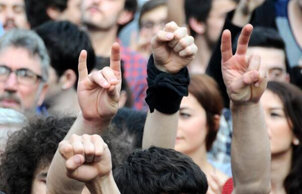
Protesters have accused Erdogan, who has been in power for a decade, of taking Turkey down the road of authoritarian and Islamist rule. Erdogan, who has triumphed with wide electoral majorities, has dismissed the protesters as militants and losers.
After night fell, his security forces put these words into force. They used bulldozers to clear out Gezi Park, which had become a symbol of the resistance in recent days. They chased protesters and beat them down with clubs, and they shot tear gas into cafes and hotels as the people fled. Doctors who treated the wounded were arrested.
President Erdogan may mount pro-government demonstrations, but he has a way to go with regard to quelling anti-government unrest, and to judge both by the article in Spiegal Online and the balanced footage above, he’s inclined to do it with the heavy hand of a dictator.
The orchestration of his own AKP pro-government demonstration, which included busing fans to the location, while at the same time suppressing Taksim Square activity by clearing the streets with force and closing routes into the city reflects well the autocrat’s want to control without a lot of back and forth in the conference room or negotiating table.
Add:
Deflection of responsibility for his state’s spontaneous demonstrations to foreign influence (of some kind) and the international press;
Detention of lawyers sympathetic with demonstrators and the alleged arrests of doctors — that detail seems to be in the news today — attending those injured by government forces.
If preventing attention to the injured is a part of the governing ethic “over there”, that too speaks of the barbarian within and a reigning mentality not much different than that which has made a mess of Damascus. The process doesn’t change: the greater and more extensive the repression, the more amplified the resentments and, when those surface, the response.
Describing Erdogan’s government as “despotic,” two main union blocs say they plan to march to Istanbul’s Taksim Square, which has been at the heart of more than two weeks of protests. It is the second time unions have called a strike to support the protest movement.
Erdogan inveighed against the international media, blaming the BBC and CNN for distorting the drama of the past three weeks in what he repeatedly alleged was an international plot to divide and diminish Turkey.
“You will make your voice heard so anyone conspiring against Turkey will shiver,” he told the crowd. “Turkey is not a country that international media can play games on.”
Using language that belittled the protesters as disrespectful and irrelevant, Erdogan appeared to point the finger of blame at everyone except himself and his ruling Justice and Development Party (AKP), citing instead the party’s economic triumphs and democratic reforms.
While the title includes the term “video”, when I viewed the piece at about 9:17 a.m. EDT, there was none.
Political cartooning has gotten an update in recent years (or days, considering the pace of media technology development and its broad distribution. I thought this piece catchy (yes, I am chatyping like the old man I’ve become here) and while it doesn’t reflect my thoughts, which are so much more sober, the presentation would seem part of the zeitgeist of a dawning political era.

 BackChannels