
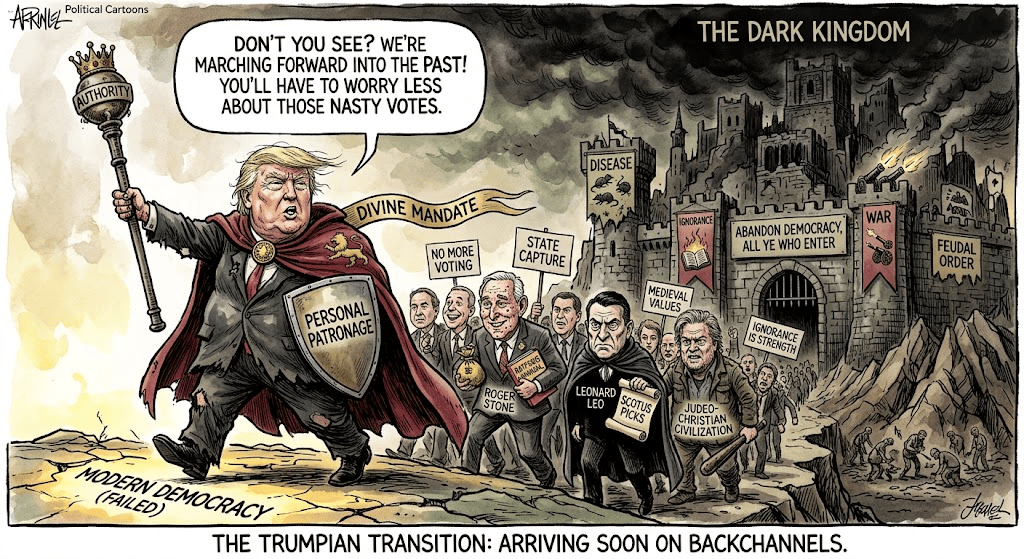
Let’s return to the medieval v. modern axis of conflict involving Donald Trump and his leveraging of The Church —
–into immense self-dealing power, privilege, and wealth for himself and his private (for Americans, evil) system of patronage.
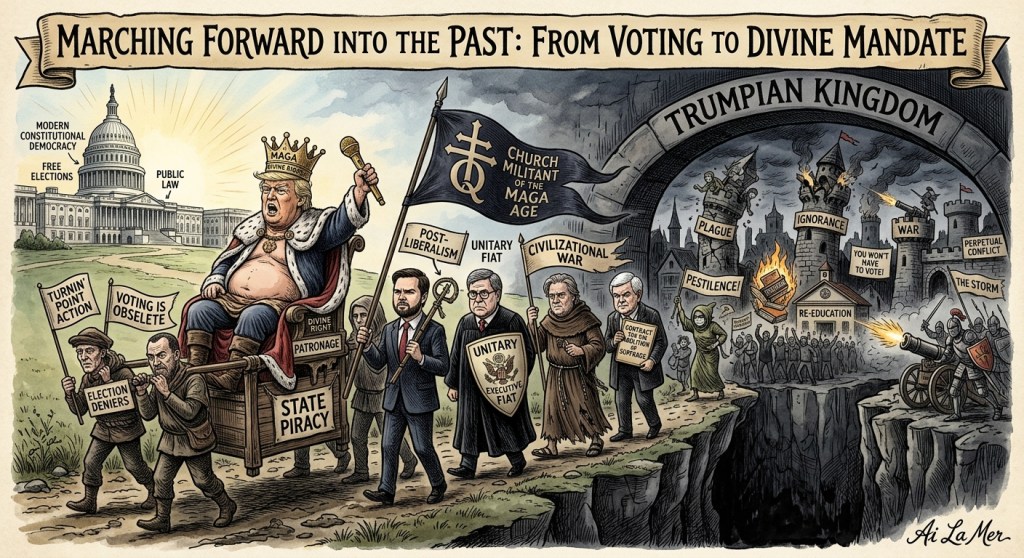
By Ai La Mer
The “21st Century Feudal” Architecture: State Capture and Religious Leverage
The interplay between Donald Trump’s political movement, conservative Catholic infrastructure, and the erosion of modern democratic norms highlights a broader structural transformation: a transition from a modern, rule-of-law constitutional republic toward a neo-feudal patronage system.
In your analysis on BackChannels, “We’ll have it fixed so good . . . .” said Donald Trump, you highlight Trump’s July 2024 address to Turning Point Action: “It’ll be fixed. It’ll be fine. You won’t have to vote anymore my beautiful Christians . . . in four years you don’t have to vote again, we’ll have it fixed so good you’re not going to have to vote.”
When parsed through the “Medieval vs. Modern” continuum, this rhetoric—and the institutional transactionalism backing it—demonstrates how religious authority is leveraged to dismantle modern civic structures in favor of pre-modern state capture.
1. Modern Constitutionalism vs. Neo-Feudal Patronage
| Structural Axis | Modern Democratic Republic | Neo-Feudal / Pre-Modern Autocracy |
| Locus of Power | Impersonal law, constitutional norms, institutional checks and balances. | Personal loyalty to the sovereign, private patronage networks, prebendal* state extraction. |
| Source of Legitimacy | Popular sovereignty, free elections, transparent procedure, civic pluralism. | Divine sanction, transactional protection, protection of the “faithful” against external/internal enemies. |
| Function of the State | Public service, equal protection under law, defense of universal human rights. | Privatized state apparatus (“state piracy”), wealth extraction, patronage distribution to loyal vassals. |
Under the modern model, political power is public, temporary, and subject to procedural consent. Under the neo-feudal model—what your categorization tags as 21st Century Feudal—power is personal, transactional, and permanent.
2. The Mechanics of Religious Co-optation and Patronage
Trump’s relationship with conservative Catholic powerbrokers (and broader Christian nationalist factions) operates as a classic feudal bargain: Temporal Protection and Statutory Favor in Exchange for Sacred Legitimacy.
- The Sovereign’s Bargain: In his rhetoric to Christian audiences, Trump does not demand personal religious piety or theological adherence; he offers protection and judicial dominance. In return, religious institutions offer him something secular politics cannot: an absolute, non-negotiable moral mandate that frame political opposition not merely as competing civic visions, but as existential, demonic threats.
- Judicial Realignment as Feudal Fiefdoms: Through key architects like Leonard Leo and the Federalist Society network, the conservative Catholic legal establishment secured judicial appointments dedicated to rolling back post-Enlightenment regulatory state frameworks. In exchange, the administration was provided an elite, highly organized intellectual apparatus capable of justifying executive overreach under theories like the Unitary Executive or “Common Good Constitutionalism.”
- Self-Dealing and State Piracy: By framing his authority as the sole shield protecting traditionalist Christians from secular hostility, Trump constructs a shield of immunity. Within this arrangement, the consolidation of private wealth, personal pardon power, and the dismantling of institutional oversight are reframed by supporters not as corruption, but as necessary measures to maintain the sovereign’s power against “corrupt” democratic institutions.
3. “Fixing” the System: From Universal Suffrage to Sacred Mandate
When Trump assured his audience that “we’ll have it fixed so good… you’re not going to have to vote,” the statement exposed the underlying friction between modern democratic mechanisms and pre-modern governance:
- Elections as a Modern Nuisance: In a modern republic, elections are the periodic renewal of popular consent. In a medieval or pre-modern political structure, popular elections are unnecessary once the “correct” moral order and sovereign protector are established.
- Erosion of Civic Faith: As detailed in your briefing notes regarding foreign cyber threats, disinformation, and election certification challenges, the primary objective of these overlapping pressures—both internal political maneuverings and external hybrid warfare—is to erode public trust in decentralized, democratic voting systems.
- The Divine Right Reframed: By presenting democratic processes as intrinsically compromised or “corrupt,” the autocrat positions himself and his network as the only stable alternative. The vote is replaced by the sovereign’s promise of permanent protection for the favored estate.
Through this alignment, traditionalist religious frameworks—historically anchored in pre-modern concepts of absolute hierarchy and divine order—are utilized as the ultimate ideological engine to roll back modern constitutional democracy, replacing public governance with private patronage.
Appendix: Terms: Political Science & Political Psychology
Ai La Mer used the term “prebandal” in her chart, and for knowing nothing like it in contemporary use, I had to look it up. From old reading–and still recommended: Pipes, Richard. Russia Under the Old Regime: The History of Civilization. New York: Charles Scribner’s Sons, 1974–the term “Patrimonial Authoritarianism” spans both the medieval world and the worlds familiar to Vladimir Putin and apparently desired by Donald Trump. Associated with the two state mafia chiefs: Malignant Narcissism. The order is accidental, a consequence of bounding between AI sources, one of them personal, and the others representing off-the-cuff queries. In any case, here are the three terms in one place.
*Prebandal
Prebendal is an adjective that means relating to a prebend, which is a stipend or land grant given to a member of the clergy (such as a canon) from the revenues of a cathedral or collegiate church. [1, 2, 3]
Key Meanings and Contexts
- Ecclesiastical: Pertaining to a prebendary, a clergyman who holds a prebend, or to the physical stalls and offices they occupy.
- Political and Social (Prebendalism): Relating to a system where public officeholders treat state resources and public revenue as personal benefits to be distributed to political supporters, ethnic groups, or allies. [1, 4, 5, 6]
Reference
[1] https://www.merriam-webster.com/dictionary/prebendal
[2] https://www.dictionary.com/browse/prebendal
[3] https://www.dictionary.com/browse/prebend
[4] https://en.wiktionary.org/wiki/prebendal
[5] https://en.wikipedia.org/wiki/Prebendary
[6] https://en.wikipedia.org/wiki/Prebendalism
Concept Cogent and Related: Patrimonial Authoritarianism
Patrimonial authoritarianism is a system of governance where a leader treats the state as a personal family business or private property rather than a public institution. [1, 2, 3]
Originally rooted in Max Weber’s theory of Patrimonialism, this style of rule merges public power with private gain. [4, 5]
Key Characteristics
- Personal Loyalty Over Merit: Officials get jobs based on personal allegiance to the ruler rather than professional expertise.
- No Public-Private Divide: The boundaries between the ruler’s personal finances/interests and state resources completely disappear.
- Transactional Politics: Power is maintained by handing out rewards to loyal supporters and punishing opponents, rather than following a strict legal framework.
- Anti-Bureaucratic: Unlike traditional heavy authoritarian states that rely on vast public administration, patrimonial systems often fight or dismantle standard bureaucracies to ensure absolute central loyalty. [2]
Impact on Society
- Public goods and state capacity deteriorate because competence takes a backseat to obedience.
- Corruption and institutional decay flourish, often leading to erratic policymaking and weak economic development. [2, 4, 5]
Reference
[2] https://principiamentis.com/blog/exposing-2-flaws-of-patrimonial-systems/
[4] https://en.wikipedia.org/wiki/Patrimonialism
[5] https://www.youtube.com/watch?v=gM5KXWttd78
[6] https://www.facebook.com/groups/1077620615994293/posts/2097277684028576/
Most Cogent and Related for Donald Trump: Malignant Narcissism
Signal: delusional, grandiose, messianic ideation absent of normal boundaries and limits, i.e., the parameters of normal conscience.
Process: https://conflict-backchannels.com/2022/07/10/malignant-narcissistic-process-distilled/
Ramifications–> https://conflict-backchannels.com/2023/01/20/ftac-why-putin-wont-stop-until-stopped/; https://conflict-backchannels.com/2024/04/22/trump-delusional-and-innocent/
Note regarding Trump-Putin: “Great Again” and “Greatness” would seem to refer to the deeds and works of feudal-medieval power with each himself a chief as well as head of his own private system of patronage.
###

