In the bloody theatrical production that has been “Assad OR The Terrorists” — and guess who’s responsible for casting “The Terrorists”? — Russia and Syria, who have ejected the terrorists from Palmyra, have turned to assert the values of their feudal aristocracies against the barbarism of their foes. http://www.nytimes.com/…/syria-russia-palmyra-isis…
While classical music may set the tone of a better deal, the larger picture sustains political absolute power over “the masses”, an affront and challenge to the democratic and deeply humanist character of those the Russian Federation has chosen to label as its enemies.
***
Posted to YouTube May 5, 2016.
If the reader has no memory, then the reader may obtain one of two possible impressions: civilization, as represented by the symphony, is “winning” in Syria; civilization, as represented by the aftermath of an air strike against a refugee camp, is losing in Syria, and only barbarism is winning across that godforsaken land.
The truth has finer points.
In recent weeks, despite Russia’s promised pullback from Syria, Russia has instead strengthened its presence in the embattled state.
By strengthening Moscow’s hand in Syria, Putin may be firming up Assad’s perception of Syria as a Russian client state after all. As argued repeatedly on this blog, the true axis appears to be “Moscow-Tehran” and the purpose of it the sustaining of feudal absolute power enabling both imperial ambitions and further unrestrained kleptocracy.
Perhaps symphonies play louder than murder in so many state-controlled presses, but in the Open Source Environment, the same may be juxtaposed in a timely manner with the slaughter of noncombatants that would appear to secure their stay in service to the feudal aristocracies that appreciate them.
Also, the upgraded Russian military and political presence in Syria may leverage Washington into compromising with Moscow over Damascus in the control of situation. Given the horrors of the “Syrian Tragedy”, the ancillary humanitarian and political fallout that coalesces around refugee camps and mass migration, western resistance to the feudal program(s) on display may stand diminished and neither Moscow nor Tehran changed very much if at all.
The revelations come from new letters added to the 22,000 internal ISIS documents Sky News leaked in March. Before the Syrian troops regained control of the ancient city of Palmyra earlier this year, the Syrian government arranged a deal to allow ISIS to “withdraw all heavy artillery and anti-aircraft machine guns from in and around Palmyra to [the] Raqqa province.
On Corroborating Stories — Multiple Independent Sources
Tweet: “Putin, Assad, Khamenei — Together They Are Defending Absolute Power.”
Add Baghdadi.
BackChannels has been supporting the idea that malign and medieval leaders work together, whether directly or indirectly makes no difference, in supporting the feudal image and theater that in turn justifies they stay in political absolute power. As evidence mounts as regards the incubation of al-Qaeda-type forces and ISIS through the selective bombing of other targets, and as new reportage surfaces with news of collusion between Russian air power and ISIS ground forces, it starts to look like BackChannels got it right in the first place. From the above cited Daily Caller piece: “ISIS gets a detailed warning of when a strike is scheduled to take place, which allows it to withdraw to an agreed evacuation point.”
Anatoliy Golitsyn, a high-ranking KGB defector who served in the KGB’s ultra secretive long-range disinformation Department D, explained in his book New Lies For Old (1984) the then-Soviet Union’s reason for sponsoring terrorism:
The objective of violence is to create chaos and anarchy, to impose additional strains on ruling democratic parties, to eliminate their ablest leaders, to force them to resort to undemocratic measures, and to demonstrate to the public their inability to maintain law and order, leaving the field open to the legal communist party to present itself as the only effective alternative force.
“An extensive spy network has been set up inside Islamic State,” Kadyrov’s office quoted him on Monday as telling Russia’s state-controlled Russia 1 channel.
“Thanks to their work as agents the Russian air force is successfully destroying terrorist bases in Syria.”
Based on extensive fieldwork in one village in the North Caucasus, reporter Elena Milashina has concluded that the “Russian special services have controlled” the flow of jihadists into Syria, where they have lately joined up not only with ISIS but other radical Islamist factions.
While the Kremlin channels jihadis to ISIS, it may also embed spies, so it rids itself of at least a few potential terrorists — or thousands of them — in Russia and sets them up in easily targeted (because it may have also sent in spies) “kill zones” in Syria. Politically, it can promote, vicariously, say, the symphony while “barrel bombing” noncombatant Syrians while making its case for “Assad OR The Terrorists”, and through the Baathist generals who have become ISIS generals, it can display a convenient foil for Khamenei’s Revolutionary Guard, reported as embedded in the more “fiery” Shiite militia, for Tehran’s expansion of influence in Iraq. By doing all of the above, which I believe it has, the familiar post-Soviet axis has reproduced the image of the feudal world that each despotic leader needs to remain legitimate (in the eyes of their followers) in power.
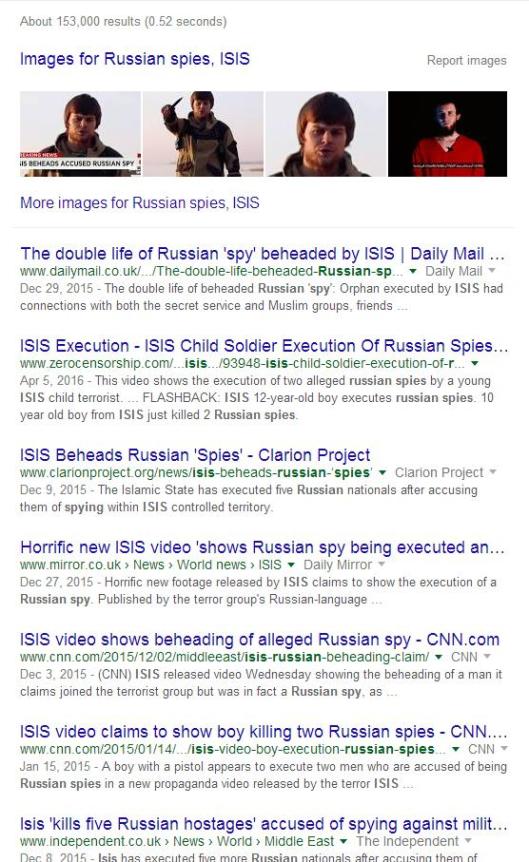
Reports of ISIS beheading Russian spies surfaced in several news reports in December 2015, and similar reportage continued into April 2016.
Apparently, Russian spies inserted into ISIS may have both signaled ISIS positions to Russian air power as well as warned ISIS troops of impending strikes.
Of BackChannels’ several inventions in political psychology, the “Paranoid Delusional Narcissistic Reflection of Motivation” might apply best to President Putin’s way of looking at western liberalism, developing cause to consider it threatening, and then, at last, accusing the west of possessing his own true motives as regards political control through disinformation, force, and manipulation.
For history, start with Czar Nicholas III’s “Okhrana“, the political secret police tasked with influencing and shaping the Czar’s own opposition — Ayatollah or Emperor, why not play both sides of the chessboard? The political theater is either yours or it’s not — prove it’s yours: put on a play; give the opposition its head; slip it a script; settle back and enjoy the show.
Of course, there’s more to the story of Russia’s romance with autocracy, state-controlled information and the perversions that are disinformation and propaganda, and secret political police. What follows on this post is an afternoon’s brief compilation of articles pertinent to the challenge posed today by Putin’s approach to throwing the wool over so many eyes, including, possibly, his own.
In general, the Russian media portrays anything going on from the point of view of Vladimir Putin. He has unlimited access to the media and they explain everything that’s going on according to his official statement. It doesn’t really matter if it’s a war in Syria or any other topic.
Russia today is the first intelligence dictatorship in history. It is a brand new form of totalitarianism, which we are not yet familiar with. Now the KGB, rechristened FSB, is openly running Russia.
BackChannels also possesses in its library a small “Russian Section” that boasts many volumes on the Russian experience in the 20th Century, on the Soviet, and on the transition from the Soviet to “Putin’s Kleptocracy”.
When the Soviet Union collapsed, its people had a unique opportunity to also cast off the country’s political police, that peculiarly Russian instrument of power created by the 16th century’s Ivan the Terrible, which had changed its name many times, from Okhrana to Cheka, to GPU, to OGPU, to NKVD, to NKGB, to MGB, to MVD, to KGB. Unfortunately, the Russian people were not yet ready — or able — to seize that opportunity.
The international community faces serious challenges arising from a new mode of information warfare, which Russia has deployed during the Russian-Ukrainian conflict in 2014-2015. This ongoing “propaganda war” is the most recent and frightening example of information warfare. It reflects the wide array of non-military tools used to exert pressure and influence the behaviour of countries. When skilfully combined, disinformation, malicious attacks on large-scale information and communication systems, psychological pressure, can be even more dangerous than traditional weapon systems, since they are extremely difficult to discover and combat.
The Kremlin’s disinformation campaign goes far beyond controlling its own media. It is aimed at nothing less than presenting a parallel version of reality and disseminating it as if it were news. The Kremlin’s goal is to make people question the value of media at all; to reject the idea of an absolute truth; and to persuade the public that “reality” is relative.
If someone—some lost, ersatz-port-begotten ghost—materializing before me at that moment, had told me that, thirty years later, I would be writing about Andropov’s death in English, in America, on the week when post-Soviet Russia’s ruling class—made up, to a considerable extent, of the old K.G.B. cadre—would be celebrating the hundredth anniversary of his birth with a large exhibit dedicated to his life, at whose opening a glowing telegram from his spiritual successor, President Vladimir Putin, would be read—well, I would have known for certain that I had finally and irrevocably, once and for all, lost my mind.
As a former KGB officer and head of the KGB’s successor agency, the FSB, Putin knows the value of information. His concept of the media, however, is a far cry from the First Amendment. For him, it’s a simple transactional equation: Whoever owns the media controls what it says.
“There should be patriotically minded people at the head of state information resources,” Putin told reporters at his 2013 annual news conference, “people who uphold the interests of the Russian Federation. These are state resources. That is the way it is going to be.”
Disinformation is always a conscious policy and part of a larger policy agenda. It is not simply dishonesty of this or that official in response to a particular event. It is implemented with a clear understanding that a combination of truth and falsehood is useful and effective. And it is pursued as long as it is effective, being sacrificed only when there are reasons to believe that either it is no longer necessary or it is no longer being accepted. All of those things have characterized Putin’s approach to information about Ukraine, a pattern that makes what Moscow is doing all the more disturbing.
Wikipedia. “Okhrana”. The following comes from the “Pre-1905” section of the Wikipedia entry:
While P.I. Rachkovsky, as head of the Okhrana’s Foreign Agency, had long ordered Okhrana agents to infiltrate and influence revolutionary movements abroad, Zubatov brought these tactics to a new level by creating Okhrana-controlled trade unions, the foundation of police socialism.
Oil has nothing to do with the Syrian Tragedy. The primary “driver” is the medieval political absolutism exploited and sustained by Putin, Assad, and Khamenei, each of whom relies on feudalism to keep themselves in business.
Note that Putin put $52 billion into the Winter Olympics at Sochi. What Putin has put into Syrian humanitarian aid: $0.00.
Obvious pacifism in the Obama Administration has been balanced some by weakening Putin’s own ability to prosecute his chosen enemies across time and in intensity. The in-and-out demonstration of power in Syria may reflect that reality, although the show worked well in Moscow. The stalling of the incursion into Ukraine through Crimea also attests to the Russian Federation’s underlying fragility. However, Russia remains a nuclear power, a newly militarized (revived in that aspect) and nationalist state, and a little unpredictable. It may be for that reason that “diplomacy” rather than “confrontation” has so far defined the western limits of engagement in Syria.
No one knows today how it will end, but I believe the west may look back on this period with immense shame for not having done more to block “Moscow, Damascus, Tehran” while pulling Syria — and Syrians — out of the medieval mode and into a modern politics. Results of related efforts on the battlefield appear to me to have been mixed, although one may credit Assad with the incubation of ISIS through the election to bomb other targets and leave Baghdadi’s enterprise to develop.
The themes are now tangled but still coalesce around “medieval vs modern”.
What is “medieval” now?
And what is modern?
Although BackChannels has frequently paired “medieval” with “absolute power” — and as much seems so — it may be more worthwhile at this point to travel into the 21st Century image of deeply medieval political worlds.
BackChannels readers will get to Riyadh, but let’s start with Moscow.
I have used the term in my own work, as well, and I define sistema as a style of exercising power that turns the country’s people into temporary operating resources, against their wills and in breach of their rights. Sistema is a deep-seated facet of Russian culture that goes beyond politics and ideology, and it will persist long after Putin’s rule has ended. Sistema combines the idea that the state should enjoy unlimited access to all national resources, public or private, with a kind of permanent state of emergency in which every level of society — businesses, social and ethnic groups, powerful clans, and even criminal gangs — is drafted into solving what the Kremlin labels “urgent state problems.” Under Putin, sistema has become a method for making deals among businesses, powerful players, and the people. Business has not taken over the state, nor vice versa; the two have merged in a union of total and seamless corruption.
Q: What are the roots of Putin’s ideological worldview?
A: By the beginning of the 1990s Putin had developed almost all the ideas he espouses today. He’d only just started working in St Petersburg, but if we look at documentary recordings of the time, we see that he already had a whole series of attitudes concerning, for example, the idea that Russia’s system of administration should be a unitarian, centralized state, and also his condoning the chinovniki [bureaucrats] taking bribes. That surprised many people, but it’s undeniable that he took a positive view of this. He even shared—and repeated—the scandalous thesis of the then mayor of Moscow, Gavril Popov, that bureaucrats had the right to a commission on contracts.
And here’s an image from the modern world according to Andy of Mayberry:
Posted to YouTube May 22, 2012.
The “Syrian Tragedy” — I don’t know what else to call it, for it represents in its various facets a bitter revolution, a (medieval) tyrant’s assertions about a family’s outright control and ownership of a state, a civil war but one complicated by multiple sides and the political “flavors” preferred — conveniently, earnestly, momentarily — by the roving bands of the hours — but it is most certainly the result of a consecrated villainy fit to the absence of conscience and the bloody caprice of the worst of kings and emperors of history.
Once tweeted: “Putin, Assad, Khamenei — together they are defending absolute power.”
Pavlosky, in the Foreign Affairs article cited, notes of Putin’s inner circle, “Transformed from a campaign committee into a presidential entourage, the team has changed only marginally in its composition. These are people who have never once told Putin, “You can’t do that” (p. 12).
In light of that observation, it might be worth taking another look at Andy and Opie and the difference between a quarter earned and three “just because”.
The university campus is becoming increasingly hostile to both Jews and Israel. From what I have witnessed and experienced, it is no side effect, but rather part of a deliberate and well-planned strategy. We are witnessing an entry operation.
Arab-American college radicals such as Jess Ghannam (a professor of psychiatry today at UC San Francisco), Zahi Damuni ( a biochemist, formerly of St. James University in Canada), and Mazen Qumsiyeh (a geneticist from Yale, fired for anti-Semitic emails), some of whom were born in the West Bank, went on to graduate university and with their professional incomes started the group Al Awda (Arabic for “the Return”), an organization set up to promote PLO and later Hamas goals against Israel’s existence.
During this time, Al Qaeda was also founded by a Palestinian named Abdullah Azzam, the mentor for Osama Bin Laden. This was the Muslim jihadist link behind the BDS Movement to this day.
Today, the leadership of Al Awda helps promote BDS along with myriad other groups and clubs that have sprung up to promote starving out the Jews in the Middle East and, by extension, linking to the worldwide jihad. Al Awda is still very active in the USA and in promoting BDS.
BDS was launched in Israel in 2005 by Palestinian Jamal Juma and later Omar Barghouti, an Arab student from Kuwait attending Tel Aviv University helped to specifically launch the academic boycott in Israel and worldwide with the help of Jess Ghannam, Manzar Foroohar (an Iranian Muslim) and some other Arab professors in the USA in 2007 that comprised a steering committee.
Lee Kaplan, who has made a career of investigating the International Solidarity Movement (in BackChannels’ opinion, too many themes lead back to Moscow, Soviet Era and Feudal Revanch), has produced a sprawling tour de force in investigative journalism, videos included, as regards connections between Islamist movements and the BDS Movement. It’s difficult reading for the wall of verbage presented to the eyes online, but, for the patient, it’s rich with BDS Movement links back to the history of Palestinian terrorism, and it affords insight into the greater politics leading into the progressive circles that unwittingly — or, if otherwise, less innocently — sustain suffering throughout the middle east.
There are differences in how different scriptures work and (!) how they may be leveraged into religious or secular autocratic power.
I’m the editor of the blog cited, and for the idea that more human misery has to do with the character of leaders and their followers than with related artifacts — books, legends, poems, songs, etc. — I’ve used for dictators the phrase, “Different talks — same walk.”
In general, most people don’t like the “walk” — or strut — laid down by a strongman, but for the medieval of mind, the crowds or “masses” matter much less than relationships with similar powerful persons, their own inner circles in business, military, and paramilitary communities, and then the constituencies that have bought in with them. Out of that complex political community come the “evildoers” and those leveraged to cooperate with them.
“Different talks — same walk.”
The latest in polling has given us the “94 percent” figure: what is different then about the six percent who would endorse the violence against innocents that may be delivered with the cry “Allahu akbar”?
I think the true immediate axis in global conflict is that between medieval and modern conceptions of man and related concentrations or distributions of power in those who govern. How absolutely powerful a tyrant is compared to the leader constrained by institutional powers greater than himself.
Chatyping in social media dredges up a host of ideas familiar to BackChannels readers, not least among them the idea that a kind of personality produces for itself a political environment suited to its need for control of the surrounding world — and that to the point where it may mete out suffering to others with impunity. Such power proves always deeply destructive and sadistic.
It’s best to catch it at the gates — in the truly functioning democracies, at the polls — but even then the popular will may invest in an egregious choice.
Addendum – April 16, 2016
Regarding narcissism, which may be malignant or reparative in its balance, one possible trigger for the malignant — those who seek absolute power over others and in the process lose their brakes (or “exceed limits”), an instance or pattern of “narcissistic mortification” may set off attempts at covering (hiding) and repair that lead to the barking, as it were, and the rejection of criticism.
The reinvention of the self that follows may include a verbal part that then serves to aggrandize, elevate, empower the narcissist, and when it gets going as a kind of cycle and dare, then develops the business that is a cult at the lowest level and a dictatorship at the highest.
______
One may infer such a development between Jim Jones, the mass murder by Kool-Aid guy, and Bashar al-Assad, the mass murderer by way of whatever means have happened to be at hand, but not find the incident or period of mortification as that resides in the narcissist’s memory.
Writing about Russia can be like that: Focus on a crime, follow it into more general corruption, arrive at the “mafia state”; overview energy and economics, move on to “hybrid warfare” and other aggressive military and paramilitary activities, and it dawns that there is an imperial state at work; have a glance at history, then get the nose out of the books and have a look around at present Putin & Co. relationships, disinformation, domestic information control, and global propaganda.
What may be most dangerous about Russia today is the slowly developing surround in alliance and axis accompanied by the seduction of the popular mind (in Soviet-speak, “the masses”) by way of the promotion of confusion.
For its part, this blog has pressed the idea that defending Putinism, much less spreading it, devolves to sustaining a deeply feudal-medieval worldview that in turn undergirds the power of state elites: the “New Nobility” that is the FSB; the “Vertical of Power” that is this most singular Russian President around whom other elements revolve; the Oligarchs that produce and enjoy the state’s wealth, albeit with a nod to the permit provided by their political mastermind.
With numerous stolons — plant-generated surface and underground runners that propagate some of the species that use them — the Moscow hub appears to support an immense array of illicit and licit relationships.
Here’s a nugget pulled from the illicit bin, which, of course, is the one that most bothers the west:
The leaked files suggest that Roldugin is not keeping this wealth for himself, but is funneling the money to Putin’s inner circle, the reports say. Although Putin is not mentioned in the documents, he appears to be at the center of a web of Russia’s most influential and powerful men who owe their posts and fortunes to nothing but their friendship and association with him.
“It’s possible Roldugin, who has publicly claimed not to be a businessman, is not the true beneficiary of these riches,” the International Consortium of Investigative Journalists wrote. “Instead, the evidence in the files suggests Roldugin is acting as a front man for a network of Putin loyalists — and perhaps for Putin himself” (Mirovalev, LAT, April 4, 2016).
How deep go these relationships?
How many are there?
Can you see the tree? The trees? The forest?
The blight?
The Syrian Tragedy, as BackChannels refers to that horrific process in which it appears Damascus with tacit approval from Moscow and Tehran pursued a course certain to produce “The Terrorists” by preferentially bombing more moderate Free Syrian Army forces and refraining from curbing the early development of al-Nusra and ISIL, needs no introduction: the human spillover is either encamped or migrating all over the Middle East and Europe.
Posted to YouTube April 14, 2016.
Moscow, however, has been also busy from the Baltic Sea (as depicted in the above naval incident) to the Black Sea. Crimea and Ukraine, Lithuania, and Moldova, among others moan with the impositions or threats posed by the phantom of the Soviet alive within the Russian Federation.
Given Moldova’s limited economic potential, the country struggles to maintain its defense capabilities. It only allocates 0.3% of its GDP for military purposes, which amounts to about 25 million dollars per year. Furthermore, Moldova presents limited interest to the West. Its strategic and economic importance is negligible. To make things worse, Moldova is highly dependent on Russian energy supplies, export and labor markets. Russian media control a significant share of Moldova’s informational space. Finally, Kremlin has been instrumental in using Russian speaking minorities in Moldova to advocate interest that often go against the will of the majority of the local population.
Whatever the Soviet was thinking — arms sales? Expansion of forced influence? — it sure wasn’t thinking about the lives and needs of either either Ethiopians or Somalis. In effect, in the promotion of the Ogaden War, The Bear wrapped an arm around the Somali leadership and offered to help the same acquire a fair patch of earth as redress for earlier grievance — and then with that accomplished, it did the same on the other side.
What works, unfortunately, works.
If you now see the Ogaden in history — you have seen one tree.
Nothing has changed: now as then, one may wonder at the character and mentality of the post-Soviet neo-imperial Russian leadership, the same that has treated Russia as it has other states: create chaos and danger, drown the masses in propaganda (ah, those good old Party days are here again!), and for power — and the protection of so many money making enterprises, licit and illicit — promise the super nationalist’s version of greatness, security, and stability.
Note: Putin-Erdogan — politically opposed (there’s that Shiite vs Sunni thing + NATO) but psychologically aligned (and Erdogan has the White Palace to prove it).
This blog’s editor got off on a little bit of a roll this morning, but will ease off on pontification. 🙂
The challenge is setting off and managing a transition from the medieval mode in governance toward modern features.
Europe itself continues to support at least a dozen monarchies, and they would be no different as centers of power and sources of patronage than the Saudi Kingdom or the Islamic Republic of Iran were it not for the leveraging of power out of exclusive hands.
Much of the world contesting the authority of the west (basically: Russia vs NATO) has either to press forward with “political absolutism” or turn toward “classical liberalism”. In Moscow, Putin has chosen a feudal, neo-imperial course. In Riyadh, such a luminary as Prince Al-Waleed has found ways to blend — at least for himself and those to whom he extends patronage — the best of both worlds.
What Moscow, again using that proper noun to represent Putin, the “New Nobility” (FSB), and the Oligarchs, appears to want is greater chaos in the world to which it then may respond as a provider of greater stability!
Moscow plays a deeply manipulating script over and over and over.
Let’s try this Matryoshka doll method of nesting from the larger to the smaller:
Moscow vs NATO
Tehran vs Riyadh (Shiite vs Sunni Islam)
Damascus vs Split Proto-Democratic | Proto-islamist Forces
Hamas | Hezbollah vs Tel Aviv
From the big conflict-containing political doll down to the smallest:
Medieval Autocratic Power vs Modern Distributed Power
From my desktop experience and perspective, the principle as regards the architecture of the most notable “conflict set” — we should stop calling it “East vs West” at this point — doesn’t change.
Moscow appears to want a world of vast feudal estates managed by “strongmen”.
Washington may appreciate and produce wealth fit for kings, but its system prefers the presence of a meaningful electorate, then politicians, then the Chief Administrator we call a President, lesser administrators, and then appointed judges, all of its political machinery governed by a stable Constitution and a host of legal codes upheld from township to Federal region.
That’s the “different kind of war” seen from the BackChannels’ desktop. It has great stability — “Medieval Autocratic Power vs Modern Distributed Power” — but also some variance within (and the Rolling Stones have conquered only popular Cuba).
In that parenthesis is another conflict that involves the discrepancy between the rule of the strong (anywhere) and the popular will (anywhere). Although both Moscow and Washington — and all the others — support vast internal security campuses, the differences may be at least superficially marked (e.g., KGB/FSB vs FBI / CIA / U.S. Homeland Security) but with depth immediately beyond this blog’s interest, reach, and scope.
As regards the binary “Medieval vs Modern”, change on the side of the good — universally compassionate and reparative — involves myriad elements in transition. Perhaps when President Obama has counseled patience or refused to demonize Islam in its totality — a common complaint from the extreme wings of western nationalists — it has been to both compel but manage a global and gradual political greening. Whether the Administration has done far too little at a mosey may be subject for another post.
 BackChannels