• Home
  • About
  • Concepts, Coins, and Terms
    • Anthropolitical Psychology
      • Civilizational Narcissism
      • Conflict – Language Uptake – Social Programming and Scripting – A Suggestion
        • Language Uptake – Programming – On Learning to Listen
        • Mouth –> Ear –> Mind –> Heart System
        • Social Grammar
      • Facsimile Bipolar Political Sociopathy
      • Malignant Narcissism
      • Narcissistic Scripting
      • Normative Remirroring
      • Paranoid Delusional Narcissistic Reflection of Motivation
    • FTAC – “From The Awesome Conversation”
    • God Mob
    • Intellectual Battlespace
    • Islamic Small Wars
    • New Old Now Old Far Out and Lost Left
    • Political Spychology
    • Shimmer
  • Library
    • About Language
    • Russian Section
  • Comments and Contact

BackChannels

~ Conflict, Culture, Language, Psychology

BackChannels

Category Archives: Books

Books: Arkady Polishchuk’s _Dancing on Thin Ice_ Due Out July 3, 2018

14 Monday May 2018

Posted by commart in 21st Century Feudal, Books, Political Psychology, Russia

≈ Leave a comment

Tags

Arkady Polishchuk, Christian persecution, Communism, Dancing on Thin Ice, disinformation, Soviet Era, totalitarianism

From the publisher’s promotion:

In this memoir, replete with Jewish humor and sardonic Russian irony, exiled Russian journalist and human rights advocate Arkady Polishchuk colorfully narrates his evolution as a dissenter and his work on behalf of persecuted Christians in 1970s Soviet Russia. Told primarily through dialog, this thrilling account puts the reader in the middle of a critical time in history, when thousands of people who had been denied emigration drew international attention while suffering human rights abuses, staged show trials, forced labor, and constant surveillance.

From 1950–1973, Polishchuk worked as a journalist for Russian state-run media and as an editor at Asia and Africa Today, where all foreign correspondents were KGB operatives using their cover jobs to meddle in international affairs. His close understanding of Russian propaganda makes this memoir especially eye-opening for American readers in today’s political climate.

https://doppelhouse.com/dancing-on-thin-ice/

–33–

Guest Post by Mitchell Gray: Reflection on _L’Etranger_, by Albert Camus

11 Sunday Feb 2018

Posted by commart in 21st Century Feudal, Books, Conflict - Culture - Language - Psychology, International Development, Islamic Small Wars

≈ Leave a comment

Tags

Algiers, book review, Camus, commentary, Mitchell Gray, review, The Stranger

Camus-CVR-TheStranger.jpg

Every US military leader ought to study the Algerian War of Independence from 1954 to 1962. The problems in Indo-China and Southwest Asia could have been reduced. Here was insurgency, terrorism, asymmetric warfare and the “eastern” method of warfare.

This novel was published in 1942 and is set in Algeria, a French colony since the 1830’s. France encouraged French citizens to colonize in Algeria and France also brought Algerians to France.

Camus won a Nobel Prize for literature for The Stranger in 1957 during the uprisings.

The end of WWI in 1918 ushered in a wave of anti-colonialism and this included Algeria. Independence was craved.

The novel focuses on the “antihero” Mersault who is a simple man who impulsively shoots and kills a nameless Arab on a beach on a blinding day. He is tried for murder.
After WWII France was very weak and began to lose contested colonies such as in Southeast Asia. The Front de Liberación Nationale (FLN) in Algeria spearheaded the fight and brutalities occurred on both sides as the French resisted independence.

The “absurdity” (Camus rejected that he was an Existentialist) of the trial was that Meurault was depicted by the prosecutor as “uncaring” or indifferent towards his dying mother. The outrage was not that he murdered an Arab but that he was not an appropriate son. That was his real crime.

Finally, in 1962 Algeria achieved independence and hundreds of thousands had been butchered. The fighting was extreme violence and cruelty. Hatreds fueled the inhumanity.
Critics point out the Arab victim was never named nor developed by Camus. This was seen as the French snobbery towards the native Arabs.

Algeria suffered an extremely brutal and cruel civil war in the 1990’s with ISIS like brutality. The Islamic party won elections in 1991 but the government canceled them.

Blood flowed. Heads fell. Flesh burned. Fear ruled.

Algeria is a major natural gas supplier. France still has great influence and al Qaeda has large cells there. Terror attacked still occur.

Europe battles problems with its Muslim populations especially from Algeria and neighboring Morocco. For decades the Algerians were marginalized and they claim treated as inferiors by France. Many joined ISIS.

We must learn from history and this includes novels that capture popular moods. We must learn better ways to live among ourselves and realize every human life is equal.
Meursault was a murderer. His crime was not being a bad son. But in this novel, much is learned about French attitudes towards their colonial possessions. We still deal with these attitudes today.


Mitchell Gray is the author of I Heard You Were Going on Jihad: How a Minnesota FBI agent may have prevented a second wave of attacks before 9/11 and exposed the Oklahoma terror network (Minneapolis: Mill City Press, 2015).  An Iraq War veteran, he previously provided valuable information to counter-intelligence agencies after 9/11, had practiced as an attorney, and taught as an adjunct professor on matters having to do with the oil and gas industries.


Reference

Above: cover of and Amazon link to the graphic novel adaptation.

Camus, Albert.  The Stranger.  New York: Vintage Books, 1946.


Related Online

Film trailer: The Battle of Algiers (film with subtitles), released September 1967 in the United States (IMDB).

–33–

Book Excerpt: Shekhovtsov: KGB Seeds Anti-Semitic Violence: Period 1959–1960.

16 Monday Oct 2017

Posted by commart in 21st Century Feudal, Anti-Semitism, Books, Conflict - Culture - Language - Psychology, Philology, Political Psychology, Politics, Russia

≈ Leave a comment

Tags

Active Measures, anti-Semitism, KGB history, political manipulating, political technologists, seeding hate crime, seeding political crime, seeding terrorism, Soviet Era

The KGB and its counterparts in the countries of the Warsaw Pact kept on infiltrating neo-Nazi organisations in West Germany and some other Western countries, but then with a different aim, namely to goad them into extremist activities, only to accuse Western countries of the alleged resurgence of Nazism afterwards. One example of such initiatives was the ‘swastika graffiti operation’ devised by Soviet KGB General Ivan Agayants, who at that time headed the KGB Department D (disinformation), and carried out in 1959– 1960 in West Germany. 79 In that period, KGB agents painted swastikas and anti-Semitic slogans on synagogues, tombstones and Jewish-owned shops. Jewish families received anonymous hate mail and threatening phone calls. The initial KGB operation would stir up residual anti-Semitic sentiments in the West German society and, consequently, produce a snowball effect where troublemakers would carry out anti-Semitic activities on their own.

Shekhovtsov, Anton (2017-09-08). Russia and the Western Far Right: Tango Noir (Routledge Studies in Fascism and the Far Right) (Kindle Locations 1272-1279). Taylor and Francis. Kindle Edition.  (Publishers URL).

Amazon U.S.: https://www.amazon.com/Russia-Western-Far-Right-Routledge/dp/1138658642.

Related Reference

Michel, Casey.  “Inside Russia’s alliance with white nationalists across the globe.” Interview with Anton Shekhovtsov.  Think Progress, October 15, 2017.

Note: the above relayed passage was highlighted while reading and before encountering Michel Casey’s interview with the author, in which it is described as “One of the most widely cited moments in reviews on your book . . . .”

🙂

It has been BackChannels hope that readers less specialized in political history and dimensions within it will nonetheless appreciate some bridging between the world of the ambitious academic and the information bombarded generalist who may most of all appreciate a point made fast and indelibly.

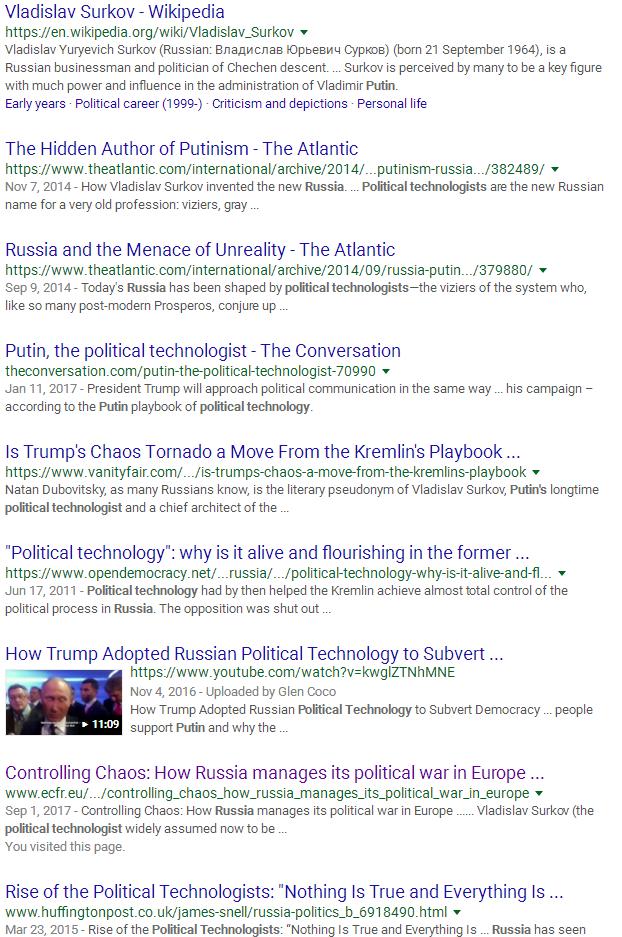
As its editor and, I’m sure, it’s readers have figured out, more material of interest often winds up in reference than in the main body of the post.  At near publication on this post, a quick look-up was given the terms, “Putin, political technologist” — here’s the image of first page results (Oct. 16, 2017):

L-U-Putin-PoliticalTechnologist

Also related on BackChannels as regards the “KGB Playbook”, two posts, one related to the incubating of ISIS by Bashar al-Assad and the other the “application” of Islamic Terrorism to the development of what this blog refers to as the “Newest Nationalism”:

https://conflict-backchannels.com/2016/12/09/syria-assad-isil-background/

https://conflict-backchannels.com/2017/03/11/reflexive-control-process-allahu-akbar-terrorism-new-nationalism-neo-feudalism/

–33–


Excerpt – 1920s – The Spread of Hate – Russia -> Germany | An Excerpt from Laqueur

27 Tuesday Dec 2016

Posted by commart in 21st Century Feudal, Anti-Semitism, Books, Conflict - Culture - Language - Psychology, Political Psychology, Politics, Psychology, Religion

≈ 28 Comments

Tags

anti-Semitism, cultural transfer, history, intellectual history, intellectual poisoning, intellectual transfer, Russia and Germany, Vinberg, Walter Laqueur

Excerpted from Walter Laqueur’s Russia and Germany: A Century of Conflict (1965) in the interest of understanding anti-Semitic ideation as a transferable cultural technology useful for controlling and leveraging mobs.  Of course, for anti-Semitic theorists, expression may not be so cold but rather driven by their own malignant narcissism and related contempt, defensiveness, and paranoia  — and Paranoid Delusional Narcissistic Reflection of Motivation — that goes with it.

Wikipedia has an entry on the benighted star of the following paragraph:  Fyodor Viktorovich Vinberg


Vinberg was a most loyal and devoted subject of his Tsar and his writings are full of invective against all Russian politicians, particularly of the centre and the right, who had been deficient in this respect.  Shortly before the October revolution, Vinberg took part in a conspiracy to overthrow the provisional government, was arrested and sent to the Peter and Paul fortress.  There he had ample time to write his diaries and to bring some order into his ideas; like Hitler in Landsberg prison, he then and there prepared himself for his future political and publicist career. Vinberg was released, or escaped, in 1918, and went first to the Ukraine and later to Germany, where he systematically developed his ideas in the short-lived Berlin newspaper, Prizyv, the yearbook Luch Sveta (A Ray of Light), published first in Berlin and subsequently in Yugoslavia, his book Krestny Put (Via Dolorosa), and a number of other writings.  Vinberg’s ideas can be summarized as follows:

  1. The Jews are the source of all evil.  They must be exterminated.
  2. The liberals and the constitutional monarchists are responsible for Russia’s ruin.  Any form of democracy and republican regime is bad.  A strong dictatorship is needed, for the people are stupid and bad and can never be trusted.
  3. Russia and Germany must unite in order to crush the revolution.
  4. The Catholic and Orthodox Churches must unite against the combined power of the Judeo-masonic sects now operating as a new International.

. . . In his ‘Berlin letters’ published in Luch Sveta, we learn that nature loves the strong, the brave, the agile, those who act and do not talk; she loathes weakness and democratic half measures.  Vinberg has only contempt for the masses, and his only criticism of Nicholas II is that the late Tsar unduly idealized the muzhik, and the Russian people in general, who are really a good for nothing lot and deserve to be punished for having betrayed their Tsar.  The people will always remain a blind, ignorant, senseless mass which has never and nowhere understood anything apart from the crudest material needs.

Laqueur, Walter.  Russia and Germany: A Century of Conflict.  P. 115.  Boston and Toronto: Little, Brown and Company, 1965.

Starting well before Vinberg and moving far past him, Laqueur connects the dots between the Tsar’s White Russian loyalists and emigres who had carried from the experience of the royals the anti-Semitic cant and nurtured racial contempt and supremacism of that medieval world.  The transfer of thought from Vinberg to Germany’s Rosenberg ensues.

What Rosenberg says of Jews and Jewish history can be traced, chapter and verse, to Vinberg’s ‘Berlin letters’ of 1919: the Jewish religion is highly aristocratic; the Jews have been engaged for many hundreds of years in a struggle against the gentile aristocracies; they use in this fight democratic, liberal, and socialist doctrines which act as a poison in the non-Jewish body politic.  Thus they destroyed the Roman empire through the deadly injection of democratic-Jewish Christianity . . . . (op. cit. p 116)

And on goes Walter Laqueur’s documentation of the intellectual history involving the transfer of such thought from the Russian experience and invention into a German culture soon to embrace Nazism.

 Vinberg died in February 1927, and did not witness his ideas coming to fruition.  His views are of historical interest because they constitute something in the nature of a half-way house between the old Black Hundred and National Socialism (op. cit. p. 117).

Related Reference

Alpha History.  “19th Century Anti-Semitism”.

Kellogg, Michael.  The Russian Roots of Nazism: White Émigrés and the Making of National Socialism, 1917–1945.  Cambridge: Cambridge University Press, 2005; online 2009.

United States Holocaust Memorial Museum.  “Pogroms”.


The Aufbau Vereinigung (Reconstruction Organisation) was a Munich-based counterrevolutionary conspiratorial group formed in the aftermath of the German occupation of the Ukraine in 1918 and of the Latvian Intervention of 1919. It brought together White Russian émigrés and early German National Socialists who aimed to overthrow the governments of Germany and the Soviet Union, replacing them with authoritarian régimes of the far right. The group was originally known as Die Bruecke (The Bridge). Aufbau was also the name of a periodical it brought out.[1]

According to Michael Kellogg,[2] the Aufbau Vereinigung was a vital influence on the development of Nazi ideology in the years before the Beer Hall Putsch of 1923 as well as financing NSDAP with, for example, funds from Henry Ford. It gave Hitler the idea of a vast Jewish conspiracy, involving a close alliance between international finance and Bolshevism and threatening disaster for mankind.[3] Recent research on Hitler’s early years in Vienna (1905-1913) appears to have shown that his antisemitism was at that time far less developed than it became under the new influences.[4]

https://en.wikipedia.org/wiki/Aufbau_Vereinigung


Additional Wikipedia Reference

Wikipedia.  “Max Erwin von Scheubner-Richter”.

As Hitler’s close associate, the white emigre Scheubner-Richter, familiar with private wealth and the defense of its productive assets, may have positioned the early Nazi movement as strongly anti-Semitic and anti-Communist.

Wikipedia.  “White émigré”.

White émigrés were, generally speaking, anticommunist and did not consider the Soviet Union and its legacy to be Russian at its core, a position which was reflective of their Russian Nationalist sympathies; they did not tend to recognise the demands of Ukrainian, Georgian and other minority groups for self-determination[citation needed] but yearned for the resurrection of the Russian Empire. They consider the period of 1917 to 1991 to have been a period of occupation by the Soviet regime which was internationalist and anti-Christian. They used the tsarist tricolour (white-blue-red) as their national flag, for example, and some organizations used the flag of the Imperial Russian Navy.

A significant percentage of white émigrés may be described as monarchists, although many adopted a position of being “unpredetermined” (“nepredreshentsi”), believing that Russia’s political structure should be determined by popular plebiscite.

Many white émigrés believed that their mission was to preserve the pre-revolutionary Russian culture and way of life while living abroad, in order to return this influence to Russian culture after the fall of the USSR. Many symbols of the White emigres were reintroduced as symbols of the post-Soviet Russia, such as the Byzantine eagle and the Russian tricolour.

The second Wikipedia piece may fill out the image of a region in which an entire class of residents have been forced to disperse while retaining the beliefs, principles, and values of their former lives.

–33–

FTAC – Module – 12-25-1991 -> 12-25-2016

18 Sunday Dec 2016

Posted by commart in 21st Century Feudal, Anti-Semitism, Books, Conflict - Culture - Language - Psychology, FTAC - From The Awesome Conversation, Gaza, Israel, Palestinia, Russia

≈ Leave a comment

Tags

21st Century Feudalism, 21st Century Neo-Feudalism, anti-Semitism, Gaza, Hamas, Jew hate, middle east conflict, Moscow, Nazism, totalitarianism

https://conflict-backchannels.com/2016/10/03/palestinian-kgb/

https://conflict-backchannels.com/2016/11/28/a-short-page-referencing-works-by-or-associated-with-ion-mihai-pacepa/

The Cold War ended with the dissolving of the Soviet Union, December 25, 1991.

This represents Putin’s Russia today:

http://www.politico.eu/article/vladimir-putin-resurrects-the-kgb-moscow-security/

Those who have energy and time may want to review the “narrative arc” from 25 years ago to this day.

https://conflict-backchannels.com/2015/10/12/ftac-tip-to-the-kgbs-amplification-of-middle-eastern-anti-semitism/


The prompt: a Gaza tykes’ combat training film — uniforms, guns, and all — focused on killing Jews.


Posted by The Israel Project on Facebook, May 9, 2016.

Related Reference

Freimann, Myer.  “Hamas Killed 160 Palestinian Children to Build Tunnels: Militant group used child labor to construct underground network in Gaza.”  Tablet, July 25, 2014.

–33–

Lunev’s 1998 Statement – Moscow and the Mob

27 Sunday Nov 2016

Posted by commart in 21st Century Feudal, American Domestic Affairs, Books, Conflict - Culture - Language - Psychology, Russia, transnational crime

≈ Leave a comment

Tags

21st Century Neo-Feudalism, Russian mafia, transnational crime

I have no fear of death now whether it comes from cancer or from a paid Russian assassin.  but I do feel I have an obligation to use my experience to warn America of the dirty tricks that can be played against her.  And if I have one message for my adopted country, it is this: the Cold War is not over; the new cold war is between the Russian mafia and the United States; and in this new cold war, the Russian mafia has every tool, every weapon, every intelligence asset at its disposal that the old Soviet Union had.  America is facing a nation led by gangsters — gangsters who have nuclear weapons . . . .

Lunev, Stanislav and Ira Winkler.  Through the Eyes of the Enemy:  Russia’s highest ranking military defector reveals why Russia is more dangerous than ever.  Washington, D.C.: Regnery Publishing, Inc., 1998.


” . . . and some of those weapons are actually on American soil, as I will explain” finished the ellipses left in the quotation block.

One hesitates when typing such a sentence.

At minimum, the import calls for digression.

Was Lunev’s 1999 book disinforming as regards the “suitcase bomb” question?

Or has the matter been suppressed?

Or has the asserton been just too large and scary a possibility to hang on for long without donning the tinfoil hat?

That too is a possibility as searches for a related 60 Minutes report — “The Perfect Terrorist Weapon” — produces reference online, but to get at the episode appears to involve hitting one of dozens of iffy “torrent” type (illicit share site) web addresses.

BackChannels will plead with both the legal and faint of heart on that potentially disastrous next step — and not take it.

So one may toss Lunev’s page-turning statement into the “don’t know /won’t know” bin, at least, so BackChannels and its readers may hope, for a good long time.

Less questionable: the Russian state as a “mafia state” and international mafia enterprise:

Investigators in Spain have been at the vanguard of the fight against Russian organized crime, warning fellow NATO members for years of the dangers posed by what they call state-sanctioned syndicates, an issue that’s become more acute since the conflict in Ukraine rekindled Cold War distrust.

After a briefing by Grinda, one of the prosecutors, in Madrid in 2010, U.S. officials concluded that Putin runs a “virtual mafia” state where the activities of criminal networks are indistinguishable from those of the government, according to a classified cable from the U.S. embassy in the Spanish capital that was published by WikiLeaks.

Russian security services control criminal groups and use them to do things the government “cannot acceptably do,” Grinda was cited as telling U.S. officials at the time.

http://www.bloomberg.com/news/articles/2015-06-29/putin-allies-aided-russian-mafia-in-spain-prosecutors-say – 6/29/2016.

At the base of this post is a 14-minute trailer for a 91-minute documentary (subtitled) about Russian mafia — “Thieves by Law (Ganavim Ba Hok).”

Additional Reference

CNN.  “Former Russian spy Col. Stanislav Lunev’s reaction to FBI agent’s arrest for spying.”  February 20, 2001.

Committee on National Security, Military Research and Development Subcommittee, House of Representatives.  “OPENING STATEMENT OF HON. CURT WELDON, A REPRESENTATIVE FROM PENNSYLVANIA, CHAIRMAN, MILITARY RESEARCH AND DEVELOPMENT SUBCOMMITTEE”.  Inquiry into Moscow’s potential deployment of “man-portable nuclear weapons”.  August 4, 1998.

Drudge Report Archives.  “Lebed: 100 Nukes Missing in Russia.”  Norris Carden’s e-mail collection of Drudge’s Special Reports. September 5, 1997.

Meyer, Josh.  “Ex-Soviet Spy Testifies on Hidden Weapons.”  Los Angeles Times, January 25, 2000.

National Terror Alert.  “Suitcase Nukes”.

Nuclear Threat Initiative (NTI).  “The Perfect Terrorist Weapon.”  Comment on 60 Minutes program aired September 7, 1997.

Yablokov, Alexei.  “Comments on Russia’s Atomic Suitcase Bombs.”  Frontline, PBS, n.d.

PDF Format

Finckenauer, James O. and Yuri A. Voronin.  “The Threat of Russian Organized Crime.”  Issues in International Crime, NCJ, 2001.

Russia as Mafia State – Fast Links

In time, Louie and Z left the shores of the Atlantic for Zurich, Switzerland – and a far more menacing situation: A meeting with a high-ranking Russian General offering his government’s arsenal for sale.

“We’re talking long-range missiles, tanks, submarines, everything,” Z said.

The danger was driven home last week with the New York indictment of notorious Russian arms dealer Victor Boot, captured in Thailand in March. He was charged with selling weapons to a terrorist group to be used to kill Americans.

That’s hardly a scene from “The Sopranos.”

http://www.cbsnews.com/news/undercover-look-inside-the-russian-mob/ – 5/13/2008.


http://www.rferl.org/a/putins-mafia-statecraft/27329898.html – 10/27/2015.

http://www.thedailybeast.com/articles/2015/06/23/crimean-gangland-putin-s-seaside-mafia-state.html – 6/23/2015.

http://www.ecfr.eu/article/commentary_security_concerns_russian_mafia_back_on_agenda7083 – 7/25/2016:

In the 1990s, the so-called “Russian Mafia” was Europe’s new nightmare, an overblown threat surging west into Europe instead of Soviet tanks. In the 2000s, it had become a cliché, the thriller-writer’s staple. Now it is back on the agenda, with serious concerns that organised crime has become a ‘fifth column’ of the Kremlin’s effort to undermine European security.


http://uatoday.tv/crime/mafia-friends-of-president-putin-wanted-in-spain-642267.html – 5/3/2016.

http://uatoday.tv/crime/seven-members-of-russian-mafia-arrested-in-spain-681260.html – 6/28/2016.

http://www.bloomberg.com/news/articles/2015-06-29/putin-allies-aided-russian-mafia-in-spain-prosecutors-say – 6/29/2016.

http://www.huffingtonpost.com/armine-sahakyan/the-export-other-countrie_b_11009200.html – 7/15/2016.

Wikipedia Entries

https://en.wikipedia.org/wiki/Special_Atomic_Demolition_Munition

https://en.wikipedia.org/wiki/Stanislav_Lunev


https://youtu.be/diUIhztNxbQ


–33–

Summer Reading – What’s Old Should Be New!

22 Monday Aug 2016

Posted by commart in Books, Conflict - Culture - Language - Psychology, Politics

≈ Leave a comment

Tags

books, Cold War, politics, Putin's Revanche, summer reading

Note: BackChannels’ editor will take reviewer’s copies in advance of publication.

However, this post is simply to pass along a few titles that promise to “entertain, educate, and delight” the reader who has found his way to the intersection of post-Cold War politics and contemporary “hybrid warfare” and terrorism.

As 2016’s production of a summer out of the 1960s enters its final month, BackChannels enjoyed these oldies but still very, very goodies.

Gaddis, John Lewis. The Cold War: A New History. New York: The Penguin Press, 2005.

Everything you wanted to know condensed.

Motyl, Alexander J.  Vovochka: The True Confessions of Vladimir Putin’s Best Friend and Confident.  Augusta, Georgia: Amphora Literary Press, 2015.

A “me and Vlad” story — and no President-for-Life ever had a better buddy or mirror!

Pomerantsev, Peter.  Nothing is True and Everything is Possible: The Surreal Heart of the New Russia.  New York: Public Affairs, 2014.  Nothing is true but Pomerantsev’s book, and at the end even Pomerantsev’s reality becomes a surreal impression left to fade in memory.  In between: criminals, state-managed happy media, a mind-control cult involved in an ill-fated model’s leaping boldly into suicide, and assorted men on the take and women on the make bagging “Forbes’s”.

How crazy surreal?

A man dials the serial number on his firearm, comes up with a woman’s voice, pursues, woos, and marries the dame — and it works out.

How crazy making?

If hesitating on the book, enjoy this sample of Pomerantzev’s perspective first: “Why We’re Post-Fact,” Granta, July 20, 2016.

Smith, Martin Cruz.  Stalin’s Ghost.  New York: Simon and Schuster, 2007.  When it comes to heroism and virtue — also combat, corruption, crime, and history — fate is funny — and Cruz, in the telling of a great tale, peerless.

–33–

Books – Reading Recommended – Maslow

28 Sunday Feb 2016

Posted by commart in 21st Century Feudal, A Little Wisdom, Books, Conflict - Culture - Language - Psychology, Philosophy, Political Psychology, Psychology

≈ Leave a comment

Tags

authentic self, freedom, human development, human performance, humanism, individuation, Maslow, psychology, spirituality, The Farther Reaches of Human Nature

An indisputable fact about the work of A. H. Maslow is that it gives off sparks — very nearly all of his writing gives off sparks.  An attempt to understand this by thinking of him as simply a psychologist would probably prove futile; he must first be thought of as a man, and then as one who worked very hard at psychology, or rather, who rendered his growth and maturity as a man into a new way of thinking about psychology.  This was one of his major accomplishments — he gave psychology a new conceptual language.

Geiger, Henry.  “Introduction: A. H. Maslow”.  P. xv.  The Farther Reaches of Human Nature.  New York: The Viking Press, 1971 (Second Printing, 1972). 

While for some, life may be about the balance of forces involved in charting individual courses; for the Moslowans, life may be more about becoming, and that by way of the development of an authentic person (on the inside) and struggle with the world to enjoy that person and the related engagement with, indeed, the external forces of the world.

Of all the books encountered in the life of the BackChannels editor, The Farther Reaches of Human Nature produced the greatest hope and longing and it reset the editor’s personal course — and a great course it has been — entirely.

Readers from every walk in politics and religion may find the journey taken with Maslow perfectly universal in appeal and practicality.

# # #

← Older posts
Newer posts →
  • Compassion
  • Empathy
  • Justice
  • Humility
  • Inclusion
  • Integrity
____________

Caution: The possession of anti-Semitic / anti-Zionist thought may be the measure of the owner's own enslavement to criminal and medieval absolute power.
___________

Recent Posts

  • East-West Rivalry: Trump-Putin Divide the World
  • AI: Russia Increases Sale of Gold Reserves
  • America: No Kings
  • On X: About Donald Trump’s State Capture & State Piracy
  • An Untrustworthy and Vile Ignoramus
  • Trumpian Coup -> American Enserfment & Slavery

Categories

  • 21st Century Feudal
  • 21st Century Modern
  • A Little Wisdom
  • Also in Media
  • American Domestic Affairs
  • Anti-Semitism
  • Asides
  • BCND – BackChannels News Day
  • Books
  • Conflict – Culture – Language – Psychology
  • COVID-19
  • Epistemology
  • Events and Other PSA's
  • Extreme Brown vs Red-Green
  • Fast News Share
  • foreign aid
  • Free Speech
  • FTAC
  • FTAC – From The Awesome Conversation
  • International Development
  • IRT Images Research Tropes
  • Islamic Small Wars
    • Gaza Suzerain
  • Journal
    • Library
  • Journalism
  • Links
  • Notes On Reading BackChannels
  • OnX
  • Philology
  • Philosophy
  • Poetry
  • Political Psychology
  • Political Spychology
  • Politics
  • Psychology
    • Facsimile Bipolar Political Sociopathy
  • Qualities of Living (QOL)
  • Referral
  • Regions
    • Africa
      • Central African Republic
      • Guinea
      • Kenya
      • Libya
      • Mali
      • Morocco
      • Nigeria
      • South Africa
      • Sudan
      • Tunisia
      • Zimbabwe
    • Asia
      • Afghanistan
      • Burma
      • China
      • India
      • Myanmar
      • North Korea
      • Pakistan
      • Turkey
    • Caribbean Basin
      • Cuba
    • Central America
      • El Salvador
      • Guatemala
      • Honduras
      • Mexico
    • Eastern Europe
      • Serbia
    • Eurasia
      • Armenia
      • Azerbaijan
      • Russia
      • Ukrain
      • Ukraine
    • Europe
      • France
      • Germany
      • Hungary
      • Poland
    • Great Britain and United Kingdom
    • Iberian Peninsula
    • Middle East
      • Egypt
      • Gaza
      • Iran
      • Iraq
      • Israel
        • Palestinia
      • Jordan
      • Kurdistan
      • Lebanon
      • Palestinian Territories
      • Qatar
      • Saudi Arabia
      • Syria
      • United Arab Emirates
      • Yemen
    • North America
      • Canada
      • United States of America
    • Norther Europe
    • Northern Europe
      • Sweden
    • South America
      • Argentina
      • Brazil
      • Columbia
      • Ecuador
      • Venezuela
    • South Pacific
      • Australia
      • New Zealand
      • Papua New Guinea
      • West Papua
  • Religion
  • Spain
  • Syndicate Red Brown Green
  • transnational crime
  • Uncategorized
  • Visual Data

Europe

  • Defending History
  • Hungarian Spectrum
  • Yanukovych Leaks

Great Britain

  • Stand for Peace

Israeli and Jewish Affairs

  • Chloe Simone Valdary

Journals

  • Amil Imani
  • New Age Islam

Middle East

  • Human Rights & Democracy for Iran
  • Middle East Research and Information Project

Organizations

  • Anti-Slavery
  • Atlantic Council
  • Fight Hatred
  • Human Rights First Society
  • International Network Against Cyberhate
  • The Center for Victims of Torture

Meta

  • Create account
  • Log in
  • Entries feed
  • Comments feed
  • WordPress.com

Epigram

Hillel the Elder

"That which is distasteful to thee do not do to another. That is the whole of Torah. The rest is commentary. Now go and study."

"If I am not for myself, who will be for me? If I am not for others, what am I? If not now, when?"

"Whosoever destroys a soul, it is considered as if he destroyed an entire world. And whosoever that saves a life, it is considered as if he saved an entire world."

Oriana Fallaci
"Whether it comes from a despotic sovereign or an elected president, from a murderous general or a beloved leader, I see power as an inhuman and hateful phenomenon...I have always looked on disobedience toward the oppressive as the only way to use the miracle of having been born."

Talmud 7:16 as Quoted by Rishon Rishon in 2004
Qohelet Raba, 7:16

אכזרי סוף שנעשה אכזרי במקום רחמן

Kol mi shena`asa rahaman bimqom akhzari Sof shena`asa akhzari bimqom rahaman

All who are made to be compassionate in the place of the cruel In the end are made to be cruel in the place of the compassionate.

More colloquially translated: "Those who are kind to the cruel, in the end will be cruel to the kind."

Online Source: http://www.rishon-rishon.com/archives/044412.php

Abraham Isaac Kook

"The purely righteous do not complain about evil, rather they add justice.They do not complain about heresy, rather they add faith.They do not complain about ignorance, rather they add wisdom." From the pages of Arpilei Tohar.

Heinrich Heine
"Where books are burned, in the end people will be burned." -- From Almansor: A Tragedy (1823).

Simon Wiesenthal
Remark Made in the Ballroom of the Imperial Hotel, Vienna, Austria on the occasion of His 90th Birthday: "The Nazis are no more, but we are still here, singing and dancing."

Maimonides
"Truth does not become more true if the whole world were to accept it; nor does it become less true if the whole world were to reject it."

"The risk of a wrong decision is preferable to the terror of indecision."

Douglas Adams
"Isn't it enough to see that a garden is beautiful without having to believe that there are fairies at the bottom of it too?" Epigram appearing in the dedication of Richard Dawkins' The GOD Delusion.

Thucydides
"The Nation that makes a great distinction between its scholars and its warriors will have its thinking done by cowards and its fighting done by fools."

Milan Kundera
"The struggle of man against power is the struggle of memory against forgetting."

Malala Yousafzai
“The terrorists thought that they would change our aims and stop our ambitions but nothing changed in my life except this: weakness, fear and hopelessness died. Strength, power and courage was born.”

Tanit Nima Tinat
"Who could die of love?"

What I Have Said About the Jews

My people, not that I speak for them, I nonetheless describe as a "global ethnic commune with its heart in Jerusalem and soul in the Land of Israel."

We have never given up on God, nor have we ever given up on one another.

Many things we have given up, but no one misses, say, animal sacrifice, and as many things we have kept, so we have still to welcome our Sabbath on Friday at sunset and to rest all of Saturday until three stars appear in the sky.

Most of all, through 5,773 years, wherever life has taken us, through the greatest triumphs and the most awful tragedies, we have preserved our tribal identity and soul, and so shall we continue eternally.

Anti-Semitism / Anti-Zionism = Signal of Fascism

I may suggest that anti-Zionism / anti-Semitism are signal (a little bit) of fascist urges, and the Left -- I'm an old liberal: I know my heart -- has been vulnerable to manipulation by what appears to me as a "Red Brown Green Alliance" driven by a handful of powerful autocrats intent on sustaining a medieval worldview in service to their own glorification. (And there I will stop).
One hopes for knowledge to allay fear; one hopes for love to overmatch hate.

Too often, the security found in the parroting of a loyal lie outweighs the integrity to be earned in confronting and voicing an uncomfortable truth.

Those who make their followers believe absurdities may also make them commit atrocities.

Positively Orwellian: Comment Responding to Claim that the Arab Assault on Israel in 1948 Had Not Intended Annihilation

“Revisionism” is the most contemptible path that power takes to abet theft and hide shame by attempting to alter public perception of past events.

On Press Freedom, Commentary, and Journalism

In the free world, talent -- editors, graphic artists, researchers, writers -- gravitate toward the organizations that suit their interests and values. The result: high integrity and highly reliable reportage and both responsible and thoughtful reasoning.

This is not to suggest that partisan presses don't exist or that propaganda doesn't exist in the west, but any reader possessed of critical thinking ability and genuine independence -- not bought, not programmed -- is certainly free to evaluate the works of earnest reporters and scholars.

Archives

Blog at WordPress.com.

  • Subscribe Subscribed
    • BackChannels
    • Join 356 other subscribers
    • Already have a WordPress.com account? Log in now.
    • BackChannels
    • Subscribe Subscribed
    • Sign up
    • Log in
    • Report this content
    • View site in Reader
    • Manage subscriptions
    • Collapse this bar