School of Media and Public Affairs (SMPA) George Washington Univeristy 805 21st Street NW Room 309 Washington, DC 20052 Phone: 202-994-6227 smpa@gwu.edu
Of the 110 schoolgirls kidnapped in Dapchi in February, 104 were released by the Boko Haram, five died during the kidnap while one remains with the terrorists for allegedly refusing to put on a hijab and renounce her Christian faith.
Her killers wear masks and appear to have no names.
From The Awesome Conversation —
The Ummah of Islam has bloody edges, and the Christian community of Nigeria appears to be an edge. The “Fulani Land Pirates” — that’s what I’m calling them — are nibbling away Nigerian Christian territory with rape and rapine, and the Christian community disarmed by the state is become “internally displaced”, currently by about 200,000 souls in relation to the Land Pirates, about 2 million in relation to Boko Haram, who have got a kind of game going: abduct, convert or kill, and return the sworn converts to their parents.
There are multiple levels in these conflicts — locally, Boko Haram is a scourge; however, the arms are Kalashnikov, generally speaking; we know today that Moscow arms and backs the Taliban in Afghanistan; we know that the same defends politically absolute systems, AKA “dictatorships”, and we know that the sponsors in the surrounds of these fighting elements, emir, general this or that, fit that description.
My call: it’s not overpopulation or too much imagination that drive the Islamic Small Wars, although that would be true for producing recruits for war parties: Nigeria provides dual images — the assaults of the Fulani Land Pirates in one part, the barbarism practiced by Boko Haram in the other — of the Islamist program of conquest “by the sword” in action.
Whatever reassurances and sweet words may come from the “leadership” may appear more and more as cover.
The marauders keep getting away — and refreshed with arms and funding keep returning too.
Posted to YouTube on February 26, 2018 — before the return of most of the schoolgirls: ” . . . and just asking how could our daughters be left unprotected to be taken again . . .?
Speaking in tears, the middle-aged resident of Jumbam, a village 2km away from Dapchi, said rather than the Nigerian soldiers combating the insurgents after they came back to drop the girls, the soldiers simply “watched with folded arms while the insurgents left triumphantly.”
The resident spoken was the father of Aisha Adamu, Adamu Jumbam.
The report involved 3,455 household surveys and 46 focus group discussions across 12 local government areas in Borno State. Most of the IDPs surveyed expressed fears about security as their main reasons for not wanting to return home.
Nigerian President Muhammadu Buhari has claimed on several occasions that Boko Haram—which has fractured into at least two major factions—was no longer a fighting force in Nigeria. But the militants have continued to launch attacks and have been solely responsible for some 700 deaths so far in 2017, according to the Council on Foreign Relations.
IDMC estimates that there are almost 2,152,000 internally displaced people (IDPs) in Nigeria as of 31 December 2015 . . . .
Of the total figure of IDPs, the assessment indicates that 12.6 per cent were displaced due to communal clashes, 2.4 per cent by natural disasters and 85 per cent as a result of insurgency attacks by Islamists. The decrease in the percentage of IDPs who were displaced by insurgency from 95.3 per cent in August to 85 per cent in December 2015 and the increase in the numbers of those displaced by communal clashes from 4.6 per cent to 10.1 per cent in October were due to the inclusion of five additional States witnessing communal violence more than insurgency by Islamist groups.
But a source who also participated in the negotiations with Boko Haram that led to release of over 80 Chibok girls in 2017 told SaharaReporters that the federal government not only made the ransom payment of five million euros to the insurgents, it also exchanged some Boko Haram prisoners in return for the Dapchi girls.
However, the lie that no ransom was paid to secure the return of the Dapchi girls followed a consistent pattern of such under the table millions of dollars payments by the Nigerian government to Boko Haram to secure freedom of abductees, especially since the advent of the Buhari administration.
Addendum – More From the Awesome Conversation
Moscow’s hidden hand may be behind both conflicts — Boko Haram and the Fulani Land Pirates — for the still medieval Russian state appears to promote “political absolutism” — the power of the tyrant to destroy both property and persons with impunity — worldwide. In such systems, the state exists to serve the Great Leader who may hold his position beneath a banner and program essentially swallowed by the public. As regards dictatorships, one may say: “Different Talks — Same Walk!” Always.
And the incumbent President has not been so? Has the news really been fake? Had his vendors been paid completely and on time at completion of work? And then with hindsight, we could update this chart appearing in POLITICO last March:
Here’s the nut: “Did he or didn’t he?” doesn’t matter.
What matters is America’s coherence in its confidence in its presidency.
Where is that now?
The prompting statement to the effect that the “Clintons are pathological liars.”
Even if accepted in the nonpartisan spirit, where are Americans with their critical evaluation of the present leadership?
While drafting this temperature-checking note, I had asked “Where is the United States today as regards the Skripal poisoning in the United Kingdom?”, and I had expected to find not much given President’s Trump image as an autocrat in line with Putin’s encouragement of EU / NATO “New Nationalism”, an element part and parcel in the prying apart of the Alliance.
The two log lines — ” . . . with UK ‘all the way'” and ” . . . hesitant to blame Russia for the attack . . . .” address the ambivalence and suspicions that have dogged the Trump Presidency from before the elections (perhaps starting with the eyebrow-raising Trump campaign association with the now indicted Paul Manafort).
However Americans may feel about the American President at this moment, it’s the “Phantom of the Soviet” and the “phantoms of the Soviet” in issues that are being spotlighted in relation to KGB-style political assassinations that in turn have been evaluated by the intelligence services of the three NATO states now apparently in agreement on their origins.
America: have you no dreams, faith, ideals, memories, values?
One cannot argue with the Soviet origins of the PKK — nor today it’s probable conflation with “TAK” terrorists operating occasionally in Turkey — and the long-term effects of the Kurdish-Russian relationship that is today being leveraged by a potentially genocidal (proven once — has the world to see it again proven?) Turkish and neo-Islamist authoritarian state. However, modern Kurdistan and the “Rojava Experiment” with liberal democracy may be more “western” than commonly acknowledged.
Credit Turkish President Erdogan with Soviet-style defamation when he frames all Kurds as action-producing PKK terrorists.
Credit American Revolutionary memory to with what had to be brought together to overcome an avaricious king and to mark its first steps on the road to becoming not only self-governing but uniquely so as the redoubt of freedom from all political and religious tyrannies.
The Kurdish Community may need to advance its own inter-tribal cooperation and perhaps temper the power of its own autocrats to achieve meaningful, responsible, and responsible authentic democratic governance; however, both Moscow-Damascus and “Moscow-Ankara” would seem to be working to squeeze the community back into political impotence and from there out of existence.
Followers and readers with timely information and insight into the Kurdish community’s political makeup, its arrangements with other powers — including Russia and related energy projects — and its desire for autonomy, dignity, and freedom are welcome to contact the editor through the contact page and form on this blog.
During Turkey’s war for independence, Turkish leaders, promised Kurds a Turkish-Kurdish federated state in return for their assistance in the war. After independence was achieved, however, they ignored the bargain they had made.
Months after the declaration of a Turkish republic, Ankara, under the pretext of creating an “indivisible nation,” adopted an ideology aimed at eliminating, both physically and culturally, non-Turkish elements within the Republic. These “elements” were primarily Kurdish and Armenian.
On the night of December 31, 2016, 94 associations, including the institute, were shut down on allegations of “connections to terrorist organizations.” A month later, the authorities confiscated all documents, course materials, and hardware—computers, two projectors, a TV—as well as the school’s furniture. The institute’s website was taken down. In theory, the institute has the right to appeal the shutdown through a state-appointed commission, but human-rights organizations such as Amnesty International have criticized it as insufficient, as more than 100,000 cases are pending review by just seven commissioners within a two-year deadline.
For nearly seven decades, this combination of factors has been the potential Achilles heel of NATO: that one day, its members would be called to defend the actions of a rogue member who no longer shares the values of the alliance but whose behavior puts its “allies” in danger while creating a nightmare scenario for the global order.
After 67 years, that day has arrived: Turkey, which for half a century was a stalwart ally in the Middle East while proving that a Muslim-majority nation could be both secular and democratic, has moved so far away from its NATO allies that it is widely acknowledged to be defiantly supporting the Islamic State in Syria in its war against the West.
He tells me he worked from 1961 to 1990 at the ministry of Potsdam, exclusively in counter-espionage. He picks up the thesis and reads its title:
The Work of the Ministry for State Security on the Defence Against Intelligence Infiltration by the Secret Services of the NATO States against the GDR. Presented from the Viewpoint of a Member of the Division for Counter-Espionage, Regional Administration, Potsdam.
‘This is a discussion paper I wrote based on my work at the ministry. If you read this, you will learn a lot of what you want to know.’
I flick to the front page, and see that the paper was written in 1994 for the ‘Potsdam Working Group of the Insiderkomitee for the Reexamination of the History of the Ministry for State Security, Inc.’
— In BackChannels experience of the eternal present online (and in the library), herewith a gush —
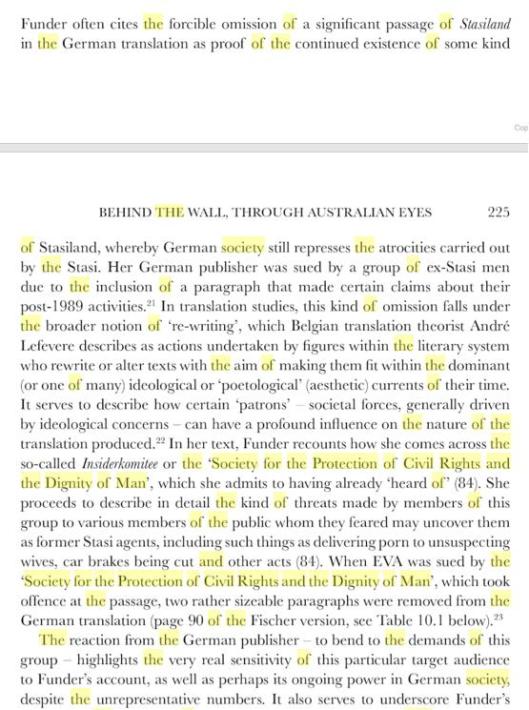
“‘ . . . we have changed our name to the ‘Society for the Protection of Civil Rights and the Dignity of Man’.”
Okay, then.
Here’s a chill —
Moore, Nicole and Christina Spittel. Australian Literature in the German Democratic Republic: Reading through the Iron Curtain. Pp. 224-225. London & New York: Anthem Press, 2016
For corroboration here in the open source, another writer, Gary Bruce, has made mention of the same ghost:
The organization of former Stasi officers known as the Insider-Komitee, whose self-styled objective is to restore “balance” to the current literature on the Stasi by writing “objective” history of the Ministry for State Security, assisted me in locating an important Stasi officer for interview.
As resources appear fairly wide open to the curious on the web, BackChannels will wrap up the gawking now that it has stumbled across the tracks of at least a few others, and including those of the author her brave self, for she acknowledges, “My great mistake was to imagine that the stories of resistance, courage and decency would be well received by Germans” — for who would show up at the launching of Stasiland in the ballroom “of the former Stasi Offices in Leipzig”?
The first two rows of seats were filled with ex-Stasi (or perhaps ex-Party) men. I know this because they were in the ex-Stasi (or ex-Party) uniform, which consists of polyester trousers with a nice firm crease, a bomber jacket and a significant amount of Brylcreem. They were sitting in their former ballroom, legs splayed, arms crossed, looking daggers at us.
The same crew would later make a show of walking out on the event.
An observation higher up in the above cited piece precedes the willies and seems more worth remembering:
When I encountered Miriam, Julia, Frau Paul and Klaus Renft, what they told me was deeply thrilling. Not only in the sense of the bravery it took to climb the Berlin Wall or dig an underground tunnel or defy a governmental declaration that you “no longer exist”. The thrill was more fundamental. I felt I was witnessing, alive and breathing and drinking coffee opposite me, heroic human decency.
The GDR was a furtive and insidious tyranny. Through the Stasi it pried into every aspect of your life. It possessed armies of spies, paid and unpaid. Some estimates run as high as one for every six and a half members of the population. Any attempt to achieve success in East Germany involved a pact with the devil – you paid with your soul if you wanted to attend a university, enter a sports-club, become a lawyer or a clergyman or marry a foreigner – like Funder’s friend Julia. You could only avoid contact with the regime if you opted out, and went into “inner emigration” – not an option for the ambitious.
This was a regime ruled by dour old men – Marxisten-Senilisten.
Stasiland has been published in sixty nine countries and translated into a dozen languages. It was shortlisted for many awards in the UK and Australia, among them the Age Book of the Year Awards, the Queensland Premier’s Literary Awards, the Guardian First Book Award 2003, the South Australian Festival Awards for Literature (Innovation in Writing) 2004, the Index Freedom of Expression Awards 2004, and the W.H. Heinemann Award 2004. In June 2004 it was awarded the world’s biggest prize for non-fiction, the Samuel Johnson Prize.
At first, it looked like an ordinary dictator’s response to a little criticism and a comparatively polite people’s request for a little consideration and power, but in 2011, what looked like a civil war masked the deeper, more prolonged, and vicious desire to sustain medieval absolute power — the power of the tyrant — against the entire Christian, humanist, and liberal experience and political philosophy of the western world.
Are there to be no differences between property and persons?
Are such malign narcissistic personalities, uniquely limited in conscience and that mysterious thing we call heart, to be given free reign to assert themselves as powerful primarily with false flag theater (e.g, “Moscow Apartment Bombings“, “Assad v The Terrorists”) followed by an expressed cruelty and sadism in power that encounters neither boundaries nor limits?
Know thy tyrants.
This east-west conflict between thieving barbarians and the just nobility of western civilization has been brewing in the post-WWII region in time, and the world that won’t massacre refugees is being drawn into the vortex.
Perhaps we should now ask about the nations watching from similar sidelines the horror on continuous display in Syria: where has been their courage, humanity, and resolve as Russian and Syrian air power directly bombed nearly two dozen hospitals and other medical facilities in the vicinity of East Ghouta, Syria?
Triebert, Christiaan, Evan Hill, Malachy Browne, Whitney Hurst, Dmitriy Khavin, Masha Froliak. “How Times Reporters Proved Russia Bombed Syrian Hospitals.” The New York Times, October 13, 2019, updated April 7, 2020.
“The commission found reasonable grounds to believe that government forces and the Shabbiha had committed the crimes against humanity of murder and of torture, war crimes and gross violations of international human rights law and international humanitarian law, including unlawful killing, torture, arbitrary arrest and detention, sexual violence, indiscriminate attack, pillaging and destruction of property,” said the 102-page report by the independent investigators led by Paulo Pinheiro.
Since the beginning of anti-government protests in March 2011, Syrian authorities have subjected tens of thousands of people to arbitrary arrests, unlawful detentions, enforced disappearances, ill-treatment, and torture using an extensive network of detention facilities, an archipelago of torture centers, scattered throughout Syria.
BackChannels experience suggests that if it’s called what it is — “war p___n” — it will attract a lot of viewers, such are the low desires of the world when it comes to deliberately seeking artless depictions of sex and violence. the above URL links to a video of a young man who wears a tire around his chest while receiving a beating.
A UN inquiry has found “massive evidence” that the Syrian president, Bashar al-Assad, is implicated in war crimes as the latest reported death toll in the country’s civil war reached 126,000.
Navi Pillay, the UN’s human rights chief, said a commission of inquiry into human rights violations in Syria “has produced massive evidence … [of] very serious crimes, war crimes, crimes against humanity” and that “the evidence indicates responsibility at the highest level of government, including the head of state.”
Setting aside the Israeli story a moment, points of leverage may have involved the “Turkish Stream” energy project, a piece of “realpolitik”, and an appeal to the narcissistic concept of cultural leadership and state in which the “Great Leader” is the embodiment of the living state concept _and entitled_ to aggrandizement and glory without limit (or, clinically, “unlimited narcissistic supply). Putin’s vision appears to me to be that of the medieval world sustained with raw power put in place of democracy.
The look of the mode — big palaces, nepotism on a royal scale, confusion in relation to the boundaries of person and state (and the state’s treasury) — marks the medieval mind and related revanche.
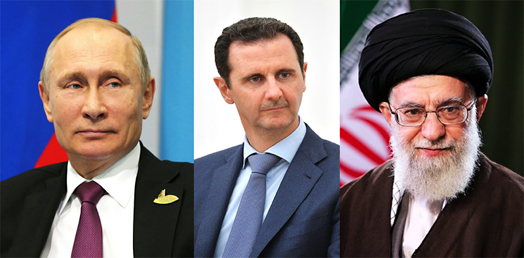
Men like Putin, Assad, Khamenei, Erdogan, Orban may consider true popular democratic government as impeding their own authority, sovereignty, and will. While the term “autocrat” sounds quite bureaucratic, similar concepts — caliph, emperor, king, sultan — fit these guys.
Because we know of the “Moscow Apartment Bombings” and that Russia has been arming the Taliban in Afghanistan — and there’s more back there with Zawahiri and others — it may not be too far fetched to suggest that Moscow has manipulated terrorism to induce in struck targets a predictable patriotic new nationalism and that “the terrorists” — ISIS or PKK — now provide a platform for conflict, all against all, and without end. Where Putin has held sway, he has turned back history’s clock.
Our President Trump has had no issues bearing and wearing the mantle of authority, but it would be facile to say he hasn’t had some issues with the “Estates” of a matured democracy. In that regard, he may fit the world to which Putin has wished to return the world.




 BackChannels