At first, it looked like an ordinary dictator’s response to a little criticism and a comparatively polite people’s request for a little consideration and power, but in 2011, what looked like a civil war masked the deeper, more prolonged, and vicious desire to sustain medieval absolute power — the power of the tyrant — against the entire Christian, humanist, and liberal experience and political philosophy of the western world.
Are there to be no differences between property and persons?
Are such malign narcissistic personalities, uniquely limited in conscience and that mysterious thing we call heart, to be given free reign to assert themselves as powerful primarily with false flag theater (e.g, “Moscow Apartment Bombings“, “Assad v The Terrorists”) followed by an expressed cruelty and sadism in power that encounters neither boundaries nor limits?
Know thy tyrants.
This east-west conflict between thieving barbarians and the just nobility of western civilization has been brewing in the post-WWII region in time, and the world that won’t massacre refugees is being drawn into the vortex.
Perhaps we should now ask about the nations watching from similar sidelines the horror on continuous display in Syria: where has been their courage, humanity, and resolve as Russian and Syrian air power directly bombed nearly two dozen hospitals and other medical facilities in the vicinity of East Ghouta, Syria?
Triebert, Christiaan, Evan Hill, Malachy Browne, Whitney Hurst, Dmitriy Khavin, Masha Froliak. “How Times Reporters Proved Russia Bombed Syrian Hospitals.” The New York Times, October 13, 2019, updated April 7, 2020.
The recent Russian rejection of an American initiative at the UN Security Council for the world community to express solidarity with the Iranian protesters in the face of the Islamist regime’s brutalities did not come as a surprise. In fact, given the history of Russia’s imperialistic behavior towards Iran, the rejection came as a natural move on the part of Putin. In this article I am going to make a survey of Russian imperialism in Iran and indicate what America can do to neutralize that threat and consequently bring Iran back to the West.
One more excerpt as a teaser to this reading highly recommended:
The Tudeh’s professed goal, according to Abrahamian (Iran Between Two Revolutions, 1982), was to “adapt Marxism to the local environment” so that in the end a Soviet-style Communist revolution can be brought about in Iran. In other words, as Iran was mostly a Shiite Muslim community, the Tudeh would use Shiite religious jargon and lore in order to attract the attention of the masses. This ploy would later play into the hands of the revolutionary Islamists who took over in 1979.
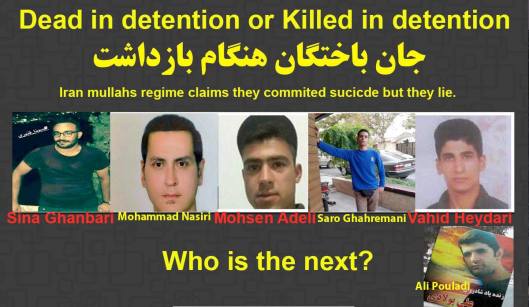
Detainees disappeared
Families of a number of detained protesters have not been able to obtain any information about their loved ones. Among them are Ashkan Absavaran, a 20-year-old male detainee, and Sepideh Farhan (Farahabadi), a young female. Ashkan Absavaran informed his family of his detention in a telephone call on 4 January. Officials of Evin prison told his family later that he had disappeared.
The IRGC and its affiliated paramilitary force, the Basij, have been mainly responsible for the heavy crackdown on the protesters. Having initially denied direct involvement in repressing the protesters, the IRGC commander declared on 3 January that they had taken action in three provinces. Furthermore, the IRGC has been responsible for torturing the detainees in order to make false confessions in Wards 2A and 240 of Evin prison.
For how long will Iran’s payoffs for murder continue to be accepted by the patronized of the state?
Noted on the Human Rights Day post:
In one of the above clips, Maryam Rajavi put the number of regime executed political martyrs at above 120,000, with 30,000 killed shortly after the taking of power in 1988.
Iran Protests, Dec 30, 2017 – chanting slogans against Khamenei in Tehran University – NCRI
Demonstrators were reportedly heard yelling slogans like “The people are begging, the clerics act like God”. Protests have even been held in Qom, a holy city home to powerful clerics.
Other demonstrators chanted “leave Syria, think about us” in videos posted online. Iran is a key provider of military support to the government of Bashar al-Assad in Syria.
Twenty-one hours ago:
#Update7 :protesters attacked the governor office of #Hamedan, chanting: “ Death to the Islamic Republic”, “We don’t want Islamic Republic”.#Qom chanting “Death to the Islamic Republic “, “Death to Hezbollah”, we don’t want an Islamic Republic”#Iranprotests#RegimeChangepic.twitter.com/GlsovMmygg
US President Donald Trump has repeatedly taken aim at Iran, denouncing its government as a “fanatical regime” and accusing it of violating an international agreement aimed at curbing Tehran’s nuclear program, refusing to certify its compliance with the deal.
State Department spokeswoman Heather Nauert also addressed the protests.
“The United States strongly condemns the arrest of peaceful protesters. We urge all nations to publicly support the Iranian people and their demands for basic rights and an end to corruption,” she said in a statement.
While the Laws of War may apply to contested space and recognize the division between the “occupier” and the “occupied” — and the “stronger” and the “weaker” for that matter — there’s something now absurd about the preoccupation with an occupation that treats the “occupied” better than their own leaders.
The law and the thinking behind it have become absurd as the conflict becomes redefined. I think I’ve done my part to harp on the Soviet / post-Soviet engineering of the conflict and get in the way of the memorization of political cant and disinformation that keeps the darned thing — and the Arab apartheid of the Palestinians and related exploitation of the main base by the leadership elite — cycling.
Maybe the cadre who most genuinely care about the Palestinian main base are figuring out the true history of the conflict — that would be a better preoccupation than the one to which too many have been and are still indoctrinated.
Related on BackChannels for Palestinian Cadre – A Module
Reference Abdullah Ocalan’s vision that misrepresents liberalism and true representative democratic process, which may in turn replicate what the Soviet axis always produced using “sweet words” combined with the rapacious temperament of the politically privileged in an autocratic system: kleptocratic strongmen in palaces and manipulated “masses” around them.
2. Phantoms of the Soviet – PKK
Related to the first point, the PKK set up in the Soviet Era with, apparently, related dogma for intellectual definition, and in that its presence in persons may persist beneath other banners, the same may serve to block western enthusiasm for an independent Kurdistan. In other words and in relation to the Phantoms of the Soviet (a category referenced frequently on BackChannels in relation to other conflicts), the persistence of PKK ideas and actions, whether vengeful or provocative, cloud western support. The only answer to that is to reconsider what is advanced in Kurdistan as regards practical ideals and political language (across languages) and adjusting for the distance in intellectual history between states of affairs in 1984 and those of this day.
3. Putin’s Feudal Revanche
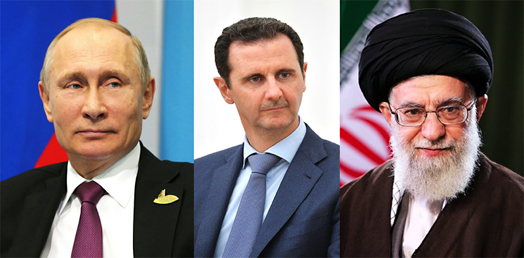
Putin’s Russia represents another rapacious autocracy bent on producing conflict worldwide within a global system of feudal absolute power certain to drive wars of all against all.
The Federation represents Russia’s third flip — two revolutions, three governments — within 100 years of the days of the tsars, and appears now to leverage deals on that basis, e.g., in range of Putin’s sway (and leveraged by the Turkish Stream energy pipeline project, Erdogan has diminished the democracy that initially empowered him and all but returned Turkey to a feudal estate from which he cannot be politically (by mere elections) ejected.
4. Moscow / Moscow-Tehran’s Totalitarian Approach to the Creation and Presentation of Conflict
The intent was to produce a large piece of theater, truly, that would make Assad look good — he envisioned and helped into power the enemy wanted — while producing a major headache for the west. By remaining somewhat fixed in past arrangements and ideas, the Kurdish community has perhaps been maneuvered into aiding the devil that most seeks to control it (and everyone else).
5. State of Kurdish Administrative and Constitutional Development
It has been hard to see the coordinating and self-subordinating (“for the greater good”) character of Kurdish leaders to an overarching administrative and democratic (power checking, power displacing, power distributing, and culturally and politically evolving) system. The latent Kurdish state in fact that may be defined by the subordination of officials to greater institutional arrangements may be there, but the western / publishing-in-English journos haven’t laid out relationships, or I’ve missed that coverage, or the same is not wanted.
In deference to Ocalan’s “democratic communalist” vision, there may be little incentive (by way of example too) to bring western commercial elements and associated vulgarity into a culturally independent Kurdistan. There are many other ways to pursue and sustain both cultural and political evolution and distributed economic development across a new polity (reference authors Brown, McRobie, Schumacher, among others).
Addendum to the Above: Found Posted on YouTube – October 17, 2017
6. Modern Kurdish Defense Considerations Against Adverse Feudal Estates
Much in favor of the defense of Kurdish independence may be the reversion of the Turkish government to feudalism and its history of persecution of the Kurds and others. Clearly, the Kurdish community needs an effective defense against adverse egomaniac and ill-willed potentates.
7.Armed Proxies of Iranian Fascism
Washington needs to be pressed hard about the powering up and evident fielding of Iranian-backed Iraqi Shiite militia in the latest suppression of Kurdish independence. At this point, Moscow / Moscow-Tehran’s kleptocratic totalitarian ambition should be glaring, and the western public should join the Kurdish community in blocking greater Iranian fascism through armed proxies.
If there’s a secret to peace all around, it may be in the separation of the present western-backed governments from the external meddling of rogue dictatorships that wish to drag the region backward toward feudal barbarism using the most nefarious of political methods to do it. The leaders in that aggression have learned how to make money off the misery of others while they themselves remain remote from the nightmares they have created.
The Kurdistan region enjoys autonomy in Iraq, and that has meant running its own airports; borders; maintaining its own Peshmerga security forces; and exporting oil through its own economic management.
Baghdad now wants to use the referendum as an excuse to roll that back.
With the war on the Islamic State seemingly close to an end, Baghdad wants to punish the Kurdish region for seeking independence.
BackChannels has turned up the following themes related to the Kurdish struggle for independence:
Iranian resistance expressed in Iraq via Iran aligned and backed Shiite militia.
Persistence of the Kurdish PKK and a perhaps too robust relationship with a persistently feudal and political absolute, criminal, and totalitarian Russia.
Inability, so far, to attenuate the power of chiefs and produce a disciplined and power balancing democracy.
Reference – Iraq: Iran Aligned Shiite Militia
Note, please, the date year associated with reference. Whether 2015, earlier, or later, BackChannels’ Kurdish source has cited Iraq’s Iranian-aligned Shiite militia as posting a persistent challenge to the defense of the Kurd’s ancestral land.
Washington’s response to the Islamic State’s (IS) advance, however, has been disgraceful: The United States is now acting as the air force, the armory, and the diplomatic cover for Iraqi militias that are committing some of the worst human rights abuses on the planet. These are “allies” that are actually beholden to our strategic foe, the Islamic Republic of Iran, and which often resort to the same vile tactics as the Islamic State itself.
. . . from the KRG perspective, two Shia militia forces—Asaib Ahl Haq and the Badr militias—are uncontrollable.
Both these militias are backed by Iran, and the their military operations are effectively overseen by Qassem Suleimani, the head of the Qods Force, which serves as the external arm of Iran’s elite Islamic Revolution Guards Corps (IRGC).
Hashd al-Shaabi is the defender of “Iraqi sovereignty and its unity,” he declared, and it will not fight any other group except ISIS.
Kurdish Peshmerga and Shiite militia forces have clashed several times in Kirkuk’s southern ethnically-mixed city of Khurmatu in recent months. Several people from both sides were killed in the confrontations.
A century after the breakdown of the Ottoman boundaries, Iraq remains a forced union of peoples whose national aspirations and sense of identity have been suppressed. Members of my family spent decades in exile from successive Iraqi governments that, since the turn of the 20th century, butchered generations of Kurdish men, women and children who struggled to find their place in this artificial state.
Thus there has always been a lingering, unresolved question of identity for the Kurds of Iraq. That identity will finally achieve resolution when the people of Iraqi Kurdistan vote in the referendum. This expression of popular will should not only close a long chapter of grief but also bring new certainty and stability to an increasingly volatile region plagued by sectarian conflict and bloodshed.
Of special concern was the possibility that Iran-backed Shiite militias in Iraq could seek to gain political advantage by challenging Kurdish control in the oil-rich, ethnically mixed city of Kirkuk and other disputed territories also claimed by the central government in Baghdad.
John Hannah relays a chilling list of actions taken or threatened by Iraq and Turkey in their pique with the Kurdish referendum. He goes on to note the following and then pleads for Washington’s regaining its own initiative in moral courage in partnering with the Kurds and forestalling the escalation of force applied in keeping them captive to forces clearly out of step with Washington’s moral and political missions:
I was taken aback by the intense frustration and anger directed at a critical wartime ally and longtime, loyal U.S. partner whose history of oppression and even genocide at the hands of other nations leaves it with — if nothing else — an almost unimpeachable moral case for self-determination.




 BackChannels