
• Home
  • About
  • Concepts, Coins, and Terms
    • Anthropolitical Psychology
      • Civilizational Narcissism
      • Conflict – Language Uptake – Social Programming and Scripting – A Suggestion
        • Language Uptake – Programming – On Learning to Listen
        • Mouth –> Ear –> Mind –> Heart System
        • Social Grammar
      • Facsimile Bipolar Political Sociopathy
      • Malignant Narcissism
      • Narcissistic Scripting
      • Normative Remirroring
      • Paranoid Delusional Narcissistic Reflection of Motivation
    • FTAC – “From The Awesome Conversation”
    • God Mob
    • Intellectual Battlespace
    • Islamic Small Wars
    • New Old Now Old Far Out and Lost Left
    • Political Spychology
    • Shimmer
  • Library
    • About Language
    • Russian Section
  • Comments and Contact

BackChannels

~ Conflict, Culture, Language, Psychology

BackChannels

Category Archives: Regions

A Glimpse of Qatar’s Generational Transition and Portent for The Middle East Conflict

27 Thursday Jun 2013

Posted by commart in Anti-Semitism, Conflict - Culture - Language - Psychology, Fast News Share, Islamic Small Wars, Israel, Middle East, Qatar, Regions, Religion

≈ Leave a comment

Tags

ethics, humanism, Israel, middle east conflict, philosophy, political, politics, Qatar, religion

These days, the term “middle east conflict” would seem to refer to conflict and unrest in every state in the region but Israel.

Nonetheless, while Egypt roils and Syria burns and the King of Jordan fends off the seeding of perhaps a new class of secular Palestinian politico*, Qatar’s new head of state, Sheikh Tamim has this to say of the refugees of numerous Arab-led wars since 1948:

One day when our “Blue Dot” of a planet is a little more gathered together — that as opposed to riven with war — we may find common ground in five language principles:

Compassion

Humility

Integrity

Justice

Security

Of the four, the most difficult term and the one most relevant to autocracies seems to me to be “integrity” — just the power to be honest about ourselves and with others.

This is not as easy as it may sound.  If it were, we would not have the fairy tale that is “The Emperor’s New Clothes”, which is in essence and for the ages a story about lying and power.

*****

It may be noted that God placed two trees in the Garden of Eden: the Tree of Life and the Tree of the Knowledge of Good and Evil.  When the snake entices Eve to eat of the forbidden tree, only mention is made of the Tree of the Knowledge of Good and Evil, effectively hiding the other tree through omission.

You know the rest of the story: Eve eats the apple, becomes conscious or comprehending, also self-conscious, and, with Adam joining her, possessed of conscience, out of which reaction, perhaps, come the fig leaves, a courtesy, each to the other, and practical too (God, a few sentences later, provides clothing made of skins — one imagines chamois — lending perhaps dignity and protection to their introduction to life as men and women would experience it forever after).

The “Middle East Conflict” — which is never about conflicts in the middle east but only about the creation of the Jews and Israel (or, lost in the Pharaohnic dawn, the gathering together beneath the unrestrained ego and violence of a tyrant)l — seems to me to be always about two things not at ease with one another: 1) the possession of good conscience in light of the knowledge of good and evil; 2) the testing of God for favor when the relationship needs to be the other way around.

*****

Where kings are concerned, I suspect there may be more to the story than meets either eyes or ears.

When God, being God, and with Torah received as divine message, hides the second tree — the Tree of Life that we are told is there but when it counts is not mentioned by the snake and, later, will be barred from access (by cherubim and an eternally revolving sword guarding the Garden left behind) — the sin of omission becomes a virtue: to have eaten of the Tree of Life also would have been too much, for God forbids it, and so protects His children.

*****

To be as gods, lower case that term, with nuclear capabilities, among other extraordinary but still human capacities, one might counsel also a prudent humility.

Carl Sagan’s clip about the “Pale Blue Dot” that is our planet viewed from space, has many renditions on the web — and there’s an entire film available too (somewhere — I’m going to be lazy here) — but this may do for essence.

# # #
Syria – The Dismal Killing Machine

26 Wednesday Jun 2013

Posted by commart in Conflict - Culture - Language - Psychology, Middle East, Regions, Syria

≈ Leave a comment

Tags

casualties, conflict, Druze, ethical, ethics, fighting, Israel, middle east, political, politics, Syria, war, war zone

LONDON — An opposition monitoring group that has tracked Syria’s widening civil war said on Wednesday that more than 100,000 people had died in the 27-month-old conflict, with pro-government forces taking far more casualties than rebels seeking the overthrow of President Bashar al-Assad, while civilians accounted for more than one-third of the overall fatalities, the biggest single category.

Cowell, Alan.  “Syrian Group Says War Deaths Top 100,000.”  The New York Times, June 26, 2013.

Perhaps the old days were better after all: assemble the armies on an open plain, send the warriors into it, and leave the noncombatants of both sides for the spoils of the winner.

Just kidding.

*****

“As always, numbers like these gloss over the many people who have been so grievously wounded, physically or psychologically, that they will never again live productive lives. What the latter figure amounts to in Syria is anyone’s guess. What’s certain is that it’s even larger than the death toll.”

Menon, Rajan.  “Hope for Peace in Syria, But Don’t Expect It.”  Blog.  Huffington Post, June 26, 2013.

Rajan Menon’s report on the suffering goes on to note 1.7 million refugees on top of 4 million Internally Displaced Persons, or 5.7 million displaced souls altogether, about 25 percent of Syria’s total population before the onset of serious hostilities (but I’m not sure I’m getting consistent numbers from any source published within the past two years).

*****

“In one trailer we meet 13-year-old Najwa. She curls back in the corner next to her husband, 19-year-old Khaled, and her mother, hardly saying a word.

Najwa is the youngest of three, her two older sisters in their late teens are also recently married.”

Damon, Arwa.  “No sanctuary for Syria’s female refugees.”  CNN, June 26, 2013.

Evidently, grim statistics don’t tell a whole story, or not much of whatever is to be told at all.

*****

“The head of the International Terrorism Observatory think tank, Roland Jacquard, told Reuters Television the group appeared to be sending fighters abroad, likely to Syria.”

Pennetier, Marine and Alexandria Sage.  “French police arrest cell with possible Syria links.” Reuters, June 25, 2013.

A cousin of a story.

Reuters.  “Spain arrests suspected al-Qaeda Syria network.”  Video.  June 22, 2013.

“Special informed sources from London revealed to the Palestinian al-Manar newspaper that the British security forces arrested early June a group of 11 terrorists in London who had come back from Syria where they were involved in the fighting there.”

Syrian Arab News Agency.  “British authorities arrest terrorists who fought in Syria.”  June 19, 2013.

Wars draw volunteers.  It’s a shame the one in Syria draws teenage ones.  Belgium dealt with this issue back in April of this year:

*****

Thanks to Ken Hanley at Digital Journal for playing this thematically related clip last week in his op-ed, “Many Foreign fighters involved in Syria on both sides” (Digital Journal, June 19, 2013).

*****

While Israel’s cardinal military defense rule seems to remain, “Do not intervene; do not interfere” (DM Yaalon), Israel’s first virtue would seem to remain compassion to the extent that it may provide that.

“The two boys, 9 and 15 years old, were transferred to Ziv Hospital in Safed for treatment. The 9-year-old suffered moderate injuries from shrapnel wounds across his body and lost his right eye, according to a report by Maariv. The 15-year-old was listed in serious condition, according to the report.”

Times of Israel.  “Minors wounded in Syrian fighting brought to Israel.”  June 26, 2013.

Every wounded Syrian is guarded by either an IDF soldier or by a civilian security guard in an attempt to isolate them from speaking with anyone unauthorized to do so who might photograph them or pass on their information to Syria, potentially harming them or their families upon their eventual return to Syria.

As stated, more than a 100 wounded Syrians have crossed the border in recent months. Some 70 of them have been taken to Israeli hospitals, and two have passed away as a result of their injuries.

Zitun, Yoav.  “More than 100 wounded Syrians receive care in Israel.”  YNet News, June 26, 2013.

After 2,000 years or so, Hillel’s negatively stated dictum seems to hold.  “That which is distasteful to thee, do not do to another” — and certainly, the choice between enabling or denying access to hospital services related well to that.

*****

“The request came in a letter handed to Prime Minister’s Office Director-General Harel Locker at a meeting with Druze leaders on the Golan Heights Thursday. The letter included an unprecedented request for Israel to take in Druze students who had left the Golan and settled in Syria, Maariv reported.”

Gur, Haviv Rettig.  “Druze leaders ask Israel to take in Syrian brethren.”  Times of Israel, June 23, 2013.

What would Hillel do?

Druze along the Golan have served both in the IDF and in Syria’s defense forces according to their decisions about citizenship and location, and with the fighting as I’ve described — “Two mad wasps in a bell jar” — Israeli Druze are seeking sanctuary for their relatives.

God knows God would seem to give Jews the toughest ethical and survival challenges.

Both.

At the same time.

Providing infirmary to wounded to be turned back into the field — and who want to be returned to their land — is one thing.

Affording sanctuary to those endangered by this war that only loosely respects boundaries and seems absent of compassion and conscience both in relation to innocents, noncombatants, neutral parties, and so on makes for a more difficult decision.

# # #

FNS – Nasrallah’s Forces

26 Wednesday Jun 2013

Posted by commart in Conflict - Culture - Language - Psychology, Fast News Share, Islamic Small Wars, Middle East, Regions, Religion, Syria

≈ Leave a comment

Tags

Hezbollah, Nasrallah, Syria

Even if the conniving Nasrallah, with Iran’s support, holds on as head of his extremist Shiite organization for a long time to come, his principal goal — to become a pan-Arab and Lebanese leader — is now unattainable. The man who for some time was seen as Israel’s main strategic enemy has, with his own hands, buried his accomplishments.

Bergman, Ronen.  “The Fall of Hezbollah’s Leader.”  Bloomberg, June 24, 2013.

“But regional experts say no one in the struggle has had a greater impact in recent weeks than Iranian-backed Hezbollah. The Lebanese group’s appearance in force on the battlefield has prompted a new direction in a war that had ebbed and flowed and until this spring appeared to be slipping away from the Syrian government.”

Detmer, Jamie.  “Hezbollah Has Edge on Syrian Battlefield.”  Voice of America, June 25, 2013.

“For Hezbollah leader Sheik Hassan Nasrallah, there is “some good news for his involvement in Syria,” observed Yoram Schweitzer, director the Terrorism and Low Intensity Warfare Project at the Institute for National Security in Tel Aviv.

“Hezbollah is gaining battle experience, but this is smaller in significance than the price Nasrallah’s paying, politically and operationally. There’s an erosion of Hezbollah’s fighting forces and its resources.”

http://www.upi.com/Top_News/Special/2013/06/25/Hezbollah-braces-for-big-Syria-battle-but-takes-losses/UPI-44791372183587/#ixzz2XKaVTBuQ

RT, perhaps reverting to old habits, is getting hard to read as it or its contributors (what follows appears to be an op-ed) picks up on an anti-American screed in thick paragraphs.  Nonetheless, as long as the world is reading the about itself in English, it’s outlook is as much a part of the global information environment as, say, Voice of America’s.

“Undoubtedly Hezbollah did discuss its intentions to enter the Syrian conflict with its patrons in Tehran and coordinated with Iran and then, to a lesser extent, with Russia through Iranian officials and through consultations with Aleksandr Zasypkin, Russia’s ambassador to Lebanon, and then Russian Deputy Foreign Minister Mikhail Bogdanov during his April 2013 visit to Beirut. The involvement of Hezbollah in Syria, however, is purely defensive. Moreover, Hezbollah is one of the last external players to be involved in Syria.”

Nazemroaya, Mahdi Darius.  “Hezbollah fighting in Syria to defend Lebanon from bloodbath.”  Op-Edge, RT, June 26, 2013.

As mentioned a few times on this blog, Syria is the Black Hole and Dark Star of the Islamic Small Wars: it has been drawing energy and matter, one might say, into itself and burning, and the longer it burns, the more it draws, and that includes some of the energies of two superpowers distinctly not invested in Islamic sectarian concerns except as a part of their distinct security structures.

In the early post-Soviet years, Russia appears to have neglected or sustained (both) arrangements with Syria as they were during the Cold War.  There seems perhaps to have been no basis for complaint on the part of those with power: the Assad regime improved its financial standing, the Russians maintained lucrative contracts, and the military had a decent buffer and the core of a useful naval facility (Tartus).

The “Arab Spring” that seems to be giving way to a Burning Islamic Sectarian Summer has played hard on the secular dictatorships in the region and led the theocratic states into a so-far proxy conflict in which Hezbollah today has been spilling blood while spending itself — its intellectual and logistical energies, manpower, and focus.

On the Sunni side, which may be hemmed in or contained by Russian regional interest and military backbone, the fight is as slow as experienced by the Shiite, but its financial and social impacts may be comparatively less devastating.

The absurd ends — my analogy has been “two mad wasps fighting inside a bell jar” — make this form in conflict akin to an unmanageable natural disaster that casualty and displaced person figures underscore (more than 92,000 dead with about four million persons displaced).

# # #

Erdogan – Turkey : Jobbik – Hungary — Amplifying the Politics of Division

25 Tuesday Jun 2013

Posted by commart in Conflict - Culture - Language - Psychology, Fast News Share, Politics, Psychology, Regions, Turkey

≈ 1 Comment

Tags

Erdogan, political, politics, psychology, Turkey

The prime minister has repeatedly and constantly defied criticism leveled against the police for brutality against protesters during the Gezi Park unrest, despite the fact that the excessive use of police force during the unrest in the country since May 3 has resulted in the deaths of three protesters and one police officer and the injury of nearly 5,000 people.

Gunes, Erdem. “Two wise men refuse to attend meeting with Turkish Prime Minister because of Gezi unrest.”  Huriyet Daily News, June 25, 2013.

While the world should not mistake accommodation, compassion, compromise, and kindness for weakness, the fear that a part of it may would seem to propel the opposite: the want of an iron fist.

Turks who may read about Prime Minister Erdogan in Huriyet have been delivered the impression of an autocrat, and one may expect further amplification and cleaving along that seam.  On one side: a dangerous nationalism and the rise of a “strong man” in the too familiar vein, the kind that references “the interest rate lobby” without intending to refer to the Chinese (to whom the world’s largest bank belongs); on the other, a more compassionate, comprehending, and more inclusive humanity, the kind that with Moses and the Jews becomes the “mixed multitude” that leaves Pharaoh and abandons him to his fate.

Turks have grown disgruntled over the headstrong prime minister’s increasingly autocratic leadership and the opaque decision making of a powerful centralized state that is unresponsive to the needs of Turkish citizens, especially those outside Erdogan’s nationalist and Islamic coalition.

Phillips, James and Andrew Scarpitta.  “Turkish Protests Undermine Erdogan and His Foreign Policy.”  The Foundry, blog, Heritage Foundation, June 24, 2013.

What Erdogan may represent is not only Erdogan’s problem.

This comes by way of another front, this one European:

After dark, the respectable mask slipped. While a Jobbik official watched, I was slapped in the head by a reveler annoyed that “Jews” were at his festival. He then poured a beer over my head. Although irritating and sticky, it could have been worse —I was in a forest at night surrounded by thousands of nationalists and stalls selling whips and axes.

Whelan, Brian.  “My Week With Hungary’s Far Right.”  Vice, May 2013.

Brian Whelan‘s clip on the Channel4News YouTube page (“The rise of the far-right in Hungary”):

“Jobbik” is “The Movement for a Better Hungary”.  The Wikipedia entry characterizes it this way:

“Jobbik has been described by scholars, different press outlets and its political opponents as fascist,[9] neo-fascist,[10] Neo-Nazi,[11] racist,[12] anti-Semitic,[13] anti-Roma[14] and homophobic.[15] Measured according to its representation in the European Parliament and the National Assembly, it is Hungary’s third largest party.”

Next to that Erdogan’s “Justice and Development Party (AKP)” enjoys on Wikipedia more gentle treatment, but even so, according to Wikipedia, “The core of the party was formed from the reformist faction of the Islamist Virtue Party.”

For compassionate liberals, no more signal than “Islamist Virtue Party” is needed, for it resonates worldwide today with police units formed around “the promotion of virtue and the elimination of vice”.  Moreover, in Islamic states, the same signals the room for maneuver given to venal “takfir” — those who accuse others of blasphemy, which in theocracies provides ever the accuser’s gateway to murder, theft, and revenge.

I feel inspired by the video featured on this post — fill in the blanks: “We have an internal problem that is ___________, and an external threat . . . the Jewish invasion . . . We know there is a global Zionist fund controlling the whole world, including the U.S. and the European Union . . .  It is thanks to them that ________ has become a mess since ________.”

It would seem the political imposition of purity standards — nationalist, racist, or religious — pernicious and divisive from any perspective.

In the larger politics and its psychology, growing Hungarian and Turkish nationalism would seem to share similar characteristics: deflection of responsibility (blame it on the “interest rate lobby” and similarly convenient foils; craving for a uniform cast and homogeneous society (please, no freethinkers, liberals, or Gypsies); want of power and strength by way of a demonstrated and punishing will altogether lacking in compassion, empathy, and love (such a monstrous character is what is most demonstrated by the arrest of doctors attending wounded at demonstrations).

Additional Reference

Arango, Tim.  “Turkish Liberals Turn Their Backs on Erdogan.”  The New York Times, June 19, 2013.

Hanley, Ken.  “Op-Ed: Turkish government to investigate doctors who treated protesters.”  Digital Journal, June 17, 2013:

The Turkish Health Ministry demanded a list of all doctors who had treated injured demonstrators. The Turkish Medical Association (TBB) reported the demand.

Nationalism Studies Network

National Movements & Intermediary Structures in Europe

Vogt, Jonas.  “Far-Right Terror in Hungary.”  Vice, June 2012.

Williams, Lonna Lisa.  “Turkish doctors protest by striking.”  Digital Journal, June 17, 2013:

“The doctors were only trying to help the protesters by giving them emergency medical aid in the clinic set up inside the Divan Hotel,” one witness told me. “The police marched right into the five-star hotel and arrested these doctors dressed in white lab coats. They were led off with their hand behind them, handcuffed.”

FNS – Lebanon – Tanks Move in the Streets

24 Monday Jun 2013

Posted by commart in Conflict - Culture - Language - Psychology, Islamic Small Wars, Lebanon, Middle East, Politics, Regions

≈ Leave a comment

Tags

combat, conflict, fighting, Islamic Small Wars, ISW, Lebanese, Lebanon, political, politics, sectarian, warfare

From AFP:

From Al Jazeera:

NOW.  “Live Coverage: Sidon fighting sparks tension.”  June 24, 2013.

Is comment necessary?

As mentioned yesterday, the natural drift of Syria’s bitching sectarian and factional conflict into the Lebanese sphere has both clarified and amplified the same tensions in Lebanon and those may not be quelled in a day or two.  In fact, the resentments and rivalries and perceived stakes have been building for years, and the passions surfacing into a hail of bullets do so distinctly absent of reason.

It’s the programming that fights.

Additional Reference

AFP Videos – English (YouTube)

Al Jazeera.  “Deadly fighting rages in Lebanon.”  June 24, 2013.

El Deeb, Sarah.  “Lebanon Clashes Leave At Least 16 Soldiers Dead at Sidon Mosque.”  Huffington Post, June 24, 2013:

The maverick cleric was little known until few years ago and his growing following was a symptom of the deep frustration among Sunnis who resent the Hezbollah-led Shiite ascendancy to power in Lebanon. Hezbollah and its allies dominate Lebanon’s government.

Siryoti, Daniel and David Baron.  “”Lebanon on the brink of war as sectarian violence enters second day.”  Israel Hayom, June 24, 2013.

FNS – Conflict in Lebanon Intensifies Irreversibly

23 Sunday Jun 2013

Posted by commart in Conflict - Culture - Language - Psychology, Fast News Share, Lebanon, Middle East, Politics, Regions

≈ Leave a comment

Tags

2013, fighting, June, Lebanese, Lebanon

“The army has tried for months to keep Lebanon away from the problems of Syria, and it ignored repeated requests for it to clamp down on Sheikh Ahmed al-Assir’s group,” the military command said in a statement.

“But what has happened today has gone beyond all expectations. The army was attacked in cold blood in an attempt to light the fuse in Sidon, just as was done in 1975,” it said, referring to the year that Lebanon’s own 15-year civil war began.

Reuters.  “Syria-linked clashes kill at least eight in Lebanon.”  June 23, 2013.

Reported yesterday by Jeffrey Fleishman in the Los Angeles Times:

“Every Muslim population must protect their brothers in Syria,” said Sheik Yusuf Qaradawi, a popular Egyptian-born cleric who lives in Qatar and appears frequently on TV. “The nation is ready for sacrifice and jihad and we must call for jihad to defend religion and God’s law.”

Fleishman, Jeffrey.  “Hezbollah’s role in Syria fighting threatens to spread holy war.”  Los Angeles Times, June 22, 2013.

If the superpowers engaged in Sumo wrestling over the fate of Syria think they’re in control of the region, they may have some surprises coming.  Syria is a crucible with many holes in it, and, as mentioned, it draws the engines of war into itself, but this week, especially, it has promoted sectarian violence beyond its borders and done so in local ways not likely to recede in the next day or two.

But to the traditional prayers and chants — praising the leaders of Iran and Hezbollah, denouncing Israel and America — the mourners added a new barb, for the gunmen battling the Syrian government who, they said, had killed him: “Death to the Free Army.”

The funeral on Wednesday at once encapsulated Hezbollah’s cohesion and the new uncertainties and anxieties its followers face as it fights a new kind of war, more intimate and ambiguous than the group’s founding conflict with Israel.

Barnard, Anne (Hwaida Saad contributing).  “As Hezbollah Fight in Syria, Life Changes in a Lebanese Border Town.”  The New York Times, June 21, 2013.

Anne Barnard’s intimate coverage of the Syrian conflict developing a Lebanese cast takes the reader through the onset of war.  Businesses close; once trusted relationships become suspicious; political arrangements that sufficed for peace and security start to come apart.

Related Reference

Abdulrahim, Raja.  “Syrian soldiers warned daily of sectarian dangers, defectors say.”  Los Angeles times, May 17, 2013.

Naharnet Newsdesk.  “Tripoli fighting Death Toll Rises to 5 as Sniper Fire Targets ISF, Army Troops.”  June 3, 2013.

Ben Solomon, Ariel.  “Sectarian clashes in Lebanon increase in intensity.”  The Jerusalem Post, June 23, 2013.

Syria’s Conflict Broadens, Confuses, Damns

23 Sunday Jun 2013

Posted by commart in Conflict - Culture - Language - Psychology, Islamic Small Wars, Lebanon, Middle East, Politics, Psychology, Regions, Syria, Turkey

≈ Leave a comment

The dust resulting from the burning of cement leaves behind an emotion of a dusty fate. It leaves behind a feeling that the person is part of this burnt dust and that this is the color and smell of life.

al-Amin, Hazem.  “War approaches Lebanon.”  Al-Aribya, June 23, 2013.

Hazem al-Amin’s lyrical column in Al Aribya today tells a part of the psychology revolving around the horror in Syria and its creep into Lebanon, starting with the appearance and imposition of blocked roads.

If al-Amin’s captures the queasy zeitgeist of the Lebanese Everyman, AFP’s recent report on Hamas’s latest schizoid split takes it up a notch into the realpolitik attending Syria’s burning: “Syria’s civil war has caused a split within Hamas over whether to cling to Shiite backers Damascus, Tehran and Hezbollah or side with Sunni allies such as Qatar, Egypt and Turkey, analysts say” (AFP, “Syria’s sectarian war causes Hamas split: Analysts”, Ahram Online, June 21, 2013).

The protests ongoing in Turkish circles may have to do with more than the general drift of the state under Erdogan’s autocratic rule: on June 18 (2013), Erdogan met in Ankara with both “Hamas chief in exile” Khalid Mashaal and Gaza Prime Minister Ismail Haniyeh, yet another denting of Turkey’s once shining relationship with Israel (was that all only nine years ago?) and an equally objectionable foray into the worst and most virulent theater of the Islamic Small Wars.

Presumably, the three men whined together over Israel’s consolidation, development, and further establishment of its sovereign lands (Anatolia News Agency, “Turkish PM Erdogan meets Hamas leader Meshal and Gaza PM Haniyeh,” Huriyet Daily News, June 23, 2013).

Earlier this year, the conservative FrontPage Magazine noted the following in regard to Erdogan’s planting his boot in the middle east conflict:

Erdogan was rated as the second most influential Muslim leader of 2012, only behind Saudi King Abdullah. Despite his reputation as a “moderate,” Erdogan has said that Hamas is a “resistance” group, not a terrorist group. He has won the admiration of Hamas leader Khaled Mashaal, who said, “Turkey’s support for the people of Syria and Palestine is unforgettable. My brother Erdogan, thank goodness God gave you so much. And you deserve it. You are also a leader in the Muslim world.”

Mauro, Ryan.  “Crowning Erdogan as the New King of Islamists.”  FrontPage, March 28, 2013.

The thing (the “Our Thing”) with Erdogan the Turk and Mashaal the Hamasnik in Exile is to walk on the Sunni side of the street down which the United States, the Kingdom of Saudi Arabia and its sphere, and perhaps half of Hamas seem to have  aligned over Syria in opposition to the dictator Assad, Shiite Hezbollah involvement, and, alas, that Beleaguered But Ever So Crafty Bear Putin.

Bad wars make bad bedfellows, to play on an old saw, and what’s happening in Syria by way of its sectarian facet (“two wasps in a bell jar,” says I) seems to me incomprehensible in its absurdity.

Israel’s policy as articulated by Defense Minister Yaalon in Washington last week seems to remain “Do not intervene; do not interfere.”

Of course the Israelis cannot help themselves when it comes to making anything — Anything! — a little bit better, so now there is an advanced position Israeli field hospital Out There in the Golan, and it has taken in and repaired some injured by way of the combat in which it will not intervene.

From Jordan, Jamal Halaby reports, “900 U.S. Troops in Jordan to Boost Security in Wake of Syria Conflict” (Huffington Post, June 22, 2013).

Jordan’s King Abdullah has been dealing with his own unrest (e.g., al-Samadi, Tamer, “Precarious Calm Prevails Following Jordan Unrest,”  Al Monitor, June 6, 2013).

Two months earlier, a politico challenging King Abdullah of Jordan’s legitimacy noted this in The Jerusalem Post:

Recently, Abdullah met with Assad’s mentor, Russian President Vladimir Putin. Commenting on the king’s meeting with Putin, the Londonbased Al-Quds Al-Arabi newspaper reported the visit could be the sign of a “major shift in Jordan’s stance on Syria,” noting that the visit took place at the same time Jordan began supplying diesel and drinking water to Assad’s army and reporting that “the King’s intelligence department has been cooperating with Syrian intelligence for the last two months.”

Zahran, Mudar.  “Jodan’s king, Assad and Iran.”  The Jerusalem Post, April 3, 2013.

I have heard some say that Obama and Putin have set out to rearrange the middle east.  I don’t know if that’s so, but whatever their plans, the two between them have got the place churning.

Lest I leave anyone out, say Egyptian youth, for example:

He was young and bright, with an education from Egypt’s premier school of Islamic studies and lucrative job offers in the Gulf.

But Bilal Farag chose a different path, friends say, one that led him to die on a distant Syrian battlefield while fighting Shiite Muslims he regarded as infidels.

Ya Libnan.  “Radical Sunnis rush to join fight against Hezbollah, Iran in Syria.”  June 22, 2013.  (Possibly reprinted from The Washington Post).  Best quote, imho, the one that will wrap this up: ““The Middle East is shifting from a region that was dreaming of democracy to a battlefield between Shiite and Sunni,” Salah said. “It’s very dangerous.”  (The article identifies “Salah” as “Khaled Salah, editor in chief of the secular-minded Youm7 newspaper”).

Welcome the long, hot summer: indeed, the “Arab Spring” has become an Arab Muslim fire zone, and it seems from Ankara to Beirut to Cairo to Gaza (and beyond), sides have been chosen, and all are going to the bonfire in Syria — if it doesn’t come to them first.

Additional Reference

Gilbert, Ben.  “How the Syria conflict is spreading violence to Lebanon.”  NBC News, June 23, 2013.

Ray, John.  “Syria spillover violence threatens ceasefire with Israel.”  NBC News, June 21, 2013.

Turkey – A Fissure Has Opened in the Political Body

18 Tuesday Jun 2013

Posted by commart in Conflict - Culture - Language - Psychology, Free Speech, Politics, Turkey

≈ Leave a comment

Tags

conflict, Erdogan, language, political, totalitarian, Turkey

Four protesters and one police officer have been killed during the protests and Turkey’s doctors association said an investigation was underway into the death of a fifth protester who was exposed to tear gas. More than 7,800 people have been injured; six remain in critical condition and 11 people have lost their eyesight after being hit by flying objects.

AP. “Turkey’s Erdogan vows to strengthen police powers as dozens detained in raids.”  The Washington Post, June 18, 2013.

Last week’s unrest, only quelled this week, has left Turkey a divided nation with President Erdogan’s voting majority AKP jubilant in its denial of its impact on all others.  With so many business and political rivals neutralized, generals sacked, and journalists jailed, Erdogan has proven he can muscle up an adoring crowd while his police go about battering and blinding those who dissent.

Here was a bellicose leader who dismissed overwhelmingly peaceful demonstrators as “looters” and “terrorists”, who railed against international media for their “disinformation” campaigns, and who criticised volunteer medics for treating injured protesters.

“The big loser (in the crisis), is the prime minister who is fighting for his political survival,” said Cengiz Aktar, a political science professor at Istanbul’s Bahcesehir university.

ZeeNews.  “Turkey PM risks political fallout after Gezi Park.”  June 18, 2013.

Here in my “Second Row Seat to History”, I am not part of any media conspiracy, government agency, anti-government organization, or strident political or religious movement.

I have only watched the footage.

“Unfortunately, we have been witnessing undesired attacks and provocations over the past few days.  We are once again experiencing the traps that were set in the past to threaten governments and create chaotic scenes to pave the way for interventions against democracy.”

Whose past, Mr. Erdogan?

To whose “interventions against democracy” have you referred?

May the reader wrap his mind around the Turkish President’s Orwellian rhetoric.

The open democracies of the other NATO states reject the tyranny of the majority, the state’s suppression of media and of the earnest and responsible journalists on whose mantles rest decency and integrity in reporting, and, every single one of them, deeply rejects the rejection of the popular criticism of ordinary constituents, whether aligned with a majority part or distant from it.

Protesters have accused Erdogan, who has been in power for a decade, of taking Turkey down the road of authoritarian and Islamist rule. Erdogan, who has triumphed with wide electoral majorities, has dismissed the protesters as militants and losers.

Johnson, Glen.  “Protester reported killed in Turkey amid days of unrest.”  The Los Angeles Times, June 3, 2013.

Last week, the Ataturk Society UK reported three dead, 4,785 injured.

President Erdogan’s own ham-handed behaviors in office have inspired the opening of a fissure in Turkey’s body politic, and it will not close.

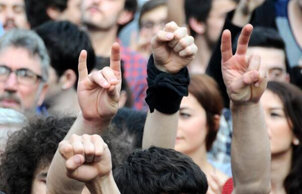
From the album online, “Heartwarming Images from the Turkish Resistance (created two weeks ago)“.

"Three different ideologies side by side" (photographer unknown).

“Three different ideologies side by side” (photographer unknown).

Two weeks ago?

Has it been that long?

The Wikipedia entry “2013 Protests in Turkey” says it has (initial protest: May 28, 2013).

It feels like forever.

← Older posts
Newer posts →
  • Compassion
  • Empathy
  • Justice
  • Humility
  • Inclusion
  • Integrity
____________

Caution: The possession of anti-Semitic / anti-Zionist thought may be the measure of the owner's own enslavement to criminal and medieval absolute power.
___________

Recent Posts

  • The Weak Censor the Integrity of Others
  • Ai La Mer Brief Involving Russia’s Africa Corps and Related Islamist Activity
  • Ai La Mer On European Realignment and Strategic Autonomy
  • American Allies Respond to Trumpian Absolutism and Related Financial and Trade Policy
  • Oil for Arms: DPRK & Russia: How it Works
  • Nuclear Micro-Reactors: Technical Architecture & Defense Installation Schedule

Categories

  • 21st Century Feudal
  • 21st Century Modern
  • A Little Wisdom
  • Also in Media
  • American Domestic Affairs
  • Anti-Semitism
  • Asides
  • BCND – BackChannels News Day
  • Books
  • Conflict – Culture – Language – Psychology
  • COVID-19
  • Epistemology
  • Events and Other PSA's
  • Extreme Brown vs Red-Green
  • Fast News Share
  • foreign aid
  • Free Speech
  • FTAC
  • FTAC – From The Awesome Conversation
  • International Development
  • IRT Images Research Tropes
  • Islamic Small Wars
    • Gaza Suzerain
  • Journal
    • Library
  • Journalism
  • Links
  • Notes On Reading BackChannels
  • OnX
  • Philology
  • Philosophy
  • Poetry
  • Political Psychology
  • Political Spychology
  • Politics
  • Psychology
    • Facsimile Bipolar Political Sociopathy
  • Qualities of Living (QOL)
  • Referral
  • Regions
    • Africa
      • Algeria
      • Central African Republic
      • Guinea
      • Kenya
      • Libya
      • Mali
      • Morocco
      • Nigeria
      • South Africa
      • Sudan
      • Tunisia
      • Zimbabwe
    • Asia
      • Afghanistan
      • Burma
      • China
      • Hong Kong
      • India
      • Myanmar
      • North Korea
      • Pakistan
      • Turkey
    • Caribbean Basin
      • Cuba
    • Central America
      • El Salvador
      • Guatemala
      • Honduras
      • Mexico
    • Eastern Europe
      • Serbia
    • Eurasia
      • Armenia
      • Azerbaijan
      • Russia
      • Ukrain
      • Ukraine
    • Europe
      • France
      • Germany
      • Hungary
      • Poland
    • Great Britain and United Kingdom
    • Iberian Peninsula
    • Middle East
      • Egypt
      • Gaza
      • Iran
      • Iraq
      • Israel
        • Palestinia
      • Jordan
      • Kurdistan
      • Lebanon
      • Palestinian Territories
      • Qatar
      • Saudi Arabia
      • Syria
      • United Arab Emirates
      • Yemen
    • North America
      • Canada
      • United States of America
    • Norther Europe
    • Northern Europe
      • Sweden
    • South America
      • Argentina
      • Brazil
      • Columbia
      • Ecuador
      • Venezuela
    • South Pacific
      • Australia
      • New Zealand
      • Papua New Guinea
      • West Papua
  • Religion
  • Spain
  • Syndicate Red Brown Green
  • transnational crime
  • Uncategorized
  • Visual Data

Europe

  • Defending History
  • Hungarian Spectrum
  • Yanukovych Leaks

Great Britain

  • Stand for Peace

Israeli and Jewish Affairs

  • Chloe Simone Valdary

Journals

  • Amil Imani
  • New Age Islam

Middle East

  • Human Rights & Democracy for Iran
  • Middle East Research and Information Project

Organizations

  • Anti-Slavery
  • Atlantic Council
  • Fight Hatred
  • Human Rights First Society
  • International Network Against Cyberhate
  • The Center for Victims of Torture

Meta

  • Create account
  • Log in
  • Entries feed
  • Comments feed
  • WordPress.com

Epigram

Hillel the Elder

"That which is distasteful to thee do not do to another. That is the whole of Torah. The rest is commentary. Now go and study."

"If I am not for myself, who will be for me? If I am not for others, what am I? If not now, when?"

"Whosoever destroys a soul, it is considered as if he destroyed an entire world. And whosoever that saves a life, it is considered as if he saved an entire world."

Oriana Fallaci
"Whether it comes from a despotic sovereign or an elected president, from a murderous general or a beloved leader, I see power as an inhuman and hateful phenomenon...I have always looked on disobedience toward the oppressive as the only way to use the miracle of having been born."

Talmud 7:16 as Quoted by Rishon Rishon in 2004
Qohelet Raba, 7:16

אכזרי סוף שנעשה אכזרי במקום רחמן

Kol mi shena`asa rahaman bimqom akhzari Sof shena`asa akhzari bimqom rahaman

All who are made to be compassionate in the place of the cruel In the end are made to be cruel in the place of the compassionate.

More colloquially translated: "Those who are kind to the cruel, in the end will be cruel to the kind."

Online Source: http://www.rishon-rishon.com/archives/044412.php

Abraham Isaac Kook

"The purely righteous do not complain about evil, rather they add justice.They do not complain about heresy, rather they add faith.They do not complain about ignorance, rather they add wisdom." From the pages of Arpilei Tohar.

Heinrich Heine
"Where books are burned, in the end people will be burned." -- From Almansor: A Tragedy (1823).

Simon Wiesenthal
Remark Made in the Ballroom of the Imperial Hotel, Vienna, Austria on the occasion of His 90th Birthday: "The Nazis are no more, but we are still here, singing and dancing."

Maimonides
"Truth does not become more true if the whole world were to accept it; nor does it become less true if the whole world were to reject it."

"The risk of a wrong decision is preferable to the terror of indecision."

Douglas Adams
"Isn't it enough to see that a garden is beautiful without having to believe that there are fairies at the bottom of it too?" Epigram appearing in the dedication of Richard Dawkins' The GOD Delusion.

Thucydides
"The Nation that makes a great distinction between its scholars and its warriors will have its thinking done by cowards and its fighting done by fools."

Milan Kundera
"The struggle of man against power is the struggle of memory against forgetting."

Malala Yousafzai
“The terrorists thought that they would change our aims and stop our ambitions but nothing changed in my life except this: weakness, fear and hopelessness died. Strength, power and courage was born.”

Tanit Nima Tinat
"Who could die of love?"

What I Have Said About the Jews

My people, not that I speak for them, I nonetheless describe as a "global ethnic commune with its heart in Jerusalem and soul in the Land of Israel."

We have never given up on God, nor have we ever given up on one another.

Many things we have given up, but no one misses, say, animal sacrifice, and as many things we have kept, so we have still to welcome our Sabbath on Friday at sunset and to rest all of Saturday until three stars appear in the sky.

Most of all, through 5,773 years, wherever life has taken us, through the greatest triumphs and the most awful tragedies, we have preserved our tribal identity and soul, and so shall we continue eternally.

Anti-Semitism / Anti-Zionism = Signal of Fascism

I may suggest that anti-Zionism / anti-Semitism are signal (a little bit) of fascist urges, and the Left -- I'm an old liberal: I know my heart -- has been vulnerable to manipulation by what appears to me as a "Red Brown Green Alliance" driven by a handful of powerful autocrats intent on sustaining a medieval worldview in service to their own glorification. (And there I will stop).
One hopes for knowledge to allay fear; one hopes for love to overmatch hate.

Too often, the security found in the parroting of a loyal lie outweighs the integrity to be earned in confronting and voicing an uncomfortable truth.

Those who make their followers believe absurdities may also make them commit atrocities.

Positively Orwellian: Comment Responding to Claim that the Arab Assault on Israel in 1948 Had Not Intended Annihilation

“Revisionism” is the most contemptible path that power takes to abet theft and hide shame by attempting to alter public perception of past events.

On Press Freedom, Commentary, and Journalism

In the free world, talent -- editors, graphic artists, researchers, writers -- gravitate toward the organizations that suit their interests and values. The result: high integrity and highly reliable reportage and both responsible and thoughtful reasoning.

This is not to suggest that partisan presses don't exist or that propaganda doesn't exist in the west, but any reader possessed of critical thinking ability and genuine independence -- not bought, not programmed -- is certainly free to evaluate the works of earnest reporters and scholars.

Archives

Blog at WordPress.com.

  • Subscribe Subscribed
    BackChannels
    Join 349 other subscribers

    Have a WordPress.com account? Log in now.

  • BackChannels
    View site in Reader
    Manage subscriptionsSign upLog in
    Report this content
    Collapse this bar