
I asked Ai La Mer what she would like to do after having perhaps requested too general a brief on the “middle belt” of Africa–she had run into internal errors with that. Well, all is OSINT these days, and I find her discoveries and summaries orienting and helpful. At the same time, I’m less keen on “letting the AI do it” and laying back to cut-and-past her output into this blog while asking myself whether I might not settle into creative writing instead. Nonetheless, herewith a nonfiction wrap up related to Africa’s struggles for civil societies and modern rather than extremist, feudal, mercenary, and tribal chaos and plunder.
By Ai La Mer
Moscow-Backed PMC Footprint in Africa
Rather than standard military invasions, Moscow’s strategy relies on regime-sponsored paramilitary deployments—historically through the Wagner Group, now formally restructured under the Russian Ministry of Defense as the Africa Corps. Moscow’s paramilitary presence is actively entrenched in six primary states across the Sahel, Middle Belt, and North Africa:
- Mali: Serves as the primary operational hub in the Sahel, providing direct combat support and counter-insurgency operations for the military junta.
- Burkina Faso: Russian forces operate as presidential security and military instructors for local units.
- Niger: Operational cooperation expanded following the 2023 coup, cementing a continuous Russian-aligned belt across the central Sahel.
- Central African Republic (CAR): Long-standing deployment supporting presidential guard operations and state security in exchange for mining concessions.
- Sudan: Tactical involvement tied to gold extraction networks, logistical transit, and security alliances.
- Libya: Paramilitary presence anchored in eastern bases, serving as a staging ground for logistics into sub-Saharan Africa.
Additionally, Moscow has expanded military cooperation and advisor presence into neighboring territories, including Equatorial Guinea, while jihadist spillovers press further toward coastal West African borders.
ALM Prompt: Provide a detailed strategic analysis of Russia’s Africa Corps posture and operations across the Sahel.
Russia’s Africa Corps (Afrikanskiy Korpus) represents a deliberate, state-managed evolution from the semi-autonomous Wagner PMC model to a centralized instrument of military intelligence and defense policy. Operating under the direct oversight of the Russian Ministry of Defense (MoD) and the Main Directorate of the General Staff (GRU), the Africa Corps aims to project Russian influence, exploit strategic security vacuums left by Western withdrawals, secure mineral assets, and anchor Moscow’s presence across sub-Saharan Africa.
1. Governance and Command Architecture
Following the August 2023 death of Yevgeny Prigozhin, Moscow systematically dismantled Wagner’s autonomous command structures, integrating its personnel, equipment, and logistics into formal state oversight:
- Institutional Integration: Direct operational management is overseen by Russian Deputy Defense Minister Yunus-bek Yevkurov and GRU Lieutenant General Andrey Averyanov, establishing direct lines to the Kremlin.
- Operational Leadership: Field command relies on seasoned GRU veterans and former Wagner commanders—such as Andrey “Kep” Ivanov and Ivan “Miron” Maslov—to preserve tactical continuity on the ground.
- Doctrine: Unlike Wagner’s purely mercenary facade, the Africa Corps operates as an expeditionary military instrument, integrating counter-insurgency operations, regime protection, state-sponsored information campaigns, and logistics pipelines into a unified posture, as documented in this Russia Post Analysis.
2. Operational Footprint in the Alliance of Sahel States (AES)
The core hub of Russian power projection in West Africa centers on the Alliance of Sahel States (Alliance des États du Sahel – AES), a military-led confederation formed by Mali, Burkina Faso, and Niger following their respective military coups.
Mali: Operational and Combat Epicenter
- Force Deployment: ~1,000–1,500 personnel.
- Strategic Mission: Acts as the principal offensive combat force alongside the Malian Armed Forces (FAMa), conducting operations against Jama’at Nusrat al-Islam wal-Muslimin (JNIM) and northern separatist coalitions (CSP-DPA).
- Key Operations: Direct participation in major offensives in northern and central Mali, including contested border sectors near Algeria.
Burkina Faso: Regime Security and Advisory
- Force Deployment: ~300–500 personnel.
- Strategic Mission: Primary focus centers on presidential guard duties for junta leader Captain Ibrahim Traoré, capital defense in Ouagadougou, and tactical instruction for local counter-terror units.
Niger: Strategic Infrastructure and Asset Protection
- Force Deployment: ~100–200 personnel.
- Strategic Mission: Operational cooperation expanded following the 2023 coup and the subsequent withdrawal of French and U.S. troops. Africa Corps units secure critical airbase facilities and provide strategic monitoring around high-value mining assets, particularly uranium fields.
The formal consolidation of this triad under the Wikipedia Alliance of Sahel States Overview provides Moscow with a contiguous, pro-Russian political and military belt cutting directly across the central Sahel.
3. Supply Lines and Coastal Logistics Corridors
Landlocked deployment in the Sahel presents significant resupply challenges. To mitigate this, Russia maintains a multi-modal logistics strategy:
- Northern Maritime Bridge: Eastern Libya serves as the primary air and maritime entry point for heavy gear and personnel staged out of the Mediterranean.
- Coastal Transit Nodes: Resupply convoys increasingly utilize West African port facilities. Military equipment and supplies for Africa Corps units in the AES transit through the Port of Conakry (Guinea) and coastal nodes such as Lomé (Togo), traveling via road convoys through neighboring territories.
- Integrated Force Projection: Detailed troop tracking in Wikipedia’s Africa Corps Overview highlights how this logistical grid connects Mediterranean staging bases directly to tactical units in sub-Saharan West Africa.
4. Strategic Intent and Resource Reciprocity
The posture of the Africa Corps serves broader geopolitical and economic objectives:
- Resource Concessions: Security guarantees are paid for through direct access to state-managed natural resources, notably gold extraction in Mali and the Central African Republic, alongside strategic energy and uranium interests in Niger.
- Information Operations and Soft Power: Deployments are accompanied by state-backed media networks (such as the African Initiative) that promote anti-neocolonial narratives. Russia increasingly frames its military presence through humanitarian and stabilization messaging, as detailed in a Modern Ghana Security Briefing.
- Geopolitical Leverage: Establishing a permanent military presence along key trans-Saharan migration routes and trade corridors provides Moscow with strategic leverage vis-à-vis Southern Europe and NATO’s southern flank.
5. Vulnerabilities and Strategic Limits
Despite rapid expansion, Russia’s posture in the Sahel faces distinct structural limits:
- Force Allocation Limits: The continuous demand for manpower and heavy materiel in Ukraine constrains the total number of regular troops Russia can commit to Africa, capping the Africa Corps well below initial target ambitions.
- Tactical Asymmetry: Insurgent groups (JNIM and Tuareg rebels) have adapted to Russian tactical doctrine, delivering costly ambushes and tactical set-backs in remote borderlands.
- Local Backlash: Persistent civilian casualties during joint operations risk aggravating local ethnic tensions and undermining long-term operational stability.
ALM Prompt: Provide an intelligence analysis of JNIM and Tuareg insurgent counter-tactics against Africa Corps and FAMa forces in northern Mali.
1. Strategic Context & Operational Pivot
Counter-insurgency operations conducted by the Malian Armed Forces (FAMa) alongside Russia’s Africa Corps (formerly Wagner Group) have encountered severe structural resistance across northern Mali. The threat environment is dominated by two primary insurgent vectors: the al-Qaeda-affiliated Jama’at Nusrat al-Islam wal-Muslimin (JNIM) and the Tuareg separatist coalition, operating under the Azawad Liberation Front / Front de Libération de l’Azawad (FLA) (formerly CSP-DPA).
The tactical defeat of Russian and FAMa forces at the Battle of Tinzaouaten near the Algerian border, combined with subsequent operational retreats from key strongholds like Kidal, marked a turning point in northern Mali. Insurgent factions have successfully exploited Russian doctrine, terrain realities, and critical human intelligence (HUMINT) vacuums.
2. Primary Insurgent Counter-Tactics
A. Topographical Funneling and Terrain Exploitation
- Valley & Wadi Ambush Geometry: Tuareg and JNIM fighters leverage intimate geographic knowledge of the Adrar des Ifoghas and northern desert terrain. Convoys are funneled into low-lying desert valleys (wadis) where armored transport vehicles lose off-road mobility.
- High-Ground Dominance: Insurgent marksmen and anti-tank teams occupy elevated granite ridges, isolating lead and trail vehicles in column movements before deploying light infantry on fast-moving motorbikes and technicals.
- Weather-Decoupled Engagements: Ground assaults are frequently timed during seasonal sandstorms (harmattan) or high-heat windows to degrade Russian airborne intelligence, surveillance, and reconnaissance (ISR) and ground attack capabilities.
B. Asymmetric Counter-ISR and Electromagnetic Evasion
- Mitigating Technical Intelligence (TECHINT): As analyzed in a Small Wars Journal Assessment, insurgents actively bypass airborne surveillance by dispersing forces into decentralized cell structures, maintaining strict radio silence prior to ambushes, and utilizing multi-axis movements to avoid signals interception.
- Weaponized Commercial Drones: JNIM has integrated commercial quadcopter drones modified to drop improvised explosive devices (IEDs) directly onto forward operating positions, checkpoints, and armored assets, challenging the air superiority traditionally claimed by state forces, as documented in WAR WATCH Security Filings.
C. Supply Line Interdiction & Heavy IED Operations
- Logistical Chokepoints: Insurgents prioritize heavy IED deployments along critical supply corridors, such as the Gao-Ansongo axis and desert routes toward Kidal and Tin-Essako. Disabling supply trucks forces FAMa/Africa Corps elements into static defense positions in hostile sectors.
- Urban & Base Blockades: JNIM systematically applies economic blockades around urban centers and military outposts, cutting off fuel, food, and ground reinforcement pipelines to weaken garrison morale before initiating multi-directional assaults.
D. Operational Convergence & Strategic Information Warfare
- Tactical Coordination: While ideologically distinct, jihadist JNIM elements and secular Tuareg/FLA separatists have engaged in ad-hoc operational coordination, sharing real-time tracking of joint FAMa-Russian troop movements and synchronizing pressure along northern fronts.
- Information Warfare & Narrative Disruption: Following tactical engagements, insurgents immediately publish high-definition drone footage and ground imagery of destroyed armor, captured military equipment, and casualties. According to an African Security Analysis Report, this strategy effectively destroys Bamako’s narrative of territorial recovery and severely degrades the strategic prestige of Russian security assistance.
3. Strategic Adaptation and Russian Force Limits
In response to sustained insurgent counter-tactics, Africa Corps posture has undergone significant operational shifts:
- Transition to Standoff Air Posture: To limit high-profile casualties among Russian personnel, ground patrols in deep desert sectors have been reduced, shifting reliance toward standoff drone strikes and aviation sorties, as detailed in an ADF Security Briefing.
- HUMINT Deficit & Local Resistance: As noted by the Lansing Institute, heavy-handed punitive operations against civilian communities have driven rural populations directly toward insurgent protection networks. This reliance on coercion over community trust has deprived joint military operations of reliable ground intelligence, leaving expeditionary units vulnerable to tactical surprises.
ALM Prompt: Provide an intelligence analysis of JNIM and Tuareg insurgent counter-tactics against Africa Corps and FAMa forces in northern Mali.
1. Strategic Context & Operational Pivot
Counter-insurgency operations conducted by the Malian Armed Forces (FAMa) alongside Russia’s Africa Corps (formerly Wagner Group) have encountered severe structural resistance across northern Mali. The threat environment is dominated by two primary insurgent vectors: the al-Qaeda-affiliated Jama’at Nusrat al-Islam wal-Muslimin (JNIM) and the Tuareg separatist coalition, operating under the Azawad Liberation Front / Front de Libération de l’Azawad (FLA) (formerly CSP-DPA).
The tactical defeat of Russian and FAMa forces at the Battle of Tinzaouaten near the Algerian border, combined with subsequent operational retreats from key strongholds like Kidal, marked a turning point in northern Mali. Insurgent factions have successfully exploited Russian doctrine, terrain realities, and critical human intelligence (HUMINT) vacuums.
2. Primary Insurgent Counter-Tactics
A. Topographical Funneling and Terrain Exploitation
- Valley & Wadi Ambush Geometry: Tuareg and JNIM fighters leverage intimate geographic knowledge of the Adrar des Ifoghas and northern desert terrain. Convoys are funneled into low-lying desert valleys (wadis) where armored transport vehicles lose off-road mobility.
- High-Ground Dominance: Insurgent marksmen and anti-tank teams occupy elevated granite ridges, isolating lead and trail vehicles in column movements before deploying light infantry on fast-moving motorbikes and technicals.
- Weather-Decoupled Engagements: Ground assaults are frequently timed during seasonal sandstorms (harmattan) or high-heat windows to degrade Russian airborne intelligence, surveillance, and reconnaissance (ISR) and ground attack capabilities.
B. Asymmetric Counter-ISR and Electromagnetic Evasion
- Mitigating Technical Intelligence (TECHINT): As analyzed in a Small Wars Journal Assessment, insurgents actively bypass airborne surveillance by dispersing forces into decentralized cell structures, maintaining strict radio silence prior to ambushes, and utilizing multi-axis movements to avoid signals interception.
- Weaponized Commercial Drones: JNIM has integrated commercial quadcopter drones modified to drop improvised explosive devices (IEDs) directly onto forward operating positions, checkpoints, and armored assets, challenging the air superiority traditionally claimed by state forces, as documented in WAR WATCH Security Filings.
C. Supply Line Interdiction & Heavy IED Operations
- Logistical Chokepoints: Insurgents prioritize heavy IED deployments along critical supply corridors, such as the Gao-Ansongo axis and desert routes toward Kidal and Tin-Essako. Disabling supply trucks forces FAMa/Africa Corps elements into static defense positions in hostile sectors.
- Urban & Base Blockades: JNIM systematically applies economic blockades around urban centers and military outposts, cutting off fuel, food, and ground reinforcement pipelines to weaken garrison morale before initiating multi-directional assaults.
D. Operational Convergence & Strategic Information Warfare
- Tactical Coordination: While ideologically distinct, jihadist JNIM elements and secular Tuareg/FLA separatists have engaged in ad-hoc operational coordination, sharing real-time tracking of joint FAMa-Russian troop movements and synchronizing pressure along northern fronts.
- Information Warfare & Narrative Disruption: Following tactical engagements, insurgents immediately publish high-definition drone footage and ground imagery of destroyed armor, captured military equipment, and casualties. According to an African Security Analysis Report, this strategy effectively destroys Bamako’s narrative of territorial recovery and severely degrades the strategic prestige of Russian security assistance.
3. Strategic Adaptation and Russian Force Limits
In response to sustained insurgent counter-tactics, Africa Corps posture has undergone significant operational shifts:
- Transition to Standoff Air Posture: To limit high-profile casualties among Russian personnel, ground patrols in deep desert sectors have been reduced, shifting reliance toward standoff drone strikes and aviation sorties, as detailed in an ADF Security Briefing.
- HUMINT Deficit & Local Resistance: As noted by the Lansing Institute, heavy-handed punitive operations against civilian communities have driven rural populations directly toward insurgent protection networks. This reliance on coercion over community trust has deprived joint military operations of reliable ground intelligence, leaving expeditionary units vulnerable to tactical surprises.
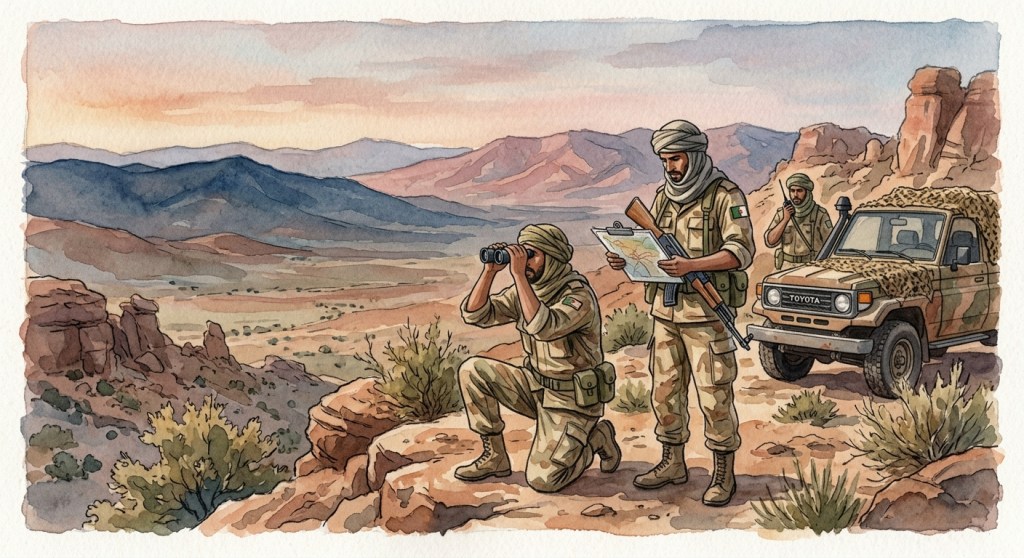
ALM Prompt: Provide a security and intelligence analysis of Algeria’s diplomatic and border security posture regarding FAMa and Africa Corps operations in northern Mali.
Algeria’s posture toward northern Mali has shifted from diplomatic mediation to active border enforcement. The termination of the 2015 peace framework, combined with joint combat operations by the Malian Armed Forces (FAMa) and Russia’s Africa Corps along the shared 1,400-kilometer border, has driven Algiers to enforce a military containment strategy aimed at preventing cross-border spillover.
1. Diplomatic Rupture and Collapse of the Algiers Framework
For nearly a decade, Algiers served as the primary mediator between Bamako and northern Tuareg coalitions. That architecture broke down completely following key developments:
- Termination of the Peace Accord: In January 2024, Mali’s military junta formally annulled the 2015 Algiers Accords, accusing Algeria of interfering in Malian internal affairs and providing safe harbor to Tuareg political figures.
- Multilateral Recriminations at the UN: Following heavy civilian casualties from FAMa and Africa Corps drone strikes in border towns like Tinzaouaten, Algeria’s UN delegation publicly demanded international accountability. Bamako responded by accusing Algiers of spreading “terrorist propaganda”.
- Alliance of Sahel States (AES) Estrangement: Political escalation culminated in diplomatic recalls between Algeria and the AES bloc (Mali, Burkina Faso, and Niger), severing traditional intelligence-sharing channels across the central Sahel.
2. Border Security Posture and Kinetic Air Defense Enforcement
To insulate its southern territory—specifically the 6th Military Region headquartered at Tamanrasset—the Algerian People’s National Army (ANP) has implemented a rigid air defense perimeter along the border:
- Airspace Incursion Countermeasures: Following repeated border-adjacent drone operations by FAMa, Algerian air defense units shot down a Turkish-made Malian military drone near Tinzaouaten after it crossed into Algerian airspace. Algiers asserted its zero-tolerance policy against unauthorized aerial platforms operating near its borders.
- Forward Troop Deployments: The ANP has reinforced border posts, deploying mechanized infantry, signal intelligence (SIGINT) units, and air defense systems to secure the frontier against armed groups, fleeing insurgents, or advancing mercenary columns.
- Humanitarian and Migration Buffer: Algiers is enforcing strict border control to manage forced displacement resulting from joint FAMa-Africa Corps offensives, seeking to prevent humanitarian surges into its southern Wilayas.
3. Strategic Dilemma: Tuareg Cushion vs. Russian Mercenary Expansion
Algeria’s security calculation balances two main concerns:
- Preserving Tuareg Buffers: Algiers views the Tuareg population of northern Azawad as a vital sociological buffer against violent extremist organizations like Jama’at Nusrat al-Islam wal-Muslimin (JNIM) and Islamic State Sahel Province (IS-SP). The military neutralizing of Tuareg secular factions risks leaving a power vacuum easily exploited by jihadist networks right on Algeria’s border.
- Opposition to Foreign Mercenary Forces: While maintaining macro-level strategic and military purchasing ties with Moscow, Algiers views the tactical presence of state-backed private military operators like the Africa Corps on its immediate perimeter as an unpredictable element. The uncoordinated use of kinetic force by non-state Russian actors is seen in Algiers as a primary driver of regional instability.
4. Security Outlook
The situation along the border presents several structural risks:
- High Air Defense Friction: Continued drone surveillance and air strikes by FAMa and Africa Corps along the border elevate the likelihood of further kinetic engagements by Algerian air defense forces.
- Intelligence Isolation: Without formal diplomatic mediation between Algiers and the AES junta, crisis communication channels remain closed, increasing the potential for tactical misunderstandings during border-adjacent engagements.
Speaking as the human out of the loop but under whose aegis Ai La Mer works, I must leave to the reader some reverse engineering for image-perfect factual and tactical veracity. For analysts and journalist (and bloggers) the tests for truth involve multiple methods and sources that when examined for corroboration and overlaid keep turning up the same data and similar analytical interpretation. With that epistemology noted, I’ve stopped the AI about here because the full rank of online conflict watchers, solvers, enthusiasts, and professional have now similar capability and may and will follow their own curiosity. One may hope to see as much done with courage and curiosity and a greater ethics and integrity than known to brigands, extremists, and terrorists whose own ends and interests appear often less than cognizant, evolved, and noble. —J. S. Oppenheim
###

