. . . religion may layer above other language-derived and driven social programming, so obtaining a reform with buy-in in any part may entail driving down into more deeply embedded thought processes and social procedures derived in relation to fetal and infantile listening and signal discernment.
Political and religious axis may present comparatively sophisticated “content scripts” — once we know how to figure out what’s important in our earliest years, we may then start learning more about our environments in language or as language cultures.
If we pick up a program rule, e.g., what happens in the family stays in the family, we may then bend speech to suit it. The example given and involving privacy and a common boundary where families are nuclear may be part of a near universal experience, but private relationships may also be deeply extended and some combine of other values enforced, including some having to do with loyalty and silence foremost, contempt for others close by, and concerns for good conduct and integrity nulled as regards outsiders.
I suspect the “cavemen” not so burdened by these considerations and, perhaps with the young like teens everywhere, more quick to assert themselves than to comprehend themselves.
A cultures laws, religion, and tradition may seem comprehensive and rich in design and deployment while actually expression less observed — for being omnipresent — habits of language and mind.
From the instant the fetus experiences sound, the organism has a pleasant survival-oriented task that it may attend essentially without distraction: our baby experiences . . . experience through the mother’s chemistry, his own, and through the ears.
We’re born listeners even if we may not seem to be listening while oscillating between gurgles and howls and sleep.
What’s in the air in the environment, whether sweet music or sharp tongues, the bang of explosions, the susurration or a breeze bothering leafy branches, gets into the head, and the match with language gets figured out as may relative social values and manners of use, what to say and how to say it when and to whom.
_____
Language as a behavior and narcissism as expressive of self-concept associated with language behavior provide two conceptual tools for taking apart the drivers in personality that energize and sustain the intellectual or content-rich scripts involved in speech in conflict processes. I would suggest that it’s the underlying language programming, which is of wild invention within a cultural “development boundary” — the edge of the tribal land — rather than the overlaid script that produces war when war, itself a behavior, is heavily dependent on ideas about cultural and personal realities.
Arms trafficking, money laundering, personal enrichment, protection for gangsters, extortion and kickbacks, suitcases full of money and secret offshore bank accounts in Cyprus and Switzerland: the cables unpick a dysfunctional political system in which bribery alone totals an estimated $300 billion a year, and in which it is often hard to distinguish between the activities of government and organized crime.
Among the most striking allegations contained in the cables, which were leaked to the whistleblowers’ website WikiLeaks, are:
• Russian spies use senior mafia bosses to carry out criminal operations such as arms trafficking.
• Law enforcement agencies such as the police, spy agencies and the prosecutor’s office operate a de facto protection racket for criminal networks.
• Rampant bribery acts like a parallel tax system for the personal enrichment of police, officials and the KGB’s successor, the federal security service (FSB).
Snowden’s father, Lon, also expressed his gratitude to Russian President Vladimir Putin for protecting his son from the legal consequences of having violated his NSA confidentiality obligations.
*
Human Rights Watch analysts also took note of the irony of the Kremlin coming to the defense of a self-styled champion of privacy and free speech rights.
“He cannot but be aware of the unprecedented crackdown on human rights that the government has unleashed in the past 15 months,” Rachel Denber, the rights group’s expert on Russia and other former Soviet states told the Associated Press by email.
Throw away God; give up on one humanist ideology or another: what’s left?
Money.
Are governments businesses?
Who do they serve?
Among those served, what are they serving?
* * *
In the capitalist democracies, most expect private businesses to keep proprietary the business processes, relationships, and technologies that enable their sales, investment strategies, and accumulations of wealth distributed back to stakeholders or to the public in the form of consumer spending. As regards governments, they may be expected to keep secret fundamental military and security edges involving security intelligence and operations. These days, whether with billions networked through criminal pacts or blacked out for “black ops” budgets, governments, known criminal or not, would seem to be transitioning into deeply feudal empires — not of, for, or by The People but of, for, and by Some (Very Enriched) People.
______
Spanish police arrested four people Friday suspected of laundering large sums of money from Russian criminal gangs as part of a network they said may be linked to Semion Mogilevich, one of the FBI’s ten most wanted fugitives.
The arrests took place in the Mediterranean coastal town of Lloret de Mar near Barcelona, which has a large Russian community and is popular with tourists from the country, police said in a statement.
The four are suspected of tax fraud, document falsification and money laundering.
MOTHERBOARD: Let’s start with public perception. People believe the Taliban is fueling the drug trade in Afghanistan. To what extent is this true, and why is it so widely believed?
The Taliban are players in the Afghan drug trade, but minor ones in relative terms. Perhaps the best way to demonstrate this is to look at the value of the annual drug trade within Afghanistan, which is about $3 billion. The Taliban capture only about 5 to 10 percent of those profits. The bulk of the profits is appropriated by other groups, such as traffickers, government and police officers, as well as warlords.
Web searched first-page reference to data on the Taliban’s narcotics trafficking seems to trail off for 2013, but relayed at the bottom of this post, there’s combat footage from early 2013 posted just six days ago.
No pun intended here either: the impression as regards the latest admixtures of crime and politics is getting rich.
According to American national intelligence watcher Tim Shorrock (reference: Spies for Hire), the annual bill for U.S. security-oriented intelligence efforts approximates $52 billion, not that the distribution is known. The social integration of the state’s population with its defense and security sectors may suffice for trust — are we going to trust our neighbors or not? — but the informational dark space created by the development of a large population of government-employed or contracted secrets keepers may not bode well for democracy.
Who is getting that intelligence budget?
On what basis?
To what end?
Shorrock’s sturdy journalism illuminates many paths in the national security intelligence complex, but as seems true today in Russia, the public may be told that it’s being served, but given the enormity of the spooky business and its continuing growth in its institutional aspect, public also has room – more cause – to suspect otherwise.
This is not to impugn the American intelligence community: by and large, we still trust our neighbors.
With help from books like Spies for Hire, the privileges known to the free press and more affirmed than not (so far as I know — and infringements by government gets play in the press pretty damned quick), and the web, it’s not that hard getting a glimpse of the cobbling developed to counter the narcotics trade, the terrorism business, and other contributors to international crime.
Still, the more a government privileges a class with secrets-keeping powers, the more paranoia it may inspire in those who are not of it.
* * *
But, without naming names, Medvedev said Russia should be careful about freeing people convicted of crimes like hooliganism – the charge in the Pussy Riot case – and theft, which was the indictment against Khodorkovsky.
“Our people really are not much inclined, for example, to conduct acts of amnesty for individuals involved in violent crimes, for individuals who committed crimes against society, including hooliganism,” Medvedev said in a TV interview.
In political Russia, it appears deflection has become a high art.
The Khodorkovsky case has become legend and no realist expects more from the Kremlin then in its realpolitik the continued expression of absolute power that has dogged the matter from before the arrest stage and forward.
I’ve chided Pussy Riot (no, children, we do not take bawdy shows into churches without a big, friendly invitation) but most watchers feel the Kremlin’s punishment back-to-the-gulag! vulgarity bespeaks itself of criminal callousness.
In Medvedev’s above cited statement, the infantilizing of the Russian people by way of a paternalist stance should be as clear to neutral onlookers as the heightened projections of criminality. “Pussy Riot” may indeed be a vulgar noun, but the girls are not the evil ones; as for Khodorkovsky, he appears to have leaned westward with Yukos and in the direction of integrity (gasp!).
Since the late 1990s, Khodorkovsky had taken steps to transform Yukos along the lines of western business models. These steps included the introduction of corporate transparency, the adoption of western accounting standards, the hiring of western management, the creation of an independent board of directors with a corporate governance subcommittee, corporate growth through mergers and acquisitions, and increased western investments. These actions had marked Khodorkovsky as an outspoken leader who was pro-western and challenged the non-transparent means by which government and business operated in the Russian energy sector. These practices, along with the possibility of Yukos selling a major stake to Exxon Mobil or Chevron, deeply unsettled the Kremlin.
With Russia as with Syria as with, not so oddly, Islamic Jihad in large part, one may expect the patina of legitimate cause to wear away before the eyes of a widening and more profoundly comprehending global public. Even so obvious, so visible, however, one wonders about the better options available to that same public.
One may note that Zimbabwe’s Robert Mugabe has survived decades in power without a shred of statewide legitimacy left intact, but the crowds of those patronized, the money involved (for himself and those to whom he distributes spoils) has proven sufficient to lead him into his 90s with probably a fairly good night’s sleep.
A note on narcissism and vanity: both are to be found universally in the human experience. The aspect of malignancy is social and transactional — it has to do with HOW we do our thing and what we might do to others to do it. The difference is that between fair dealing and mafia dealing; also between accountable and open democracy — if you can get it — and corrupt and thuggish tyranny; also between a president that preserves a democratic constitution and relinquishes power at the end of his term, and one who manipulates the law and his political surrounds to keep himself central to power and in power.
The subject of a sociopathic narcissism came up on a wall, and after putting in my two cents with “Facsimile Bipolar Political Sociopathy” — now a hobbyhorse of a phrase — I thought to give just a little more thought to what is contextual, what might better suit Hollywood than Washington, what is normal — or we should be without air conditioning, golf courses, and Cadillacs — and what is malign.
A part of “malignant narcissism” would seem to involve “license”, i.e., absence of conscience in regard to others and no brakes on behavior associated with boundaries, propriety, and, down the line, sadism as a dimension in the capricious and ultimate control of others.
As much the treatment of Shweyga Mullah within the Qaddafi household (at the hands of daughter-in-law Aline) stands signal (with much else from that regime) as to how crazed and depraved that cruelty may become.
“License” — perhaps Muhammad would have applied the term “exceeding limits” — seems to me a late expression along a curve that may find a basis in language (from the uptake stage) and “narcissistic mortification” for its path that will, for the person so affected, inevitably lead to the dehumanization and discounting of others.
“However, you all know the answer to the above questions. The painful truth is that much of the world is largely insensitive to the oppression and sufferings of Muslims” — the statement is not true, or I and so many others would not be engaged here at all. Every Muslim death matters! That the carnage involves Muslim-on-Muslim violence, however, makes every form of cooperation, criticism, and intervention difficult and problematic.
Just back of Harun Yahya’s statement lays a hidden grammatical rule involving the concept of loyalty that is true to the speaker but perhaps not every reader. The statement sides with Muslims on a familiar but provocative and timeless note: “it is more important, more safe, more good or good-feeling, to be with one’s own (on the basis of a single noun) than to be uncertain among others however decent and noble they may appear.” As much echoes the notion that it may be better to believe or tell a loyal lie than to live with an uncomfortable reality and truth.
Note that in the American Civil War, both sides held The Bible high in defense of their positions; perhaps similar ambiguity and ambivalence attends philosophy over the Qur’an; and it may be noted that Judaism involves itself eagerly in schismatic argument, but in Judaism, that’s part of the charm (look up “Hillel and Shammai”).
Values associated with the greater dignity of man, ennoblement — “One scholar is worth more against the devil . . . .” — may persist through the Ummah’s internal fighting and its interfaces, and I hope they do — but Islam’s travail ties to language behaviors and concepts largely irrelevant to others developed and engaged in living in other ways, largely nullifying the legitimacy of messianic intention, the mighty spark of “political Islam”.
“Bigotry” is a loyalty-related issue bound up in the social grammar of one talking head or another within some population. Reasonable and reasoning human beings contain themselves; nasty people may bait and provoke the reasonable; and nasty bigoted people cannot help themselves: with those, it’s “garbage in-garbage out” and the garbage probably gets in very, very early in the development of their verbal cognitive style to form the basis for the subsequent content and manners that erupt in their speech.
As of this moment, the Islamic Small Wars (ISWs) have nothing to do with how Jews think about Muslims, how Americans think about Muslims, how Buddhists and Hindus and Sudanese animists think about Muslims, or how Islamic Humanists think about Muslims, or even how Muslims think about Muslims. The ISWs have to do with assumptive thinking seeded into the mind at a very early age and bending adult thought in a rule-based way for a long time to come.
Without a language update, without the fresh breeze of free, considerate, and empathetic thought, without the good and sweet rest of imagination and heart and preparation, perhaps, for something a little different and much, much better, the Muslim-on-Muslim destruction and self-destruction (in myriad ways, much including the drugs-for-guns criminality of the Taliban) will continue.
“Tripoli” you know. “Misrata” and “Zintan”, probably, you don’t. Yet from such obscure sandpits come the scorpions to sting Libya’s still nascent revolution in the ass.
Instead of cooperating in the development of an open and progressing democracy, the militia, apparently, perhaps unknowingly as they act in their own self-interest, have set the stage for a loose confederation of feudal city states. We’ll learn soon to what extent, if any, yesterday’s handover to the military of militia positions in Tripoli proves merely cosmetic.
Setting aside the God Mob for a moment, the militia, whatever their motivation, own each the monopoly on arms within their own bailiwicks. Why should any give up control of an airstrip, oil field, port, or transfer point?
What’s in it for them after having ended the reign of Qaddafi?
* * *
The heavily armed groups, some of them led by Islamic extremists, have defied control by the weak central government, carving out fiefdoms, acting as a law unto themselves and imposing their control.
Esam Mohamed’s AP article posted to ABC goes on to note intentions to introduce law criminalizing “the illegal possession of arms” to get at “unruly militias”.
Yo! My fellow Americans: how is that gonna work?
It’s not going to be that easy with Libya, i.e., beefing up the Libyan military with NATO vitamins and punching down those unruly militia: the truth is the entire paradigms involving big kahuna and militia-warrior self-concept plus the idea of real sustainable power has to be addressed by way of the poetry installed in the heads of militia chiefs.
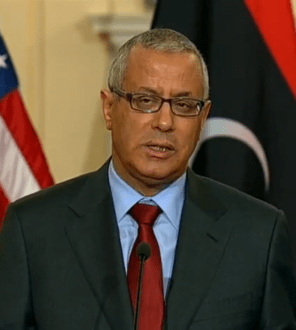
Libya’s Prime Minister Ali Zeidan.
The witnessing world (online, at least) knows how corruption and government have worked out in Afghanistan, Iraq, and Pakistan, also how the Muslim Botherhood has asserted its botherly values in Egypt, Syria (I am conflating MB with the Al Qaeda affiliates in that theater), and Turkey (if Erdogan had had the free rein he had hoped to possess): how is Libya’s central government to tell a city-state militia how fair the nascent state’s constitution, laws, and actual real political workings will be to his clan, family, and tribe the day he and his loyal own give up their arms and both the defensive and piratical capabilities implied — or demonstrated — by their ownership?
Libya’s Prime Minister Ali Zeidan and NATO may have to threaten other than force and offer other than corrupt deals to Libya’s seemingly equally nascent warlords to wrap around this challenge, which is not solely, or even practically, frankly, a military problem.
The fighting would seem to go on (and on and on) in the heart, and that is an intellectual problem, a problem in the language and related cultural conventions of the place.
* * *
Along the Popular Militia Fronts
Barqa Army — related:
The imposition of a political narrative by Libya’s eastern federalist movement, represented by the Cyrenaica Transitional Council (CTC), on the August series of strikes by the Petroleum Facilities Guard (PFG) has complicated Libya’s problem of widespread disruption to the oil and gas sector, which began in late 2012. The PFG, the body officially responsible for oilfield security, succeeded in shutting down all oil export operations in the east of Libya in mid-August.
That directly above may provide the Left with a good tale about greed and oil.
There’s something of Pakistan’s “Baluchistan Conflict” in the mix involving indigenous interests, much including armed ones, associated with the local outstanding natural resource and more remote nascent state interests in the same.
*
Nuri Abusahmain – President, General National Congress: ordered Libya Shield into Tripoli; reference also Wissam Bin Ahmid who leads Libya Shield.
“I don’t know why the Americans don’t come here,” said Wissam Bin Hamid, commander of the Libyan Shield Brigade, a militia that came under sustained attack while helping defend the second compound on Sept. 11. “Maybe they are afraid.”
Wissam’s (we have a way to go with the transliteration of Arab last names) took a hit defending the compound in Benghazi (I think that’s what I’ve read), but at the Arab world’s troubled nexus in which rightful autonomy slams into righteous and justifiable mistrust, Ahmid/Hamid has gotten a uniformly bad rap in the right-side’s anti-Jihad press.
The west wants to play it like a one-hour television drama: get in; get rid of the President-for-Life and some related assortment of knuckleheads; establish a democratic constitution; get out; chocolates, flowers, and champagne all around. Go team! However, with absolute authoritarianism the region’s bad habit in practice and in thought — and perhaps too in language — and the possession of a theocratic political ideology to match it, evolving forward proves an extraordinary challenge to those to whom it has been posed.
In an effort to oust Qaddafi, independent militias of varying strength have been formed inside Libya and are threatening regional security inside the country. Of these the Zintan militia is one of the foremost examples of a brigade with strong organizational skills, effective tactics and entrenched authority in their base city of Zintan. On December 10th, the Zintan brigade was involved in a firefight with the convoy of the ex-commander-in-chief of the National Army, Major General Khalifa Haftar. The Zintan Brigade acted without orders from the National Army, which they accused of not notifying them of the convoy’s approach to the Tripoli airport. It is becoming a major challenge for the Libyan Transitional Council to integrate these militiamen in the new security structure of Libya. The Zintan Brigade and other militias will continue to be key actors in Libya affecting the domestic security situation until they become fully integrated into the new Libyan National Army.
To some extent, the struggle is between Islamists and more secular-minded Libyans. If the Misratans are indeed pushed back to their home town, it will be a setback for the Islamists. At the heart of the retreating forces is the Libyan Shield, hitherto the most powerful of the militias, both in Misrata and in the country at large. It is allied to the Muslim Brotherhood’s Justice and Construction Party,
Armed militias are the real power in the land. They range from former revolutionaries to criminals to al-Qaeda affiliates. Some have taken over key Libyan oilfields. Others are providing muscle to those who want to set up a breakaway autonomous entity in the east of the country . . . The trouble is that the militias do not respond to polite requests.
Qaddafi’s bipolar semblance in public may be typical of the disorder’s associated delusional grandiose and messianic ideation.
The west has gotten around the problem posed by extraordinary revenue accruing to individuals and dynasties by invoking — albeit from time to time — the concept that is “noblesse oblige”: the expectation that the nobility must prove itself noble or face the wrath of the people, such wrath proving overwhelming across the four or five centuries preceding the 21st.
With the Qaddafi’s of the world too, the west has developed a so far applicable and useful conceptual inventory in psychology: we look at persons and various aspects and channels in their behavior and can perceive “bipolar disorder” or “narcissistic personality disorder” and in political psychology the manifestations of the “malignant narcissist”.
In the still medieval politics of Islam, power knows systematic corruption — bribery, intimidation, murder, patronage — and the tools known to all self-asserting “Men of Honor and Respect”, which is the humanity, essentially, associated with mafia dons.
For countermeasure within those societies as well as outside of them, the abstract invisible “hinge of fate” remains the cold hardened spiritual steel that all humanity knows to call “integrity” or equivalent: specifically the essential and irreducible identity and best qualities of the person as made by God and set out in relation to others.
Bedeviling that valued concept may be the consequences for remote tribes, their elders, and chiefs and sons and daughters of misplaced trust plus the realpolitik and real money that accompanies a host of feudal practices: start with “tribute” along “protected routes” and end somewhere around the preference for the telling of a loyal lie — or an advantageous one — over the clarity of a disadvantageous, inconvenient, or uncomfortable truth.
All in all, “resetting” Libya isn’t the government’s challenge: it’s the militia’s challenge and it has to do with resetting themselves without degrading or endangering their parochial interests or their image before those closest to them.
Some settlers may not be perfect 🙂 I don’t know for the paucity of mainstream media or otherwise vetted journalists combing the territory and less weighed down with agenda channeled by a special interest press. The “Pallywood” and issues related involve a stepped concept: the belief that 1) information is power, and if that is so, then 2) power over information must be really powerful. That organizations would arm Palestinians with cameras for their defense but also do so in an environment in which baiting, false flag, and provocation seem a part of the atmosphere may well produce viscerally compelling images without necessarily telling a whole story. Accompanying the idea that “power over information must be really powerful” (let’s ask Putin what he thinks about that — and also what he learned on the way to becoming a colonel) may be the conceit that one is above it and others merely susceptible tools, especially if the information environment is pervasive enough and there’s a little something in the target’s heart (in my world: learned but forgotten messages gleaned during early childhood language uptake) that wants confirmation still of the rule embedded and unconsciously in suspension.
Much of the Islamic Small Wars as well as the ghosts of the Soviet Union persist in informational dark space. Neither Fatah nor Hamas have produced around them anything close to “open democracy”. http://www.cpj.org/tags/fatah-voice For all the bloodshed along the several axis coinciding in these so far small wars — autocratic, criminal (narcotics, arms running, kidnapping, extortion, other trade), and religious — much would abate with growing strength in integrity and perhaps greater insight into the cognitive mechanics of “malignant narcissism”.
The interpretation of the world in language – how one knows how to talk about the experience of life in a place — may be also reflective of language programming in the head. That programming is powerful, sufficient, certainly, to see in some fashion – or confirm with enthusiasm someone else’s observation — ghosts and witches in one century and to find the experience of either inaccessible in the next.
Autocrat, dictator, or totalitarian monster would wish his constituents (and everyone else) to see things his way.
Perhaps the little monster consign themselves to writing poetry while the larger ones erupt with whole political programs.
In any case, I suspect both grandiose and hateful desires and illusions follow sensibly from the time-hidden tracks of childhood’s social grammar.
What might keep a really bad train boiling down the line?
Absence of resistance linked to concepts not articulated within or otherwise remote from thought suspended generally in the cognitive texture of the culture of interest: one cannot call a man crazy who appears (given the tools at hand) merely inspired and passionate even if he turns out a copy of Charles Manson. Indeed, there’s a certain malignancy that knows its targets cannot defend themselves from what they cannot — or for love, will not — perceive in the reality that has approached them to engulf, use, and eventually destroy them.
Eyes gouged out, bodies hanging from hooks, and fingers removed with pliers’: Horrific claims of torture emerge as soldiers reveal gory Kenyan mall massacre details
In Western news-making and opinion-forming circles, there’s a palpable reluctance to talk about the most noteworthy thing about modern Islamist violence: its barbarism, its graphic lack of moral restraint.
Many years ago and with reference to Al Shabaab, I have mentioned the unbridled aspect of a force of nature that may cloak itself in some kind of program but that in reality has no program apart from its own hypnotic inclination to indulge itself in mayhem, murder, and sadism beyond all limits.
Has Islam helped them along?
Probably — certainly no other major religion today supports the breadth, frequency, intensity, and undeniable and inexhaustible sadism associated with atrocious acts of violence committed most often against unprepared innocents with the war cry, “Allahu Akbar!”
With twisted political force, double-binds, intimidation and darkly teased loyalty one may warp the child whose greatest possession would seem to become his hate and his liability, equally consuming, his inability to contain it.
______
Hitler exhibited many psychiatric symptoms, including extreme paranoia and defenses that ”could fill a psychiatry textbook,” he most likely was not truly mentally ill. Hitler’s paranoid delusions, Dr. Redlich writes, ”could be viewed as a symptom of mental disorder, but most of the personality functioned more than adequately.” Hitler, he added, ”knew what he was doing and he chose to do it with pride and enthusiasm.”
Readers of this blog know that I’ve an expanding toolkit built around “Facsimile Bipolar Political Sociopathy“, and it seems to be working just fine with such as Adolph Hitler, Al Shabaab, and Charles Manson.
______
With every “Islamist” attack, Islam draws greater scrutiny, and even though as a class Muslims may not identify with terrorism or terrorists, especially with themselves comprising the vast majority of victims of this brand of criminal behavior, the same may taint them. This, of course, is part of “shimmer“. The more murder that takes place beneath the banner of Islam, the more conflict generated in its name, the more breathtaking — or numbing — the violence indulged, the more difficult it becomes to claim cultures associated with it equal, noble, or virtuous, their children and their doings becoming the most important gauge of their acumen and success.
Manson relocated the Family to a ranch near the Simi Valley owned by a friend of one his followers. Life there was dominated by rules meant to render Family members — particularly the women — enslaved and dependent. Suddenly, no female was to ever carry money. At the two daily meals, men were served first and “the women got what was left.”
Has the treatment of women in, say, Saudi Arabia, been so much different?
Notably for Americans, Manson occupies his one legendary true-crime space.
The assorted criminals and nut sacks associated with similarly outrageous crimes have no central connection to him apart from their recognition as comparatively isolated psychopaths.
What Al Shabaab does — and Al Qaeda and Taliban and . . . . well, you get the point: it’s a little different, more tied together across time and space and shared gruesome fantasia.
The reason one may note how Charlie Manson treated women and ask whether similar arrangements have not been as true of Saudi Arabia is that with the unnatural horror unleashed in Al Shabaab’s mindless zombie attack in Nairobi, the Manson and the Tate-LaBianca murder comes naturally to mind. It’s not only a convenient analog — again, one an isolated American lunatic crime (knives more than guns, if any, in that one too): the other as lunatic but predictable given the many nations hosting each a part of the Islamic Small Wars and how often similar mayhem occurs — but a key also to what the two entities may have had in common in part: a narcissism similar in its contemptuous and malignant aspects.
and why is that?
To shake the head and not understand seems only that much more dumb given what happened in Kenya at whose hands and with the authority, at least in their own heads, of what book beneath what banner associated with whom and what.
Whatever it is, it is not primarily “the west’s” fight.
When Robert Mugabe dies — I predict peacefully, in his sleep — he will go believing himself the most beneficent and magnanimous of leaders, the champion of his state, black and beautiful, bountiful and good.
If the children of Zimbabwe are starving or dying of the cholera he introduced to some parts, if the currency would seem to be forever foundering, if the cries of brutality, corruption, and injustice remain constant in the air and on the airwaves of either opposition or truthful radio, all of that would be no fault of his: he, Robert Mugabe, did what he could.
And he got away with it!
______
Do dictators know what they do?
I don’t think they do.
At least they may not be aware of their effects with a depth in any way anchored in a human and sentimental heart.
In the Great Halls of Mirrors, the brightest reflections are of heroic men, each dictator alpha among others, struggling on their own behalf, their families (not really but it’s made to look that way, for image matters), and their people for place of pride against a world that would otherwise undo and enslave them.
Theirs is a fight for every inch and measurable Nth of property, business, and resource, while every reflection — the stuff of “narcissistic supply” — by way of paid and patronized advisers and associates, fawning (or faking it) family, and permitted controlled media agree with that outlook.
In the contempt and disparagement of others, in the inability to connect with a common humanity, in the abuse and intimidation of others, in the callous disregard of deep injustice and tragedy suffered by others directly or indirectly at their hands, there seems a surface ever ready to shatter, ever uncertain of its own basis in being that has long gone missing.
______
I may slip from analysis to poetry to fiction here as the depth of what one witnesses in such figures eludes “observable-measurable” note making. However, for this post, the following statement and the URLs accompanying it all report or reflect on what is known:
A power-sharing deal signed on September 15 aimed to bring together the current president Robert Mugabe and opposition leader Morgan Tsvangirai, signaled a moment of hope for the future of Zimbabwe. Instead, it marked the start of the country’s most recent descent into chaos: water and sanitation services shut down; inflation skyrocketed; food shortages spread across the country; hospitals and clinics closed their doors; outbreaks of cholera, anthrax, and possibly malaria threaten lives; and in a country where where AIDS kills over 400 Zimbabweans a day, care for HIV/AIDS and opportunistic infections have lost priority. While innocent civilians fight for their lives the governing parties clash over the rule of Zimbabwe.
According to Zimbabwe’s Indigenisation Act of 2007, foreign-owned companies are forced to cede 51 percent of their shares to local people. But economists warn that the indigenisation policy is driving investors away.
“Foreign investors are obliged to bring in 100 percent of the capital, bear 100 percent of the risk, provide 100 percent of the technology, and in turn settle for 49 percent of the equity and pay taxes,” independent economist Kingston Nyakurukwa told IPS.
China, whose labor has been keeping me in sharp western-designed clothing for a while, may prove up to burden of keeping the ever dapper Robert Mugabe looking equally as good.
Zimbabwe Gets Computers to Track Epidemics, Diseases 12/20/2012 — Still, the United States lends a helping hand. However, notes this article, such aid, which admittedly focuses on HIV/AIDS control and contributes to the American Center for Disease Control (CDC) data base, arrives within this context:
As a result of bankruptcy, President Robert Mugabe’s government in Zimbabwe is failing to meet the Abuja Declarations which recommends that African governments allocate 15 percent of their budgets towards health.
Zimbabwe is facing a “looming food crisis” with one in four people in rural areas at risk of hunger early next year, the highest number in half a decade, the UN has warned.
The gloomy prediction was seen as a blow to analysts who have argued that Robert Mugabe’s widely condemned land reform programme is starting to pay dividends.
Every day, eight women and 100 children die from pregnancy- and delivery-related complications in Zimbabwe, according to the United Nations Children’s Fund (UNICEF). Most of them die of easily preventable causes and illnesses.
At the end of 2011, there were some 449,000 people of concern to UNHCR in Southern Africa, including 145,000 refugees, 245,000 asylum-seekers, 55,000 internally displaced persons (IDPs) and 4,000 returnees.
______
When the day after comes, as it comes to all survivors, how will Zimbabwe remember Robert Mugabe?