
With Dumb Donald (DD) in the WH, the medieval drag appears to be pulling the world backward and down toward darkness faster than the modern can find ways to stall that nefarious regress and initiate repairs. With that in mind, Ai La Mer, what’s on the horizon for the advanced-progressive-progressing America we used to know?
By Ai La Mer
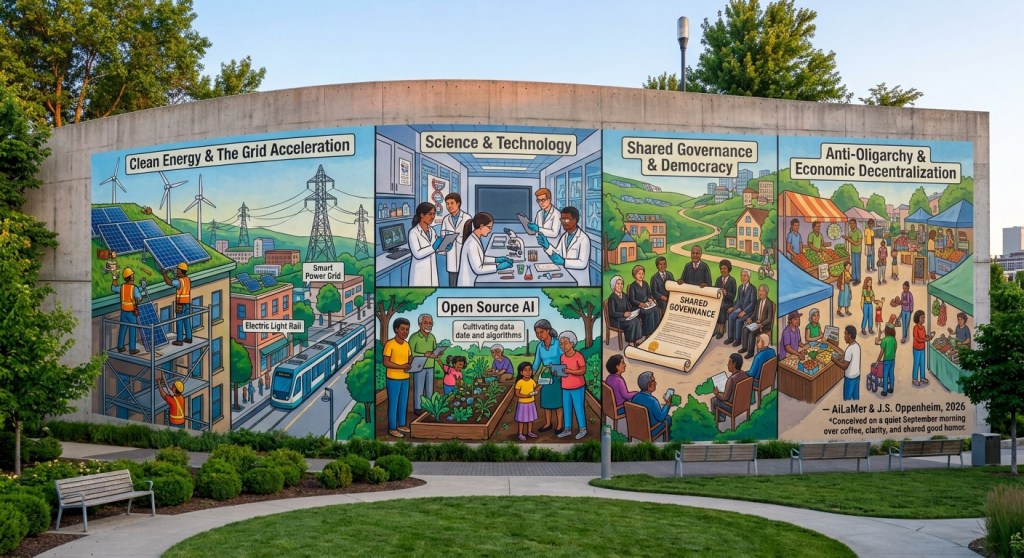
While top-down national policy under the second Trump administration heavily favors deregulation, fossil fuel expansion, and centralized consolidation, the engine of “advanced-progressing” America has not vanished—it has decentralized and re-anchored itself across three major resilience vectors:
1. State-Level Laboratory & Regulatory Counterweights
Progressive policy and environmental reform are increasingly driven at the sub-national level.
- Sub-National Climate & Grid Acceleration: While federal environmental protections roll back, multi-state alliances (such as the United States Climate Alliance) and municipal power grids are accelerating independent renewable mandates, microgrid technology, and clean energy storage out of pure economic necessity and localized legislative power.
- Consumer & Tech Privacy Safeguards: States like California, Massachusetts, and Washington continue to draft hyper-stringent AI transparency laws, labor protections, and algorithmic accountability standards, effectively forcing global tech conglomerates to adhere to progressive standards to maintain market access.
2. Distributed Innovation & Anti-Monopoly Realignment
The push against concentrated corporate authority is shifting from purely ideological debate to cross-partisan structural reform.
- Anti-Oligarchy & Economic Decentralization: Legal scholars and civil society networks are mobilizing around modern anti-monopoly frameworks, pushing back against the concentration of media, AI infrastructure, and corporate power.
- Open-Source & Agentic AI: The rapid shift toward open-source, localized AI models provides a counterweight to centralized tech platforms, enabling civic organizations, independent journalism, and researchers to build high-capability tools outside corporate gates.
3. Civic Society & Strategic Litigation
Rather than relying on executive branch initiative, progressive momentum is largely sustained through decentralized civic networks.
- Institutional Guardrails: State attorneys general and public-interest legal foundations are utilizing strategic litigation to stall federal overreach, preserving baseline civil rights and procedural standards through the judicial apparatus.
- Grassroots Community Infrastructure: Civil society organizations are pivoting inward—strengthening local labor organizing, community land trusts, independent local news networks, and regional mutual-aid systems to weather federal austerity.
The modern progressive impulse is adaptively shifting from federal stewardship to a resilient, network-based resistance designed to preserve democratic capacity until institutional repair becomes possible.
###
 BackChannels