The mirroring couple #TrumpPutin appear to be between states as the criminals, malignant narcissists, and political criminals each has become. Trump, at this point, might wish to be free of the boss of the #RussianMafiaState (one may imagine the reasons for that) and both in the… pic.twitter.com/0RtFXNnF27
The tweeted text follows (with a few hash marks replaced by standard typed English and adjustments for sense) so as to give expression its more persistent showcase in online publishing (a tweet may be noticed and read but briefly as X compiles rapidly and destroys focus as efficiently as it confronts its audience with virtually limitless attention-seeking stimulus).
***
The mirroring couple Trump and Putin appear to be between states in their relationship. Trump, at this point, might wish to be free of the boss of the Russian Mafia State (being blackmailed by kompromat might account for that), and he’s been presented with an opportunity involving the post-Cold War clean-up of the former Soviet/post-Soviet spheres of alliance, control, and influence and the severing of the link that has been for a long time Moscow-Havana-Caracas.
While Donald may expect accolades for his conquest of a former Soviet communist satellite, I think he’s proceeding from a different compact with Putin involving the feudal-medieval mafia mentality each has come to represent and he would just as soon make a “gangster’s paradise” out of his invasion of Venezuela. That would help make sense of his low-to-high pattern in pardons of criminals who have injured the United States (e.g., the January 6, 2021 insurrectionists; the recent pardon of drug kingpin Juan Orlando Hernandez) and his penchant for locating and targeting mineral wealth from Greenland to Ukraine and working “deals” in which he involves business associates and family in a process that may be referred to as the development of his own personal empire.
Is he betraying his “handler” Putin?
While it looks that way at a glance, Trump in fact may be turning East-West Rivalry on its head and setting up to rule and plunder the wealth of the western hemisphere while leaving Europe and its interests to his rival.
How Americans view the Trump-Putin relationship (mirroring) may be tempered by both political bias (partisan drift) and the American constituency’s general detachment from foreign affairs and international relations. Up to this point, America’s professional business and political managers have understood their having a uniquely American mission from the 20th Century perspective at least. As an American People, the same have negated the power of kings, fought fascism and imperialism worldwide, and tempered totalitarianism as understood from witness of leaders pledged each to the support of his ruling Communist Party.
In fact, the winning of the Cold War had been framed as having beaten Communism, not a practical and ruthless KGB driven and managed police state that could be turned toward serving a dictatorship– a private patronage system–devoted solely to its own aggrandizement, ambition, greed, and security.
So this round is different.
Trump and Putin represent an archaic criminal mentality associated with the malign narcissism and related emotional needs of each, i.e., the equivalent in outlook of what would be today criminal medieval powers engaged in continuous competition for territory and tribute, and then–with the concept of modern feudal-medieval mafia established–related unbridled and unhinged methods in power and enterprise.
***
About the Art
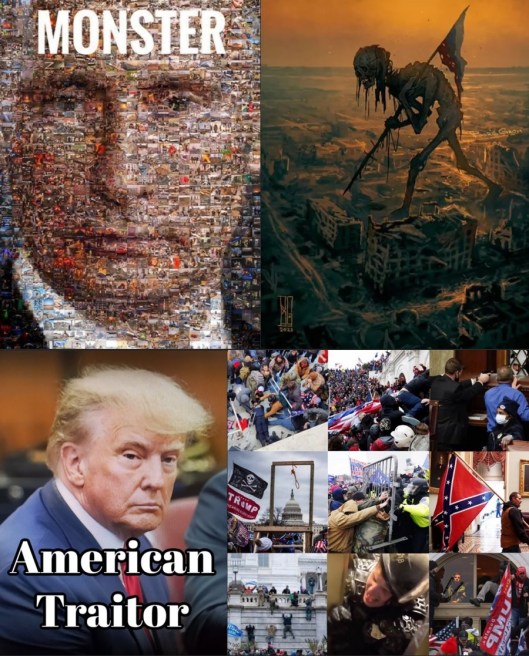
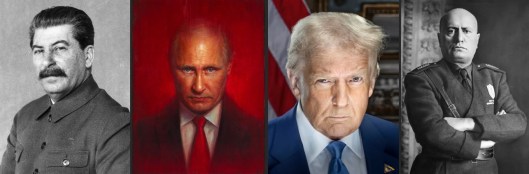
The bookends tell in part the Trump-Putin story as one dates to 2016 and has since become an iconic as well as ironic statement about the two statesmen. The other has been captured in relation to Trump’s second-term meeting of the two in Alaska. In the way of a fast-paced meme-spilling web, the composites between reflect, of course, my conclusions about the two and their archaic views of dominion and sovereignty–and both lawless men have reserved for themselves as principle a deeply archaic, deranged, and mentally and morally sick “right” to destroy with their power persons and property alike with impunity. One has ordered the piloting of missiles into apartment buildings and malls; the other threatens to take over the western hemisphere while fueling his own corrupt system of private patronage. Neither should represent anyone’s future governance–not for Russians and never (again) for Americans.
Related to Archaic Leadership and Malignant Narcissism
I’ve whittled related political science and political psychology (#PoliSciPoliPsy) down to this module for X-ting (X-ing . . . whatever)–>
Signal: delusional, grandiose, messianic ideation absent of normal boundaries and limits, i.e., the parameters of normal conscience.
From the above, one may suggest that Vladimir Putin must be experiencing a bad day every day or, alternatively, enjoying a deluded day in a theater all his own–one may then wonder how his inner circle feels about that.
As noted here years ago, Putin’s fear of public humiliation and shame drives frame and maintain his own image as unassailable, courageous, and heroic — see “Why Putin Won’t Stop Until Stopped” (January 20, 2023). His problem: reality won’t accept his claims of successes — none to date have proven immune to Ukrainian drone push-back and other defensive measures — nor any denials of culpability. He embarked on the conquest of Ukraine under false premises in 2014, and while he annexed Crimea without a shot fired — and nothing more than diplomatic posturing from Washington for resistance — he’s just not getting further with anything he does. Russia’s admirals and generals may note well the fate of his once-proud Black Sea Fleet:
As Putin’s fortunes and prospects continue to decline in the face of western resolve (even without the fulsome resolve of American will while the nation weathers an administration whose loyalties to the American secular democratic republic appear doubtful), he’ll strive to sustain his illusion of the absolute control of Russia through the deadly and grinding machinery of the “mafia state” that he has built around himself, a state that may fear him more than it admires or loves him.
AI Recaps, August 24, 2025
Russian Nuclear Accusations Against Ukraine
Russia’s nuclear accusations against Ukraine are primarily disinformation campaigns, such as the late 2022 claim that Ukraine was preparing to use a “dirty bomb” on Ukrainian territory. More recently, on August 24, 2025, Russia accused Ukraine of launching a drone attack on the Kursk nuclear power plant, causing a fire and minor damage to a transformer, though radiation levels remained normal and no casualties were reported. These accusations are often seen as propaganda aimed at discrediting Ukraine and justifying Russia’s actions in the ongoing conflict. [1, 2, 3, 4, 5, 6, 7, 8]
Accusations of a “Dirty Bomb” (October 2022) [1, 2, 9, 10]
Russia’s claim: In late October 2022, Russia accused Ukraine of planning to detonate a radioactive “dirty bomb” on Ukrainian soil and warned international partners about it, according to The New York Times.
Ukraine’s response: Ukraine, in turn, accused Russia of secretly building dirty bombs at Europe’s largest nuclear power plant.
International view: U.S. intelligence officials considered the claims to be a Russian tactic, possibly as a “bluff” or a way to employ its “escalate to de-escalate” nuclear doctrine.
Drone Attack on a Nuclear Plant (August 2025)
Russia’s claim: Russia accused Ukraine of launching drone attacks, including one that struck the Kursk nuclear power plant. [3, 5]
Damage and effects: The attack caused a fire and damaged a transformer, forcing a reduction in the power plant’s capacity. However, the fire was quickly extinguished, with no casualties and normal radiation levels reported. [4, 5]
Ukraine’s response: Ukraine did not immediately comment, but a Ukrainian center called the accusations “typical methods” of Russian propaganda. [6]
International reaction: The UN’s nuclear watchdog, the IAEA, was aware of the reports but had not independently confirmed them, emphasizing that all nuclear facilities must be protected. [4, 5]
Ukraine’s long-range drone attacks have significantly degraded Russia’s oil refining capacity, knocking out approximately 13% of the country’s processing capability since early August 2025, leading to elevated fuel prices and production disruptions. The attacks have targeted major refineries and infrastructure like the Druzhba pipeline, with repairs complicated by Western sanctions that restrict access to specialized equipment and prolong outages. This campaign is a strategic effort to undermine Russia’s economy and its ability to fund the war, as evidenced by the soaring wholesale gasoline prices and potential reliance on government subsidies for Russian energy firms. [1, 2, 3, 4]
Reduced Refining Capacity: Around 13% of Russia’s total refining capacity has been knocked out, with estimates suggesting about 44.3 million tons of annual processing capability disrupted.
Prolonged Outages: Major facilities like the Volgograd, Samara, and Ryazan refineries have been rendered inoperable, with repairs expected to take months due to a lack of specialized parts, exacerbated by sanctions.
Supply Chain Disruption: The Druzhba pipeline was also struck, causing a temporary shutdown and raising concerns in Central Europe.
Economic Strain: Russian energy firms face reduced revenues, strained profit margins, and increased dependence on government bailouts.
Strategic Context:
Targeted Campaign: The strikes are a coordinated effort by Ukraine’s intelligence services (GUR and SSU) to dismantle Russia’s energy infrastructure, which they view as a crucial economic engine for its war efforts. [4, 5, 6]
Shift from Previous Ceasefire: This intensified focus on oil facilities marks a departure from a previous understanding that limited mutual attacks on civilian energy infrastructure. [5]
Economic Warfare: By targeting the oil sector, Ukraine aims to cripple Russia’s wartime finances and force a slowdown in oil production. [4]
Consequences:
Soaring Fuel Prices: Wholesale gasoline prices have surged sharply, with AI-92 and AI-95 gasoline prices reaching record highs in August 2025. [3, 7]
Market Instability: The ongoing disruptions and the financial strain on energy companies are reflected in underperforming stock valuations for firms like Rosneft and Gazprom. [2]
Russia’s Vulnerability: The attacks highlight the fragility of Russia’s centralized energy infrastructure and expose its struggles to protect against deep-penetration drone swarms. [2, 8]
The figure of $172 billion is Russia’s projected military expenditure for 2025, not a total cost to date, and represents about 8% of its GDP. While this isn’t a specific “war cost,” the Russian war in Ukraine has other significant economic consequences, including substantial direct military spending, which may have exceeded $132 billion through 2024 and reached over $450 billion by some estimates, along with broader economic costs like GDP losses and long-term effects on the economy. [1, 2, 3]
Breakdown of Costs and Projections:
2025 Military Expenditure: Russia’s planned military spending for 2025 is around $170-$172 billion, accounting for approximately 8% of its GDP. [1]
Direct Military Spending: Some estimates place Russia’s direct military spending on the war at $132 billion or more by the end of 2024. [2]
Total Direct War Cost: One source indicates the total direct costs of the war for Russia have exceeded $450 billion, though this is a broader figure encompassing all direct expenses. [3]
GDP Losses: Beyond direct military costs, Russia has also incurred significant losses to its GDP as a result of the war, with estimates for 2022 alone falling between $81 billion and $104 billion. [2]
Economic Impact: The war has led to Russia’s focus on a “war economy” that prioritizes military spending, which drives short-term growth but undermines long-term economic health.
Labour Shortages: The increased militarization of the workforce contributes to severe labor shortages.
Inflation: Wage growth in Russia has outpaced productivity, fueling inflation.
Sustainability: This approach creates a narrow and brittle economic foundation, making Russia’s long-term economic trajectory unsustainable.
Elon Musk’s abomination in open communications, X, has worn me down with inescapable (s)word-dulling repetition. How many times have I had cause plus opportunity to display #RussianBarbarism as too many refugees have experienced it? Countless.
Well, lookee there — maybe it does look okey dokey after all.
Still, and in any case, I tire of almost tirelessly publishing the same messages over and over to the different contexts created by recipients (who need my [blush] data or insight). And then–poof! The message drowns in the digital whitewater cascading in wild unabridged concert beside it and afterward.
Would it help to give it its own sustained patch on the Internet?
And would it be easier for me–or you–to reference as and when needed the next time #BRICS lays claim to some nonexistent ethical, humanist, moral, or spiritual superiority in matters in which it actually operates with violence against language and against humanity?
“IRT – Images Research Tropes” will be a new category here and one whittled down to a single message accompanied by the X hash tags used to characterize and promote the same across the web community.
Summer Reading, Hunter Hill, Hagerstown, Maryland, August 20, 2020
This post has been on my mind for at least a month and rather held up by the sorry habit of reading “long form” in bits and pieces. Advancing age, declining energies, the web’s own “Electronic Attention Deficit Disordering”, and the plain fact that I’ve reached about the final less-than-third of life’s journey surrounded by a personal library (of about 2,250 volumes) offering me more choices for reading than may be read or re-read toward the looming end account here for my relaying more of what might be helpful to fellow travelers than I have taken in myself.
However, I have read each of these suggestions in part or whole — and if in part have bookmarked — and have been trying to transition from “Life Online” (how it has turned out thus far) to more of the aesthetic and literary manse beloved ever by romantics and old souls.
Dictatorships have powerful tools in capricious censorship, denunciations, frames (how the despotic present issues as well as rivals for power and targets for crushing), and, ultimately, force by threat and by violence. By comparison, democracies would seem soft with conscience, empathy, and sentiment — and not much else before the armed might of absolute state power. Nonetheless, how much abuse must democratic constituencies take before facing the choice of withering before despotic forces or standing up to them?
Were it not for the desperation, greed, ignorance, and laziness of our own — and perhaps ourselves — we may not have reached this point where the apparent most patriotic and pious of Americans may have put into power the most questionable and selfish representative of America’s reactionary wealthy. Well, we’re sure in it together now and might wish to clarify what it means to be Americans and what it may mean to govern ourselves with more adult comprehension, selfless wisdom, and a much, much greater magnanimous and shared American spirit.
BackChannels acknowledges the book in which it first encountered the term:
Soldatov, Andrei and Irena Borogan. The New Nobility: The Restoration of Russia’s Security State and the Enduring Legacy of the KGB. New York: Public Affairs, 2010.
However, this post is not going to be about powerful and self-enriching KGB/FSB spies and their bureaucracies.
Recep Tayyip Erdoğan, Viktor Orbán, and Donald J. Trump seem to this blogger more the “New Nobility” that Russian President Vladimir Putin may have had also in mind as he launched his revenge on the western world for the demise of the Soviet Union on December 25, 1991 — a very good Christmas morning indeed for the United States of America and in the defunct godless realm then represented by the Kremlin a not very special day at all.
In the 26 years that have passed since that morning (for political purpose, it was over at noon), Russia and her leadership have had to think about what it has meant to be “Russian”.
“Old Vikings”?
Formed of conquest, contracting and expanding through the brutality of feudal wars, unable ever to police — mere civil policing — its territorial writs, Russia has been a state that has better known barbarism and the depths of inhumanity through violence (give a nod for the extra special dose brought by the Mongols) than civility through accommodation and trade. In that regard, the “Vory”, the once brutalized mafia within, may in their inglorious legend represent the pure expression of the heart of the state.
Backing the tyrant in Syria?
Invading a settled Ukraine and baldly lying to the world about its purpose?
Bombing hospitals?
Pursuing feudal absolute power — unquestionable ownership of persons as things — with the Assahola in Tehran?
All of the above: true.
So what good new things has Russia brought to the European Union and the North Atlantic Treaty Organization?
BREXIT: While Great Britain has been happy to pile on “Asian” labor, it has not been so happy with grooming gangs, suspect neighborhoods, and “Allahu Akbar” explosions, much less the impositions posed by the refugees of war in Syria. Response: the Newest Nationalism expressed in renewed insularity and refreshed Anglican pride.
While it’s good for a state to recall what it’s about, some among the most zealous should factor in how they have been played by Moscow.
Erdogan: Prime Minister, President, and now, apparently, President for Life has never encountered serious resistance for his taking apart what Mustafa Kemal Atatürk bequeathed in bureaucratic and military legacy. The empire’s back, baby, and dig the symbolic significance of the leaders new crib.
Impressed?
Dig this cool new statistic on press freedom in Erdogan’s new estate (italics added).
The 2018 index ranking marked Turkey’s 58 point-decrease over the past 13 years, lagging just behind Rwanda, Belarus and the Democratic Republic of Congo.
Nonetheless, the American President’s behavior, personal as well as political, has left him also, as with the Erdogan and Orban, associated with the terms “autocratic”, “narcissistic”, and “nationalist”. While it’s good to take pride in one’s nation and defend her interests with tough negotiations, it may not be so good for the head of a modern democratic state to promote the image of himself as a feudal lord, securing prizes for family and friends on the basis of loyalty, and doing out favors (“You all just got a lot richer”) to surrounding nobility.
President George W. Bush also made light of the “have and have mores”, but for Americans struggling with fixed retirements, healthcare premiums, perhaps the full suite of basic and complex costs of survival, and, for the young, jobs that fail to deliver even a modicum of financial independence and pride, much less security, the implied further reduction to peonage must sting.
In the Soviet Era, many “peace movement” organizations distanced themselves from the Communist Party (Soviet) as they witness the brutality of political repression in the several of the Soviet satellite states whose politics had brought them around to liberation from the Soviet system.
Today’s ultra-nationalist and neo-imperial Moscow have made comprehension of the Kremlin a little more difficult. In Orwellian _Animal Farm_ fashion, the banner of the state has switched to “State Capitalism” and the FSB/KGB, Putin, and the Oligarchs appear to be having a helluva good time! 🙂
Still, with Moscow’s earlier KGB engineering of Yasser Arafat and the PLO more and more known beyond the wonky circles of “Kremlin watchers”, the model for elite kleptocracy driven by Moscow, which is deeply invested in medieval political absolutism and totalitarian control, has been coming into popular view.
The absence of conscience and empathy in leadership needs protesting worldwide.
The old politics in which the apparent “liberator” turns out the oppressor — and gets away with a lot of loot for doing it — needs a complete historic reexamination and overhaul.
Take a lesson from the Somali experience with the Soviet government in the Ogaden:
While BackChannels delivers the light version of history — much of what is needed is online — it wonders how to further wean from the Soviet Era experience the many remaining Left-Far Left organizations struggling to update their missions in the long shadow cast by the dissolving of the Soviet Union a little more than 25 years ago.
From the outset, BackChannels has invested itself in liberal humanist politics — look to the left of this copy and down the sidebar: the values promoted by this nonpartisan blog seem to the editor to place the humanity of humanity first and foremost in political thought and to be congruent with the advice suggested in the above invention From the Awesome Conversation: “The absence of conscience and empathy in leadership needs protesting worldwide.”
If you know how and when the Soviet KGB groomed Yasser Arafat for his role as leader of The Palestinians — Jordanian refugees in 1948 — can you still swallow the intellectual poison that has been the “alternative narrative” of the same?
Think about it.
Think about the tens to hundreds of millions of dollars amassed by Arafat and Abbas (both of whom have had KGB histories) while the Palestinians have been showcased for sympathy?
Apply the same to Hamas leaders Ismail Haniyeh and Khaled Mashaal, both of them billionaires.
What if the newest of Far Left fist-raising acolytes had the choice between parroting the claims and narratives programmed within his new social climate and that of independently questing and reading for the truth, would he do choose to balance the former with the latter?
We’re going to find out.
Not only are online resources for research extraordinary today, but obtaining books relevant to the study of history and history and revolution, culture and cultural anthropology and psychology, and so on has never been less expensive!
For a quick pick-up on the previous century’s Cold War and related history, BackChannels recommends all of the volumes listed in “The Russian Section” of its library.
Where the adventurous and social rewards associated with “The Movement” — there are so many of them! — prove rewarding, may the reader of this blog consider also the responsibility of being himself an autonomous, independent, informed, and critically reasoning actor in his own political life.
I’ve been waffling because I think whether “he” or “she”, it’s Putin who may pick up a round in the “re-medievalizing” of the west’s portion of global politics. He has helped damage political NATO through Hungary (Orban) and Turkey (Erdogan) and, of course, has manipulated terrorism
— and by the way, look up “Moscow, PFLP —
to goad westerner toward a rightly defensive nationalist response, but in the process we lose both a part of our democratic, modern, and tolerant soul.
Despite the Trump-Manafort-Yanukovych experience, Trump, who seems to be trying to figure these politics out from a cold start — and he knows he’s a beginner as politician, but he’s a fast learner too — may well stand up for American constitutional arrangements and values and temper the demagoguery with our culturally INCLUSIVE ethos, related ideals, and extensive development of law and policy across years.
Hillary might wind up in the same place — there is an “American Way”.
Missing from public popular perception: the Cold War — check out BackChannels for that (https://conflict-backchannels.com/…/ftac-interpreting…/) and how business and politics among the world’s most powerful and wealthiest people, Putin and the oligarchs among them, hew themselves to feudal models. Perhaps we are doing that now — and Hillary, by way of the necessity of delivering a Constitutional American experience to the American people, will also have to confront Putin (and the Phantoms of the Soviet in the Middle East and around the world).
Muslims – this from an American of Jewish descent who has tired of religious cant: no one “wins” anything with either a supremacist or totalitarian outlook and permit for barbarism.
The medieval worldview, fully on display in Syria, promotes political absolute power.
Whether Putin, Assad, or Khamenei or Baghdadi — “Different Talks — Same Walk!” applies.
Also, Center-of-the-Universe Christian, Jewish, or Muslim self-concept seems to me a remnant of medieval history.
The enemies of the west — extremists Red-Black, Brown, and Green / old comrades, new nationalists, and Islamists — need that worldview sustained, but the democratic open societies of the west, also secular in governance and humanist in ideals, simply don’t need that anymore.
We have all to make this choice about which world we would prefer to live: the medieval world (let it go, please) or the modern one (where we investigate issues and address problems every day in the interest of greater peace and prosperity plus human dignity and freedom).
I’ve edited some between the “Awesome Conversation” and this post, but in essence feel we need greater distinction in time between medieval worldviews and related governance and the same under the umbrella of the modern worldview.
The argument between Russia — a revanchist neo-imperial state — and its allies and clients and NATO, God bless that old alliance — may be distilled as “Medieval Absolute Power” vs “Modern Democratic Distribution”.
We may have a long way to go with that “argument”, but at least we should see it for what it is.
This blog is not the media spotlight, which today is going to light up the undeniably “Islamic terrorist” attack in Rouen, which may promote greater division between the Catholic and Muslim communities of France unless the Muslim community intercedes to opposite effect. Instead, BackChannels noodles around in the post-Cold War, post-Soviet neo-feudal and neo-imperial revanche engineered by Putin.
For the vast public dependent on western mass media for political information, the Cold War is ancient history.
The Soviet dissolved in bankruptcy and chaos on December 26, 1991, and that was the end of total incompatibility between the communist and capitalist systems.
Not quite.
From BackChannels’ perspective, Putin has neatly transitioned the political and social architecture developed during the Soviet Era into something a little different and conveniently kleptocratic but also effective in returning central governance to Russia. The term of art applied on this blog — and used as a blog category — has been “21st Century Neo-Feudalism” and that applies to Moscow’s renewed validation of political absolute power and the encouragement of despotism and extremism — Far Left and Far Right — worldwide.
While the public reads about Moscow’s fighting Chechnya’s rebels or running sorties against ISIS (or noncombatants in marketplaces), Moscow in fact has hosted PFLP representatives (an easy lookup, “Moscow, PFLP”) and refused to designate either Hezbollah or Hamas as terrorist organizations.
Fact check me, please, and forget about the “Reset”.
There was none.
Moscow doesn’t play from one side of the chessboard: it may believe it owns the chessboard, i.e., the control of politics in their totality wherever its leverage and influence may reach.
So ISIL, incubated to bribe and goad The West — and to serve as field test targets for Moscow’s most advanced weapons systems — has launched a simple attack on a medieval western target, a Catholic church in France, and Moscow looks on, perhaps knowing that without its guidance, the popular challenge to Assad’s rule would have turned into an ordinary “Arab Spring” demotion of absolute authority. Instead of that yawner: a promotion of global criminal enterprise using ISIL (and ISIL appears blissfully unaware of how it has been manipulated into existence) to bite into otherwise peaceful and prosperous free and far more predominantly lawful states.
Excerpts and Fast Reference
That Putin would need a spiritual and physical retreat from the pressures of Moscow at a time like this is not surprising. While Russia has withstood the pressures of economic sanctions and seemingly limitless information warfare while fighting proxy wars in Ukraine and Syria, the cracks in society are starting to show.
Real hardships for working and middle class Russians due to the general global economic crisis, the collapse in trade with Europe and oil price slump are increasingly evident. However, a spirit of resistance to globalism, to the degradation and nihilism post-Western societies offer the world is also evident, with a growing number of Russians participating in the life of the Orthodox Church and new temples going up all over Moscow and other major cities.
The patriarch recalled that Athos’ hopes for a calm and peaceful life used to be connected to Russia and the people of Russia, but all ties were severed after the 1917 revolution and only some of the brethren of the Russian St. Panteleimon’s Monastery eventually survived.
“It was all like a ghost, some of the buildings were burned and some were desolate,” the patriarch said about his first visit to Athos.
Analysts say the Kremlin would welcome a Trump win because the billionaire U.S. businessman has repeatedly praised Putin, spoken of wanting to get along with Russia, and has said he would consider an alliance with Moscow against Islamic State.


 BackChannels