The Palestinian liberation movement descends directly from the Soviet Era and Moscow’s interest in leveraging grievance into the political power familiar to the world’s most piratical dictatorships. This is not to excuse western perfidy on parts of the global far right in the 20th Century, but to note where the phoniness in Palestinian politics originated.
At the end of WWII, what Adolph could not hold, Uncle Joe picked up and although representing a very different system from that of the German fascists, the feudal authoritarianism was there to encourage similar drift associated with absolute power — or “political absolutism” — in the middle east. (Note regarding Moscow: two major revolutions, three governments, one-hundred years — and The Bear remains absolutely authoritarian, criminal, and totalitarian).
We know today the KGB’s relationship with Arafat and the PLO (also the pride Yuri Andropov took in the airline hijackings of the 1970s) and we have learned within the past couple years of Mahmoud Abbas’s own KGB record.
Keep loving Moscow — and you will love even more Palestinian suffering by way of its designs.
Note well that ALL Palestinian top leaders have become multi-millionaires while Khaled Mashaal and Ismail Haniyeh long ago developed reputations as billionaires.
The seduction, captivity, and suffering of the Palestinian main base has turned out a long-lived and powerful business for thieving elites and their systems of patronage.
In this memoir, replete with Jewish humor and sardonic Russian irony, exiled Russian journalist and human rights advocate Arkady Polishchuk colorfully narrates his evolution as a dissenter and his work on behalf of persecuted Christians in 1970s Soviet Russia. Told primarily through dialog, this thrilling account puts the reader in the middle of a critical time in history, when thousands of people who had been denied emigration drew international attention while suffering human rights abuses, staged show trials, forced labor, and constant surveillance.
From 1950–1973, Polishchuk worked as a journalist for Russian state-run media and as an editor at Asia and Africa Today, where all foreign correspondents were KGB operatives using their cover jobs to meddle in international affairs. His close understanding of Russian propaganda makes this memoir especially eye-opening for American readers in today’s political climate.
Trump should not have stepped off with denouncements of the Fourth Estate. However, BackChannels believes the location of tension in the world is that between the Modern and Medieval political worlds, and in the 21st Century, the medieval is a world of lies and manipulations. Motivation: money — for its own sake.
The observation a year ago was that Islamic Terrorism had been prodded, channeled, and used _by Moscow_ to produce a reflexive “New Nationalism” in the EU / NATO states as part of Moscow’s efforts to degrade cohesion among the western democracies and within the military alliance defending them.
In an update, I would want to look over the potential integrating and related interference and shaping of Russo-American relations at highest levels. I’m a little tired as a volunteer poli-sci / poli-psy blogger, but were there encouragement plus a few $$$, that’s where intuition would send me.
There is obviously — and from the start with this Administration — a global class of immensely wealthy business personalities who appear to help one another along while also moving their hosting nations around in ways that address a number of issues.
BackChannels has to this point generally promoted “Authentic Popular Democracy” (APD) — not Potemkin Democracy operated by global elites. The guys (generally speaking) mixed up in these “Russian connection” investigations seem to believe otherwise, and that their money may purchase controlling influence.
Is that a world that is wanted from a democratic perspective?
President Trump’s “Russian Thing” becomes ever more complex and deep with the latest explorations into the working of financial clout by one of Russia’s wealthiest men, Viktor Vekselberg (the look-up may be left to the reader because the web has made that part of the blogger’s work almost superfluous).
For Gaza as an interim measure brought out any which way: Egyptian and Israeli suzerainty until the Hamas civil thug and terrorist culture is no more a burden to the Palestinian population.
For the West Bank, treatment as an in-holding similar to Quebec in Canada with security measures corresponding (as they have for many years) corresponding to threat.
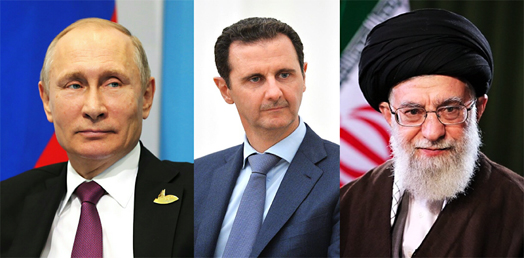
Moscow-Tehran (Red-Green / Old Comrades and Neo-Islamists): that is to be taken care of now, or the “phantoms of the Soviet” will indeed haunt another generation of Israelis and Palestinians.
We know Mr. Khamenei’s cards; Mr. Putin may only hold his close — and sustain his power in potential threat — for so long. He needs to move Russia forward of Imperial and KGB Russian history. I have no idea whether he’s up to doing that or not.
There’s a little craziness in believing — or accepting — that either the PLO or Hamas have been helping the Palestinians as a People (after 70 years of Arab Apartheid in the camps of Lebanon, Jordan, Egypt, and Syria plus the same as a suspended culture in their space and much bedeviled by official corruption and feudal patronage systems, they’re a cohort, but as a people perhaps a little different than presented). For those in the world a little tired of the post-WWII Stalinist project (Hitler’s loss back then: Stalin’s gain), the Palestinians may be thought of as deserving of honest, responsible, and responsive government.
” . . . they are making a show to other countries . . . “
True. The action taken to forestall additional Chemical Weapons (CW) attacks was conducted as a deliberate and open demonstration of capability (imho) and not as one blow among others launched without warning in the chaos and fury of combat.
Russo-American cooperation in “optics” has been a theme in the Syrian Tragedy from the beginning and in current form dates back at least to the end of the Cold War in which Moscow and Washington in a presumptive peace were to work on terrorism and transnational crime together.
It is uncertain that that is not taking place!
🙂
How would one know?
In that Moscow sustains numerous “frozen conflicts”, operates its war machinery against noncombatants in Syria and Ukraine, and that it has long cherished (by not reforming itself much) the title, “Mafia State”, I may suggest the west had been snookered by old political criminals or a mentality in Moscow befitting the same.
Related Reference
In the too-fast press associated with blogging, there may be a little bit of post-first-read-later taking place here. Even if so, the main point is to look into what happened between Moscow and Washington in their respective thematic characters — paternal authoritarian for one; liberal democratic for the other — in the nearest shadows of the Cold War.
PDFs cited go straight to the BackChannels Kindle and may be read on that platform soon afterward.
Where did all the money come from? Most of the new robber barons — an estimated 61 percent of Russia’s richest people, according to one study — simply turned the socialist empires they managed into their own private companies. Others built their fortunes on the roots of criminal trading they were doing secretly during Soviet times. The result is a pervasive sense of unfairness — particularly since Russia still has no real middle class. But Russian society for centuries has been driven by envy.
“In Western Europe and the United States . . . organized crime controls only criminal activities such as prostitution, drug trafficking and gambling,” wrote Pyotr Filippov, a former adviser to President Boris Yeltsin, in a report to the president last year. “In our country, it controls all types of activities.”
In the former Soviet republic of Georgia, an alleged criminal leader with a long prison record and a private militia loyal to him is the right-hand man to the country’s leader, former Soviet foreign minister Eduard Shevardnadze. In Russia’s Far Eastern city of Khabarovsk, an ex-convict named Vladimir “The Poodle” Podiatev, who spent 17 years in prison, is said by police to be the city’s foremost power broker, allegedly controlling his own television station and much commerce in the city.
Russia’s attempt to subvert Ukraine cannot, however, be seen in isolation.Russia’s attempt to subvert Ukraine cannot, however, be seen in isolation. Its tactics are part of a wider pattern in which the Kremlin uses separatist conflicts as engines for corruption and criminality, and as Trojan horses to block progress in reform-minded countries on Russia’s periphery.
Organized crime has penetrated most of the newly independent states of the former Soviet Union at all governmental levels, and is assuming an important role in the political , economic and social evolution of these states, with consequences already being felt in Europe , the United States and parts of Asia . The collapse of communism may not lead to democratization and the transition to a competitive capitalist economy. Instead, the pervasiveness of organized crime may lead to an alternative form of development — political clientelism and controlled markets. Domination by the Communist Party may be replaced b y the controls of organized crime.
Possibly: when the Soviet Union dissolved Dec. 25, 1991 and then presumably ended the Cold War, it’s possible (possibly) that American and Russian security elements thought to cooperate on issues confronting both states, Islamic Terrorism high on the list of possibilities conveniently at hand for that.
For the United States, one presumes that cooperation would have been intended to reduce the power and presence of dictatorship in the world and (in domino effect) remove the vestiges of the defunct Soviet Union in global foreign affairs. In the way of political “optics” — how things look — the American and other EU / NATO constituencies would have perceived some great measure of peace and trade taking place between the former superpower antagonists, so when Clinton and others signed off on “Uranium One”, it may have been in that context that the deal went down.
East and West had taken the great leap forward toward peace in 1992 and by 2010 business involving uranium, a strategic asset, appeared to have been conducted in overall calm, bureaucratic, and peaceful conditions.
While other business and political mixers were proceeding, Saddam Hussein’s Iraq and Muammar Qaddafi’s Libya were also transformed (in 2003 and 2011, respectively), at least as regards the deposing of each dictator — and let none remember them fondly: they were both monsters in each their own demonic way.
Then in 2011: Syria.
When offered the choice, Putin refused the liberal western path and reverted to the KGB past. At that moment, possibly(!), Team Security USA, in some part, discovered that it had been duped
(Note: intervention in Libya preceded the perceived (Wikipedia) start date of the Syrian Civil War — on BackChannels, the “Syrian Tragedy” — by five days).
Moscow had intended to refuse the adoption of democratic liberalism all along.
What the United States and EU / NATO had done for peace between 1992 and 2011?
I don’t know.
However, one may imagine the possibilities.
However, the old news cross my desktop a few minutes ago, and it seems to add its little bit to the BackChannels perspective on Cold War / post-Cold War / Phantom of the Soviet history.
If you haven’t hit the link, the “old news” was this:
Syria was a key participant in the C.I.A. rendition program at a time when President George W. Bush’s administration labelled Damascus part of the “axis of evil,” according to a report by the Open Society Justice Initiative.
The report – titled “Globalizing Torture” – said President Bashar al-Assad’s regime was one of the “most common destinations for rendered suspects,” indicating an established security relationship between Syrian intelligence and Western agencies.
The story — and not written for conservative Americans — traces its thesis back to at least 2003.
Apparently, Moscow and Washington had been fighting terrorism together in the double-0’s of the new century.
Welcome Moscow’s post-Cold War totalitarian design and the west’s apparent partial cooperation with it, possibly, up to the Syrian gambit of spring 2011 when Obama tested Putin’s navigational tendencies.
In Russia’s persistent feudal mode, states serve power, and power need see no difference between property and persons, sovereignty in the politically absolute mode implying the right — more: even the obligation and demonstration — to destroy either with impunity and without explanation. A little foolery with political perception and CIA “rendition” programs (to fight al-Qaeda and others) would be one thing, but to travel further with Moscow and Damascus in their tyrannous journey appears to have been something Washington could not bring itself to do.
Now everyone has a problem, not least the state of ______: do the leaders of the world — and the worlds of business, finance, and politics — want the present to recycle into the future using totalitarian techniques — or does it want authentic progress on behalf of our species and the planet that hosts all of us?
I have come to know — no longer just think — the Moscow believes that political issues and perceptions can be invented and controlled from ‘behind the curtains”. Knowing the little I know of wildness in nature and evolutionary unpredictability, I would counsel against that Orwellian ambition.
Place the blame for 9/11 on “east-west competition” for political and resource (“Grand Game”-related) control; post-Cold War realignment, perhaps — the idea that western security services would cooperate with Moscow’s on crime, for example, or on “fighting the terrorists” (after Moscow has positioned them) where it belongs and in proportion to the contribution to design. Of the two, “Moscow” and “Washington”, the data I have dredged from the web points to Moscow’s so-far persistent totalitarian ambition.
There’s much to hash in the above message, but all will distill into the two familiar and very different worldviews so often referenced by BackChannels as “Medieval Political Absolutism v Modern Democratic and Liberal Distribution of Power”.
In which world would you rather live?
Point by point —
First, official Saudi Arabia revoked Osama Bin Laden’s citizenship over the crime visited on the United States of America on September 11, 2001. That leaves unofficial KSA and other actors as possible donors to the Wahhabi al-Qaeda enterprise, but as the sovereign state has maintained its innocence, the potential rogues within have made themselves only potential persons of interest for internal policing. At this time, about 17 years later, a KSA-USA alliance has been established and is being promoted as reliable online.
Regarding reliability, we shall see, as it seems in the nature of history and politics to be full of surprises.
Second and in regard to the news articles cited, BackChannels has noticed from the Cold War Era a kind of symmetrical diplomacy attending “east-west relations”. When, for example, the Soviet Union reclaimed its nuclear missiles from Cuba, the United States moved back its forward-based Jupiter missiles from presence near the Soviet Union’s fringe. Whatever the two states may have been saying to one another, they were saying it at the same time. In popular history, the more dramatic and visible recovery of “nukes” from Cuba was more quietly matched by similar behavior in Europe. It would not be much of a stretch, if any, to suggest that as the Soviet Army retreated from Afghanistan, the American CIA similarly pulled back from its involvement with the Mujaheddin even though that would leave the proxy available to the next Russian state, which was to announce its presence, however pale, with the appearance of the Russian Tricolor raised above the Kremlin on the morning of December 26, 1991.
Finally, BackChannels may wish not to know what took place in 1992 between business interests and multiple state security services with the Cold War presumed over, Communism defeated in Russia, and some new western-leaning and capitalist state about to be born. It would rather — and so will — fast forward to today’s “Phantom of the Soviet” and the destruction brought to Syria and Ukraine (Crimea), the revival of feudal ambitions spurred in EU/NATO targets by the reflexive response to Islamic terror attacks, and in both Turkey and nascent Kurdistan the leverage applied to ego by Putin’s “energy politics” and appeals to narcissistic aggrandizement in leadership in both geopolitical spaces.
Today’s Hamas-produced political theater on Gaza’s border with Israel smacks of Soviet Era spectacle. While nothing would appear to have changed from earlier days, much has changed as regards “state-sponsored terrorism”. The Soviet Union passed into history more than 25 years ago, and the phantoms of it in search of the source of their dark souls must find it absent. In its place now stands the autocratic “Mafia State” fully willing to destroy innocents in its chosen combat arenas, induce greater chaos in the world (seldom more so than in Syria and in Ukraine’s Crimea), bomb hospitals with impunity, and revive the Soviet’s most criminal and pernicious practices and programs.
If Gazans, who in the main have gotten very little out of decades of so-called — and violent — “resistance” only knew for what and for whom they were protesting . . . .
Hmm.
The Internet is fully up: now the Palestinians may know (and know well who has lied to them and how) and — if and when determined to extricate themselves from the powers that have profited off their sustained suffering — make themselves truly free within their own community and more genuinely nascent Palestinian state.
At first, it looked like an ordinary dictator’s response to a little criticism and a comparatively polite people’s request for a little consideration and power, but in 2011, what looked like a civil war masked the deeper, more prolonged, and vicious desire to sustain medieval absolute power — the power of the tyrant — against the entire Christian, humanist, and liberal experience and political philosophy of the western world.
Are there to be no differences between property and persons?
Are such malign narcissistic personalities, uniquely limited in conscience and that mysterious thing we call heart, to be given free reign to assert themselves as powerful primarily with false flag theater (e.g, “Moscow Apartment Bombings“, “Assad v The Terrorists”) followed by an expressed cruelty and sadism in power that encounters neither boundaries nor limits?
Know thy tyrants.
This east-west conflict between thieving barbarians and the just nobility of western civilization has been brewing in the post-WWII region in time, and the world that won’t massacre refugees is being drawn into the vortex.
Perhaps we should now ask about the nations watching from similar sidelines the horror on continuous display in Syria: where has been their courage, humanity, and resolve as Russian and Syrian air power directly bombed nearly two dozen hospitals and other medical facilities in the vicinity of East Ghouta, Syria?
Triebert, Christiaan, Evan Hill, Malachy Browne, Whitney Hurst, Dmitriy Khavin, Masha Froliak. “How Times Reporters Proved Russia Bombed Syrian Hospitals.” The New York Times, October 13, 2019, updated April 7, 2020.


 There’s much to hash in the above message, but all will distill into the two familiar and very different worldviews so often referenced by BackChannels as “Medieval Political Absolutism v Modern Democratic and Liberal Distribution of Power”.