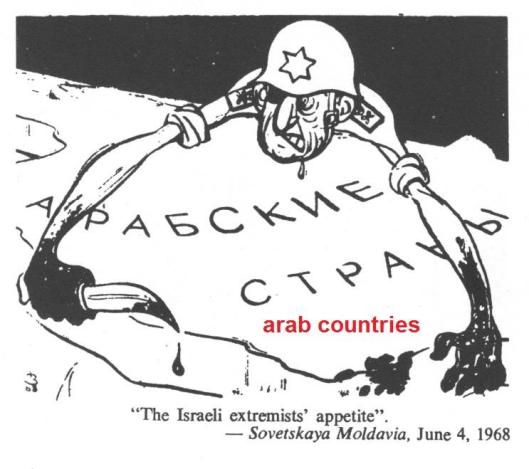
The influence of the Soviet by way of agitation, disinformation, political manipulation (through the KGB) and sponsorship of terrorism in relation to the middle east conflict cannot be underestimated. The post-WWII leveraging of Arab anti-Semitic sentiment — involving some with power, not everyone — succeeding in developing despotic regimes benefiting the Soviet as client states.
Soviet cartoons distributed in the Middle East to leverage “the masses” into the Soviet camp.
The Soviet dissolved in financial and moral bankruptcy about 25 years ago; however, in its place has developed a feudal state in the Russian historic tradition, and it continues to entertain PFLP and to interface with both Hezbollah and Hamas.
Who has been made to suffer as a consequence of Soviet / post-Soviet Russian influence and KGB-designed manipulation?
There are differences between the medieval world and the modern one, and the modern is a much, much better world in which to live.
These too are Palestinians:
Additional Reference
“Eshkol knew and feared the Russians,” noted Michael Oren. “War with Syria [and Egypt] was risky enough; with the USSR, it would be suicidal.” But Eskhol calculated that without U.S. support, the Soviets would find themselves compelled to get involved directly. Moscow had, after all, “invested massively in the Middle East, about $2 billion in military aid alone—1,700 tanks, 2,400 artillery pieces, 500 jets, and 1,400 advisers—since 1956, some 43 percent of it to Egypt.”
Sure enough, as the Israelis demolished the forces of the Arab coalition over the next three days and captured the Sinai, the West Bank, the Gaza Strip, and the Golan Heights, reunified the holy city of Jerusalem, and began an offensive against Damascus itself, Moscow saw itself staring into the face of a geopolitical disaster. Those were, after all, Soviet-trained soldiers being defeated. Those were Soviet-made arms being seized or destroyed. Those were billions of dollars in Soviet funding to their Arab client states being poured down the drain. And—it would later be learned by U.S. and Israeli intelligence—the Egyptian war plan itself (code-named, “Operation Conqueror”) had actually been written in 1966 by the Soviets. As a result, the Soviets feared their prestige was quickly unraveling.
Before hostilities were established back in 2011, Syria may have been washed, as it were, in two streams of political poison that would render it untouchable and toxic to the west and its interests. Both streams would be located in the medieval worldview of political power as legitimate when exercised as dictatorship. Soviet Era duality combining anti-Semitic expression, socialism, and pan-Arab nationalism would become part of today’s “lostness”; and then on the political track linked to religious belief, “Islamist” exceptionalism and hubris would mirror the nationalist dictat.
As regards speaking . . . reporting, seeing, and speaking have not been of issue.
As regards extremism + post-Soviet history, ah, there’s the issue that now has former Iraqi Baath Party officers fighting for ISIL against (some) Iraqi Shiite militia embedded with Iranian Revolutionary Guard officers.
Which is the war being fought?
Medieval v Modern; Sunni v Shiite; “Political Absolutism” v Democracy — and then the lesser politics: Iran v Iraq; Turkey v Russia; Turkey v the Kurdish Liberation community; and so on
???
I tend to focus on post-Soviet Moscow for answers as regards motivation and policy for shaping the conflict as it appears. However, one might also focus on multiple elements in the field and ask about illusive motivations. There seem to me multiple aspects of the conflict that can only be seen _by everyone_ — all involved or on the sidelines — as absurdly anachronistic, barbaric (especially in the cultivation and expression of cruelty) and surreal.
The poem that set off the response was lovely and correct in its complaint about silence and its query about the lack of human intervention in deposing Bashar al-Assad. However, great vision matters in Syria, and, in fact, it may now be all that matters in Syria, specifically the ability to observe from a distance in time and space that views the whole of it as contained in time.
Truly, the conflict began with a despot’s sadistic response to a peaceful challenge to his authority, and here five or six years later, thereabouts, those outside of Syria area overviewing a complete medieval theater of politics and war of which Putin, Assad, Khamenei, and Baghdadi — and similar others — are of a whole piece.
Different talks — same walk!
The leaders are not opponents: they have been cooperating perfectly in mutual destruction, disregard, and unspeakable sadism.
Posted to YouTube by Muhammed Al Mousa on September 4, 2016
Homs represents a brutal depopulating. It brings to my mind the drought that impelled a combination of “Arab Spring” and economic protest in 2011 that would be met with a brutality and sadism far out of proportion to the regime’s political needs. In turn, that would make sense of Assad’s choosing to produce a general bloodbath in Syria out of which he could then play to his own family’s advantage as owners of a Russian client state, as an enemy of the west, and as a symbol of state order against “The Terrorists”, both anyone not with Assad as well as the al-Qaeda types incubated expressly to serve for blackmailing and goading the west and as a foil for the aligned powers, Moscow-Damascus-Tehran.
If you want to see what Assad had been fighting instead of western-back revolutionaries, have a look at the destruction of Homs (in the video at the bottom of this post).
BackChannels is not suggesting ISIL was never hit but rather that it has been groomed and shaped over the years for a role in “Assad vs The Terrorists”.
On this list, you will see that al-Nusra gets some early “licks” in in Damascus but, ISIL, which assembled into the “Islamic State” a couple of years into the war (around 2014), does not show up in association with Damascus until April of this year. Now there’s conspiracy-think: why not a 2014 or 2015 car bombing in Damascus credited to ISIL. And why this year? Perhaps they started taking hits from Russian jets. Finally.
WikiLeaks released an August 2014 e-mail from Hillary Clinton to John Podesta, who currently serves as her campaign chairman, stating that the governments of Saudi Arabia and Qatar have been “providing clandestine financial and logistic support to ISIL and other radical Sunni groups in the region.” Evidently President Obama has not heeded Hillary’s concern, or chose to ignore it. In December 2014, Obama praised Saudi Arabia’s significant role in helping to fight ISIL (also known as ISIS and the Islamic State) during a meeting in Washington with the Kingdom’s Minister of Interior Prince Mohammed Bin Naif Bin Abdulaziz. And at a meeting he hosted with Sheikh Tamim bin Hamad Al-Thani, the Emir of Qatar, at the White House in February 2015, Obama said, “Qatar is a strong partner in our coalition to degrade and ultimately defeat ISIL.”
BackChannels believes the post-Soviet Moscow axis — Moscow-Damascus-Tehran — chose, as it resisted the challenge to Assad’s authority, to emphasize fighting the west first by first combating the defecting officers who took up leadership of the Free Syrian Army while holding off, or shaping, the al-Qaeda-type organizations coming onto the field (reference, again, Lucy Westcott’s report in Newsweek, “U.S. Accuses Assad of aiding ISIS Through Airstrikes” (June 2, 2015) and compare that with more recent reports on Russia’s air campaigns both leading to the “Concert in Palmyra” (Russian jets appear to have bombed a refugee camp the next day) and the more recent barbarism, including the wanton destruction of hospitals taking place in Aleppo.
Based on extensive fieldwork in one village in the North Caucasus, reporter Elena Milashina has concluded that the “Russian special services have controlled” the flow of jihadists into Syria, where they have lately joined up not only with ISIS but other radical Islamist factions. In other words, Russian officials are adding to the ranks of terrorists which the Russian government has deemed a collective threat to the security and longevity of its dictatorial ally on the Mediterranean, Bashar al-Assad.
Putin — and everyone else with a yard of the political science classroom — knows that every “Allahu Akbar Attack” induces some patriotic nationalist response, just as a bee sting causes the flesh to swell. The same therefore becomes a tool of a greater political force: what if you could get the “worst of the worst” to now and then hit a western target? Of course, each drama would amplify injured state’s existing political divisions by giving voice to the “defense leagues” and each state’s most conservative leaders while also reaching through the old comrade networks and combative Muslim defense circles in their hate-the-west-first presumptions.
It turns out the URL cited near the top of Klein’s piece says nothing about “. . . clandestine financial and logistic support to ISIL . . . .” from Saudi Arabia or Qatar!
>> 2. It is important that once we engage ISIL, as we have now >> done in a limited manner, we and our allies should carry on until they are >> driven back suffering a tangible defeat. Anything short of this will be >> seen by other fighters in the region, Libya, Lebanon, and even Jordan, as >> an American defeat. However, if we provide advisors and planners, as well >> as increased close air support for the Peshmerga, these soldiers can defeat >> ISIL. They will give the new Iraqi Government a chance to organize itself, >> and restructure the Sunni resistance in Syria, moving the center of power >> toward moderate forces like the Free Syrian Army (FSA). In addition to air >> support, the Peshmerga also need artillery and armored vehicles to deal >> with the tanks and other heavy equipment captured from the Iraqi army by >> ISIL.
Unless “Leaks” changes — too late now! — the claim made about the URL doesn’t jive.
Addendum – November 5, 2016
His fellow prisoners were members of ISIS. “Abu Muhammad al-Joulani, (founder of the Jihadist group, Jabhat al-Jabhat al-Nusra) was rumored to be there. Mohammed Haydar Zammar, (one of the organisers of the 9/11 attacks) was there. This is where the Syrian part of ISIS was born,” he said.
Alghorani is convinced that members of ISIS were released strategically by Assad. “From the first days of the revolution (in March 2011), Assad denounced the organisation as being the work of radical Salafists, so he released the Salafists he had created in his prisons to justify the claim … If you do not have an enemy, you create an enemy.”
Syria is the world without Israel. It is the world of Pharaoh in which four dictators, Assad flanked by Putin and Khamenei, his enablers, and another benighted soul, among others, Baghdadi, each believes himself representative of law. Together, they have recreated an image of the medieval world, a complete theater of politics and war.
Israel has received and provided medical services to Syrians for many years now. It leaves the politics of each person in need outside the hospital.
As this tragedy began in 2011 in Dara where a mild protest was met with the arrests and torture of students, it got formed rapidly into a statement about absolute power. No democracy; no talk; no compromises. The prize for each kleptocratic dictator, for each absolute ruler: the power to make others suffer with impunity.
Moscow-Damascus-Tehran chose a long time ago to sustain political absolutism and produce between themselves a medieval spectacle, “Assad OR The Terrorists” AKA “Assad vs The Terrorists”. To get “The Terrorists”, Assad chose to bedevil noncombatants and early FSA, whose officers defected from his own corps, while allowing al-Nusra and others greater space and time — an act of incubation, deselection for combat — to consolidate.
No one likes this story — https://conflict-backchannels.com/2015/10/02/syria-assad-vs-the-terrorists-how-isis-defends-assad/ — because it suggests that Syria has been made into a complete theater of politics and war, courtesy of Putin, Assad, Khamenei, and, led into it by the early easing off, Baghdadi. The display or tableaux moves “the masses”, but it wasn’t necessary but to defend the politics of dictatorships (“different talks — same walk”) — and Syria has been all but destroyed by it.
We know there is such a thing as the medieval world because we look back on it.
The medieval takes up space in the world’s museums.
Is there such a thing as “modern”?
Perhaps time blends ages and experiences.
One may be certain, however, that what Assad has brought about in Syria combines modern aesthetic and social norms — recall that Concert at Palmyra — with a deeply medieval politics, one that feasts on blood and sets the other side up for doing as much. Driven from the land or killed: noncombatants and perhaps the more modern of revolutionary units.
Posted to YouTube by Al Jazeera English, September 12, 2016.
Posted to YouTube by AFP News Agency, September 12, 2016.
BackChannels feels that Assad flanked by Putin and Khamenei and accompanied in their medieval journey by Baghdadi are “all in” for “absolute power” — “Different talks, same walk” — and none have either “internal brakes” or personal incentives for compromise. However, external influences, starting with state (or “state”) money and either the want of it or the loss of it, might apply.
Also, for Putin, greater state interests plus, perhaps, interest in his reputation in history, may come to bear — no pun intended — for as the destruction of Syria intensifies and western intervention remains limited, it’s himself as much as Assad, the head of a Russian “client state”, who may in the world’s memory bear the brunt of responsibility for the horror of it.
And the confusion in the “battlespace” fails to recognize the true oppositions in the Syrian Conflict and Tragedy.
The correct framing: the 25th anniversary (Dec. 26) of the dissolve of the Soviet Union.
The correct opposition:
“Medieval Political Absolutism” vs “Modern Democratic Distributions of Power”
The medieval axis: Moscow-Damascus-Tehran + others who invest themselves in authoritarian politics. Fair slogan for the kleptocratic dictatorships: “Different Talks — Same Walk!”
The dictators are those who walk all over their own constituents (or subjugated populations).
The modern axis: the United States, NATO, the open democracies of the west and worldwide.
There are a lot of fence sitters — Pakistan may be one — but the medieval world is on full display between Putin, Assad, Khamenei, AND Baghdadi.
I don’t know when the perception of the witness of the “Syrian Conflict and Tragedy” will kick in, grow, and align within the lovers of broadly distributed freedom and prosperity worldwide, but this blog has been working on that for a while.
By now, Abu Bakr al-Baghdadi may know the extent to which his enterprise had been enabled in its infancy to service to serve in these ways:
A collector of “jihadist” passion;
An organization suiting the blackmailing of the west in a political theatrical one might call “Assad OR The Terrorists” — never mind the both operating as tyrants;
A goad to the west, especially mixed in with the hapless of Syria’s mass migration;
An excuse to destroy (“Assad or We Burn It”) Syria and depopulate the region for the greater political control of the despotic powers.
Those who merely follow each day’s headlines (and Russian post-Soviet disinformation) will not “see” the political reality that is Syria. They will see the glorious “Assad vs The Terrorist” and witness Moscow’s latest in military technology set loose on the landscape, while those who dig, and those who have memory — all the way back to Daara, 2011 — will get the whole story, understand it, and perhaps be enraged by what it represents.
Related
Like Syria itself, Daraa has been ripped apart by five years of conflict. What began as a local protest movement against the Assad political dynasty slowly morphed into an international proxy war that’s drawn in the United States, Russia, Iran and nearly all of Syria’s neighbors. Hundreds of thousands are dead, millions are displaced. While it’s difficult to find a Syrian who honestly believes there’s an end in sight, there’s some agreement about where it all began: with Omar’s friends. The graffiti they dared to paint on the schoolyard walls has become an origin myth for Syria’s tragic conflict — not just for the citizens of Daraa, but for the entire country.
By some accounts, the schoolkids were deeply political; they painted dozens of political slogans that day, and eventually set fire to a police kiosk to express solidarity with anti-police protests erupting across the Arab world. Omar remembers his friends a little differently. Sure, they had an eye on Egypt and Tunisia, but Omar says they defaced the school wall because they were teenagers, and it was the rebellious thing to do, not because they were die-hard revolutionaries.

 BackChannels