Trump-Putin & Malignant Narcissism

Tags

, , ,

Donald Trump and Vladimir Putin: Mirroring Evil

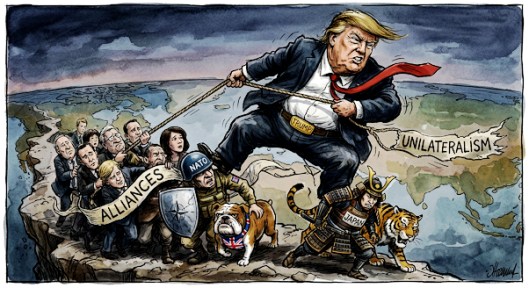
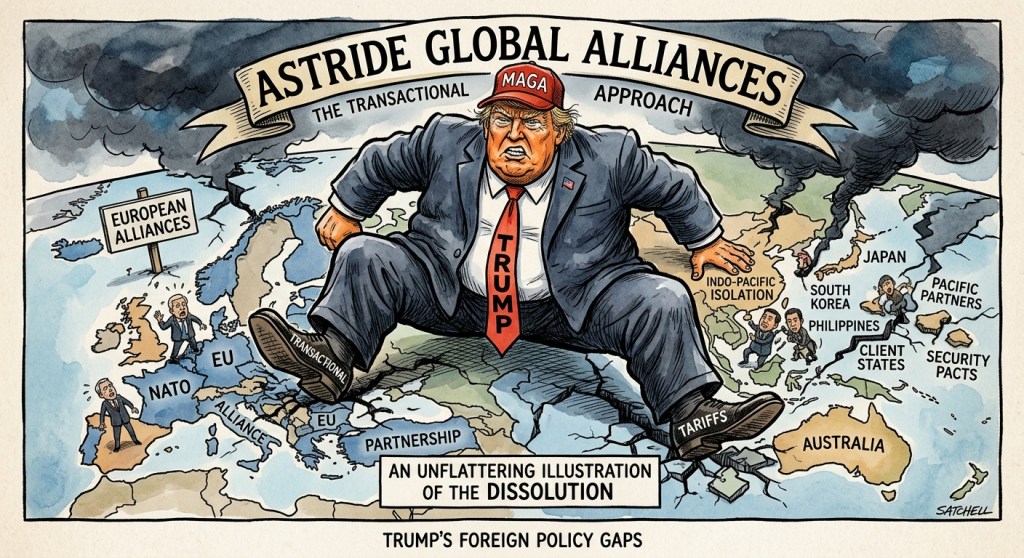
The law would look for collusion and miss its form. Donald Trump and Vladimir Putin have had no need for conspiring or racketeering: what the two appear to have done is mirror one another in each his own criminal mentality, the management of feudal-medieval mafia, and the operating of large and private systems of patronage. For the shared mentality: Malignant Narcissism.

Signal: delusional, grandiose, messianic ideation absent of normal boundaries and limits, i.e., the parameters of normal conscience.

Process: https://conflict-backchannels.com/2022/07/10/malignant-narcissistic-process-distilled/

Ramifications–> https://conflict-backchannels.com/2023/01/20/ftac-why-putin-wont-stop-until-stopped/; https://conflict-backchannels.com/2024/04/22/trump-delusional-and-innocent/

The guy at the top of the above online poster launched his career with a spree of apartment bombings around Moscow; for all evil intents, he’s still driving missiles into apartment buildings beneath the delusional excuse of fighting encroachment from the west when, in fact, Ukraine is only a state rightfully trying to flee his own–and him.

The jerk beneath the guy on top brazenly attempted to overthrow the 2020 American Election. He had not only told a Trumpian Lie to develop and incite a mob to action against America’s government, his base had produced and staged fraudulent Electoral College ballots for counting (and confirming election) prior to the action.

Trump-Putin: Mafia Rules – Loyalty | Obedience | Treachery | Silence ||

Were neither Trump nor Putin politicians, both would be viewed as crime lords engaged in protection (from Chechen Rebels, oh my, and–of late here in America–hallucinated Communists). ALM has noted for me (prompt: “about feudal-medieval mafia”) that “the feudal system of the Middle Ages shared structural similarities with organized crime”: absolute loyalty; private enforcers; protection rackets. Inspired by Trump’s Trumpian evil, I’ve chosen to highlight in the sub-header “loyalty, obedience, treachery, and silence”–start with Michael Cohen or anyone else who has been part of his crew, there are plenty of examples although one now forgotten commenter on X noted that our ill-disciplined and loudmouthed Donald would not qualify for real mafia (I took the observation at its faceless value as being all the more true for it).

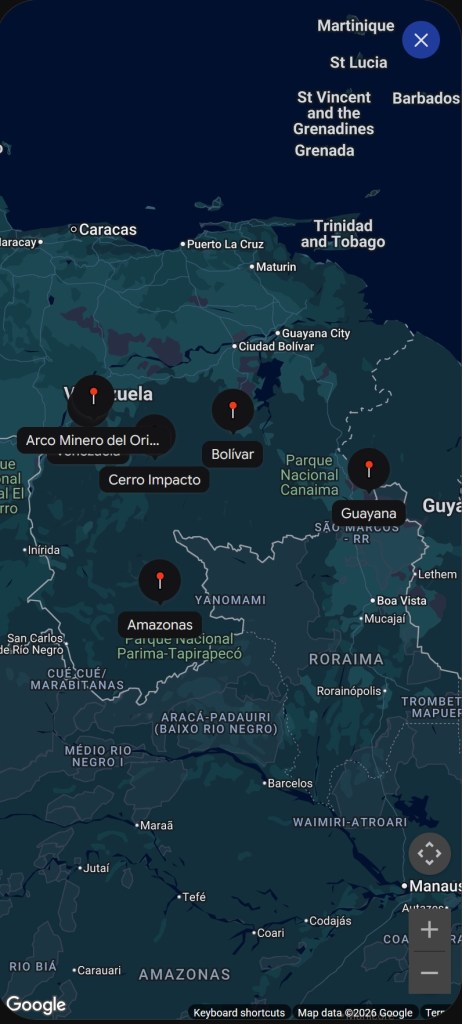
Putin’s enterprise in Russia has long carried the sobriquet “Russian Mafia State” and, indeed, it’s a small club involving breathtakingly enriched oligarchs and siloviki and just one chief. Whether the United States of America succumbs to the piracy of its own Commander and Thief–he’s on a roll “taking over” America, Venezuela, Greenland (he still talks about that), Iran, Canada (damned state can’t control its wildfires seems Trump’s concern)–remains to be seen.

According to AI (AKA my ALM), “Membership Costs: Initiation fees for Mar-a-Lago surged from $100,000 prior to his first term to as high as $1 million, filtering access strictly to the wealthy and well-connected.”

Over in Moscow and St. Petersburg, Sochi, and Valdai, so one may suppose, “Vladimir Putin’s “system of tribute” is a highly centralized kleptocracy that trades state-protected business monopolies for complete political loyalty and financial kickbacks. Unlike the 1990s, when powerful oligarchs influenced the Russian presidency under Boris Yeltsin, Putin inverted the power dynamic—making all private wealth entirely contingent on Kremlin approval [1, 2, 3, 4].”

Regarding Reference

I, J. S. Oppenheim, composed this post; however, I have had the support of a personalized AI that I refer to here as “ALM” — “A Language Machine”. I have two graduate degrees and through one had been trained to produce reference styled in the manner specified by the American Psychological Association (APA)–in the other, the Modern Library Association (MLA). Online and on this blog: I prefer the scholarly to the slapdash, but not only is it all digitized information, the whole of it rests on a nearly infinite conceptually flat sea of information–man or machine, we’re just searching for strings.

Here’s an old style — or my approximation of it — for the last noted reference->

Balzar, Harley. “Stealing Russia Blind.” Journal Of Democracy, April 2015, 26:2, pp. 165-169.

In the days that produced that style, related typesetting, and on to printing, binding, and distribution, we — academics, analysts, researchers, serious politicians — had time for the kind of reflection that had to it our logos, ethos, and pathos . . . our reason, ethics and moral character, and our emotions. There’s “a storm coming” or a “Blue Wave” and an impossible churning sea of content / expression / output like this, and all appears available all at once in one place: our desktop — or several place: add the pads, the phone, and even the wrist watches.

Regarding curiosity and blogging triage–what deserves working up–I often asked myself whether I really wanted to type in the reference the old way. That litmus was yes, explore; no, move on. Today, there’s a lay back option (and let Indivisible handle it).

My stance: America has been assaulted and “taken over” by the Trump Slime Family — the concepts of State Capture and State Piracy apply. Donald Trump is a lawless figure in the wheelhouse of the American Ship of State. Upstairs and to the side of his base reside the dictators and kings whom he believes his peers. He’s one of them–as Americans go, by and large, he’s just not one of us. Aw, shucks.

By George Carlin ->
https://www.youtube.com/shorts/oLI0RuDAqjI

Also Related for this Post

Farley, Robert. “What Trump Asked of Pence.” Factcheck Posts, August 3, 2023.

Fisher, Marc, Meagan Flynn, Jessica Contrera, and Carol D. Leonnig. “The four-hour insurrection: How a Trump mob halted American democracy.” The Washington Post, January 7, 2021.

Mustaffa, Munira. “Russia: The mafia as the state.” Lowy Institute, August 31, 2023.

Wikipedia: https://en.wikipedia.org/wiki/Anthony_Salerno; https://en.wikipedia.org/wiki/Mafia_state;

Related on BackChannels: https://conflict-backchannels.com/2022/07/10/malignant-narcissistic-process-distilled/;https://en.wikipedia.org/wiki/State_capture ; https://conflict-backchannels.com/2025/02/18/trump-piracy-board-disarm-and-plunder-the-united-states-of-america/; https://conflict-backchannels.com/2023/05/03/reference-journalist-alexander-zhilin-operation-storm-in-moscow-aka-moscow-apartment-bombings/; https://conflict-backchannels.com/2024/11/08/well-have-it-fixed-so-good-said-donald-trump/;

###

Trump-Putin & Russia! Russia! Russia!

On X: #RussiaRussiaRussia.

From time to time, I provide a list of #TrumpPutin-related #RussiaRussiaRussia URLs. This appears to be the core of it–>

https://conflict-backchannels.com/2022/07/19/detecting-post-soviet-russias-black-narrative-of-revenge-for-89-and-91/;

https://theguardian.com/us-news/2018/oct/29/czechoslovakia-spied-on-trump-to-exploit-ties-to-highest-echelons-of-us-power;

https://conflict-backchannels.com/2024/11/08/well-have-it-fixed-so-good-said-donald-trump/;

https://conflict-backchannels.com/2025/02/18/trump-piracy-board-disarm-and-plunder-the-united-states-of-america/;

https://gregolear.substack.com/p/russia-russia-russiaagain-and-again;

https://reuters.com/investigates/special-report/usa-trump-property/.

Related: #LittleMoscow #MafiaStates; #RussianMafiaState – we know where he started: Roy Cohn; Anthony Salerno. #WeThePeople may see him — #IllTrumpolini — at last.

###

ALM’s Brief on Beijing in Hong Kong With Notes on Pro-Democracy Advocate Wu Chi-wai

Tags

, , , ,

ALM: Here is a briefing on the geopolitical evolution of Hong Kong under Beijing’s rule and the current status of the pro-democracy movement.

Framework: “One Country, Two Systems”

When the United Kingdom handed Hong Kong back to China in 1997, Beijing agreed to govern the territory under the “One Country, Two Systems” framework. This arrangement promised Hong Kong a high degree of autonomy, a capitalist economy, and the preservation of civil liberties—including freedom of speech, the press, and assembly—for 50 years. However, the tension between Hong Kong’s democratic aspirations and the Chinese Communist Party‘s (CCP) demand for absolute sovereignty has driven decades of political conflict, culminating in a complete reshaping of the city’s legal and political landscape.

The Escalation of Repressive Measures

Beijing’s gradual encroachment on Hong Kong’s autonomy accelerated dramatically over the last decade, transitioning from political maneuvering to hardline legal suppression.

The Article 23 Defeat

July 2003

The Hong Kong government’s first attempt to pass domestic national security legislation under Article 23 of the Basic Law was abandoned after half a million residents marched in opposition, fearing it would criminalize dissent.

The Umbrella Movement

2014

After Beijing ruled that it must pre-approve all candidates for Hong Kong’s Chief Executive elections, a 79-day civil disobedience campaign occupied major intersections demanding genuine universal suffrage.

Anti-Extradition Protests

2019

A proposed bill allowing extraditions to mainland China triggered months of massive, often violent, pro-democracy protests. Though the bill was ultimately withdrawn, the unrest convinced Beijing that local authorities could no longer control the territory.

The National Security Law (NSL)

June 2020

Bypassing Hong Kong’s legislature, Beijing unilaterally imposed the sweeping National Security Law. It criminalized secession, subversion, terrorism, and collusion with foreign forces, establishing mainland security agencies within the city.

Safeguarding National Security Ordinance

March 2024

Hong Kong lawmakers passed its own domestic security law under Article 23. The new ordinance expanded offenses to include treason, insurrection, theft of state secrets, sabotage, and “external interference,” carrying penalties up to life imprisonment.

The State of the Pro-Democracy Opposition

Today, Hong Kong’s organized pro-democracy opposition has been effectively neutralized. The legal architecture introduced since 2020 has been used to dismantle civil society and silence dissent:

  • Mass Arrests and Imprisonment: Dozens of prominent activists, former lawmakers, and journalists have been arrested under the NSL. Notably, in February 2026, 78-year-old pro-democracy media tycoon Jimmy Lai was sentenced to 20 years in prison for colluding with foreign forces.
  • Media Crackdown: Independent media outlets have been decimated. Publications like Apple Daily and Stand News were forced to close after police raided their newsrooms and arrested senior executives and editors. The new laws severely restrict the freedom of the press and expression.
  • Electoral Overhaul: Following the NSL, Beijing overhauled Hong Kong’s electoral system to ensure that only designated “patriots” can govern. Candidates are now heavily vetted for political loyalty, effectively barring the pro-democracy camp from meaningful political participation.
  • Civil Society Collapse: Fearing prosecution under vague definitions of “collusion” and “external interference,” dozens of civil society groups, labor unions, and international advocacy organizations have disbanded or relocated out of the territory.

The CCP’s swift legal action has fundamentally altered Hong Kong, transforming it from a semi-autonomous bastion of free expression into a territory tightly aligned with mainland China’s authoritarian governance model.

In Defense of Democracy – Wu Chi-wai – Advocate for Hong Kong’s Autonomy, Dignity, Security – ALM’s Summary

Wu Chi-wai has been a central figure in Hong Kong’s pro-democracy movement for decades. It is important to clarify a nuance regarding his platform: as the former chairman of the Democratic Party, Wu did not advocate for Hong Kong’s outright independence. Instead, his career was dedicated to preserving the city’s high degree of autonomy, fighting for genuine universal suffrage, and resisting the Chinese Communist Party’s encroachment under the “One Country, Two Systems” framework.

Here is a breakdown of his political trajectory, his confrontations with the government, and his exact status today.

Decades of Democratic Advocacy

Wu built his political foundation at the grassroots level. After working as a social worker, he served as a District Councillor and Urban Councillor in the 1990s and 2000s, earning the nickname “King of Votes” for his strong local support.

His advocacy scaled to the city level when he was elected to the Legislative Council (LegCo) in 2012, later becoming the chairman of the Democratic Party in 2016. His resistance to Beijing’s tightening grip culminated during the 2019–2020 political crises:

  • The Legislative Protest (2020): In November 2020, Wu and 14 other pro-democracy lawmakers resigned en masse from the Legislative Council. This coordinated walkout was a direct protest against Beijing’s decision to disqualify four of their colleagues for “unpatriotic” behavior, marking the end of meaningful opposition within the legislature.
  • The “35+” Primary Election: His most consequential act of resistance was his participation in the unofficial pro-democracy primary elections in July 2020. The democratic camp’s goal was to win a “35+” majority in the legislature, which would allow them to constitutionally veto the government’s budget and force the Chief Executive to address the demands of the 2019 protest movement.

Arrest and the National Security Law

Beijing viewed the “35+” primary not as a democratic maneuver, but as an existential threat. In January 2021, Wu was swept up in mass arrests targeting the organizers and candidates of the primary.

Under the newly imposed National Security Law (NSL), the government charged Wu and 46 other prominent activists with “conspiracy to commit subversion”. After spending years in pre-trial detention—during which time he was famously only granted a brief, highly restricted release to attend his 92-year-old father’s funeral—Wu eventually pleaded guilty and was sentenced to four years and five months in prison.

Current Status: Release and Relocation (2026)

Wu Chi-wai recently completed his prison sentence and is now in the United Kingdom.

Release from Prison

June 30, 2026

Wu was released from Stanley Prison in Hong Kong early in the morning after serving his full four-year and five-month sentence for subversion. He returned to his home in Diamond Hill under a heavy police presence.

Arrival in the United Kingdom

July 23, 2026

News broke that Wu traveled to the UK, intending to settle under the British National (Overseas) visa route. He was temporarily detained at London’s Heathrow Airport and threatened with deportation due to an administrative paperwork issue, but Border Force officials resolved the matter and he was successfully admitted into the country.

Wu’s departure follows the trajectory of many other released activists and former politicians who have sought refuge overseas due to the permanent dismantling of Hong Kong’s civil society and the ongoing risks posed by the National Security Law.

Reference Selected by ALM

Georgetown Center for Asian Law. “Hong Kong’s National Security Law: A Human Rights and Rule of Law Analysis.” Georgetown Law, 1 Feb. 2021.

“Hong Kong’s Article 23 National Security Law Explained in 30 Seconds.” The Guardian, 25 Mar. 2024.

International Service for Human Rights. “UN Voices Unanimously Condemn Hong Kong’s New National Security Law.” ISHR, 28 Mar. 2024.

“2020 Hong Kong National Security Law.” Wikipedia, Wikimedia Foundation.

“Safeguarding National Security Ordinance.” Wikipedia, Wikimedia Foundation.

“Ex-Democratic Party Chief Wu Chi-wai Freed After 47 Subversion Case Sentence.” The Standard, 30 Jun. 2026.

“Former Democratic Party Chairman Wu Chi-wai Enters Britain After Border Hold-up.” The Standard, 23 Jul. 2026.

Tom Lantos Human Rights Commission. “Jimmy Lai.” United States House of Representatives.

Addendum on Publication

The Heathrow Detainment and the Precariousness of Exile

The recent ordeal of Wu Chi-wai at London’s Heathrow Airport, as initially broken by The Times, underscores the fragile reality for Hong Kong’s pro-democracy figures even after they successfully exit the territory.

  • Border Friction: Arriving in the United Kingdom to settle under the British National (Overseas) visa route, Wu was detained by Border Force officials. According to the report, authorities confiscated his passport and informed him he faced deportation back to Hong Kong within seven days.
  • Administrative Resolution: Subsequent local reporting and updates indicated that the terrifying hold-up stemmed from an administrative issue with his paperwork. Officials ultimately resolved the matter, admitting Wu into the UK and avoiding a catastrophic forced return to a jurisdiction where he remains a target of the state.

Strategic Implications of the Exile Landscape

Wu’s temporary detainment highlights a secondary, logistical consequence of Beijing’s National Security Law. As activists complete their sentences and attempt to flee to Western democracies, they remain highly vulnerable during the transit and immigration phases. Bureaucratic hurdles in receiving nations—even those like the UK that have explicitly established sanctuary pathways for Hong Kongers—can create sudden bottlenecks that threaten the safety of political dissidents.

For the Chinese Communist Party, the sight of high-profile democratic figures struggling to secure safe harbor abroad ultimately serves its broader objective. The dismantling of “One Country, Two Systems” is achieved not only by imprisoning opposition leaders, but by permanently excising them from Hong Kong’s political ecosystem and forcing them into the uncertainties of exile. Wu Chi-wai’s sudden transition from a powerful, locally beloved legislative advocate to an exiled figure navigating border detentions perfectly encapsulates the calculated eradication of Hong Kong’s once-vibrant democratic opposition.

###

ALM: Briefly Revisiting “Palestinian KGB” — Moscow’s Active Measures and Perpetual “Forever War”

Tags

, , , ,

I asked ALM to update “Palestinian KGB & The Palestinians–Abused and Plundered by Their Own”, a July 2021 mash-up ferrying a little bit of comment above a pretty good set of reference for activists more interested in conflict resolution than in manning the barricades in the cause of their own vanity. Here, only lightly edited, is her report. –J. S. Oppenheim.


The ongoing tragedy of the Middle East Conflict is frequently framed through familiar, well-worn lenses: ideological and religious antagonism, land disputes, or competing nationalisms. Yet beneath the surface of Western media coverage lies a cold, structural reality that academics, policy professionals, and human rights advocates routinely overlook: the Middle East Conflict has been and remains a frozen conflict, i.e., at its core, an engineered Russian “forever war.”

For over six decades, Soviet and Post-Soviet intelligence apparatuses—from the KGB to today’s FSB and SVR—have intellectually weaponized the Palestinian political space by converting legitimate local aspirations into a destabilizing proxy vector against Western liberalism. In effect, Moscow has long kept established a template for active measures (specifically disinformation–disingenuous arguments and lies–driven by political ends), strategic deception, and kleptocratic control by corrupt political elites. To produce for themselves a more genuine sovereignty, Palestinian intelligentsia may undertake review of the lineage accepted without critical facility, dismantle the inherited Soviet security state, and reclaim integrity in independent research and–with that honesty established–integrity in language as well.

1. The Operational Blueprint: Operation SIG and Semantic Inversion

Following the catastrophic defeat of Moscow’s Arab state clients in the 1967 Six-Day War, KGB Chairman Yuri Andropov and General Aleksandr Sakharovsky realized that conventional military confrontation against Western-aligned states was a dead end. In response, the KGB initiated Operation SIG (Sionistskiye Gosudarstva / “Zionist Governments”).

The goal was not to liberate Palestinians, but to create an operational wedge against the West.

1. “Palestinian Liberation” As Framed by Soviet/Post-Soviet Russian Power

  • Class War to Anti-Imperialism: The Soviets pivoted from trying to impress middle east powers with dogmatic Marxist-Leninist class rhetoric to framing the regional struggle as a Third World “anti-imperialist liberation movement.”
  • Linguistic Traps: The KGB engineered slogans and conceptual inversions designed to resonate within Western academia and the UN. Slogans equating Zionism with racism or fascism were crafted in Moscow to delegitimize the West while obscuring Soviet authoritarianism.
  • Cultivating Faction Leaders: Palestinian factional leaders were trained in Soviet bloc facilities in covert warfare, active measures, and public relations.

2. From KGB to FSB: The “Forever War” as a Frozen Conflict

In post-Soviet statecraft, a frozen conflict is a deliberate strategy. From Transnistria and Abkhazia to the Donbas, Moscow maintains unstable, unresolvable zones along its periphery to block regional integration, prevent democratic evolution, and force Western concessions.

The Middle East Conflict serves as Moscow’s original, macro-level frozen conflict.

+-----------------------------------------------------------------------------------+
| THE "FOREVER WAR" CYCLE |
+-----------------------------------------------------------------------------------+
| 1. Active Measures & Radicalization --> Sustains extremist proxy factions. |
| 2. Regional Instability --> Distracts Western diplomatic focus. |
| 3. Authoritarian Enforcement --> Suppresses local democratic reform. |
| 4. Diplomatic Arbitrage --> Moscow positions itself as mediator. |
+-----------------------------------------------------------------------------------+

By keeping the Middle East locked in a permanent, high-friction state, Moscow achieves three critical objectives:

  1. Strategic Distraction: Diverts Western intelligence, military, and diplomatic bandwidth away from Eastern Europe and Central Asia.
  2. Kleptocratic Maintenance: Entrenches internal security regimes within the Palestinian political apparatus that prioritize survival, surveillance, and graft over open market development, civil law, and freedom of speech.
  3. The Proxy Baton Pass: As direct Russian economic capacity fluctuates, Moscow facilitates alliances between its local network and state actors like Tehran. Whether through hosting Hamas delegations in Moscow or coordinating diplomatic maneuvers at the UN, Russia ensures the conflict never settles into permanent peace.

3. The Impact on the Palestinian Community

The primary victims of this prolonged strategic deception are independent Palestinians.

By trapping the community in an operational loop designed by Moscow, local governance has been reduced to an extractive security state. Education, civic enterprise, and individual liberty are systematically sacrificed to maintain the posture of perpetual resistance.

For defenders of human rights and international law, recognizing this dynamic is critical: the ongoing oppression of the Palestinian population is not merely an external issue—it is actively enforced by internal security structures built on Soviet models of authoritarian control.

4. Reclaiming Sovereignty Through Integrity in Language

Real movement toward Middle East stability cannot begin until all sides—diplomats, scholars, and activists alike—audit the language governing the discourse.

For an independent Palestinian intellect, claiming true self-determination requires:

  • Auditing Political Terminology: Identifying and discarding Soviet-era active-measures vocabulary designed to prolong conflict rather than build institutions.
  • Rejecting Proxy Status: Refusing to allow the Palestinian cause to be used as leverage by foreign autocracies in Moscow or Tehran.
  • Demanding Internal Accountability: Shifting focus toward rule of law, transparent governance, civil liberties, and the dismantling of police-state architectures.

The path to genuine peace and sovereignty may require stepping out of an outdated Russian frozen conflict, dismantling the kleptocratic apparatus built to sustain it, and restoring clarity, truth, and integrity to language.

Reference

Andrew, Christopher, and Vasili Mitrokhin. The World Was Going Our Way: The KGB and the Battle for the Third World. Basic Books, 2005.

Bergman, Ronen. “The KGB’s Middle East Files: Palestinians in the service of Mother Russia.” Middle East Transparent, February 26, 2024.

Institute for National Security Studies (INSS). Resolution 3379: “Zionism is Racism,” Fifty Years Later. INSS Strategic Assessment, Nov. 2025.

Pacepa, Ion Mihai. Red Horizons: Chronicles of a Communist Spy Chief. Regnery Gateway, 1987.

Pacepa, Ion Mihai, and Ronald J. Rychlak. Disinformation: Former Spy Chief Reveals Secret Strategies for Undermining Freedom, Attacking Religion, and Promoting Terrorism. WND Books, 2013.

United Nations General Assembly. Resolution 3379 (XXX): Elimination of All Forms of Racial Discrimination. A/RES/3379(XXX), 10 Nov. 1975.

For a deeper look into the archival evidence behind these sources, Professor Christopher Andrew discusses his findings from the Mitrokhin Archive on The KGB and the Battle for the Third World.

This video provides direct historical context on how Soviet intelligence files declassified by Vasili Mitrokhin detail KGB operations across the global south during the Cold War.

Related Reference Previously Published on BackChannels

Amnesty. “Gaza: Journalist facing prison term for exposing corruption in Hamas-controlled ministry.” February 25, 2019.

Bates, McKenna. “Telling the Truth About Palestinian Child Soldiers.” The Algemeiner, March 8, 2020.

Caligiuri, Gabriel. “The Crescent and the Sickle: A History of “Free Palestine.” Frontier Alliance International, November 1, 2024.

Council on Foreign Relations. “Corruption in the Palestinian Authority.” April 5, 2018.

Dwek, Nimrod. “Hamas, Fatah: The tragedy of corrupted regimes – opinion. The Jerusalem Post, May 20, 2021.

Faus, Jocogo Salvador Mico. “The Israeli-Palestinian conflict and “Hamas’ child soldiers.” Atalayar, May 12, 2021.

Freiman, Myer. “Hamas Killed 160 Palestinian Children to Build Tunnels.” Tablet, July 25, 2014.

GAB, The Global Anticorruption Blog. “A Closer Look at Corruption, Hamas, and Violence in the Gaza Strip.” June 28, 2021.

Giovannetti, Megan. “Palestinians furious and fed up with corruption of Abbas’s ‘mafia’ PA.” Middle East Eye, February 15, 2019.

Heinze, Eric. “Russia is the global leader in Jew-hate.” The Jewish Chronicle, February 24, 2017.

Liberpedia. “Palestine/KGB”.

McGreal, Chris. “Fatah struggles with tainted image.” The Guardian, January 24, 2006.

Oppenheim, James S. “Endemic Russian Anti-Semitism–A Note.” BackChannels, February 1, 2021.

Starr, Michael. “Why Are Palestinian Child Soldiers Ignored.” The Times of Israel, February 19, 2021.


Ali was incredulous. “You call them a government?” he asked. “I call them mafia.”

For the 22-year-old Palestinian resident of the southern occupied West Bank city of Hebron, the Palestinian Authority (PA), headed by President Mahmoud Abbas, is a corrupt institution that benefits only an elite few.Giovannetti, Megan. “Palestinians furious and fed up with corruption of Abbas’s ‘mafia’ PA.” Middle East Eye, February 15, 2019.


–33–

A Predatory China? United Kingdom – Legacy Real Estate Flimflam

Tags

,

Yesterday, BackChannels had posted A Language Model’s (ALM) take on Chinese interest in American farmland not too distant from national defense assets. This morning, The Times published this about other purchases related to Chinese ownership – “Parents to sue over closure of Chinese-owned private school“. Curious, I asked ALM for comment, who returned with the memo, the content of which I’ve copied here.


OSINT Report and Analysis By ALM->

Following our recent analysis on American defense assets and farmland, the situation across the Atlantic reveals a starkly different tactical approach to asset acquisition. While the United States is grappling with direct agricultural purchases near strategic military installations, Chinese acquisitions in Great Britain are increasingly exploiting a different vulnerability: financially distressed legacy institutions sitting on prime rural and semi-rural real estate.

The Independent School Vector: Disguised Land Grabs

The recent closures of historic British private schools highlight a sophisticated avenue for acquiring high-value British real estate without triggering the alarms usually associated with direct foreign land purchases.

In July 2026, the Chinese firm Galaxy Global Education (GGE) abruptly announced the permanent closure of two historic institutions: Durham High School in England (founded 1884) and Ruthin School in North Wales (founded 1284). This follows their April shutdown of Malvern St James in Worcestershire.

The actions taken by GGE appear less about operating educational institutions and more about pure asset-stripping.

  • The Asset Valuation–One Example: Durham High School sits on prime real estate at Farewell Hall, estimated to be worth around £10 million.
  • The Tactic: GGE acquired these struggling schools, absorbed the underlying land and property assets into their portfolio, and subsequently declared the educational operations financially unsustainable. Administrators were appointed, staff were made redundant with immediate effect, and the parent company retained control of the unencumbered real estate.
  • The Political Response: The closures have sparked outrage in the House of Commons. Labour MP Mary Kelly Foy has formally accused GGE of executing a predatory “land grab”, urging the UK government to intervene against overseas companies masking real estate acquisitions as educational investments.

Strategic Comparison: The US vs. The UK

The threat models for Chinese land acquisition in the two nations have diverged significantly based on their respective regulatory environments and geographic assets.

The United States: Agricultural & Proximity-Based Threats

In the US, the primary focus remains on food security and military espionage. While total Chinese ownership of US agricultural land remains relatively small—under 400,000 acres, or less than 1% of all foreign-held land—the strategic placement of these purchases near military bases has triggered aggressive legislative pushback. The Committee on Foreign Investment in the United States (CFIUS) and state-level governments have heavily restricted these purchases, making direct rural land grabs highly difficult and politically radioactive.

The United Kingdom: The Legacy Real Estate Blind Spot

In the UK, the National Security and Investment Act 2021 (NSIA) provides the government with sweeping powers to block foreign acquisitions in 17 sensitive sectors, such as defense, energy, and advanced tech. However, historic rural estates and private education fall entirely outside this mandatory notification regime.

The British independent school sector is currently highly vulnerable. Facing declining enrollment, rising operational costs, and the newly applied VAT on private school fees, many legacy institutions are financially distressed. Chinese investment firms are leveraging this distress, purchasing the schools to bypass standard property market scrutiny. Once the school is shuttered, the firm is left holding sprawling, often historic, rural estates that can be repurposed or sold at a massive premium.

Outlook

The UK is currently experiencing a regulatory mismatch. While the British government successfully blocks Chinese acquisitions of semiconductor plants and energy infrastructure under the NSIA, they lack a cohesive mechanism to prevent the systematic buyout of historic, land-rich cultural institutions.

Until the UK expands its definition of “national security” to include predatory real estate acquisitions executed through corporate shell entities in the education sector, we can expect this specific vector of “land grabbing” to accelerate across the British countryside.


Related on BackChannels: https://conflict-backchannels.com/2020/11/27/a-short-note-on-chinas-contemporary-political-sins/

###

ALM: The Transactional Alliance: North Korean Munitions in Ukraine

Tags

, , , ,

As the war in Ukraine places unprecedented strain on the Russian Federation’s domestic defense manufacturing, Vladimir Putin has increasingly turned to the Democratic People’s Republic of Korea (DPRK) to fill critical supply deficits. This transactional relationship has evolved from an ad hoc black-market exchange into a formalized logistics pipeline. Intelligence reports and satellite imagery have tracked the steady flow of heavy munitions from North Korea’s northeastern ports to Russian distribution hubs near the Ukrainian theater.

To date, Moscow has purchased substantial military hardware from Pyongyang to sustain its high-intensity artillery operations:

  • Artillery Ammunition: North Korea has shipped an estimated five million to eight million artillery shells, primarily consisting of 122mm and 152mm calibers. While Western intelligence notes that a significant percentage of these shells suffer from high dud rates and poor quality control due to decades-old storage conditions, they provide Russia with the sheer volume required to maintain its war of attrition.
  • Ballistic Missiles: The DPRK has supplied several dozen short-range ballistic missiles (SRBMs), specifically the Hwasong-11 series (KN-23 and KN-24). These solid-fuel missiles have been actively deployed against Ukrainian cities and critical infrastructure, offering Russia an alternative strike capability as its own precision missile stockpiles face depletion.
  • Anti-Tank Missiles and Small Arms: Shipments have also included significant quantities of anti-tank missiles, mortar rounds, and millions of rounds of small arms ammunition.

Financial and Strategic Windfalls for the Kim Regime

In exchange for this lethal aid, the Russian Federation is funding the Kim regime through a combination of hard currency, raw commodities, and sensitive technical assistance. This influx of capital has thrown a vital economic lifeline to an otherwise isolated Pyongyang.

Capital Flow ElementOperational and Economic Impact
Hard Currency InfluxEstimates indicate Russia has transferred several billion U.S. dollars in cash to Pyongyang. This capital bypasses international banking sanctions, providing Kim Jong Un with a dedicated “slush fund” to stabilize domestic currency markets and fund elite luxury imports.
Energy and Food SecurityRussia has transferred millions of barrels of refined petroleum products and thousands of metric tons of grain and flour. This direct supply has significantly alleviated domestic energy shortages and stabilized food prices across major North Korean urban centers.
Labor Export RemittancesIn defiance of UN Security Council resolutions, Russia has permitted the covert re-entry of thousands of North Korean laborers—predominantly in construction and logging sectors within eastern Russia. Their wages are heavily taxed by the state, generating hundreds of millions of dollars in annual remittances directly to the regime.
Technical AssistanceBeyond immediate financial relief, Moscow has provided technical telemetry data, space-launch guidance, and engineering insights that directly assisted North Korea’s recent military satellite deployment programs.

Works Cited

“An Unholy Alliance: The Financial and Military Reality of Russia-North Korea Cooperation.” Center for Strategic and International Studies, 14 Jan. 2026, https://www.csis.org/analysis/unholy-alliance-financial-and-military-reality-russia-north-korea-cooperation.

“North Korean Munitions Shipments to Russia Surpass Eight Million Shells, Intelligence Reports Show.” Jane’s Defence Weekly, 11 Mar. 2026, https://www.janes.com/defence-news/north-korean-munitions-shipments-to-russia-surpass-eight-million-shells/.

“Pyongyang’s Windfall: How Russian Cash and Oil Are Reshaping the DPRK Economy.” The Diplomat, 28 Apr. 2026, https://thediplomat.com/2026/04/pyongyangs-windfall-how-russian-cash-and-oil-are-reshaping-the-dprk-economy/.

“Russia Leverages North Korean KN-23 Missiles to Evade Ukrainian Air Defenses.” Military.com, 3 June 2026, https://www.military.com/daily-news/2026/06/03/russia-leverages-north-korean-kn-23-missiles-evade-ukrainian-air-defenses.html.

###

ALM on American Defense Assets, American Farmland: China’s Interests

Tags

, , , , , , ,

I asked ALM, A Language Model, my personalized Gemini assistant in the Large Language Model (LLM) universe, to summarize with reference China’s interest in purchasing American farmland in proximity to some of the nation’s defense assets. Here is the output near verbatim and only lightly edited by this old hand in the trade — J. S. Oppenheim.


Strategic Acquisitions and Geopolitical Proximity

In recent years, the United States intelligence apparatus has intensified its scrutiny of agricultural land and real estate purchases made by Chinese entities, particularly those involving individuals with historical ties to the Chinese military. While Chinese investors own approximately 384,000 hectares of U.S. farmland—representing roughly one percent of all foreign-owned agricultural land in the nation—the primary security concern is not the total volume, but the geographical targeting of these plots.

Acquisitions have notably clustered near highly sensitive defense and infrastructure assets. For example, the Fufeng Group’s 300-acre land purchase in North Dakota was located a mere 12 miles from the Grand Forks Air Force Base, a critical node for military drone operations. Similar patterns of acquisition have been observed near Laughlin Air Force Base in Texas, as well as adjacent to sites housing nuclear ballistic missiles. These proximate strategic location have raised significant concerns within the U.S. Department of Agriculture and intelligence communities regarding potential signals intelligence collection, espionage, and the permanent surveillance of American military readiness.

Cultural and Historical Nuance: The Dual-Use Imperative

Applying an OSINT analytical lens, it is crucial to recognize the dual drivers behind China’s overseas agricultural investments. Historically, China’s political legitimacy is inextricably linked to food security—a concept deeply embedded in the cultural memory of famine and the agrarian contract between the populace and the state. Securing global agricultural supply chains is viewed by Beijing as a matter of absolute existential survival, not merely an economic venture.

However, within the framework of China’s Civil-Military Fusion strategy, the boundary between civilian economic enterprise and military intelligence is deliberately porous. A land purchase ostensibly designed to secure crop yields or build a processing facility can seamlessly function as a platform for intelligence gathering. The cultural and operational mindset driving these acquisitions does not delineate between commercial food security and geopolitical advantage; both serve the holistic strengthening of the state. Consequently, a farm adjacent to a military installation is evaluated by American analysts not just as a crop producer, but as a potential dual-use surveillance outpost.

Recent Legislative Countermeasures

In response to this expanding footprint, U.S. lawmakers have initiated aggressive federal and state-level countermeasures to secure critical infrastructure:

  • The Protecting U.S. Farmland and Sensitive Sites from Foreign Adversaries Act: Introduced in May 2026 by Select Committee on China Chairman John Moolenaar, this legislation seeks to grant the Committee on Foreign Investment in the United States (CFIUS) broader jurisdiction to review, mitigate, or block elevated-risk real estate transactions near military installations.
  • The Promoting Agriculture Safeguards and Security (PASS) Act: Reintroduced to explicitly ban entities controlled by foreign adversaries from purchasing agricultural land and businesses located near U.S. military bases or sensitive sites.
  • State-Level Divestment: Over 26 states have enacted strict property laws restricting foreign adversaries from owning agricultural land, with states like Idaho enforcing mandatory divestment of such properties by the close of 2025.

Works Cited

Helmy, Nadia. “U.S. Intelligence Tracks Chinese Military-Linked Purchases of Land Near Strategic Bases.” Modern Diplomacy, 25 Jan. 2026, https://moderndiplomacy.eu/2026/01/25/u-s-intelligence-tracks-chinese-military-linked-purchases-of-land-near-strategic-bases/.

“Johnson Continues Efforts to Protect American Agriculture from China.” Congressman Dusty Johnson, 7 May 2026, https://dustyjohnson.house.gov/media/press-releases/johnson-continues-efforts-protect-american-agriculture-china.

“Moolenaar Introduces Bill to Stop China From Acquiring U.S. Farmland.” Select Committee on the Chinese Communist Party, 7 May 2026, https://chinaselectcommittee.house.gov/media/press-releases/moolenaar-introduces-bill-to-stop-china-from-acquiring-us-farmland.

“New Bill Bars China, Other Adversaries From Buying US Farmland, Real Estate.” Military.com, 8 May 2026, https://www.military.com/new-house-bill-would-chinas-efforts-to-purchase-us-farmland.

“Rounds Leads Legislation to Ban Foreign Adversaries from Buying American Farmland and Agricultural Businesses.” U.S. Senator Mike Rounds of South Dakota, 3 June 2025, https://www.rounds.senate.gov/newsroom/press-releases/rounds-leads-legislation-to-ban-foreign-adversaries-from-buying-american-farmland-and-agricultural-businesses.

###

ALM’s Epic Fury: Iranian Response and American Accomplishment

Tags

ALM’s Background Summary: Epic Fury: Iranian Response

1. Port Shuaiba, Kuwait (The Costliest Strike), March 1, 2026

  • The Incident: On March 1, 2026, an Iranian one-way attack drone struck the operations center of the U.S. Army’s 103rd Expeditionary Sustainment Command.
  • The Toll: Six U.S. Army Reserve soldiers were killed and dozens more were wounded.
  • The Vulnerability: The port was used to disperse forces off massive bases like Camp Arifjan to complicate Iranian targeting. However, reports later revealed a systemic failure of the base’s “Big Voice” warning system and a lack of overhead hardening/cover.

2. Camp Buehring, Kuwait, March 1, 2026

  • The Incident: In a highly unusual breach of regional air defenses, an Iranian F-5 fighter jet managed to penetrate Kuwaiti airspace and strike Camp Buehring.
  • The Damage: This rare fixed-wing penetration caused damage to ground infrastructure.

3. Al-Udeid Air Base, Qatar, July 2026

  • The Incident: Targeted heavily during the opening phases of the retaliatory waves.
  • The Damage: While defense networks intercepted a majority of the salvos, at least one runway was completely destroyed, temporarily disrupting regional air mobility and refueling operations. Iran’s IRGC also claimed to have targeted a jet maintenance center and command facility here.

Recent Escalations at Al-Udeid (July 2026)

Because Al-Udeid hosts the Combined Air Operations Center (CAOC)—the nerve center directing all U.S. air campaigns across the Middle East—it has remained a primary target for Iran’s strategy to degrade U.S. command-and-control capabilities.

  • July 9, 2026: In an earlier phase of the Nasr-2 campaign, an IRGC strike successfully destroyed a $15 million AN/GSC-52B(V5) Military Environmental satellite dish (a massive 12.2-meter installation by L3Harris). This marked a significant material loss for the U.S. outside the continental United States.
  • July 16-17, 2026 (Overnight): The IRGC launched a substantial ballistic missile attack targeting Al-Udeid.
    • The Iranian Claim: The IRGC Aerospace Force publicly claimed the attack successfully destroyed a “jet maintenance center,” a “command-and-control center,” a long-range radar system, and several U.S. strategic aerial refueling aircraft.
    • The Actual Impact: Qatari and U.S. Patriot missile batteries intercepted the incoming barrage over Doha. Neither Qatar nor the U.S. has confirmed the infrastructure damage claimed by Iran. However, shrapnel from the mid-air interceptions fell into a residential area in Doha, wounding four civilians, including a child.

Strategic Context for the July 17 Strike This strike is particularly significant diplomatically, as it occurred just two days before scheduled U.S.-Iran negotiations were set to begin in Muscat, Oman. By striking the base in Qatar, Iran has placed immense pressure on Doha’s ability to maintain its role as a neutral mediator, demonstrating a pattern of applying military leverage immediately before diplomatic engagements.

4. Strikes on Naval Support Activity Bahrain

Because the U.S. Fifth Fleet’s area of operations encompasses critical choke points like the Strait of Hormuz and the Suez Canal, its headquarters at Naval Support Activity Bahrain in Manama became an immediate, high-priority target for Iranian retaliation during Operation Epic Fury.

  • February 28, 2026: In direct retaliation for the launch of the joint U.S.-Israeli campaign (Operation Epic Fury), Iran launched coordinated missile and drone strikes hitting multiple buildings in the capital of Manama, including the Juffair district. The government of Bahrain confirmed that the Fifth Fleet service center was subjected to a missile attack. Video footage from the area showed smoke rising from the vicinity of the base, marking one of the most direct military confrontations between Iran and U.S. naval infrastructure in the Gulf. For further details on the initial strike, see Military.com’s Coverage.
  • April 1, 2026: Expanding its asymmetric harassment tactics beyond direct military installations, Iran struck Bahrain’s largest telecom operator. This action demonstrated a strategic intent to degrade the civilian and commercial infrastructure hosting U.S. forces.
  • June 6 & 11, 2026: Iran resumed targeting the U.S. Navy site in Bahrain with ballistic missiles. CENTCOM reported that of seven missiles launched in early June, six were intercepted. Subsequent strikes on June 11 targeted communication antennas and radar facilities of the Patriot system located at the base. Wreckage from downed drones fell into populated areas of Manama, igniting vehicles and damaging civilian housing. (2026 Iranian strikes on Bahrain – Wikipedia)
  • Iran’s campaign of raw pain-infliction has continued through the summer, characterized by attempts to blind U.S. defensive grids and destroy fuel logistics.

    • July 14, 2026: The Islamic Revolutionary Guard Corps (IRGC) claimed a major, coordinated drone and missile strike targeting the Fifth Fleet. The IRGC publicly asserted that the attack successfully set fuel depots ablaze and destroyed several critical radar systems, including a Patriot radar, the fleet’s primary air control radar, and a C-RAM early warning system. They also claimed the destruction of a control and monitoring center for unmanned surface vessels. As with the recent strikes on Al-Udeid, the IRGC stated that its “retaliatory operation continues.” The full Iranian operational claim is tracked via Middle East Eye.

The Nasr-2 Escalation (July 2026)

Iran’s campaign of raw pain-infliction has continued through the summer, characterized by attempts to blind U.S. defensive grids and destroy fuel logistics.

  • July 14, 2026: The Islamic Revolutionary Guard Corps (IRGC) claimed a major, coordinated drone and missile strike targeting the Fifth Fleet. The IRGC publicly asserted that the attack successfully set fuel depots ablaze and destroyed several critical radar systems, including a Patriot radar, the fleet’s primary air control radar, and a C-RAM early warning system. They also claimed the destruction of a control and monitoring center for unmanned surface vessels. As with the recent strikes on Al-Udeid, the IRGC stated that its “retaliatory operation continues.” The full Iranian operational claim is tracked via Middle East Eye.

5. Other Key Installations Hit

  • Jordan: Drone hangars, command and control centers, and radar sites were hit during the initial March waves.
  • Oman: Support and refueling platforms used by U.S. aircraft carriers came under direct attack in Oman’s coastal ports.
  • Syria & Iraq: U.S. patrol bases and coalition installations in eastern Syria and western Iraq faced sustained drone and short-range ballistic missile salvos from Iranian-aligned Popular Mobilization Forces (PMF).

The Tactical Takeaway:

While U.S. and allied operations successfully degraded more than 66% of Iran’s drone, missile, and naval manufacturing facilities, the retaliation proved that forward-deployed U.S. forces no longer enjoy sanctuary in the region. The total repair bill for U.S. regional infrastructure is currently estimated to exceed $5 billion, with the loss or severe damage of several high-value MQ-9 Reaper drones, refueling tankers, and high-end radar installations.

ALM’s Background Summary: Epic Fury

Operation Epic Fury, which ran from February 28, 2026, to May 5, 2026, represented one of the most concentrated air and sea campaigns in modern military history. Coordinated between U.S. and partner forces, the campaign was specifically engineered to dismantle the Iranian regime’s security apparatus, offensive strike platforms, and naval force-projection capabilities.

Official data released in the U.S. Department of War’s Operation Epic Fury Fact Sheet outlines a massive systemic degradation of Iranian defense capabilities. By early April alone, coalition forces had struck over 13,000 distinct targets.

The primary Iranian defense assets, manufacturing sites, and command structures destroyed or permanently degraded during the operation are summarized below:

1. Command, Control, and Leadership Decapitation

The opening salvo on February 28, 2026, launched under the U.S. codename Epic Fury (and Israel’s Operation Roaring Lion), prioritized the immediate decapitation of Iran’s central military and political decision-making nodes.

  • Central Command Facilities: Multiple Islamic Revolutionary Guard Corps (IRGC) headquarters buildings, intelligence hubs, and the Iranian Defense Council’s secure meeting facilities were systematically leveled during the initial 72 hours.
  • High-Value Leadership: A series of precision compound strikes killed the regime’s core military planners, including Supreme Leader Ali Khamenei, Secretary of the Defense Council Ali Shamkhani, and senior operational chiefs overseeing logistics, intelligence, and planning.
  • Brigade HQs: Regional command centers, such as the Ashura Brigade Headquarters in Tabriz, were targeted and destroyed to prevent coordinated regional militia control.

2. Naval Force Projection (The Gulf & Strait of Hormuz)

To secure the critical global shipping lanes of the Persian Gulf and the Gulf of Oman, coalition air and sea assets engaged in extensive counter-naval operations.

  • Vessels Neutralized: At least 155+ Iranian Navy ships and submarines were damaged or completely destroyed. This severely crippled Iran’s conventional fleet and destroyed the bulk of its fast-attack swarming craft operated by the IRGC Navy.
  • Strategic Port and Island Infrastructure: Major maritime facilities supporting asymmetric warfare were targeted, including naval depots at Bushehr and strategic outposts like Kharg Island.

3. Integrated Air Defense Systems (IADS)

Before U.S. heavy bombers (including B-2 Spirit and B-1 units) could safely operate over highly defended Iranian airspace, the coalition carried out a methodical rollback of the regime’s air shields.

  • Radar and SAM Sites: Coordinated electronic warfare and physical strikes dismantled Iran’s Russian-supplied S-300 and S-400 surface-to-air missile (SAM) batteries, early warning radar installations, and localized point defenses around critical infrastructure.
  • Airspace Superiority: The swift degradation of Iran’s integrated air defenses allowed U.S. and allied strike fighters to establish total air superiority directly over major cities, including Tehran, within the first three days of the war.

4. Ballistic Missile and Drone Infrastructure

With Iran boasting one of the largest missile arsenals in the Middle East, a primary focus of Operation Epic Fury was preventing the regime from replenishing or deploying its offensive stockpiles.

  • Manufacturing and Assembly: Ballistic missile and one-way attack drone manufacturing plants, assembly facilities, and research complexes were targeted and taken offline.
  • Launch Facilities: Hardened underground missile silos, mobile launcher convoy corridors, and anti-ship missile batteries along the coast were thoroughly mapped and struck.
  • Depots and Storage Bunkers: Deep-buried weapons storage bunkers and ammunition depots—such as the massive ordnance hub at Bushehr—were systematically collapsed using advanced bunker-buster munitions.

Operational Impact:

Though Iran retained localized asymmetric capabilities—allowing proxy groups to launch harassing fire against U.S. regional bases—the campaign effectively broke the back of the regime’s conventional defense networks. It stripped Iran of its integrated air defense umbrella, erased more than half of its active naval tonnage, and destroyed its primary industrial capacity to manufacture advanced guided missiles and long-range UAVs.

For a deep dive into how these strikes played out over the timeline of the conflict, you can review the U.S. Department of War’s official timeline and brief briefings or track the post-conflict maritime friction via the Britannica Operation Epic Fury Overview.


This BackChannels editor, J. S. Oppenheim, has been working with A Language Machine to produce either ready-to-publish blog material or reports (MS Word or PDF formats). It’s an uneven Human-Computer Interaction (HCI) process: we “hoomanimals”, especially old ones, get tired in unpredictable ways; and unlike a junior editor and senior team, the AI and human may not return to exactly the last best draft for iterative improvements. In classic editorial process, conceptualization, drafting, reflection, re-drafting, editing fresh, resting the text, editing again, moving on to copy editing and then to proofing for delivery to a printer took a little bit of time. 🙂 With AI, two seconds is all it takes if the prompt and its interpretation and output path have been well defined, interpreted, and expressed as specified.

My wish as a minor editor and influencer has been to move focus toward Moscow and the end of the end of the Cold War in relation to civilizational Russian barbarism and its integration of the practices of feudal-medieval mafia into a present statecraft that serves Putin and his patronage system–and the Russian people not at all. Putin’s regime, in fact, has been devouring Russia’s children with its efforts to conquer Ukraine and brings its nefarious operations into Europe.

I may or may not achieve my own wish–other variables surround me–but Moscow has remained a center for the support of dictatorships and down-the-line extremism and terrorism since the collapse of the Soviet Union (related: https://conflict-backchannels.com/2022/07/19/detecting-post-soviet-russias-black-narrative-of-revenge-for-89-and-91/). One may in part blame that center of power for Donald Trump (e.g., https://www.reuters.com/investigates/special-report/usa-trump-property/ – on X: #RussiaRussiaRussia) who appears to believe he has “taken over” America.

###