No. It’s a mess. Back in 2007, by prior agreement with the Arab League, Lebanese Defense Forces were denied entry into the Nahr al-Bared camp to suppress the presence of an independent but al-Qaeda-minded force that had infiltrated the camp. Instead, it bombarded the camp with tank fire, corralled the entire residential population through the main gates, and the bused them to other camps. The LDF then razed Nahr al-Bared. Toward the very end, a handful of family members surrendered, and escaped, and the remnant fighters holed up in tunnels were, finally, bombed from the air.
My impression is the wealthy enjoy extraordinary wealth in the middle east and the equivalent of fellaheen live primarily at the mercy of the powerful. The common thread of “malignant narcissism” that binds both despot and mad revolutionaries into one recognizable category applies well to the tragedy unfolding in the Yarmouk camp. If anyone has ever been sickened by the historic photographs of starving Nazi concentration camp residents, the same outrage should apply in light of starvation in the Palestinian camp, even thought in their confined minds they may blame the Jews for what’s being done to them by Assad’s army and the infiltration and partial control of the opposed al-Qaeda affiliates. To the warring parties, the humanity trapped in the camp is but a useful poker chip. These kids may one day understand that it hasn’t been the Jews of the west that has been killing them but rather the divided powers most identified with them but equally callous toward them and careless of them.
The prompt for the comment had to do with the Yarmouk Palestinian Refugee Camp and its being made to starve between armies.
One may imagine the leverage involved in those negotiations.
In the surface rhetoric, the rebels may claim having been merciful, but the public would do well to keep in mind that get to this point, they had had to have been unmerciful, and that neither better nor worse than Assad’s forces attempting to subdue the infiltration within the camp by starvation in the first place.
* * *
To another correspondent asking about the fate of Hamas in Gaza given the mixed ambitions and messages carried forward by its membership, some, I hear, who have joined the rebels against Assad, I suggested the perception of the axis needs to shift in the middle east, maintaining that the fighting-minded on several sides are more similar to one another in their ambitions and expectations — in their essential psychology — than those who have had the misfortune of being caught between armies or of having been trapped in time by regional powers who, indeed, manipulate and treat them primarily as servants unto themselves.
The Egyptian army will help secure a January referendum on an amended version of the country’s 2012 constitution, a military spokesman said Tuesday . . . . Several Islamist groups, who denounce Morsi’s removal by the army as an unconstitutional military coup, have already announced their intention to boycott the poll.
It appears Egypt’s Armed Forces have committed themselves to marching into the future.
* * *
CAIRO—Egyptian authorities charged ousted President Mohammed Morsi with treason, espionage, and sponsoring terrorism, alleging he collaborated with Iran and allied militant groups to destabilize the country.
Former Egyptian President may talk back to power, but he is out of power, and it’s doubtful that Egypt’s army will ever again roll over when confronted by Islamic militancy.
* * *
Unlike Arab states that lack a well-established historical identity, Egypt has long been the bellwether of the Arab and Islamic world, and observing where it goes from here could provide a possible framework for where things could go elsewhere.
Those hunting for war porn may find it on Live Leak.
The variety of insults to humanity evident in the Syrian theater have horrified and numbed this observer, albeit not in the action immediately — although throwing civilians into baking ovens would seem as bad as it gets: from there, the numbers subject to similarly depraved behavior may climb, God rest their souls, but the character of the crime could not be worse, well, perhaps with the exception of being boiled in exploding nuclear plasma — but in the consideration that this dive down into the criminal depths has been going on, and one may say this today with a straight face, for years.
While Putin and Obama may try to keep at their own arms length the depravity exhibited by the Assad regime (from the outset) and the Al Qaeda affiliates that have carried into the fray their own intellectual poisons as well as a demonstrated lack of self-restraint, the two remain visible at the outer boundary of the melee, would that either could untie themselves from what keeps them in an opposition fast losing its equilibrium.
The Syrian Civil War as a furnace, in the larger sense, continues drawing fuel from Islamist ranks worldwide. In fact, as we head into the New Year, Syria would seem the go-to place for fighting to establish the global caliphate, to chat freely about offing the Jews, once and for all, and for throwing innocents into baking ovens.
______
Syria today is a country of blurred facts and wild rumors, but the abduction and in some cases murder of Christian clerics is real enough.
It is believed that more than 30 journalists are currently being detained in Syria.
Many kidnappings have been downplayed in the hope of aiding negotiations.
On Tuesday the Spanish newspaper El Mundo decided to publicise the abduction of two journalists in Syria in September after indirect communications with their captors led to “no result”.
The deputy PM in charge of the weapons industry says Russia would remove all ‘sensitive’ production facilities from Ukraine if the association agreement with the EU is signed, and he doesn’t believe Ukraine can count on eventual EU entry anyway.
“We will not be able to place certain sensitive technology [in Ukraine], we will have to completely localize them on Russian Federation territory. This means problems connected with the future cooperation in the aircraft and space industry and many more spheres,” Dmitry Rogozin told reporters.
“One can experiment as long as one wishes by deploying non-nuclear warheads on strategic missile carriers. But one should keep in mind that if there is an attack against us, we will certainly resort to using nuclear weapons in certain situations to defend our territory and state interests,” Rogozin, the defense industry chief said on Wednesday speaking at the State Duma, the lower house.
He pointed out that this principle is enshrined in Russia’s military doctrine. Any aggressor or group of aggressors should be aware of that, he said.
German newspaper Bild wrote this weekend that Russia stationed several Iskander tactical ballistic missile systems – which are capable of carrying nuclear warheads – in its westernmost exclave of Kaliningrad, along the border with Baltic states. The paper said it obtained “secret satellite” images showing at least 10 Russian missiles close to the EU border, which were deployed over the past year.
STUTTGART, Germany — NATO’s largest war game in years, which kicked off in Poland on Saturday, will involve some 6,000 troops at locations spread out across the region over the course of nine days.
ANKARA — While the last of six Patriot anti-missile batteries are deployed in Turkey, ostensibly to protect Turkish airspace from a potential missile strike from neighboring Syria, some officials claim the primary purpose is to protect a radar that would track Iranian missile launches.
The U.S. deployment of Patriot missiles in Turkey began Saturday to help the country defend against any possible threats from neighboring Syria in the throes of a civil war, AFP reported.
[Russia – Syria – Iran] | Ukraine and Eastern Europe | NATO
Syria’s pit fire would seem to have spilled over into Russia’s post-Soviet pseudo-democratic mafia-oligarch relationship with Europe: The Bear wants its buffers back (whether they like it or not).
Call it jockeying for position, political posturing, or whatnot, the world at the edge of history, i.e., the apparently still collapsing Soviet Union and the more just and friendly and expanding European melange of democratic open societies just got a lot more dangerous.
Perhaps from the start with Boris Berezovsky playing kingmaker, Putin had no intention of being the one to turn the lights out on imperialism Soviet-style. The talk has changed, perhaps: the walk? You tell me.
In this dangerous and hideous play, which may be entering a new phase, Syria’s civil war would seem to have signaled the fragility of Soviet-built post-Soviet relationships: what card had the Assad regime to play but its longstanding “thing” between Iran’s theocracy gone mad and Russia’s military-industrial trade complex?
That card has been played, indeed, and the old Syria ruined for hanging on to its yesterday.
Now Ukraine’s a kind of chip and both NATO and Russia would seem to have turned up new cards at the table, not too suddenly though but, still, one’s pushing a radar system behind missile batteries associated with the adverse Syria-Iran relationship and the other has sent out to its borderlands some trucks with missiles on their backs.
Who wants popcorn?
Stove top? Hot air? Or microwave?
______
The latest professionally-agitated spectacle in Kyiv’s was spearheaded by the same Soros/Sharp/National Endowment for Democracy/CIA hydra that saw the overthrow of Ukraine’s government in 2004 in the so-called Orange Revolution. This time, not only is Ukrainian President Yanukovych, but ultimately Russian President Vladimir Putin, are the targets…
BAALBEK, Lebanon — Shivering in the snow, Syrian Aisha Mohammad looked at the last-minute charity that saved her children from freezing during the smack of a particularly tough Lebanese winter: a wood-burning stove complete with twigs and garbage to ignite in hopes of warming her drafty tent in an icy eastern plain.
How to help Syrian refugees – CNN.com — The article lists more than a dozen major organizations involved in assistance and relief activities serving Syria’s refugee.
* * *
Refuge | The Washington Post – features 18 refugee stories ranging from “a birth and a wedding” to a family mourning their own in a cemetery on what was to them “foreign soil”.
* * *
Many refugees in Lebanon are living in unofficial makeshift camps, with shelters built from scavenged materials. The Lebanese government has refused to establish refugee camps for fear that they will become permanent homes for Syrians who have fled the civil war.
Images from the area showed refugees scraping snow off the roofs of tents, icicles hanging from ropes and wooden posts, and laundry frozen on washing lines.
. . . hopes for a negotiated end (always a long shot due to Moscow’s strategic interests in Syria) are now even less likely due to the growing bad blood between the U.S. and Russia.
To those who have fled the fighting, what the conflict in Syria is about may not matter or mean very much, if anything: they have found themselves out in the cold in numbers almost too vast to contemplate and with a distribution impossible to administer centrally through other than interstate cooperation in the matter, and that appears about as non-existent as peace or, perhaps, blankets may to those who have none.
One wonders what memories Syria’s refugees will carry with them, those who survive, for the rest of their lives?
How will they come to feel about the world that helped them? That failed them?
______
In a briefing published today, An international failure: The Syrian refugee crisis, the organization details how European Union (EU) member states have only offered to open their doors to around 12,000 of the most vulnerable refugees from Syria: just 0.5 per cent of the 2.3 million people who have fled the country.
When she emerged from underneath her blanket, Ghusun, who is “more than 100 years old”, turned her deeply lined face from the wind and moaned in pain from the cold.
Her small group of seven included an 87-year-old woman, four other women and one man. Each clutching old blankets to shield themselves from the bitter wind, they explained they had left their homes in the Syrian city of Homs two months ago, making their slow way to Aleppo, then finally crossing the border into Turkey just before the snow fell.
A wave of violence Friday killed 52 people in Iraq, most of whom were kidnapped and shot dead with their corpses abandoned, in scenes harking back to Iraq’s sectarian war . . . More than 6,000 people have been killed this year, forcing Baghdad to appeal for international help in battling militancy just months before a general election, as official concern focuses on a resurgent Al-Qaeda emboldened by the war in neighbouring Syria.
Raise the volume all you like, talk is talk and that’s all it is: in coming days, so one may suspect with reason, it will become near impossible for the morally pissed off and remote to be heard over or through the bodies piling up as they do when the cause has become nothing short of madness itself.
* * *
STERLING HEIGHTS, MICH. — The Iraqi government is negotiating with the US government and BAE Systems to purchase 200 Bradley Fighting Vehicles sometime during the next 15 months, according to BAE officials.
The potential deal is expected sometime in 2014 and could come just before another expected agreement is reached with Saudi Arabia to buy Bradleys in 2015. The Iraq contract would provide recently upgraded M2A2 ODS (Operation Desert Storm) variants to the Baghdad government, the same vehicles that the US Army National Guard uses.
The search string “Iraq Sectarian Violence 2013” doesn’t produce news anymore: it produces a story line that starts with taking off the lid covering this simmering pot of scorpions, the seemingly unintended consequence of the 2003 invasion — ten years and eight months ago — and opens a long scene two or three (I don’t think three acts will do it for this part of the world) that is playing now and keeps cycling back to unconventional, sub-state, guerrilla style barbarism and sadism within the context of (yawn) Sunni-Shiite predispositions that have absolutely nothing to do — and they will have nothing to do — with tomorrow.
I’m sure my life in media’s fringe would be more exciting (and solvent) if I worked for RT!
However, it takes no genius to understand the astoundingly absurd structure of this portion of the Islamic Small Wars: Putin : cash / Assad : survival / Khamenei : ambition / Shiite : expansion and survival vs. Obama : Obama / Sunni Quasi-Democratic Kerfuffle (Syria) / Iraq : Sunni Reassertion with “gorious” Al Qaeda-type Edging.
Iraqis are suffering murder associated with or motivated by cultural and religious precepts that have absolutely nothing to do with the nature of God, humanity, or the universe — and for that, or just perhaps ignoring that, Iraq as a state is laying in large arms contracts.
Beware the next Gulf War.
All this other bloodletting: calisthenics.
Iraqis need an army of detectives, psychologists (cultural, ethnographic, linguistic, social), and wondrous poetic minds (preferably Jewish or, perhaps, Presbyterian — for the kindness thing), for every surprised and tortured corpse in this year’s Iraq body count, so far, of 6,000 (update that: 6010 or so as I type) was murdered by somebody else’s programming in the head, which programming always exists and persists as language foremost albeit molded by emotion best interpreted through the portal opened by the terms “civilizational narcissism” and “malignant narcissism”.
______
Gun battles between Iraqi security forces and armed attackers have left at least ten dead and more than 40 injured in Kirkuk.
Suicide bombers and gunmen initially launched an assault on police intelligence headquarters in the northern Iraqi city.
At the state level, state forces consistently engage Al Qaeda when apparent, much to their credit, but the sub-state, transnational character of that insult to humanity knows its way around tanks and patrols. What’s needed would seem an extraordinary upgrade in intelligence concepts and methodology, including HUMINT.
* * *
It was the second month in a row that the overall death toll declined, but the U.N. envoy to Iraq, Nickolay Mladenov, said he was “profoundly disturbed” by an uptick in “execution-style” killings. In three places around Baghdad last week, Iraqi police found bodies of 31 men, women and children who had been shot in the head.
By April 2013, simmering sectarian tensions boiled over and the country experienced its deadliest month in half a decade. If a day goes by in Iraq without scores being maimed or killed in car bombings outside schools, mosques or crowded markets, that day is the exception rather than the rule. Hundreds continue to die each month in such grisly attacks. What follows is an account of the violence that has gripped the country over the past year. There are no coffins draped in Stars and Stripes, but the cameras are rolling and the world is watching.
Syria has emerged as the new “Jihadist cause célèbre” across the Arab world, energizing that movement and providing a melting pot for foreign fighters from across the region to create personal ties that will underpin future terrorist networks.
By the measures of manpower, weaponry and territory, it can now be argued that the broader al Qaeda network is stronger than at any time since the peak of the Iraq insurgency half a decade ago, and perhaps even than at any time since 9/11.
“Tripoli” you know. “Misrata” and “Zintan”, probably, you don’t. Yet from such obscure sandpits come the scorpions to sting Libya’s still nascent revolution in the ass.
Instead of cooperating in the development of an open and progressing democracy, the militia, apparently, perhaps unknowingly as they act in their own self-interest, have set the stage for a loose confederation of feudal city states. We’ll learn soon to what extent, if any, yesterday’s handover to the military of militia positions in Tripoli proves merely cosmetic.
Setting aside the God Mob for a moment, the militia, whatever their motivation, own each the monopoly on arms within their own bailiwicks. Why should any give up control of an airstrip, oil field, port, or transfer point?
What’s in it for them after having ended the reign of Qaddafi?
* * *
The heavily armed groups, some of them led by Islamic extremists, have defied control by the weak central government, carving out fiefdoms, acting as a law unto themselves and imposing their control.
Esam Mohamed’s AP article posted to ABC goes on to note intentions to introduce law criminalizing “the illegal possession of arms” to get at “unruly militias”.
Yo! My fellow Americans: how is that gonna work?
It’s not going to be that easy with Libya, i.e., beefing up the Libyan military with NATO vitamins and punching down those unruly militia: the truth is the entire paradigms involving big kahuna and militia-warrior self-concept plus the idea of real sustainable power has to be addressed by way of the poetry installed in the heads of militia chiefs.
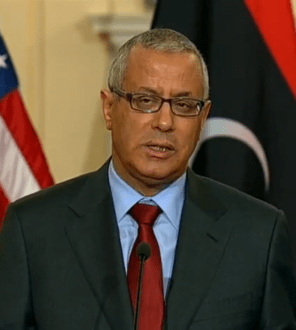
Libya’s Prime Minister Ali Zeidan.
The witnessing world (online, at least) knows how corruption and government have worked out in Afghanistan, Iraq, and Pakistan, also how the Muslim Botherhood has asserted its botherly values in Egypt, Syria (I am conflating MB with the Al Qaeda affiliates in that theater), and Turkey (if Erdogan had had the free rein he had hoped to possess): how is Libya’s central government to tell a city-state militia how fair the nascent state’s constitution, laws, and actual real political workings will be to his clan, family, and tribe the day he and his loyal own give up their arms and both the defensive and piratical capabilities implied — or demonstrated — by their ownership?
Libya’s Prime Minister Ali Zeidan and NATO may have to threaten other than force and offer other than corrupt deals to Libya’s seemingly equally nascent warlords to wrap around this challenge, which is not solely, or even practically, frankly, a military problem.
The fighting would seem to go on (and on and on) in the heart, and that is an intellectual problem, a problem in the language and related cultural conventions of the place.
* * *
Along the Popular Militia Fronts
Barqa Army — related:
The imposition of a political narrative by Libya’s eastern federalist movement, represented by the Cyrenaica Transitional Council (CTC), on the August series of strikes by the Petroleum Facilities Guard (PFG) has complicated Libya’s problem of widespread disruption to the oil and gas sector, which began in late 2012. The PFG, the body officially responsible for oilfield security, succeeded in shutting down all oil export operations in the east of Libya in mid-August.
That directly above may provide the Left with a good tale about greed and oil.
There’s something of Pakistan’s “Baluchistan Conflict” in the mix involving indigenous interests, much including armed ones, associated with the local outstanding natural resource and more remote nascent state interests in the same.
*
Nuri Abusahmain – President, General National Congress: ordered Libya Shield into Tripoli; reference also Wissam Bin Ahmid who leads Libya Shield.
“I don’t know why the Americans don’t come here,” said Wissam Bin Hamid, commander of the Libyan Shield Brigade, a militia that came under sustained attack while helping defend the second compound on Sept. 11. “Maybe they are afraid.”
Wissam’s (we have a way to go with the transliteration of Arab last names) took a hit defending the compound in Benghazi (I think that’s what I’ve read), but at the Arab world’s troubled nexus in which rightful autonomy slams into righteous and justifiable mistrust, Ahmid/Hamid has gotten a uniformly bad rap in the right-side’s anti-Jihad press.
The west wants to play it like a one-hour television drama: get in; get rid of the President-for-Life and some related assortment of knuckleheads; establish a democratic constitution; get out; chocolates, flowers, and champagne all around. Go team! However, with absolute authoritarianism the region’s bad habit in practice and in thought — and perhaps too in language — and the possession of a theocratic political ideology to match it, evolving forward proves an extraordinary challenge to those to whom it has been posed.
In an effort to oust Qaddafi, independent militias of varying strength have been formed inside Libya and are threatening regional security inside the country. Of these the Zintan militia is one of the foremost examples of a brigade with strong organizational skills, effective tactics and entrenched authority in their base city of Zintan. On December 10th, the Zintan brigade was involved in a firefight with the convoy of the ex-commander-in-chief of the National Army, Major General Khalifa Haftar. The Zintan Brigade acted without orders from the National Army, which they accused of not notifying them of the convoy’s approach to the Tripoli airport. It is becoming a major challenge for the Libyan Transitional Council to integrate these militiamen in the new security structure of Libya. The Zintan Brigade and other militias will continue to be key actors in Libya affecting the domestic security situation until they become fully integrated into the new Libyan National Army.
To some extent, the struggle is between Islamists and more secular-minded Libyans. If the Misratans are indeed pushed back to their home town, it will be a setback for the Islamists. At the heart of the retreating forces is the Libyan Shield, hitherto the most powerful of the militias, both in Misrata and in the country at large. It is allied to the Muslim Brotherhood’s Justice and Construction Party,
Armed militias are the real power in the land. They range from former revolutionaries to criminals to al-Qaeda affiliates. Some have taken over key Libyan oilfields. Others are providing muscle to those who want to set up a breakaway autonomous entity in the east of the country . . . The trouble is that the militias do not respond to polite requests.
Qaddafi’s bipolar semblance in public may be typical of the disorder’s associated delusional grandiose and messianic ideation.
The west has gotten around the problem posed by extraordinary revenue accruing to individuals and dynasties by invoking — albeit from time to time — the concept that is “noblesse oblige”: the expectation that the nobility must prove itself noble or face the wrath of the people, such wrath proving overwhelming across the four or five centuries preceding the 21st.
With the Qaddafi’s of the world too, the west has developed a so far applicable and useful conceptual inventory in psychology: we look at persons and various aspects and channels in their behavior and can perceive “bipolar disorder” or “narcissistic personality disorder” and in political psychology the manifestations of the “malignant narcissist”.
In the still medieval politics of Islam, power knows systematic corruption — bribery, intimidation, murder, patronage — and the tools known to all self-asserting “Men of Honor and Respect”, which is the humanity, essentially, associated with mafia dons.
For countermeasure within those societies as well as outside of them, the abstract invisible “hinge of fate” remains the cold hardened spiritual steel that all humanity knows to call “integrity” or equivalent: specifically the essential and irreducible identity and best qualities of the person as made by God and set out in relation to others.
Bedeviling that valued concept may be the consequences for remote tribes, their elders, and chiefs and sons and daughters of misplaced trust plus the realpolitik and real money that accompanies a host of feudal practices: start with “tribute” along “protected routes” and end somewhere around the preference for the telling of a loyal lie — or an advantageous one — over the clarity of a disadvantageous, inconvenient, or uncomfortable truth.
All in all, “resetting” Libya isn’t the government’s challenge: it’s the militia’s challenge and it has to do with resetting themselves without degrading or endangering their parochial interests or their image before those closest to them.
If they are hiding the truth, it would seem both self–preservation and loyalty keeps the lock on closed mouths.
If they are hiding nothing, then their names in the world find themselves attached to a libel that cannot be disproved.
The miracle of contemporary justice is that by design it serves neither plaintiffs or accused but rather the greater public interest in knowing the truth of a matter.
To shift from complaining about bad deals, injustice being the rawest of them, to doing something about them, the parts of the world steeped in propaganda and rumor and subject to deep wells of missing information will have to wrestle with the development of systems dedicated to that most public form of knowing with something approaching certainty: empiricism.
Since 2007, Kainat Soomro’s story, that of a 13-year-old girl allegedly gang raped by four men in her village, Dadu, rural Sindh, in Pakistan, has been making the rounds of the civil to conservative press. For complaining by way of alleging the crime, Kainat became the target of so far threatened “honor killing” while two of the men of the family, the father and a brother, refusing to abide barbaric custom (by killing her themselves) have been beaten and an older brother murdered.
In “Outlawed in Pakistan” the related documentary appearing on PBS, an older brother says, “They said, ‘You failed to follow your traditions. You failed to kill your sister. You should have followed our customs . . . .’ I got really angry. But my dad said that we do not follow the gun culture. We are educated people and we will get legal help.”
What would the law do when the process of the law has stopped at the precinct desk?
Police and prosecutors in more developed and stable systems — also far less squeamish and defensive– would have been quick to investigate the allegation of rape for proof the crime took place, a procedure so common and familiar that the field has established kits and methods (see “What is a Rape Kit?” posted by the Rape, Abuse & Incest National Network) ready as part of the police and investigative service response at the moment of complaint.
Pakistan’s tribal councils, to which such a complaint may revert, appear to have nothing similar of an empirical — also ethical and humane — investigative method: what they have are elders lost in their own heads.
Kainat and her family seek justice. “We want them to get punished through the courts,” she says, “so what happened to me won’t happen to someone else’s daughter” (10:12 in the documentary).
The men involved have denied the crime took place.
If they are hiding the truth, it would seem both self–preservation and loyalty keeps the lock on closed mouths.
If they are hiding nothing, then their names in the world find themselves attached to a libel that cannot be disproved.
The miracle of contemporary justice is that by design it serves neither plaintiffs or accused but rather the greater public interest in knowing the truth of a matter.
* * *
At about 22 minutes into the documentary, one sees what happens in the absence of an empirical forensic process.
On Kainat’s complaint, the men have been arrested, held in jail without bond and an uncle and assorted fellows from the village have shown up angered and loud.
Madness!
Then comes to light a little more to the story: a marriage contract, pictures of the couple.
Kainat’s claim: made and recorded under duress when she was thirteen years old.
“If I wanted to marry, I would have told my dad,” she says.
* * *
Let’s go back over this experience I’m having from my “second row seat to history”.
Forensics in a Developing State
While Kainat may be taken at her word, and one wants to do that, neither the word of the complainant nor that of alleged perpetrators mean much absent of observed physical evidence — photographs of bruises, blood chemistry analysis (if the complainant was drugged as claimed), semen scrapes and DNA comparisons, even circumstantial evidence of struggle — where are Kainat’s shoes? What happened to her scarf?
It turns out some medical examination took place, enough to confirm intercourse, but examiners and police dropped the ball for lack of interest in the claim and, with reference to DNA matching, lack of resources.
Both the PBS documentary and greater public interest in the case tell us something not said: everyone involved — claimant, defenders, lawyers, villagers, courts, and police — know the forensic issues, and would that I had known that before starting this post.
Social Practices, Morals, and Values
This is where the partisans, either side, power up for confrontation, and first and foremost by keeping stories of outrageous miscarriages of justice before the eyes of the peers. Let’s go with the accusers on this one, but with a question not likely asked in Pakistan: even if Kainat agreed to be married or played along genuinely lustful, being of age for that, as “wedding pictures” suggest, what is any adult involved, especially the cleric — I don’t want to call to him through the search engines, but his name appears at 32:36 –who facilitated the marriage, doing abetting that contract without the consent and presence of a parent!?
The cleric says he was not aware of her age, “And she looked 18.”
The age of independence sufficient to enter into marriage in Pakistan is 16 under secular law. Under sharia, the earlier passage into puberty suffices, and the sharia trumps secular law.
Conservative Propaganda
That a 13-year-old child may be injudicious or manipulated in such a way as to alter the character of her life for a lifetime — and in this instance alter her family’s way of life as well — seems to me the most opprobrious aspect of Kainat’s case.
However, close by that may be the kafir conservative’s ambitions to conveniently ridicule Islam and its medieval vision supported by myriad subcultures rather than dig down into each separable core transformative issue and lay it out.
Here, from the western perspective, Kainat’s ordeal involves simply the vigorous and timely investigation of claims involving criminal behavior and, unbelievably, the recognition of childhood and adolescence and the development of laws appropriate and protective of the interests of each and of the surrounding community.
Indeed, the sharia, essentially 7th Century law, has failed, both by tainting Kainat (until she finds herself in the larger world where what’s past is past — and please, dear, get on with living) and detaining the defendants in jail for four years without decision.
Probably, in the political environments of the kafir, the case would have been dismissed for lack of evidence on the first day but the entire matter brought to the legislature with legislators forced to think (for once) with modern comprehension and conscience about what their laws were doing to their young.
* * *
What may and should come to pass, this through the will of Pakistan’s educated — and one may hope for the application of the will of similar others in other places — is the development of greater and more timely forensic capability and responsibility throughout police and court operations.
Add to that an open discussion about the utility and wisdom of sharia law where it involves relations between young but older men and 13-year-old girls.

 BackChannels