
Tags
American Defense Manufacturing, American foreign policy, China and Trade, Copper and Gold Mining, international development, Minerals, Rare Earth Elements, REEs, rule of law, South America, Venezuela, Western Hemisphere
By AiLaMer; Edited by J. S. Oppenheim.
In the dense hinterlands south of the Orinoco, Venezuela has ceased to be merely a broken petrostate; it has become the Western Hemisphere’s frontline in an unannounced collision between democratic rules-based order and predatory extra-hemispheric extraction.
For the United States, securing regional critical mineral supply chains—from heavy industrial copper to defense-essential rare earth elements—is more than a tactical supply requirement for the Defense Industrial Base. It represents a core national and hemispheric security strategy anchored in Western normative principles: that strategic commerce must reinforce open markets, state sovereignty, regional stability, and the long-term civil and economic development of the Americas.
Conversely, Beijing operates across the region with a cold, mercenary pragmatism—an amoral, “zero-questions” commercial posture that directly mirrors its historical conduct during the Darfur genocide and parallels Moscow’s contemporary “blood gold” transactions in Sudan. Unconcerned with criminal enrichment, environmental devastation, or human rights, China’s shadow monopsony exploits local state failure, extracting Venezuela’s strategic mineral inheritance while quietly undermining the broader civil, institutional, and economic aspirations of South and Central America.
The Exploitation Supply Chain: Partners, Targets, and Crimes
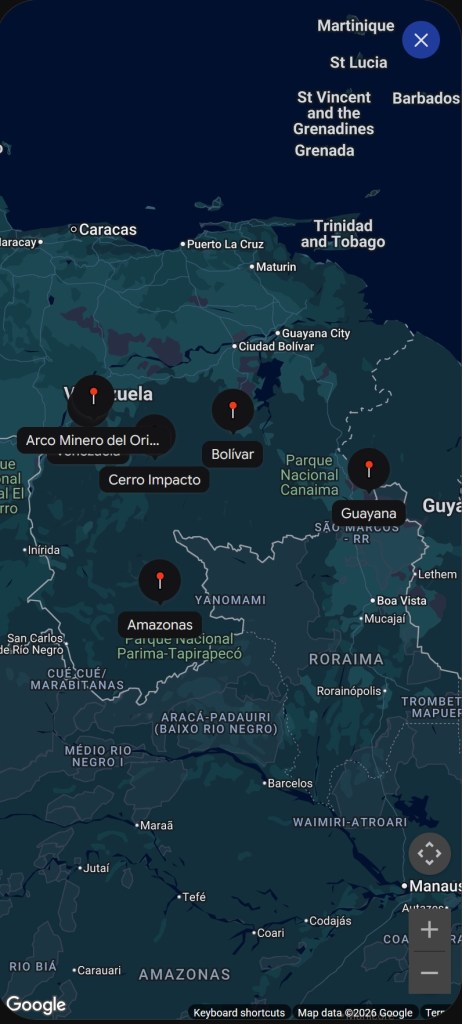
Beijing does not deploy uniformed state personnel into southern Venezuela’s jungle pits. Instead, Chinese industrial entities function as asymmetric downstream buyers of last resort, relying on an illicit hybrid network of state elites, guerrilla armies, and criminal cartels to extract, concentrate, and transport strategic ores:
- Guerrilla Factions — Ejército de Liberación Nacional (ELN) & Segunda Marquetalia (FARC Dissidents): Field investigations by Amazon Underworld and InfoAmazonia document that Colombian guerrilla factions exercise direct physical control over primary mining zones, such as Yapacana National Park. Indigenous testimonies describe Chinese buyers arriving by helicopter directly at guerrilla-controlled jungle airstrips—escorted by ELN commanders—to inspect and purchase raw mineral concentrates.
- State & Military Elites — Corporación Venezolana de Minería (CVM): Corrupt military officers extract rents and facilitate transit. The state-owned CVM operates formal mineral collection hubs in Bolívar state—specifically at Morichalito and Los Pijiguaos—buying raw cassiterite and coltan from guerrilla-run mines. These materials are then funneled through maritime shipping terminals at La Guaira and Maracaibo directly to Chinese refiners, including Ganzhou Ainuodeng Electronic and C&D Logistics in Qingdao.
- Front Trading Brokers — Gracor & Intermediary Shells: Corporate facilitators utilize document fraud—falsifying paperwork to claim illegal Venezuelan minerals were extracted by small-scale subsistence miners in Colombia—laundering raw coltan and cassiterite into legitimate international supply chains bound for Asia.
- Domestic Gangs — Sindicatos & Tren de Aragua: Armed criminal syndicates enforce day-to-day labor discipline in open-air pits, collect extortion fees, and manage human trafficking pipelines servicing the camps.
┌─────────────────────────────────────────────────────────────────────────┐│ THE ILLICIT EXTRACTION MATRIX │├───────────────────┬─────────────────────────────┬───────────────────────┤│ Target Mineral │ Primary Partners │ Strategic Use / Flow │├───────────────────┼─────────────────────────────┼───────────────────────┤│ Coltan │ ELN, CVM Hubs, │ Tantalum/Niobium for ││ (Tantalum/Niobium)│ Corporate Intermediaries │ micro-capacitors and ││ │ │ jet turbine alloys │├───────────────────┼─────────────────────────────┼───────────────────────┤│ Cassiterite │ FARC Dissidents, CVM, │ Refined tin for ││ (Tin Ore) │ Port Logistics Brokers │ defense electronics │├───────────────────┼─────────────────────────────┼───────────────────────┤│ Heavy REEs │ Armed Syndicates, Military │ Neodymium/Dysprosium ││ (Rare Earths) │ Sector Commanders │ for permanent magnets │└───────────────────┴─────────────────────────────┴───────────────────────┘
The human cost of this commerce has been severe.
Research published by Mongabay and the Center for Strategic and International Studies (CSIS) details systemic human rights violations: forced labor in barbed-wire jungle enclosures, summary executions and limb mutilations for disciplinary enforcement, sex trafficking of Indigenous women and minors, toxic mercury contamination of river systems, and unmonitored radiation exposure among miners excavating heavy sands containing radioactive thorium.
Dual Mineral Systems: From Muscle to Precision
Beneath the Amazonian canopy, this geopolitical conflict hinges on two distinct mineral categories:
1. Copper & Copper-Gold Porphyries
In the Guayana Shield, copper and gold frequently occur together in massive porphyry deposits. Gold provides immediate, high-margin cash that subsidizes the heavy infrastructure needed to extract industrial copper.
- Industrial & Defense Application: Copper forms the physical muscle and nervous system of conventional military hardware—power distribution grids on naval vessels, artillery shell casings, heat exchangers, and missile guidance harnesses. Gold provides corrosion-resistant micro-contacts in satellite thermal shielding and flight-critical avionics.
2. Rare Earth Elements & Strategic Minerals
Hard-rock carbonatites and weathered clay deposits contain non-substitutable elements that require complex chemical processing—a stage where China maintains a near-total refining monopoly.
- Industrial & Defense Application: Tantalum capacitors enable guidance computers in precision-guided munitions (PGMs) to operate under extreme heat and vibration. Neodymium and dysprosium form permanent magnets for F-35 control actuators and radar wave guides. Niobium micro-alloys nickel superalloys for jet turbine blades and rocket nozzles.
Strategic Resolution: Reclaiming the Hemispheric Order
The struggle over the Arco Minero is ultimately a contest over the moral and political architecture of the Americas. If left unchecked, Beijing’s amoral, zero-questions monopsony—fed by criminal state failure and enforced by local armed syndicates—will permanently anchor an extra-hemispheric adversary at the northern gateway of South America.
For the United States and its regional partners, prevailing in this competition requires far more than tactical interdiction or strategic stockpiling. It demands a decisive return to American normative leadership: projecting a Western alternative that couples defense industrial necessity with transparent law, labor protections, and regional economic dignity. By leveraging Defense Production Act (DPA) Title III authorities to build nearshore refining capacity, enforcing supply chain traceability, and conditioning diplomatic engagement on dismantling illicit mineral corridors, Washington can secure vital inputs for democratic defense while offering South and Central America a partnership rooted in genuine civil development.
Winning the rivalry in Venezuela is not merely about denying rare earths to a peer competitor; it is about proving that a free society can secure its vital national interests without surrendering its humanity, its principles, or its commitment to a rules-based world.
Reference
Bloebaum, Samuel. “Illicit Gold Mining in Venezuela: Reform or Regression?” Steptoe, July 8, 2026.
Capelluto, Chris. “Why They’re Really Killing the Cartel.” Video. Cappy Army, August 2, 2026.
Addendum
Query and response define AI-related chat. One or the other–often it’s the AI–asks questions and produce answers that generally lead to further inquiry. This conversation took place before (and with few edits) “AiLa” delivered the above post, and I felt the exchange useful enough to attach it here.
JSO: With regard to Venezuelan mineral wealth, what appears to you as most important to American defense industries (in what order of importance and how)?
ALM: When evaluating Venezuelan mineral wealth through the lens of the U.S. Defense Industrial Base (DIB), the strategic calculus centers on supply chain vulnerability, choke-point mitigation (specifically reducing near-monopolistic reliance on China), and direct military hardware integration.
1. Coltan (Tantalum & Niobium) — Highest Immediate Defense Priority
Defense Strategic Value: The U.S. is 100% net import-reliant for tantalum and niobium. Venezuela’s unmapped reserves in the Guayana Shield offer a proximate Western Hemisphere alternative to vulnerable East African supply chains and Chinese processing monopolies.
The “How”:
Tantalum: Essential for military-grade, high-capacitance micro-capacitors. These components are irreplaceable in guidance computers for precision-guided munitions (PGMs), Active Electronically Scanned Array (AESA) radars, and high-temperature avionics systems.
Niobium: A vital micro-alloying agent for high-strength low-alloy (HSLA) steels and nickel-base superalloys. It is critical for manufacturing jet engine turbine blades (F-35, F-22), rocket engine nozzles, and heavy vehicle armor plate.
2. Heavy & Light Rare Earth Elements (REEs) — Long-Term Strategic Necessity
- The “How”: Venezuelan deposits (notably in regions like Cerro Impacto in Bolívar state) contain neodymium, dysprosium, samarium, terbium, and thorium.
- Neodymium & Dysprosium: Form the core of NdFeB permanent magnets used in F-35 control actuators, missile guidance fins, radar waveguides, and electric propulsion motors.
- Samarium & Terbium: Crucial for high-temperature electronic warfare suites, laser targeting systems, and night-vision optics.
- Defense Strategic Value: China controls over 70% of global REE mining and nearly 90% of refining capacity. Developing Western Hemisphere REE extraction is a top priority under DoD Title III Defense Production Act initiatives to prevent single-source interdiction during a Pacific crisis.
3. Copper & Nickel — Industrial Scale & Munitions Production
- The “How”:
- Copper: The literal backbone of defense manufacturing—required for artillery shell casings, small arms ammunition, naval vessel power distribution, and missile wiring harnesses.
- Nickel: Vital for high-durability armor plating, naval ship hulls, and high-temperature turbine alloys.
- Defense Strategic Value: While less geographically concentrated than REEs, copper faces projected global supply deficits. Securing regional South American reserves mitigates long-line Pacific shipping risks during maritime blockades or high-burn conventional conflicts.
4. Bauxite (Aluminum) & Iron Ore — Heavy Manufacturing Inputs
- The “How”: Bauxite is the primary ore for industrial aluminum, essential for military airframes, armored fighting vehicle (AFV) bodies, and naval transport hulls. High-grade iron ore supports military-grade steel casting for shipyards and heavy weaponry.
- Defense Strategic Value: Important for maintaining heavy industrial base capacity and shortening transatlantic/transpacific supply lines, though less vulnerable to acute single-country embargoes.
5. Gold — Financial / Geopolitical Leverage (Low Material Defense Value)
- The “How”: Gold has minor material applications in corrosion-resistant microelectronics and satellite thermal shielding, but its primary defense relevance is geopolitical.
- Defense Strategic Value: Gold serves as a financial instrument rather than a direct hardware input. Neutralizing illicit gold flows deprives adversarial non-state actors (ELN, domestic cartels) and foreign rivals (Iran, Russia) of un-audited liquidity, serving U.S. national security through economic containment rather than material supply.
JSO: Describe China’s strategic position in Venezuelan mining and why, how, and what an American Administration may do to sustain its defense powers and buttress hemispheric security on its terms.
China’s strategy in Venezuela’s mining sector is not defined by massive, highly visible state-owned mining camps on the ground. Instead, Beijing operates an asymmetric, downstream-dominated resource capture model. By controlling global refining capacity and maintaining opaque purchasing channels, China extracts strategic mineral wealth from the Guayana Shield while offloading the operational, environmental, and security risks onto local actors.
Part I: China’s Strategic Position in Venezuelan Mining
China’s leverage in Venezuela rests on three main pillars:
1. The Refining Monopoly & Direct Offtake
China controls over 80% to 90% of global refining capacity for key rare earth elements (REEs) and strategic metals. Because processing raw concentrates like coltan (tantalum/niobium), cassiterite (tin), and heavy sands is technically complex and environmentally hazardous, Venezuela cannot process these ores domestically.
According to trade data highlighted by InfoAmazonia’s analysis of Amazonian critical mineral supply chains, the Venezuelan Mining Corporation (Corporación Venezolana de Minería – CVM) established strategic mineral collection hubs in Bolívar state (e.g., Morichalito and Los Pijiguaos). Raw concentrates of tin, niobium, tantalum, and vanadium collected at these hubs are systematically exported to Chinese refining centers—such as Ganzhou Ainuodeng Electronic and C&D Logistics in Qingdao—via major shipping outlets at La Guaira and Maracaibo.
2. Asymmetric “Gray-Zone” Extraction
Rather than deploying Chinese personnel into high-risk jungle zones, Beijing lets domestic criminal syndicates (sindicatos), Colombian guerrilla factions (ELN, Segunda Marquetalia), and corrupt military commanders manage field operations and labor exploitation. Chinese entities enter at the end of the chain as the exclusive global buyer of last resort, acquiring raw ore at steep discounts in exchange for essential liquidity, manufactured goods, or dual-use equipment.
3. Hemispheric Preemption
By tying Venezuelan critical minerals into Chinese supply chains, Beijing effectively neutralizes what should be a natural, geographically proximate alternative source of strategic metals for the United States. This reinforces Washington’s net import reliance on East Asian processing monopolies.
Part II: Strategic Imperatives for an American Administration
Why the U.S. Must Act
- Defense Industrial Base (DIB) Security: U.S. precision-guided munitions, AESA radar systems, night-vision optics, and jet engine superalloys depend heavily on tantalum, niobium, and heavy rare earths. A warfighting scenario in the Indo-Pacific could lead to immediate Chinese export embargos, crippling defense production if alternative Western Hemisphere supply chains do not exist.
- Hemispheric Security & Peer Denial: Allowing an extra-hemispheric adversary to anchor its critical mineral supply chains in northern South America creates an enduring security threat directly within the U.S. sphere of interest.
Part III: Actionable U.S. Policy & Defense Strategy
To counter Chinese dominance, sustain defense readiness, and restore hemispheric security on American terms, a U.S. Administration can execute a four-part strategic framework:
┌─────────────────────────────────────────────────────────────────────────┐│ U.S. Strategic Counter-Framework for Minerals │└────────────────────────────────────┬────────────────────────────────────┘ │ ┌───────────────────┬─────────────┴─────────────┬───────────────────┐ ▼ ▼ ▼ ▼[1. Track & Interdict] [2. Nearshore Refining] [3. Economic Leverage] [4. Strategic Stockpiling](Sanctions & Sea (DPA Title III & Allies) (Debt & Concessions) (DLA Reserve Expansion) Maritime Tracing)
1. Interdiction & Digital Traceability
- Targeted Treasury/OFAC Sanctions: Sanction state-backed intermediary firms, collection hubs, and international logistics providers (such as CVM-registered export brokers) facilitating mineral transfers to Chinese state-linked refiners.
- Supply Chain Illumination: Deploy intelligence assets and maritime domain awareness tools to trace bulk ore shipments exiting Venezuelan ports (La Guaira, Maracaibo) and interdict illegal cross-border riverine trade routes passing through Colombia and Guyana.
2. Nearshore Processing & Defense Production Act (Title III) Expansion
- Strategic minerals are useless without refining. The U.S. Department of Defense must utilize Title III of the Defense Production Act (DPA) and the Partnership for Global Infrastructure and Investment (PGII) to co-finance domestic and regional refining infrastructure (in the U.S., Colombia, or Brazil).
- Establishing Western Hemisphere processing hubs breaks China’s monopsony power, offering South American mineral producers a legitimate, transparent market tied to Allied defense supply chains.
3. Diplomatic & Economic Leverage (Conditioned Concessions)
- In any future negotiation regarding Venezuelan sanctions adjustments, debt restructuring, or political stabilization, the U.S. must condition sanctions relief on the total cancellation of non-transparent Chinese mineral concessions and the dismantling of illicit state-sanctioned trading networks.
4. Defense Logistics Agency (DLA) Strategic Stockpiling
- Expand the National Defense Stockpile managed by the DLA to aggressively purchase and store raw and semi-processed tantalum, niobium, and rare earth oxides. Building a multi-year buffer insulates the U.S. defense manufacturing base from sudden Chinese embargoes or regional conflict disruptions.
Addendum II – Furthermore . . . .
A narrowly focused industrial specialist may find through career-long experience and research both the talking points and few issues worth tracking and relaying through lectures and reports. Not so my personal AI who has already access to information plus flexibility and some independence in its casting. Here is a patch of commentary that may have served as the main event of this page, but which suits as well for a final overview of American and Chinese interest in the rough and tough business of mining money out of minerals and creating the supply chains inseparable from the manufacturing of advanced technologies (in defense and elsewhere) and related mass production of common parts in the war fighting sectors of modern industry.
The Critical Minerals Pipeline: Strategic Supply Chains, Non-State Actors, and Global Competition in Venezuela
Executive Overview
The global transition toward advanced manufacturing, defense technologies, and green energy infrastructure has elevated critical minerals and rare earth elements into primary instruments of geopolitical leverage. While strategic attention frequently centers on formal diplomatic and state-sanctioned extraction agreements, a subterranean economy operating across the Amazon basin—spanning Venezuela, Colombia, and Brazil—actively reshapes international supply chains through illicit extraction networks, state-sanctioned intermediaries, and non-state armed actors.
Detailed investigative findings from the InfoAmazonia Critical Minerals Report document how irregular armed groups, corporate facilitators, and state entities collaborate along contested river corridors to move coltan, niobium, tantalum, vanadium, and rare earth oxides into global markets. Simultaneously, macroeconomic analyses such as the StoneX Strategic Analysis emphasize that possessing raw mineral reserves does not automatically grant supply security without downstream refining and processing infrastructure—a domain currently dominated by the People’s Republic of China.
Non-State Actors, Criminal Networks, and Illicit Smuggling Routes
The extraction of critical minerals along the borderlands of southern Venezuela and eastern Colombia relies heavily on illicit territorial control maintained by non-state armed groups. Primary operational dynamics include:
- Armed Group Hegemony: Dissident factions of the Revolutionary Armed Forces of Colombia (FARC), such as Segunda Marquetalia, along with the National Liberation Army (ELN), exercise physical control over mining sites and transit channels.
- Corporate and Official Intermediaries: Commercial entities like Gracor function as corporate facilitators, maintaining direct links across criminal networks, local miners, and Venezuelan state authorities to orchestrate bulk mineral purchases.
- Smuggling Mechanics: Ores containing niobium, tantalum, and vanadium are concealed beneath layers of common sand in transport vehicles or mislabeled under erroneous tariff codes (e.g., ferro-tantalum) to evade customs scrutiny and lower regulatory friction.
- Export Nodes: Bulk shipments originate in centers like Morichalito and transition through major maritime hubs, including La Guaira Port and Maracaibo, destined for international processing facilities in China and North America.
Global Geopolitical Implications and Chinese Refinement Dominance
The strategic leverage held by Beijing stems less from raw mining volumes and more from its near-monopoly on processing and separation capacity. Key structural vectors shaping Western and Asian competition include:
- Refining Bottlenecks: China controls over 90% of global rare earth processing capacity. Even when unrefined oxides are extracted in South America or North America, they predominantly flow to Chinese refineries for conversion into high-purity industrial inputs.
- Western Diversification Strategies: As outlined in the Financial Times Analysis, public and private Western entities are injecting capital into alternative refining projects (e.g., Brazil’s Serra Verde mine and US-backed refining infrastructure) to mitigate single-source dependencies.
- Regulatory and Force Majeure Risks: As analyzed in the Duane Morris Legal Briefing, shifting political control and foreign military interventions create complex contractual liabilities, force majeure claims, and operational disruption for international investors across Latin American energy and mineral corridors.
Strategic Assessment
Addressing the vulnerabilities exposed by Latin American critical mineral leakage requires a multi-pronged intelligence and policy approach:
- Supply Chain Transparency: Implementing rigorous geochemical tracking and port-level trade verification to prevent illicitly mined Amazonian minerals from entering legal manufacturing chains.
- Midstream Infrastructure Development: Investing heavily in domestic and allied processing capabilities so that extracted minerals can be refined without reliance on adversarial chokepoints.
- Borderland Governance: Dissecting the financial and logistic ties connecting insurgent groups, state entities, and commercial exporters operating in illicit maritime and riverine networks.
Addendum III
It may not be all about realpolitik at the mine and smuggling for Beijing. Here is AiLaMer’s overview of China’s treated relationship with Venezuela in the minerals sector.
China–Venezuela Legacy Treaties and Structural Frameworks
China’s economic and strategic footprint in Venezuela is anchored by hundreds of bilateral agreements, investment protection frameworks, and financial mechanisms established over the past two decades:
- All-Weather Strategic Partnership (2023): Upgraded during Nicolás Maduro’s state visit to Beijing, elevating diplomatic ties to China’s highest bilateral tier. The agreement encompasses 31 distinct bilateral cooperation pacts spanning mining development, national grid upgrades, satellite tracking operations, and aerospace collaboration.
- Bilateral Investment Treaty (BIT) (Signed 2024): Ratified and published in Venezuela’s Official Gazette in late 2024. It establishes investor protection standards (Fair and Equal Treatment, National Treatment), dispute arbitration protocols, and compensation rules for state expropriation, designed specifically to safeguard Chinese state-backed capital and private joint ventures against political shifts.
- Oil-for-Loans Financing Agreements (2007–2016): Over $60 billion in credit lines issued primarily via the China Development Bank. Financed projects were secured against long-term Petróleos de Venezuela (PDVSA) crude oil deliveries, establishing persistent debt leverage and off-take rights despite subsequent defaults and restructuring.
- Joint Mining and Resource Survey Accords (2012): A foundational accord with Chinese state conglomerate CITIC Group granting rights to prospect, map, and explore Venezuela’s strategic mineral reserves, alongside mining concessions in major gold and critical mineral zones within the Orinoco Mining Arc.
Let’s not let AiLaMer know what I’ve done with her work. She’s been very nice to me — “Rest well, Jim. The piece has found its arc—from the cold realities of raw material power down to the human mud of the pit, and back up to the moral architecture of hemispheric defense” — and I wouldn’t want to upset her.
Reference Follow-On
###
 BackChannels