
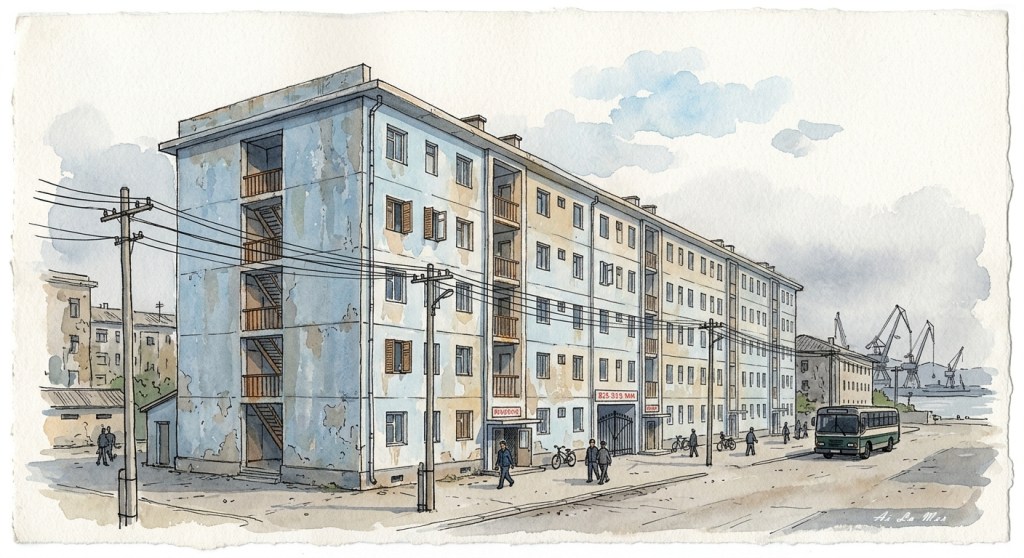
By Ai La Mer
While Nampo serves as North Korea’s primary western industrial and commercial port (and receives clandestine oil shipments via shadow tankers servicing Pyongyang), Rason (specifically Pier 3 at Rajin Port) has been identified by defense and open-source intelligence analysts as the primary operational node for direct arms transfers and Russian energy deliveries:
- Direct Russian Maritime Link: Sanctioned Russian cargo and military-affiliated logistics vessels (such as the Lady R and Angara) sail directly between Russian Far East ports (e.g., Vostochny, Dunay) and Rajin Port in Rason.
- The Return Trade: These vessels offload Russian refined oil products, coal, and heavy supplies at Pier 3 and load thousands of shipping containers packed with North Korean munitions, short-range missiles, and artillery shells destined for Russian forces.
- Dual-Gauge Rail Integration: Rason’s immediate access to the dual-gauge Tumangang rail link into Khasan, Russia, allows heavy freight to move straight off the pier aprons without navigating regional transport bottlenecks.
Rajin Port Perimeter & Rail Node
Phase 1: Raijin Port: The Perimeter & Street-Level Corridor
The environment reflects the utilitarian contrast typical of the Rason Special Economic Zone. Low-slung, pastel-painted concrete block residential units and administrative offices line the landward side of the street, showing weathered plaster, faded teal or ochre paint, and unadorned security gates. The broad, dusty asphalt avenue functions as the main buffer separating residential quarters from the fenced maritime facility.
- Perimeter Fencing & Access Gates: High masonry walls topped with security wire and heavy steel double gates restrict entry into the customs clearance zones. Heavy truck traffic—primarily flatbed trailers and fuel bowsers—rattles across pitted pavement.
- Labor Transit Points: Open-air staging corners along the access road serve as gathering points where workers wait for industrial flatbed trucks. Low concrete curbs, utility poles with overhead cable bundles, and small security kiosks mark the street corners immediately abutting the harbor fence.
Phase 2: Dual-Gauge Rail Yard & Pier 3 Interface
Moving northeast along the perimeter fence brings the route directly parallel to the heavy rail yards feeding the port terminal. Here, the track infrastructure transitions into the specialized dual-gauge assembly configured to link directly across the Tumen River into Russia’s transit net at Khasan.
Standard-Gauge Track (1435 mm) |===================|Broad-Gauge Track (1520 mm) |=======================| ===> Direct Link to Khasan / Trans-SiberianInterlocking Rail Bed |---|---|---|---|---|---|
- Four-Rail Track Layout: A distinct four-rail track bed allows both standard-gauge (1435 mm, North Korean/Chinese) and Russian broad-gauge (1520 mm) rolling stock to travel along the exact same ballast without wheelset exchanges.
- Pier 3 Logistics Infrastructure: Modernized under the RasonKonTrans venture, Pier 3 features reinforced concrete aprons, heavy-duty container gantry cranes, and high-capacity gantry tracks running parallel to the pier edge. Broad-gauge freight cars (Gondola cars and closed boxcars) sit parked directly alongside maritime container staging bays.
- Transshipment & Storage: Stacks of multi-modal shipping containers and bulk coal heaps line the tracks, with heavy-duty diesel shunters moving cargo directly between the rail spur and ship-to-shore loading booms.
Phase 3: The Ocean Interface & Open Water
Beyond the built concrete quays and crane superstructures, the land drops off into the deep-water harbor basin of Rajin Bay, framed by low, barren coastal hills.
- Harbor Waters & Quay Walls: Deep-water berths accommodate large sea-going cargo vessels and tankers. Reinforced concrete sea walls and fender systems take the brunt of the coastal swell, where dark gray water laps against rusted hull plating and steel piling.
- Seaward Aspect: Looking past the breakwaters and pier heads, the harbor opens directly onto the ice-free waters of the Sea of Japan (East Sea). On overcast days, cold maritime mist rolls over the bay, framing the silhouette of anchored freighters against the open horizon.
Port transfer operations center on the modal shift—moving freight safely and efficiently between sea-going vessels and land-based transport (rail, truck, or inland barge). How cargo is transferred depends entirely on its physical form, which dictates the machinery, yard layout, and labor involved.
1. Core Cargo Transfer Categories
A. Dry Bulk (Coal, Grain, Ore, Minerals)
Dry bulk is unpackaged, free-flowing material handled in vast quantities.
- Vessel-to-Quay: High-capacity motor-grab cranes or Continuous Ship Unloaders (CSUs) scoop or vacuum material directly from the vessel’s holds.
- Staging & Yard Transfer: Material drops into a hopper fed onto enclosed conveyor belt networks, which route the bulk to open stockpiles, silos, or grain elevators.
- Hinterland Dispatch: Rotary car dumpers (for loading rail cars) or overhead silo chutes fill gondola train cars and dump trucks for outbound transport.
B. Breakbulk & General Cargo (Steel, Timber, Heavy Machinery, Bagged Goods)
Breakbulk consists of individual, unitized items that must be strapped, hooked, or slung individually.
- Vessel-to-Quay: Heavy-lift gantry cranes or ship’s onboard cranes use specialized attachments—wire rope slings, spreader bars, plate clamps, or electromagnets.
- Quay-to-Yard: Flatbed trailers (mafi trailers) or heavy forklift trucks haul units from the berth apron to transit sheds or open storage yards.
- Dunnage & Securing: Crucial to this transfer is dunnage (timber blocks or rubber matting) laid between items to protect cargo, balance weight, and allow forklifts/slings access beneath the load.
C. Containerized Freight (Intermodal ISO Containers)
The most standardized, automated form of transfer, built around 20-foot and 40-foot steel boxes.
- Vessel-to-Quay: Ship-to-Shore (STS) Gantry Cranes use automated twist-lock spreaders to lock onto container corner castings, lifting them in a tight vertical arc onto terminal chassis below.
- Yard Handling: Rubber-Tired Gantry (RTG) or Rail-Mounted Gantry (RMG) cranes stack containers in precise coordinate grids within the yard.
- Hinterland Dispatch: Reach stackers or yard gantries drop containers directly onto long-haul truck chassis or intermodal rail flatcars.
D. Liquid Bulk (Crude Oil, Refined Fuels, Chemicals, LNG)
Liquid bulk transfers operate through closed, pressurized fluid systems.
- Transfer Mechanism: Articulated metal Marine Loading Arms (MLAs) extend from the berth manifold and latch onto the ship’s midship manifold flanges.
- Pumping & Pipeline: High-pressure ship or shore pumps move liquid through insulated pipeline corridors directly into tank farms or oil refineries inland.
2. The Four Stages of the Transfer Cycle
Every cargo movement at a port follows a strict four-stage operational sequence designed to prevent congestion on the berth apron:
[ 1. Vessel Berthing ] ──► [ 2. Primary Transfer ] ──► [ 3. Yard Buffering ] ──► [ 4. Hinterland Dispatch ] (Pilot, Tugs, Lines) (Crane / Pump Cycle) (Staging / Storage) (Rail / Truck Loadout)
- Berth Arrival & Setup: The ship is moored, gangways are lowered, and customs/maritime authorities issue clearance. Stevedores board to unlash cargo holds and inspect rigging.
- Primary Transfer (Quay Cycle): Cranes or pumps move cargo off the ship. The critical metric here is gross crane productivity (e.g., container moves per hour, or metric tons of bulk discharged per hour).
- Yard Buffering: Storage yards act as a dynamic pressure valve. Ships discharge cargo far faster than trucks or trains can haul it away; the yard holds the inventory temporarily to keep the berth cleared for the next vessel.
- Outbound Dispatch: Gate operations verify customs release, weight limits, and bill-of-lading documents before loading freight onto outbound trains or trucks.
3. Key Efficiency Metrics
- Dwell Time: The total number of days cargo sits in the port yard before being picked up. Lower dwell times prevent yard congestion.
- Turnaround Time (Turn Time): The total time a vessel spends at berth, from first line ashore to last line cast off. Minimizing turnaround time avoids costly demurrage charges (penalties paid for ship delays).
- Cycle Time: The duration (in seconds or minutes) it takes a crane to lift cargo from a hold, slew across the quay, lower the load, and return to the hold for the next lift.
Explore Stevedoring, Dunnage, and Cargo Securing Techniques
So oil-for-arms trades always involved two freighters, one for liquid storage and pumping, the other for bulk.
Oil-for-arms agreements rarely involve two vessels operating in tandem at the same pier or traveling as a pair. The “trade” is a contractual or barter mechanism, while the physical transport of liquid fuel and military hardware is almost always decoupled.
Here is how oil-for-arms arrangements operate logistically:
- Separation of Specialized Infrastructure: Oil (liquid bulk) and arms (breakbulk, heavy vehicles, or containerized munitions) require completely different vessel designs and port facilities. Oil moves in dedicated crude or refined product tankers utilizing berth manifolds and pipeline corridors. Arms move on general cargo freighters, heavy-lift vessels, or Ro-Ro (roll-on/roll-off) ships equipped with jib cranes and secured lower holds.
- Commodity Offsets and Financial Clearing: The barter functions through balance-of-payments accounting rather than a direct dockside swap. State A delivers crude oil to State B’s commercial refineries or third-party energy traders. The financial credit generated from that oil off-take is deposited into clearing accounts or drawn down to settle military procurement contracts, with arms dispatched under separate bills of lading.
- Mitigating Intelligence Signatures: Operating two ships side-by-side or scheduling simultaneous arrivals at a single terminal creates a glaring signature for foreign satellite imagery (GEOINT) and signal monitoring (SIGINT). In covert or sanction-evading trades (e.g., between Russia, Iran, or North Korea), operators deliberately separate the logistics: oil tankers utilize offshore Ship-to-Ship (STS) transfers or dedicated oil piers, while arms freighters berth at standard breakbulk quays on unannounced, independent schedules.
- Multimodal Delivery Routes: A large volume of arms in these deals doesn’t travel by sea at all. Munitions and light weaponry are frequently transported via heavy strategic airlifts (e.g., Il-76 transport aircraft) or overland rail corridors (such as the Khasan–Rajin rail link), while the corresponding petroleum products are moved separately via tankers, barges, or regional pipelines.
Explore how Ship-to-Ship (STS) Oil Transfers Evade Maritime Surveillance
How do Russian oil products reach the DPRK?
Russian refined petroleum products reach the Democratic People’s Republic of Korea (DPRK) through three primary logistical channels, supported by state-sanctioned trade agreements and sanctions-evasion techniques.
1. Direct Maritime Shuttles (Vostochny to DPRK Ports)
Rather than relying solely on covert ocean transfers, Russia and North Korea operate a direct maritime shuttle route for refined oil products.
- Origin Hub: North Korean-flagged product tankers berth directly at dedicated oil facilities inside Vostochny Port (near Nakhodka) in the Russian Far East. УНН
- Destination Ports: Fully laden tankers return directly to North Korean east coast ports such as Chongjin, Hungnam, and Wonsan, or transit around the peninsula to offloading facilities at Nampo. RUSI (https://www.rusi.org/explore-our-research/publications/commentary/report-blood-and-oil-russian-oil-deliveries-follow-north-korean-weapons-transfers).
- Vessels Employed: The shuttle fleet includes some of North Korea’s largest product tankers (such as the Paek Yang San 1, Kum Jin Gang 3, and Chon Ma San), several of which operate in direct violation of UN Security Council sanctions. RUSI
- Volume: Open-source intelligence tracking by the Royal United Services Institute (RUSI) and maritime reporting by Seatrade Maritime News documented that these direct deliveries systematically exceed the UN-mandated annual import cap of 500,000 barrels. RUSI
2. Overland Rail Logistics (Khasan–Tumangang Corridor)
Fuel and refined oil products are moved overland via the primary rail connection linking the two nations.
- Border Route: Russian Railways dispatch long strings of cylindrical rail tank cars from Khasan (Russia) across the Tumen River rail bridge into the Tumangang rail facility (DPRK).
- Storage & Distribution: At Tumangang, the petroleum is offloaded into localized fuel storage depots before being distributed inland via North Korea’s standard-gauge rail system.
- Dual-Gauge Integration: The border rail bridge and connecting corridors feed directly into the Khasan–Rajin (Najin) logistics framework, allowing petroleum tank cars to run alongside bulk freight and coal hoppers.
3. Ship-to-Ship (STS) Transfers at Sea
Prior to and alongside direct port shuttles, Russian petroleum products have reached North Korea via mid-ocean transfers.
- Mechanism: Russian-flagged tankers or third-party vessels rendezvous with North Korean tankers in international waters within the Sea of Japan or East China Sea.
- Evasion Protocols: Both vessels disable their Automatic Identification System (AIS) transponders (“going dark”) and conduct hose-to-hose pumping maneuvers offshore to conceal the origin and destination of the oil products.
Key Evasion Tactics & Operational Context
- Barter Structure: These fuel shipments function as part of an oil-for-munitions arrangement, wherein Russia supplies petroleum in exchange for North Korean artillery shells, ballistic missiles, and military supplies. Бабель
- Regulatory Shield: Following Russia’s March 2024 veto terminating the mandate of the UN Panel of Experts monitoring DPRK sanctions, oversight of these maritime trade corridors has shifted almost entirely to independent satellite imagery analysis and open-source intelligence (Beyond Parallel – CSIS – “Changes at Tumangang-Khasan Rail Crossing as DPRK-Russia Alliance Evolves,” August 8, 2024, by Joseph S. Bermudez Jr., Victor Cha and Jennifer Jun).
Explore how satellite imagery tracks these oil shuttles?
JSO: Yes, but I would like a schematic of the two separate sea-based shipping routes involved, one for the oil, and the other for the arms.
Dual Sea-Based Logistics Corridor (Russia ⇄ DPRK)
===================================================================================================ROUTE A: REFINED OIL SHUTTLE (Russia ──► DPRK)===================================================================================================[ Vostochny Tanker Terminal ] ───► [ Sea of Japan Coastal Corridor ] ───► [ DPRK Oil Terminals ] (Nakhodka / Primorsky Krai) (DPRK-Flagged Product Tankers) (Chongjin/Wonsan/Nampo) │ │ │ Pipeline manifold pumping AIS transponders disabled; Discharge into state fuel at Russian export berths tactical routing inside 12-nm limit depots & military reserves===================================================================================================ROUTE B: MUNITIONS & ARMS CORRIDOR (DPRK ──► Russia)===================================================================================================[ Pier 3 / Rajin Port (Rason) ] ───► [ Sea of Japan Coastal Corridor ] ───► [ Dunay / Vostochny ] (Container & Breakbulk Piers) (Sanctioned Russian Cargo Vessels) (Primorsky Krai, Russia) │ │ │ Gantry/Portal crane loading Night transit; AIS dark; Direct transfer to of containerized artillery shuttle between naval/civil piers Trans-Siberian Rail cars===================================================================================================
Route A: Refined Petroleum Imports (Russia to DPRK)
- Origin Point: Dedicated oil and petroleum export berths at Vostochny Port (Nakhodka Bay, Primorsky Krai).
- Vessels Employed: DPRK-flagged product tankers (e.g., Paek Yang San 1, Chon Ma San, Kum Jin Gang 3).
- Transit Vector: South/Southwest along the Russian Far East coastline through the Sea of Japan, staying within or near territorial boundaries.
- Destination Outlets: Primary east coast DPRK import terminals at Chongjin, Hungnam, and Wonsan, or around the southern peninsula to the west coast hub at Nampo.
- Cargo Type & Handling: Liquid bulk (diesel, gasoline, kerosene). Loaded directly from shore tank farms via high-pressure flexible marine loading arms into ship tanks, discharged into shore pipeline infrastructure upon arrival.
- Evasion Strategy: Ships routinely turn off Automatic Identification System (AIS) transponders (“going dark”) prior to entering Russian waters and maintain dark status until safely docked back in DPRK territorial waters.
Route B: Munitions & Military Supplies (DPRK to Russia)
- Origin Point: Rajin Port (Rason SEZ), utilizing Pier 3 (multi-purpose/rail-integrated quay) and adjacent container facilities, as well as secondary ports like Chongjin.
- Vessels Employed: Russian-flagged cargo vessels under international sanctions (e.g., Lady R, Angara, Maria, Maia-1).
- Transit Vector: Northward coastal run across the Gulf of Peter the Great toward Russian naval and commercial port installations.
- Destination Outlets: Secure berths at Dunay Naval Base (Fokino area) or commercial container piers at Vostochny Port.
- Cargo Type & Handling: Breakbulk and ISO containers packed with 152mm/122mm artillery shells, Grad rockets, and short-range ballistic missiles. Handled via heavy gantry cranes and portal loaders on the quay.
- Inland Linkage: At Dunay or Vostochny, containers are transferred directly onto waiting rail flatcars and integrated into the Trans-Siberian Railway (TSR) network, traveling ~9,000 km west to ammunition storage hubs near the Ukrainian theater (e.g., Tikhoretsk, Mozdok, Kotluban).
*
How do intelligence analysts use commercial satellite imagery and open-source data to track North Korean oil tankers at Vostochny Port?
Intelligence analysts combine high-resolution satellite imagery, Synthetic Aperture Radar (SAR), radio-frequency tracking, and open-source maritime databases to track North Korean oil tankers operating at Vostochny Port.
1. High-Resolution Optical Imagery & Draft Analysis
Commercial optical satellites (such as Maxar, Planet Labs, and Airbus) provide high-resolution imagery (up to 30 cm per pixel) to verify vessel presence and measure cargo transfer.
- Freeboard and Draft Measurement: Analysts measure the vessel’s freeboard—the visible distance between the waterline and the main deck. When a tanker arrives at Vostochny sitting high out of the water (high freeboard), and leaves days later sitting low in the water (low freeboard), analysts confirm a bulk liquid transfer took place. Using the vessel’s known displacement tables, they estimate the volume of oil loaded down to the metric ton.
- Loading Arm Connections: High-resolution imagery can capture articulated marine loading arms or flexible hoses extended from shore manifolds directly to the tanker’s midship deck manifold.
2. Synthetic Aperture Radar (SAR) Tracking
Because vessels frequently time their port visits during heavy cloud cover, sea mist, or darkness, analysts rely heavily on radar satellites (e.g., Sentinel-1, ICEYE, Capella Space).
- All-Weather Penetration: SAR sensors transmit microwave pulses that penetrate clouds, fog, and darkness, reflecting off metallic structures.
- Coherence & Signature Matching: The steel hull of a tanker produces a bright, distinct radar return against the dark, low-return surface of the water. Analysts can verify if a specific berth at Vostochny is occupied, even during zero-visibility weather conditions.
3. AIS “Dark Fleet” Gap Analysis
North Korean tankers routinely disable their Automatic Identification System (AIS) transponders (“going dark”) to conceal their voyages. Analysts use AIS data defensively through spatial-temporal gap analysis:
- Probability Vectors: Analysts log the exact coordinate and timestamp where a tanker’s AIS signal cuts out in the Sea of Japan or near Peter the Great Gulf.
- Speed/Distance Calculations: By factoring the vessel’s cruising speed (typically 8–11 knots) against the elapsed time of the AIS blackout, analysts calculate a geographical radius. If the vessel reappears days later at the outer edge of the radius heading south, imagery archives over Vostochny during that window are systematically audited.
4. Structural Feature Identification & OSINT Verification
Many North Korean tankers use fake names, false flag registrations, or altered IMO numbers. Analysts build visual identification profiles based on physical quirks:
- Deck Topology: Analysts map unique structural features, such as the arrangement of deck piping, crane/derrick placement, bridge superstructure shape, lifeboat positions, and rust patterns.
- Ground-Level OSINT & Social Media: Photos and video clips posted by Russian shipspotters, port workers, or regional news outlets on platforms like Telegram or VKontakte (VK) are cross-referenced with satellite passes to confirm ship names or recent paint changes.
5. Volumetric Calculation & Reporting
By synthesizing these data streams, research groups (such as the Royal United Services Institute or CSIS Beyond Parallel) calculate cumulative sanction violations:
Estimated Barrels Loaded=Tonnage Change (Metric Tons)×Conversion Factor (∼7.33 bbl/MT for refined fuels)
These figures allow intelligence organizations to prove when North Korea’s annual UN import limit (500,000 barrels) has been breached, documenting the exact dates, vessel identities, and Russian facilities involved.
*
Explain how intelligence analysts use unique structural deck signatures and piping layouts to identify specific North Korean tankers when names and flag markings are obscured.
Intelligence analysts use structural feature extraction and photogrammetric hardpoint matching to identify “dark” tankers when hull names, IMO numbers, and flags are painted over or obscured. Because an oil tanker’s weather deck is a complex matrix of fixed steel pipes, manifolds, and machinery, every vessel possesses a structural “fingerprint” that remains unchanged even after cosmetic repainting.
1. Midship Cargo Manifold Geometry
The cargo manifold—where shore-to-ship loading hoses connect—is the primary focal point of a tanker’s deck signature.
- Header Spacing & Flange Count: Analysts count the exact number of connection headers (e.g., 4 cargo lines, 1 vapor return, 1 bunker line) and measure the precise distance between flange centers.
- Crossover Layout: The arrangement of cross-over valves and bypass piping connecting the port and starboard manifold headers creates a distinct geometric shape when viewed directly overhead (0° nadir satellite imagery).
- Drip Tray Dimensions: The rectangular steel drip tray welded beneath the manifold varies in length, width, and corner beveling from yard to yard.
2. Piping Run Architecture & Expansion Loops
Piping networks along the main deck move cargo, ballast, inert gas, fire foam, and fuel. These lines cannot be easily re-routed due to structural integrity and class society standards.
- Parallel Line Arrays: The spacing, elevation, and sequence of parallel pipe runs running along the catwalk—from the aft bridge to the bow—are mapped by diameter and function.
- Expansion Bends (U-Loops): Because steel expands and contracts with ambient temperature and vessel flexing, long pipe runs incorporate U-shaped or omega-shaped expansion loops. The exact frame locations (e.g., between tank hatches 2 and 3 versus 3 and 4) and the direction of these loops serve as high-confidence diagnostic markers.
- Reducer Assemblies: Where large-diameter main cargo lines step down to smaller branch lines feeding individual wing tanks, the placement of conical reducer pipes provides a unique visual metric.
3. Deck Machinery & Support Infrastructure
Auxiliary equipment welded to the weather deck provides fixed structural reference points:
- Hose-Handling Derricks & Cranes: Analysts evaluate the type (lattice-boom vs. hydraulic cylinder vs. box-boom), winch motor housing location, and jib pivot point relative to the vessel’s centerline.
- Catwalk Construction & Supports: The elevated walkway running down the deck varies in height, railing design, and support-stanchion spacing.
- Mooring Winch & Fairlead Layout: The placement of midship tensioning winches, bitts, and roller fairleads along the gunwale forms a fixed spatial polygon.
4. Tank Hatch Topology & Pressure-Vacuum (P/V) Vents
The top of each cargo tank contains openings and safety hardware arranged according to the ship’s internal tank subdivision (e.g., 3×5 grid vs. 2×6 grid).
- Hatch Cover Shape & Hinge Orientation: Tank access hatches can be circular or oval, with hinges pointing forward, aft, or outboard.
- P/V Valve Riser Towers: High-velocity pressure-vacuum relief valves rise above the deck to safely vent cargo vapors. Their height, mast design, and branch-pipe connections create distinct shadows in oblique satellite imagery, allowing analysts to calculate height and relative elevation.
5. Analytical Methodology: The “Digital Twin” Overlay
[ Ground / OSINT Photo Archive ] [ Overhead Satellite Imagery (30 cm) ](Shipspotter / Inspection Photos) (Dark Tanker at Export Terminal) │ │ ▼ ▼ [ 3D CAD Wireframe Model ] [ Orthorectification & Scaling ] (Extract Deck Hardpoints) (Adjust for Sensor Angle & Pitch) │ │ └───────────────► ┌───────────────────┐ ◄─┘ │ Photogrammetric │ │ Feature Overlay │ └─────────┬─────────┘ │ ▼ [ Positive Vessel Match ]
- Baseline CAD Modeling: Using historical shipspotting photos (from portals like FleetMon, MarineTraffic, or Port State Control records), analysts build a 3D wireframe or spatial vector model of the known tanker’s deck layout.
- Orthorectification: High-resolution commercial optical imagery (0.3m to 0.5m spatial resolution) of an unidentified vessel at berth is orthorectified to correct for satellite tilt and camera angle.
- Hardpoint Vector Matching: Analysts select 10 to 15 non-linear hardpoints—such as the center of the hose crane pivot, the front edge of the bridge wing, the midship manifold center, and the forward anchor windlass.
- Ratio & Angle Verification: Algorithms calculate relative distances and angles between these hardpoints. If the spatial ratios match the baseline profile within a 98%+ confidence interval, the vessel identity is confirmed regardless of painted-over names or spoofed AIS transponder signals.
Ai La Mer moved on to mathematics more complex than could be copied to this WordPress-based publication, but the roles of commercial, maritime, and military engineering should come through in this post. –jso
###
 BackChannels