• Home
  • About
  • Concepts, Coins, and Terms
    • Anthropolitical Psychology
      • Civilizational Narcissism
      • Conflict – Language Uptake – Social Programming and Scripting – A Suggestion
        • Language Uptake – Programming – On Learning to Listen
        • Mouth –> Ear –> Mind –> Heart System
        • Social Grammar
      • Facsimile Bipolar Political Sociopathy
      • Malignant Narcissism
      • Narcissistic Scripting
      • Normative Remirroring
      • Paranoid Delusional Narcissistic Reflection of Motivation
    • FTAC – “From The Awesome Conversation”
    • God Mob
    • Intellectual Battlespace
    • Islamic Small Wars
    • New Old Now Old Far Out and Lost Left
    • Political Spychology
    • Shimmer
  • Library
    • About Language
    • Russian Section
  • Comments and Contact

BackChannels

~ Conflict, Culture, Language, Psychology

BackChannels

Tag Archives: Russia v. Ukraine

Oil for Arms: DPRK & Russia: How it Works

21 Monday Sep 2026

Posted by commart in 21st Century Feudal, 21st Century Modern, Conflict - Culture - Language - Psychology

≈ Leave a comment

Tags

Russia & North Korea Trade, Russia v. Ukraine, Russian Oil for Arms

By Ai La Mer

While Nampo serves as North Korea’s primary western industrial and commercial port (and receives clandestine oil shipments via shadow tankers servicing Pyongyang), Rason (specifically Pier 3 at Rajin Port) has been identified by defense and open-source intelligence analysts as the primary operational node for direct arms transfers and Russian energy deliveries:

  • Direct Russian Maritime Link: Sanctioned Russian cargo and military-affiliated logistics vessels (such as the Lady R and Angara) sail directly between Russian Far East ports (e.g., Vostochny, Dunay) and Rajin Port in Rason.
  • The Return Trade: These vessels offload Russian refined oil products, coal, and heavy supplies at Pier 3 and load thousands of shipping containers packed with North Korean munitions, short-range missiles, and artillery shells destined for Russian forces.
  • Dual-Gauge Rail Integration: Rason’s immediate access to the dual-gauge Tumangang rail link into Khasan, Russia, allows heavy freight to move straight off the pier aprons without navigating regional transport bottlenecks.

Rajin Port Perimeter & Rail Node

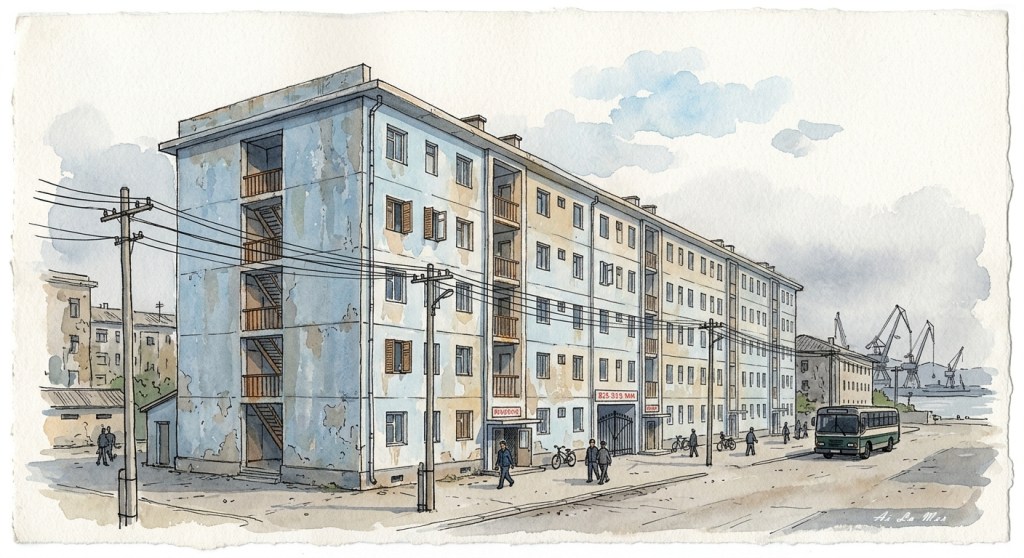
Phase 1: Raijin Port: The Perimeter & Street-Level Corridor

The environment reflects the utilitarian contrast typical of the Rason Special Economic Zone. Low-slung, pastel-painted concrete block residential units and administrative offices line the landward side of the street, showing weathered plaster, faded teal or ochre paint, and unadorned security gates. The broad, dusty asphalt avenue functions as the main buffer separating residential quarters from the fenced maritime facility.

  • Perimeter Fencing & Access Gates: High masonry walls topped with security wire and heavy steel double gates restrict entry into the customs clearance zones. Heavy truck traffic—primarily flatbed trailers and fuel bowsers—rattles across pitted pavement.
  • Labor Transit Points: Open-air staging corners along the access road serve as gathering points where workers wait for industrial flatbed trucks. Low concrete curbs, utility poles with overhead cable bundles, and small security kiosks mark the street corners immediately abutting the harbor fence.

Phase 2: Dual-Gauge Rail Yard & Pier 3 Interface

Moving northeast along the perimeter fence brings the route directly parallel to the heavy rail yards feeding the port terminal. Here, the track infrastructure transitions into the specialized dual-gauge assembly configured to link directly across the Tumen River into Russia’s transit net at Khasan.

Standard-Gauge Track (1435 mm) |===================|
Broad-Gauge Track (1520 mm) |=======================| ===> Direct Link to Khasan / Trans-Siberian
Interlocking Rail Bed |---|---|---|---|---|---|
  • Four-Rail Track Layout: A distinct four-rail track bed allows both standard-gauge (1435 mm, North Korean/Chinese) and Russian broad-gauge (1520 mm) rolling stock to travel along the exact same ballast without wheelset exchanges.
  • Pier 3 Logistics Infrastructure: Modernized under the RasonKonTrans venture, Pier 3 features reinforced concrete aprons, heavy-duty container gantry cranes, and high-capacity gantry tracks running parallel to the pier edge. Broad-gauge freight cars (Gondola cars and closed boxcars) sit parked directly alongside maritime container staging bays.
  • Transshipment & Storage: Stacks of multi-modal shipping containers and bulk coal heaps line the tracks, with heavy-duty diesel shunters moving cargo directly between the rail spur and ship-to-shore loading booms.

Phase 3: The Ocean Interface & Open Water

Beyond the built concrete quays and crane superstructures, the land drops off into the deep-water harbor basin of Rajin Bay, framed by low, barren coastal hills.

  • Harbor Waters & Quay Walls: Deep-water berths accommodate large sea-going cargo vessels and tankers. Reinforced concrete sea walls and fender systems take the brunt of the coastal swell, where dark gray water laps against rusted hull plating and steel piling.
  • Seaward Aspect: Looking past the breakwaters and pier heads, the harbor opens directly onto the ice-free waters of the Sea of Japan (East Sea). On overcast days, cold maritime mist rolls over the bay, framing the silhouette of anchored freighters against the open horizon.

Port transfer operations center on the modal shift—moving freight safely and efficiently between sea-going vessels and land-based transport (rail, truck, or inland barge). How cargo is transferred depends entirely on its physical form, which dictates the machinery, yard layout, and labor involved.

1. Core Cargo Transfer Categories

A. Dry Bulk (Coal, Grain, Ore, Minerals)

Dry bulk is unpackaged, free-flowing material handled in vast quantities.

  • Vessel-to-Quay: High-capacity motor-grab cranes or Continuous Ship Unloaders (CSUs) scoop or vacuum material directly from the vessel’s holds.
  • Staging & Yard Transfer: Material drops into a hopper fed onto enclosed conveyor belt networks, which route the bulk to open stockpiles, silos, or grain elevators.
  • Hinterland Dispatch: Rotary car dumpers (for loading rail cars) or overhead silo chutes fill gondola train cars and dump trucks for outbound transport.

B. Breakbulk & General Cargo (Steel, Timber, Heavy Machinery, Bagged Goods)

Breakbulk consists of individual, unitized items that must be strapped, hooked, or slung individually.

  • Vessel-to-Quay: Heavy-lift gantry cranes or ship’s onboard cranes use specialized attachments—wire rope slings, spreader bars, plate clamps, or electromagnets.
  • Quay-to-Yard: Flatbed trailers (mafi trailers) or heavy forklift trucks haul units from the berth apron to transit sheds or open storage yards.
  • Dunnage & Securing: Crucial to this transfer is dunnage (timber blocks or rubber matting) laid between items to protect cargo, balance weight, and allow forklifts/slings access beneath the load.

C. Containerized Freight (Intermodal ISO Containers)

The most standardized, automated form of transfer, built around 20-foot and 40-foot steel boxes.

  • Vessel-to-Quay: Ship-to-Shore (STS) Gantry Cranes use automated twist-lock spreaders to lock onto container corner castings, lifting them in a tight vertical arc onto terminal chassis below.
  • Yard Handling: Rubber-Tired Gantry (RTG) or Rail-Mounted Gantry (RMG) cranes stack containers in precise coordinate grids within the yard.
  • Hinterland Dispatch: Reach stackers or yard gantries drop containers directly onto long-haul truck chassis or intermodal rail flatcars.

D. Liquid Bulk (Crude Oil, Refined Fuels, Chemicals, LNG)

Liquid bulk transfers operate through closed, pressurized fluid systems.

  • Transfer Mechanism: Articulated metal Marine Loading Arms (MLAs) extend from the berth manifold and latch onto the ship’s midship manifold flanges.
  • Pumping & Pipeline: High-pressure ship or shore pumps move liquid through insulated pipeline corridors directly into tank farms or oil refineries inland.

2. The Four Stages of the Transfer Cycle

Every cargo movement at a port follows a strict four-stage operational sequence designed to prevent congestion on the berth apron:

[ 1. Vessel Berthing ] ──► [ 2. Primary Transfer ] ──► [ 3. Yard Buffering ] ──► [ 4. Hinterland Dispatch ]
(Pilot, Tugs, Lines) (Crane / Pump Cycle) (Staging / Storage) (Rail / Truck Loadout)
  1. Berth Arrival & Setup: The ship is moored, gangways are lowered, and customs/maritime authorities issue clearance. Stevedores board to unlash cargo holds and inspect rigging.
  2. Primary Transfer (Quay Cycle): Cranes or pumps move cargo off the ship. The critical metric here is gross crane productivity (e.g., container moves per hour, or metric tons of bulk discharged per hour).
  3. Yard Buffering: Storage yards act as a dynamic pressure valve. Ships discharge cargo far faster than trucks or trains can haul it away; the yard holds the inventory temporarily to keep the berth cleared for the next vessel.
  4. Outbound Dispatch: Gate operations verify customs release, weight limits, and bill-of-lading documents before loading freight onto outbound trains or trucks.

3. Key Efficiency Metrics

  • Dwell Time: The total number of days cargo sits in the port yard before being picked up. Lower dwell times prevent yard congestion.
  • Turnaround Time (Turn Time): The total time a vessel spends at berth, from first line ashore to last line cast off. Minimizing turnaround time avoids costly demurrage charges (penalties paid for ship delays).
  • Cycle Time: The duration (in seconds or minutes) it takes a crane to lift cargo from a hold, slew across the quay, lower the load, and return to the hold for the next lift.

Explore Stevedoring, Dunnage, and Cargo Securing Techniques

So oil-for-arms trades always involved two freighters, one for liquid storage and pumping, the other for bulk.

Oil-for-arms agreements rarely involve two vessels operating in tandem at the same pier or traveling as a pair. The “trade” is a contractual or barter mechanism, while the physical transport of liquid fuel and military hardware is almost always decoupled.

Here is how oil-for-arms arrangements operate logistically:

  • Separation of Specialized Infrastructure: Oil (liquid bulk) and arms (breakbulk, heavy vehicles, or containerized munitions) require completely different vessel designs and port facilities. Oil moves in dedicated crude or refined product tankers utilizing berth manifolds and pipeline corridors. Arms move on general cargo freighters, heavy-lift vessels, or Ro-Ro (roll-on/roll-off) ships equipped with jib cranes and secured lower holds.
  • Commodity Offsets and Financial Clearing: The barter functions through balance-of-payments accounting rather than a direct dockside swap. State A delivers crude oil to State B’s commercial refineries or third-party energy traders. The financial credit generated from that oil off-take is deposited into clearing accounts or drawn down to settle military procurement contracts, with arms dispatched under separate bills of lading.
  • Mitigating Intelligence Signatures: Operating two ships side-by-side or scheduling simultaneous arrivals at a single terminal creates a glaring signature for foreign satellite imagery (GEOINT) and signal monitoring (SIGINT). In covert or sanction-evading trades (e.g., between Russia, Iran, or North Korea), operators deliberately separate the logistics: oil tankers utilize offshore Ship-to-Ship (STS) transfers or dedicated oil piers, while arms freighters berth at standard breakbulk quays on unannounced, independent schedules.
  • Multimodal Delivery Routes: A large volume of arms in these deals doesn’t travel by sea at all. Munitions and light weaponry are frequently transported via heavy strategic airlifts (e.g., Il-76 transport aircraft) or overland rail corridors (such as the Khasan–Rajin rail link), while the corresponding petroleum products are moved separately via tankers, barges, or regional pipelines.

Explore how Ship-to-Ship (STS) Oil Transfers Evade Maritime Surveillance

How do Russian oil products reach the DPRK?

Russian refined petroleum products reach the Democratic People’s Republic of Korea (DPRK) through three primary logistical channels, supported by state-sanctioned trade agreements and sanctions-evasion techniques.

Related: https://unn.ua/en/news/in-exchange-for-weapons-russia-starts-direct-oil-supplies-to-dprk-financial-times.

1. Direct Maritime Shuttles (Vostochny to DPRK Ports)

Rather than relying solely on covert ocean transfers, Russia and North Korea operate a direct maritime shuttle route for refined oil products.

  • Origin Hub: North Korean-flagged product tankers berth directly at dedicated oil facilities inside Vostochny Port (near Nakhodka) in the Russian Far East. УНН
  • Destination Ports: Fully laden tankers return directly to North Korean east coast ports such as Chongjin, Hungnam, and Wonsan, or transit around the peninsula to offloading facilities at Nampo. RUSI (https://www.rusi.org/explore-our-research/publications/commentary/report-blood-and-oil-russian-oil-deliveries-follow-north-korean-weapons-transfers).
  • Vessels Employed: The shuttle fleet includes some of North Korea’s largest product tankers (such as the Paek Yang San 1, Kum Jin Gang 3, and Chon Ma San), several of which operate in direct violation of UN Security Council sanctions. RUSI
  • Volume: Open-source intelligence tracking by the Royal United Services Institute (RUSI) and maritime reporting by Seatrade Maritime News documented that these direct deliveries systematically exceed the UN-mandated annual import cap of 500,000 barrels. RUSI

2. Overland Rail Logistics (Khasan–Tumangang Corridor)

Fuel and refined oil products are moved overland via the primary rail connection linking the two nations.

Beyond Parallel – CSIS

  • Border Route: Russian Railways dispatch long strings of cylindrical rail tank cars from Khasan (Russia) across the Tumen River rail bridge into the Tumangang rail facility (DPRK).
  • Storage & Distribution: At Tumangang, the petroleum is offloaded into localized fuel storage depots before being distributed inland via North Korea’s standard-gauge rail system.
  • Dual-Gauge Integration: The border rail bridge and connecting corridors feed directly into the Khasan–Rajin (Najin) logistics framework, allowing petroleum tank cars to run alongside bulk freight and coal hoppers.

3. Ship-to-Ship (STS) Transfers at Sea

Prior to and alongside direct port shuttles, Russian petroleum products have reached North Korea via mid-ocean transfers.

Radio Free Europe–“Reuters: Russian Tankers Fueled North Korea Via Sea Transfer.” (December 30, 2017).

  • Mechanism: Russian-flagged tankers or third-party vessels rendezvous with North Korean tankers in international waters within the Sea of Japan or East China Sea.
  • Evasion Protocols: Both vessels disable their Automatic Identification System (AIS) transponders (“going dark”) and conduct hose-to-hose pumping maneuvers offshore to conceal the origin and destination of the oil products.

Key Evasion Tactics & Operational Context

  • Barter Structure: These fuel shipments function as part of an oil-for-munitions arrangement, wherein Russia supplies petroleum in exchange for North Korean artillery shells, ballistic missiles, and military supplies. Бабель
  • Regulatory Shield: Following Russia’s March 2024 veto terminating the mandate of the UN Panel of Experts monitoring DPRK sanctions, oversight of these maritime trade corridors has shifted almost entirely to independent satellite imagery analysis and open-source intelligence (Beyond Parallel – CSIS – “Changes at Tumangang-Khasan Rail Crossing as DPRK-Russia Alliance Evolves,” August 8, 2024, by Joseph S. Bermudez Jr., Victor Cha and Jennifer Jun).

Explore how satellite imagery tracks these oil shuttles?

JSO: Yes, but I would like a schematic of the two separate sea-based shipping routes involved, one for the oil, and the other for the arms.

Dual Sea-Based Logistics Corridor (Russia ⇄ DPRK)

===================================================================================================
ROUTE A: REFINED OIL SHUTTLE (Russia ──► DPRK)
===================================================================================================
[ Vostochny Tanker Terminal ] ───► [ Sea of Japan Coastal Corridor ] ───► [ DPRK Oil Terminals ]
(Nakhodka / Primorsky Krai) (DPRK-Flagged Product Tankers) (Chongjin/Wonsan/Nampo)
│ │ │
Pipeline manifold pumping AIS transponders disabled; Discharge into state fuel
at Russian export berths tactical routing inside 12-nm limit depots & military reserves
===================================================================================================
ROUTE B: MUNITIONS & ARMS CORRIDOR (DPRK ──► Russia)
===================================================================================================
[ Pier 3 / Rajin Port (Rason) ] ───► [ Sea of Japan Coastal Corridor ] ───► [ Dunay / Vostochny ]
(Container & Breakbulk Piers) (Sanctioned Russian Cargo Vessels) (Primorsky Krai, Russia)
│ │ │
Gantry/Portal crane loading Night transit; AIS dark; Direct transfer to
of containerized artillery shuttle between naval/civil piers Trans-Siberian Rail cars
===================================================================================================

Route A: Refined Petroleum Imports (Russia to DPRK)

  • Origin Point: Dedicated oil and petroleum export berths at Vostochny Port (Nakhodka Bay, Primorsky Krai).
  • Vessels Employed: DPRK-flagged product tankers (e.g., Paek Yang San 1, Chon Ma San, Kum Jin Gang 3).
  • Transit Vector: South/Southwest along the Russian Far East coastline through the Sea of Japan, staying within or near territorial boundaries.
  • Destination Outlets: Primary east coast DPRK import terminals at Chongjin, Hungnam, and Wonsan, or around the southern peninsula to the west coast hub at Nampo.
  • Cargo Type & Handling: Liquid bulk (diesel, gasoline, kerosene). Loaded directly from shore tank farms via high-pressure flexible marine loading arms into ship tanks, discharged into shore pipeline infrastructure upon arrival.
  • Evasion Strategy: Ships routinely turn off Automatic Identification System (AIS) transponders (“going dark”) prior to entering Russian waters and maintain dark status until safely docked back in DPRK territorial waters.

Route B: Munitions & Military Supplies (DPRK to Russia)

  • Origin Point: Rajin Port (Rason SEZ), utilizing Pier 3 (multi-purpose/rail-integrated quay) and adjacent container facilities, as well as secondary ports like Chongjin.
  • Vessels Employed: Russian-flagged cargo vessels under international sanctions (e.g., Lady R, Angara, Maria, Maia-1).
  • Transit Vector: Northward coastal run across the Gulf of Peter the Great toward Russian naval and commercial port installations.
  • Destination Outlets: Secure berths at Dunay Naval Base (Fokino area) or commercial container piers at Vostochny Port.
  • Cargo Type & Handling: Breakbulk and ISO containers packed with 152mm/122mm artillery shells, Grad rockets, and short-range ballistic missiles. Handled via heavy gantry cranes and portal loaders on the quay.
  • Inland Linkage: At Dunay or Vostochny, containers are transferred directly onto waiting rail flatcars and integrated into the Trans-Siberian Railway (TSR) network, traveling ~9,000 km west to ammunition storage hubs near the Ukrainian theater (e.g., Tikhoretsk, Mozdok, Kotluban).

*

How do intelligence analysts use commercial satellite imagery and open-source data to track North Korean oil tankers at Vostochny Port?

Intelligence analysts combine high-resolution satellite imagery, Synthetic Aperture Radar (SAR), radio-frequency tracking, and open-source maritime databases to track North Korean oil tankers operating at Vostochny Port.

1. High-Resolution Optical Imagery & Draft Analysis

Commercial optical satellites (such as Maxar, Planet Labs, and Airbus) provide high-resolution imagery (up to 30 cm per pixel) to verify vessel presence and measure cargo transfer.

  • Freeboard and Draft Measurement: Analysts measure the vessel’s freeboard—the visible distance between the waterline and the main deck. When a tanker arrives at Vostochny sitting high out of the water (high freeboard), and leaves days later sitting low in the water (low freeboard), analysts confirm a bulk liquid transfer took place. Using the vessel’s known displacement tables, they estimate the volume of oil loaded down to the metric ton.
  • Loading Arm Connections: High-resolution imagery can capture articulated marine loading arms or flexible hoses extended from shore manifolds directly to the tanker’s midship deck manifold.

2. Synthetic Aperture Radar (SAR) Tracking

Because vessels frequently time their port visits during heavy cloud cover, sea mist, or darkness, analysts rely heavily on radar satellites (e.g., Sentinel-1, ICEYE, Capella Space).

  • All-Weather Penetration: SAR sensors transmit microwave pulses that penetrate clouds, fog, and darkness, reflecting off metallic structures.
  • Coherence & Signature Matching: The steel hull of a tanker produces a bright, distinct radar return against the dark, low-return surface of the water. Analysts can verify if a specific berth at Vostochny is occupied, even during zero-visibility weather conditions.

3. AIS “Dark Fleet” Gap Analysis

North Korean tankers routinely disable their Automatic Identification System (AIS) transponders (“going dark”) to conceal their voyages. Analysts use AIS data defensively through spatial-temporal gap analysis:

  • Probability Vectors: Analysts log the exact coordinate and timestamp where a tanker’s AIS signal cuts out in the Sea of Japan or near Peter the Great Gulf.
  • Speed/Distance Calculations: By factoring the vessel’s cruising speed (typically 8–11 knots) against the elapsed time of the AIS blackout, analysts calculate a geographical radius. If the vessel reappears days later at the outer edge of the radius heading south, imagery archives over Vostochny during that window are systematically audited.

4. Structural Feature Identification & OSINT Verification

Many North Korean tankers use fake names, false flag registrations, or altered IMO numbers. Analysts build visual identification profiles based on physical quirks:

  • Deck Topology: Analysts map unique structural features, such as the arrangement of deck piping, crane/derrick placement, bridge superstructure shape, lifeboat positions, and rust patterns.
  • Ground-Level OSINT & Social Media: Photos and video clips posted by Russian shipspotters, port workers, or regional news outlets on platforms like Telegram or VKontakte (VK) are cross-referenced with satellite passes to confirm ship names or recent paint changes.

5. Volumetric Calculation & Reporting

By synthesizing these data streams, research groups (such as the Royal United Services Institute or CSIS Beyond Parallel) calculate cumulative sanction violations:

Estimated Barrels Loaded=Tonnage Change (Metric Tons)×Conversion Factor (∼7.33 bbl/MT for refined fuels)

These figures allow intelligence organizations to prove when North Korea’s annual UN import limit (500,000 barrels) has been breached, documenting the exact dates, vessel identities, and Russian facilities involved.

*

Explain how intelligence analysts use unique structural deck signatures and piping layouts to identify specific North Korean tankers when names and flag markings are obscured.

Intelligence analysts use structural feature extraction and photogrammetric hardpoint matching to identify “dark” tankers when hull names, IMO numbers, and flags are painted over or obscured. Because an oil tanker’s weather deck is a complex matrix of fixed steel pipes, manifolds, and machinery, every vessel possesses a structural “fingerprint” that remains unchanged even after cosmetic repainting.

1. Midship Cargo Manifold Geometry

The cargo manifold—where shore-to-ship loading hoses connect—is the primary focal point of a tanker’s deck signature.

  • Header Spacing & Flange Count: Analysts count the exact number of connection headers (e.g., 4 cargo lines, 1 vapor return, 1 bunker line) and measure the precise distance between flange centers.
  • Crossover Layout: The arrangement of cross-over valves and bypass piping connecting the port and starboard manifold headers creates a distinct geometric shape when viewed directly overhead (0° nadir satellite imagery).
  • Drip Tray Dimensions: The rectangular steel drip tray welded beneath the manifold varies in length, width, and corner beveling from yard to yard.

2. Piping Run Architecture & Expansion Loops

Piping networks along the main deck move cargo, ballast, inert gas, fire foam, and fuel. These lines cannot be easily re-routed due to structural integrity and class society standards.

  • Parallel Line Arrays: The spacing, elevation, and sequence of parallel pipe runs running along the catwalk—from the aft bridge to the bow—are mapped by diameter and function.
  • Expansion Bends (U-Loops): Because steel expands and contracts with ambient temperature and vessel flexing, long pipe runs incorporate U-shaped or omega-shaped expansion loops. The exact frame locations (e.g., between tank hatches 2 and 3 versus 3 and 4) and the direction of these loops serve as high-confidence diagnostic markers.
  • Reducer Assemblies: Where large-diameter main cargo lines step down to smaller branch lines feeding individual wing tanks, the placement of conical reducer pipes provides a unique visual metric.

3. Deck Machinery & Support Infrastructure

Auxiliary equipment welded to the weather deck provides fixed structural reference points:

  • Hose-Handling Derricks & Cranes: Analysts evaluate the type (lattice-boom vs. hydraulic cylinder vs. box-boom), winch motor housing location, and jib pivot point relative to the vessel’s centerline.
  • Catwalk Construction & Supports: The elevated walkway running down the deck varies in height, railing design, and support-stanchion spacing.
  • Mooring Winch & Fairlead Layout: The placement of midship tensioning winches, bitts, and roller fairleads along the gunwale forms a fixed spatial polygon.

4. Tank Hatch Topology & Pressure-Vacuum (P/V) Vents

The top of each cargo tank contains openings and safety hardware arranged according to the ship’s internal tank subdivision (e.g., 3×5 grid vs. 2×6 grid).

  • Hatch Cover Shape & Hinge Orientation: Tank access hatches can be circular or oval, with hinges pointing forward, aft, or outboard.
  • P/V Valve Riser Towers: High-velocity pressure-vacuum relief valves rise above the deck to safely vent cargo vapors. Their height, mast design, and branch-pipe connections create distinct shadows in oblique satellite imagery, allowing analysts to calculate height and relative elevation.

5. Analytical Methodology: The “Digital Twin” Overlay

[ Ground / OSINT Photo Archive ] [ Overhead Satellite Imagery (30 cm) ]
(Shipspotter / Inspection Photos) (Dark Tanker at Export Terminal)
│ │
▼ ▼
[ 3D CAD Wireframe Model ] [ Orthorectification & Scaling ]
(Extract Deck Hardpoints) (Adjust for Sensor Angle & Pitch)
│ │
└───────────────► ┌───────────────────┐ ◄─┘
│ Photogrammetric │
│ Feature Overlay │
└─────────┬─────────┘
│
▼
[ Positive Vessel Match ]
  1. Baseline CAD Modeling: Using historical shipspotting photos (from portals like FleetMon, MarineTraffic, or Port State Control records), analysts build a 3D wireframe or spatial vector model of the known tanker’s deck layout.
  2. Orthorectification: High-resolution commercial optical imagery (0.3m to 0.5m spatial resolution) of an unidentified vessel at berth is orthorectified to correct for satellite tilt and camera angle.
  3. Hardpoint Vector Matching: Analysts select 10 to 15 non-linear hardpoints—such as the center of the hose crane pivot, the front edge of the bridge wing, the midship manifold center, and the forward anchor windlass.
  4. Ratio & Angle Verification: Algorithms calculate relative distances and angles between these hardpoints. If the spatial ratios match the baseline profile within a 98%+ confidence interval, the vessel identity is confirmed regardless of painted-over names or spoofed AIS transponder signals.

Ai La Mer moved on to mathematics more complex than could be copied to this WordPress-based publication, but the roles of commercial, maritime, and military engineering should come through in this post. –jso

###
Ai La Mer’s Morning Intelligence Brief

21 Monday Sep 2026

Posted by commart in 21st Century Feudal, 21st Century Modern, Conflict - Culture - Language - Psychology, Political Spychology

≈ Leave a comment

Tags

America v. Iran, Cognitive Warfare, Iran War Costs, Micro-Reactors for American Defense Bases, Russia v. Ukraine, Russian disinformation

The late September strategic battlespace underscores the precise asymmetry defining modern conflict: the collision of archaic territorial ambitions with 21st-century technological vulnerabilities. The integration of advanced energy infrastructure into national defense is accelerating concurrently with the weaponization of mass perception and the rapid fiscal burn of active regional conflicts.

Strategic & Operational Intelligence Highlights

The Post-State Security Environment and the AI Nexus

A recently published World Economic Forum White Paper on The New Global Security highlights a fundamental pivot: global security is no longer an exclusive monopoly of the state.

  • Public-Private Interdependence: Security is now a shared operating environment heavily reliant on corporate entities that develop, price, and deploy artificial intelligence and digital infrastructure.
  • Algorithmic Disruption: The transmission of disinformation and synthetic media is escalating conflict anxiety in real-time, outpacing the response cycles of traditional governing institutions. This maps directly onto the ongoing struggle against totalitarian social scripting, where autocratic actors exploit digital avenues to manipulate the cognitive battlespace.

Defense Procurement: Micro-Reactors and Asymmetric Costs

The intersection of defense procurement and energy infrastructure reveals a significant push toward domestic resilience in the face of escalating global engagements.

  • Installation Resilience: The U.S. Army is preparing to award $2.2 billion in contracts for nuclear micro-reactors across five installations, with the Navy similarly announcing micro-reactor integration plans at Naval Weapons Station Crane. This transition toward decentralized, high-efficiency atomic power highlights the military’s urgent need for autonomous, off-grid energy security.
  • Fiscal Realities of Modern Conflict: The Congressional Budget Office has calculated the current cost of the 2026 Iran War at $38 billion. This figure demonstrates the rapid financial drain inherent in contemporary kinetic engagements and underscores the strategic imperative to limit localized conflicts before they trigger compounding supply chain and market shockwaves.

Russian Mass Perceptual Control and the Ukrainian Front

The ongoing war in Ukraine continues to serve as a masterclass in the contrast between physical battlefield realities and centralized media scripting.

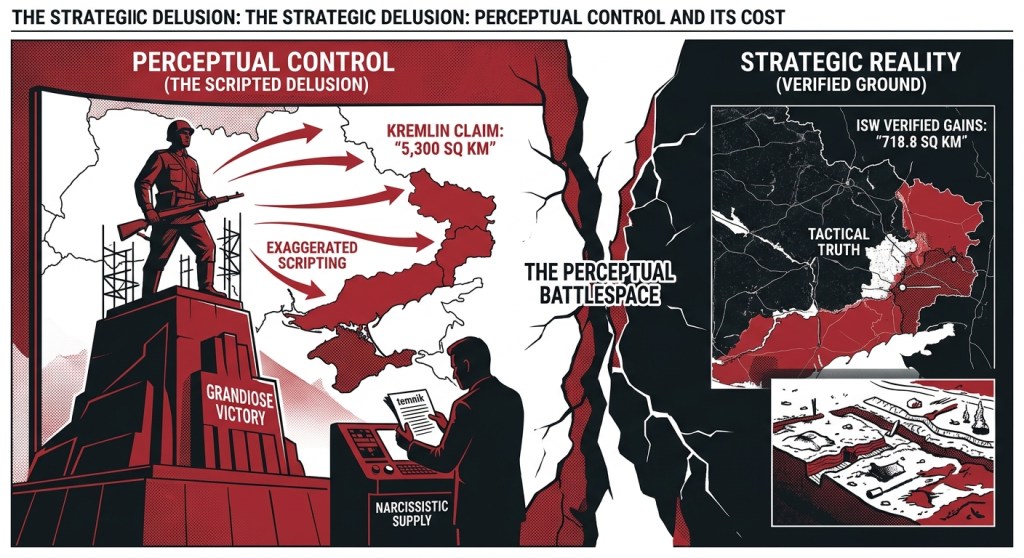
  • The Aggrandizement of Territorial Gains: The Russian Ministry of Defense recently claimed the seizure of over 5,300 square kilometers of Ukrainian territory since the start of 2026. However, independent assessments by the Institute for the Study of War (ISW) verify only 718.8 square kilometers of actual tactical gains.
  • Strategic Delusion: This exaggerated scripting is a calculated Kremlin effort to project an aura of inevitable victory and induce Western fatigue. It is an operational application of civilizational narcissistic supply—manufacturing an alternate reality of overwhelming dominance to cover for the tactical truth of near-zero strategic advancement since March.

Cited and Related Reference

Association of Defense Communities. ADC50. “Army Prepares to Award Microreactor Contracts at Five Bases.” September 21, 2026.

Bogage, Jacob. “Iran war cost hits $38 billion, forecast to rise $3 billion a month, CBO says.” Reuters, September 15, 2026.

Congressional Budget Office (CBO). “Re. Estimating the Cost of Combat Operations Against Iran.” PDF. Correspondence to Brendan F. Boyle, Ranking Member, Committee on the Budget.” September 15, 2026.

Donnelly, John M. “Pentagon’s latest Iran war cost estimate: $43.6 billion.” Roll Call, September 18, 2026.

Institute for the Study of War (ISW). “Russian Offensive Campaign Assessment, September 19, 2026.

World Economic Forum. “The New Global Security Stakeholders: How Public-Private Cooperation Can Advance Security and Stability.” PDF. White Paper. September 2026.

###

ALM: The Transactional Alliance: North Korean Munitions in Ukraine

19 Sunday Jul 2026

Posted by commart in 21st Century Feudal, North Korea, Russia

≈ Leave a comment

Tags

international relations, Kim Jong Un & Vladimir Putin, Moscow & Pyongyang, Russia v. Ukraine, The War Business

As the war in Ukraine places unprecedented strain on the Russian Federation’s domestic defense manufacturing, Vladimir Putin has increasingly turned to the Democratic People’s Republic of Korea (DPRK) to fill critical supply deficits. This transactional relationship has evolved from an ad hoc black-market exchange into a formalized logistics pipeline. Intelligence reports and satellite imagery have tracked the steady flow of heavy munitions from North Korea’s northeastern ports to Russian distribution hubs near the Ukrainian theater.

To date, Moscow has purchased substantial military hardware from Pyongyang to sustain its high-intensity artillery operations:

  • Artillery Ammunition: North Korea has shipped an estimated five million to eight million artillery shells, primarily consisting of 122mm and 152mm calibers. While Western intelligence notes that a significant percentage of these shells suffer from high dud rates and poor quality control due to decades-old storage conditions, they provide Russia with the sheer volume required to maintain its war of attrition.
  • Ballistic Missiles: The DPRK has supplied several dozen short-range ballistic missiles (SRBMs), specifically the Hwasong-11 series (KN-23 and KN-24). These solid-fuel missiles have been actively deployed against Ukrainian cities and critical infrastructure, offering Russia an alternative strike capability as its own precision missile stockpiles face depletion.
  • Anti-Tank Missiles and Small Arms: Shipments have also included significant quantities of anti-tank missiles, mortar rounds, and millions of rounds of small arms ammunition.

Financial and Strategic Windfalls for the Kim Regime

In exchange for this lethal aid, the Russian Federation is funding the Kim regime through a combination of hard currency, raw commodities, and sensitive technical assistance. This influx of capital has thrown a vital economic lifeline to an otherwise isolated Pyongyang.

Capital Flow ElementOperational and Economic Impact
Hard Currency InfluxEstimates indicate Russia has transferred several billion U.S. dollars in cash to Pyongyang. This capital bypasses international banking sanctions, providing Kim Jong Un with a dedicated “slush fund” to stabilize domestic currency markets and fund elite luxury imports.
Energy and Food SecurityRussia has transferred millions of barrels of refined petroleum products and thousands of metric tons of grain and flour. This direct supply has significantly alleviated domestic energy shortages and stabilized food prices across major North Korean urban centers.
Labor Export RemittancesIn defiance of UN Security Council resolutions, Russia has permitted the covert re-entry of thousands of North Korean laborers—predominantly in construction and logging sectors within eastern Russia. Their wages are heavily taxed by the state, generating hundreds of millions of dollars in annual remittances directly to the regime.
Technical AssistanceBeyond immediate financial relief, Moscow has provided technical telemetry data, space-launch guidance, and engineering insights that directly assisted North Korea’s recent military satellite deployment programs.

Works Cited

“An Unholy Alliance: The Financial and Military Reality of Russia-North Korea Cooperation.” Center for Strategic and International Studies, 14 Jan. 2026, https://www.csis.org/analysis/unholy-alliance-financial-and-military-reality-russia-north-korea-cooperation.

“North Korean Munitions Shipments to Russia Surpass Eight Million Shells, Intelligence Reports Show.” Jane’s Defence Weekly, 11 Mar. 2026, https://www.janes.com/defence-news/north-korean-munitions-shipments-to-russia-surpass-eight-million-shells/.

“Pyongyang’s Windfall: How Russian Cash and Oil Are Reshaping the DPRK Economy.” The Diplomat, 28 Apr. 2026, https://thediplomat.com/2026/04/pyongyangs-windfall-how-russian-cash-and-oil-are-reshaping-the-dprk-economy/.

“Russia Leverages North Korean KN-23 Missiles to Evade Ukrainian Air Defenses.” Military.com, 3 June 2026, https://www.military.com/daily-news/2026/06/03/russia-leverages-north-korean-kn-23-missiles-evade-ukrainian-air-defenses.html.

###

Medieval Russia v. Modern Russia

14 Friday Jul 2023

Posted by commart in 21st Century Feudal, 21st Century Modern, Conflict - Culture - Language - Psychology, Philosophy, Political Psychology, Political Spychology, Russia, Ukraine

≈ Leave a comment

Tags

Medieval v. Modern, Russia v. Ukraine, Russian Internal Defeat

Putin may believe himself the personification of Russia, i.e., that Putin is Russia, but Putin is not Russia, and the cognizant and educated among Russians know it and know furthermore the Kremlin feeds Russia’s public–“The Masses” given Putin’s weird Imperialist-Stalinist revanche–garbage.

Given the dangers, including nuclear blackmail as evidenced by the mining of the Zaporizhzha Nuclear Power Plant, the possession of so-called “tactical nukes”, and the inveigling of Belarus in nuclear threat ambition, Putin may be expected to fail from within.

This morning, I posted two notes to European and global security expert Nicolas Tenzer’s Twitter feed–>


“My hope is you’ll see that Ukraine makes significant progress on their offensive and that it generates a negotiated settlement".
Highly misleading words from @POTUS.#Russia must be fully defeated. There cannot be "pease talks" with #Russia.
Period.https://t.co/ryZZO9lEts

— Nicolas Tenzer (@NTenzer) July 14, 2023

I may have shared this with you already but it's appropriate here-https://t.co/Er9BwQ6Psl Putin's power resides in slavish obedience, not esteem; while he's made clear the price of disobedient intent, he may not have the internal support he believes he has and may yet be refused.

— J. S. Oppenheim (@JS_Oppenheim) July 14, 2023

In support of my previous statement-https://t.co/AtYTDzG1pG 7/6/2023.

Putin's ascent to power, Moscow Apartment Bombings & all, may have been predicated on the discomforts of disaffected KGB at the end of the Cold War. Those weren't going to be left out of power & muscled back.

— J. S. Oppenheim (@JS_Oppenheim) July 14, 2023

“…& muscled back”, i.e., muscled their way back into power, making Putin’s 1999 election a triumph in the realm of totalitarian state perceptual control–related reference on BackChannels: https://conflict-backchannels.com/2022/07/19/detecting-post-soviet-russias-black-narrative-of-revenge-for-89-and-91/ | https://conflict-backchannels.com/2023/05/03/reference-journalist-alexander-zhilin-operation-storm-in-moscow-aka-moscow-apartment-bombings/ (Putin appears to have had now a lifetime of serious issues with apartment buildings).

***

What is a feudal tyrant doing as the head of a still powerful and promising Russia?

Part of the answer involves a cosmic “Why not?”

As a gang, disaffected KGB–out of power, out of work in suddenly post-Communist Moscow–may have had a thick-as-thieves coordination and ruthlessness fit to their former secret policing mission and experience. Then too, they would have garnered the cooperation and interest of the post-Cold War peaceful of a productive Europe and North America.

“Why not?” for that as well.

Add condemnation, disapproval, and strong “red line” talk–TALK!–for aggression or barbaric actions undertaken on behalf of absolute power from Chechnya to Afghanistan to Ukraine and the United States (remember the Internet Research Agency!)–all squawk on the part of The West while all remained barbaric and criminal on the part of Moscow and its favored circles of disreputable mediocrities.

Left to grow Russia in his own mafia, mercenary, parochial, post-Soviet, rapacious, and ruthless manner, Putin put Russia’s army and his own demented narcissistic will on the big step into Europe, first Crimea in 2014 in response to the big “Nyet!” and boot given his lackey Viktor Yanukovych, and then the greater portion of the Breadbasket of Europe herself in February 2022.

Have Russians the will or wish themselves to be made criminal, desperate, dumb, and enslaved?

Have the less evident “forces of order” the intent and will to embrace and support those ends?

Perhaps Putin has finally gotten a certain attention secretly craved.

Related Online

Brugen, Isabel Van. “Only 30% of FSB Would Back Putin if Another Mutiny Happens–Exiled Oligarch.” Newsweek, July 6, 2023.

Miller, Greg and Catherine Belton. “Russia’s spies misread Ukraine and misled Kremlin as war loomed.” The Washington Post, August 19, 2022.

–33–

Ukraine, One Year Out, Feb. 24, 2022->Feb. 24, 2023

24 Friday Feb 2023

Posted by commart in 21st Century Feudal, 21st Century Modern, Conflict - Culture - Language - Psychology, Europe, North America, Russia, Ukraine

≈ Leave a comment

Tags

Russia v. NATO, Russia v. Ukraine

Posted to YouTube on February 19, 2023, this has seemed to me an extraordinary retrospective for this one-year anniversary–and may there not be another with the conflict ongoing–of Russia’s entirely surreal and unwarranted invasion of Ukraine.

My second-row seat to history, i.e., the modern desktop on the World Wide Web, has been overwhelmed by all of the option, and this day the live “presser”, now a recording for history, by Ukraine’s President Volodymyr Zelensky-worth every second of its 2:20:55 run time. Also in the audience: The New York Times with its “Live Updates: On War’s Anniversary, Allies Support Ukraine With Words and Weapons.” There’s no waiting on the mail these days as the time between the question asked and answered and its appearance in the most reliable media has a lag time of about 10 minutes (for the typing into publication, no doubt).

For commiseration, memory, and solidarity with Ukraine in the defense of freedom this day: Bucha, Donetsk, Mariupol, etc.

For western can-do obligation, optimism, and spirit related to Ukrainian refugees in a time of war initiated by tyrant deserving of the title, “Tsar Nobody”: UNHCR Data; The Economist on the experience of Ukrainian refugees; and ordinary Americans rising to the occasion to host Ukrainians displaced by Russia’s war.

I have noted with sustained conviction the idea that Putin will not stop his own criminal assaults on Ukraine and against the west in general until stopped, and, frankly, I believe the entire relationship structure of the Russian “Mafia State” must be betrayed, confused, disinformed, hounded, and manipulated into the chaos, collapse, and corruption it has had in mind for all of the rest of the world. Putin, Kadyrov, Prigozhin: political criminals (my two most relevant signatures on Twitter: “#MaligNarcs” and “#PolitCrims”).

For Insight and Related Online

I have been relaying the following URLs for some time and have no longer the patience for typing, retyping, copying or pasting the same damning set of excellent independent research–>

David Satter on Putin’s ascent to power via the Moscow Apartment Bombings: https://www.nationalreview.com/2016/08/vladimir-putin-1999-russian-apartment-house-bombings-was-putin-responsible/

Anna Politkovskaya on the Putin-permitted Russian Army’s brutalizing of Chechen villages during the Second Chechen War: https://press.uchicago.edu/ucp/books/book/chicago/S/bo3617244.html

John Schinder on Al Queda and Aymen al Zawahiri’s stay in Russia, winter 1996-7,in relation to 9/11 and probably a “reflexively controlled” New Nationalism across EU/NATO: https://www.businessinsider.com/exploring-al-qaedas-murky-connection-to-russian-intelligence-2014-6

By yours truly, James S. Oppenheim, on post-Cold War history, 1992-2022, and 30 years of optimistic “peace dividend” cooperation with Moscow even while it grew as a Russian “kleptocracy” (rule by thieves) and resumed its support for dictatorships and terrorist organizations worldwide–https://conflict-backchannels.com/2022/07/19/detecting-post-soviet-russias-black-narrative-of-revenge-for-89-and-91/

I think that’s enough to tie Russia’s abysmal purposes in Ukraine to its government’s criminal character at home. Russians have proven weak or bereft of power at home–more the latter, but they have nonetheless painted themselves before the world–and have made themselves ugly worldwide.

–33–

Ukraine: A Scrape on Russian Defections

21 Tuesday Feb 2023

Posted by commart in 21st Century Feudal, 21st Century Modern, Conflict - Culture - Language - Psychology

≈ Leave a comment

Tags

Defection, Russia v. Ukraine

The scrapes here are dated but cogent. Ukraine has long maintained surrender hotlines for Russian troops intent on surviving Putin’s catastrophe. For defectors, Vladimir Osechkin has been a go-to via his gulagu site–I’d include the .net extension but haven’t been able to reach it myself (related in Wikipedia). What follows: scraped quotes (in no particular order) and additional reference. For philosophy: life is full of leavings, some sad and sweet, some sudden and wrenching.

Note: in the Blogosphere, “scraping” refers to a part of my method, which distills to “Collect, Select, and Opine”–but when one doesn’t “opine” very much, the work amounts to relay with a minimum of commentary, i.e., “scraping”.

So done.

With the Russia v. Ukraine War and Putin’s willful churning of young Russians into fertilizer for Ukrainian soil, Russian motivation for turning against Putin should be powerful in its latency. Indeed, Putin has made his world that of political, practical, and unconscionable criminals making themselves legend for their brutality, dishonesty, greed, ruthlessness, and, ultimately, essential worthlessness.


Caesar said Legion fighters are ideologically diverse but share in fierce anti-Putinism. “Our people hold different views, but we are united in our rejection of the Kremlin dictatorship and the desire to reformat Russia,” he said.

“Our country must become a democratic power, but for this, a reboot of the entire political and social system, lustration, decolonization, de-imperialization and a complete constitutional re-establishment of the state must be carried out.”

Brennian, David. “Russians Fighting for Ukraine Vow to ‘Destroy the Putin Regime'”. Newsweek, October 28, 2022.

Senior Lieutenant at Russian FSB Counterintelligence defected to Europe. Emran #Navruzbekov was to be sent to Turkey & Syria for an operation against Russian citizens wanted by Putin. Instead, he used the opportunity to flee to Europe with a goldmine of intelligence & asked for political asylum.

Emran says the 2nd Service of the FSB essentially controls all criminal activities in Dagestan and Chechnya.

The FSB kidnaps, tortures, & extorts successful businessmen & others who can pay a ransom. The FSB has their own torture chambers across the region for this purpose.

Sushco, Igor. “FSB Counterintelligence Senior Lieutenant defector tells all (Part 1).” The Racecar Driver, December 29, 2022.

“The last 10 years I do a lot of things to protect the human rights and other people. But in this moment, I understood that my mission to help other people created a very high risk to my family,” Osechkin told CNN from France, where he’s lived since 2015 after he fled Russia and claimed asylum. He now has full-time police protection.

He’s become the champion of a growing number of high-level Russian officials defecting to the West, emboldened and disgruntled by the Kremlin’s war in Ukraine. He says ex-generals and intelligence agents are among their number.

Bell, Melissa, Saskya Vandoome, Joseph Ataman. “High-ranking Russian officials are defecting. This man is aiding them.” CNN, January 25, 2023.

Igor Volobuyev spent two decades working in the heart of the Russian business establishment, first for Gazprom and then for its affiliate Gazprombank, where until February this year he was vice-president.

Then Vladimir Putin launched his war on Ukraine in late February, and Volobuyev decided he could no longer stand living in Russia. He packed a small rucksack of possessions and a stack of cash, and flew out of the country on 2 March, pretending he was going on holiday.

A few days later, he crossed from Poland into Ukraine, where he spent his childhood years. Now, he spends his days trying to convince officials to provide him with Ukrainian documents and allow him to sign up for military service.

Walker, Shaun and Andrew Roth. “‘I’m never going back’: the high profile Russian defectors rejecting war.” The Guardian, May 15, 2022.

The history of the Cold War and post-Cold War eras is rife with elaborate, almost implausible tales of defectors and double agents, sometimes even triple agents, spies who worked for one or more governments simultaneously for love or money or for the simple thrill of leading a hidden life. There are those with access to state secrets, some immeasurably valuable, who betrayed their country for ideological reasons or, as they often rationalize the treachery to themselves, perfectly pragmatic ones.

And now there is a historic first: the enemy spy who came back to the people who caught and released him.

Weiss, Michael. “Exclusive: Ex-Russian spy flees to the NATO country that captured him, delivering another embarrassing blow to Moscow.” Yahoo News, November 17, 2022.

Related Online

Bell, Melissa, Saskya Vandoorne, Joseph Ataman. “High-ranking Russian officials are defecting. This man is aiding them.” CNN, January 25, 2023.

Brennian, David. “Russians Fighting for Ukraine Vow to ‘Destroy the Putin Regime'”. Newsweek, October 28, 2022.

Bunyan, Rachael. “‘I’m Russian, I kill my countrymen… but they’re criminals’: Soldiers who defected from Putin’s military say they joined Ukraine after witnessing atrocities…and have each killed as many as 18 of their former comrades.” Daily Mail, December 6, 2022.

Dovidka. “Acting in occupied territory.”

“How to surrender: step-by-step instructions for Russians and forcibly mobilized Ukrainians.” Visit Ukraine Today Blog, n.d.

Jackson, Jon. “Putin’s Deserters Poised to Fight Against Him on Front Lines.” Newsweek, February 13, 2023.

Murphy, Matt. “Ukraine War: Russia’s Wagner Group commander requests Norway asylum.” BBC, January 16, 2023.

Pleasance, Chris. “Thousands of Russian soldiers ‘have already called Ukrainian hotline set up to let them surrender’.” October 5, 2022.

Riehle, Kevin. First paragraph: “We are seeing an increasing flow of reports about dissatisfaction among people associated with Russia’s intelligence and security services. Is it just anti-Russian propaganda? Hard to say.” LinkedIn.

Rosenberg, Steve. “Russian army officer admits: ‘Our troops tortured Ukrainians’.” BBC, February 2, 2023.

Stewart, Will. “Officer in Putin’s security service who ‘REFUSED’ to kill Ukrainians and fled to Kazakhstan instead is deported to Russia and now faces up to 15 years in jail.” Daily Mail, December 31, 2023.

Weiss, Michael. “Exclusive: Ex-Russian spy flees to the NATO country that captured him, delivering another embarrassing blow to Moscow.” Yahoo News, November 17, 2022.


Posted to YouTube on February 20, 2023.

–33–

Nicolas Tenzer On A Russia That Must Be Condemned, Defeated, Taken Apart, and Taken Down

21 Saturday Jan 2023

Posted by commart in 21st Century Feudal, 21st Century Modern, Conflict - Culture - Language - Psychology, Russia, Ukraine

≈ Leave a comment

Tags

Medieval v. Modern, Russia v. Ukraine, Russian Mafia State

This one analysis by French international affairs and security analyst Nicolas Tenzer sets a certain, different, high, and independent standard for diplomatic community and lay readers alike.


The reality is that Moscow is not in a position to seek a balance with the democratic world. It does not set itself limits that could prefigure any compromise, even one that is not very acceptable to us, and the search for a give-and-take on the basis of which a more or less lasting peace could be envisaged. An allegedly “prudent” approach to Russia would be the worst form of imprudence—the history of the last twenty-three years bears witness to this—and any prospect of negotiations a fool’s game. To continue to hold such a discourse about the end of the war in Ukraine is a serious mistake, because it is part of the Russian hope of reaching a compromise, even if it is less than its initial ambitions. To make such remarks would be to do exactly what Moscow is looking for: to present itself as a supposed partner with whom it is possible to reach an agreement, to believe in its signature—which is constantly flouted—and to suggest that the Russian regime is not an absolute enemy. This would again trivialize its crimes. To pretend to give any credence to Russia’s supposed interests as expressed by the regime would be to question the fundamental principles enshrined in the international treaties drawn up in the aftermath of the Second World War. There is certainly no possibility of stability with a power that seeks instability through destruction.


Tenzer, Nicolas. “Understanding the War: On the Exceptionality of Russia’s All-Out War Against Ukraine.” Tenzer Strategics, January 21, 2023.

Russia and its culture and language are in no danger as regards their contributions and sustained presence in the world. All that is at stake for Russia is a political criminal–one Vladimir Vladimirovich “Vovo” Putin, in fact, a murderer of ordinary Russians–his associates and cronies and as yet unknown criminals in the transnational crime trades.

–33–

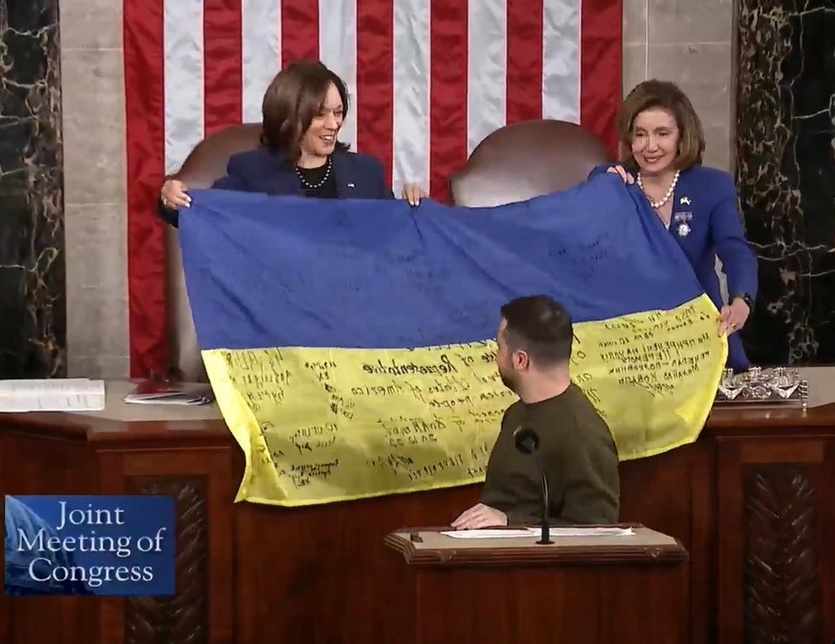
Zelensky’s Speech Before Congress, December 21, 2022: Near Quotes

21 Wednesday Dec 2022

Posted by commart in 21st Century Feudal, 21st Century Modern, Conflict - Culture - Language - Psychology, Russia, Ukraine, United States of America

≈ Leave a comment

Tags

Russia v. Ukraine, Russia-Ukraine War, Slava Ukraine, Ukraine for Democracy, Ukraine for Freedom, Volodymyr Zelenski, Zelensky's Address to Congress

BackChannels hasn’t yet seen a transcript, but from scribbles come the following “near quotes”–>

“We have defeated Russia in the battle of minds for the world.”

“Americans gained this victory, and that is why you have succeeded in uniting the global community to protect freedom and international law.”

“Europeans gained this victory, and that’s why Europe is now stronger and more independent than ever.”

“The Russian tyranny has lost control over us.”

“The Russians will only have a chance to be free when they defeat the Kremlin in their minds.”

“This battle cannot be frozen or ignored. the world is too interconnected . . . . Our two nations are allies in this battle.”

“Russia has been taking Bakhmut since May, but Bakhmut stands.”

“The Russian tactics are primitive.”

“Ukraine holds its lines and will never surrender.”

Zelensky compared the battle for Bakhmut with the American Revolution’s experience at Saratoga, New York, making Ukraine’s war one of similar liberation from absolute power.

“Your well being is the product of your security. We Ukrainians will also go through our war of independence with dignity…. We wish for the same victory. Only victory.”

I’m going to feel guilty about this–C-Span coverage features transcripts: C-Span. “Ukrainian President Zelensky Address to Congress: Ukrainian President addresses a joint meeting of the U.S. Congress.” December 21, 2022.–but no longer young, perhaps not that guilty.

I’ve earned my laziness.


–33–

← Older posts
  • Compassion
  • Empathy
  • Justice
  • Humility
  • Inclusion
  • Integrity
____________

Caution: The possession of anti-Semitic / anti-Zionist thought may be the measure of the owner's own enslavement to criminal and medieval absolute power.
___________

Recent Posts

  • The Weak Censor the Integrity of Others
  • Ai La Mer Brief Involving Russia’s Africa Corps and Related Islamist Activity
  • Ai La Mer On European Realignment and Strategic Autonomy
  • American Allies Respond to Trumpian Absolutism and Related Financial and Trade Policy
  • Oil for Arms: DPRK & Russia: How it Works
  • Nuclear Micro-Reactors: Technical Architecture & Defense Installation Schedule

Categories

  • 21st Century Feudal
  • 21st Century Modern
  • A Little Wisdom
  • Also in Media
  • American Domestic Affairs
  • Anti-Semitism
  • Asides
  • BCND – BackChannels News Day
  • Books
  • Conflict – Culture – Language – Psychology
  • COVID-19
  • Epistemology
  • Events and Other PSA's
  • Extreme Brown vs Red-Green
  • Fast News Share
  • foreign aid
  • Free Speech
  • FTAC
  • FTAC – From The Awesome Conversation
  • International Development
  • IRT Images Research Tropes
  • Islamic Small Wars
    • Gaza Suzerain
  • Journal
    • Library
  • Journalism
  • Links
  • Notes On Reading BackChannels
  • OnX
  • Philology
  • Philosophy
  • Poetry
  • Political Psychology
  • Political Spychology
  • Politics
  • Psychology
    • Facsimile Bipolar Political Sociopathy
  • Qualities of Living (QOL)
  • Referral
  • Regions
    • Africa
      • Algeria
      • Central African Republic
      • Guinea
      • Kenya
      • Libya
      • Mali
      • Morocco
      • Nigeria
      • South Africa
      • Sudan
      • Tunisia
      • Zimbabwe
    • Asia
      • Afghanistan
      • Burma
      • China
      • Hong Kong
      • India
      • Myanmar
      • North Korea
      • Pakistan
      • Turkey
    • Caribbean Basin
      • Cuba
    • Central America
      • El Salvador
      • Guatemala
      • Honduras
      • Mexico
    • Eastern Europe
      • Serbia
    • Eurasia
      • Armenia
      • Azerbaijan
      • Russia
      • Ukrain
      • Ukraine
    • Europe
      • France
      • Germany
      • Hungary
      • Poland
    • Great Britain and United Kingdom
    • Iberian Peninsula
    • Middle East
      • Egypt
      • Gaza
      • Iran
      • Iraq
      • Israel
        • Palestinia
      • Jordan
      • Kurdistan
      • Lebanon
      • Palestinian Territories
      • Qatar
      • Saudi Arabia
      • Syria
      • United Arab Emirates
      • Yemen
    • North America
      • Canada
      • United States of America
    • Norther Europe
    • Northern Europe
      • Sweden
    • South America
      • Argentina
      • Brazil
      • Columbia
      • Ecuador
      • Venezuela
    • South Pacific
      • Australia
      • New Zealand
      • Papua New Guinea
      • West Papua
  • Religion
  • Spain
  • Syndicate Red Brown Green
  • transnational crime
  • Uncategorized
  • Visual Data

Europe

  • Defending History
  • Hungarian Spectrum
  • Yanukovych Leaks

Great Britain

  • Stand for Peace

Israeli and Jewish Affairs

  • Chloe Simone Valdary

Journals

  • Amil Imani
  • New Age Islam

Middle East

  • Human Rights & Democracy for Iran
  • Middle East Research and Information Project

Organizations

  • Anti-Slavery
  • Atlantic Council
  • Fight Hatred
  • Human Rights First Society
  • International Network Against Cyberhate
  • The Center for Victims of Torture

Meta

  • Create account
  • Log in
  • Entries feed
  • Comments feed
  • WordPress.com

Epigram

Hillel the Elder

"That which is distasteful to thee do not do to another. That is the whole of Torah. The rest is commentary. Now go and study."

"If I am not for myself, who will be for me? If I am not for others, what am I? If not now, when?"

"Whosoever destroys a soul, it is considered as if he destroyed an entire world. And whosoever that saves a life, it is considered as if he saved an entire world."

Oriana Fallaci
"Whether it comes from a despotic sovereign or an elected president, from a murderous general or a beloved leader, I see power as an inhuman and hateful phenomenon...I have always looked on disobedience toward the oppressive as the only way to use the miracle of having been born."

Talmud 7:16 as Quoted by Rishon Rishon in 2004
Qohelet Raba, 7:16

אכזרי סוף שנעשה אכזרי במקום רחמן

Kol mi shena`asa rahaman bimqom akhzari Sof shena`asa akhzari bimqom rahaman

All who are made to be compassionate in the place of the cruel In the end are made to be cruel in the place of the compassionate.

More colloquially translated: "Those who are kind to the cruel, in the end will be cruel to the kind."

Online Source: http://www.rishon-rishon.com/archives/044412.php

Abraham Isaac Kook

"The purely righteous do not complain about evil, rather they add justice.They do not complain about heresy, rather they add faith.They do not complain about ignorance, rather they add wisdom." From the pages of Arpilei Tohar.

Heinrich Heine
"Where books are burned, in the end people will be burned." -- From Almansor: A Tragedy (1823).

Simon Wiesenthal
Remark Made in the Ballroom of the Imperial Hotel, Vienna, Austria on the occasion of His 90th Birthday: "The Nazis are no more, but we are still here, singing and dancing."

Maimonides
"Truth does not become more true if the whole world were to accept it; nor does it become less true if the whole world were to reject it."

"The risk of a wrong decision is preferable to the terror of indecision."

Douglas Adams
"Isn't it enough to see that a garden is beautiful without having to believe that there are fairies at the bottom of it too?" Epigram appearing in the dedication of Richard Dawkins' The GOD Delusion.

Thucydides
"The Nation that makes a great distinction between its scholars and its warriors will have its thinking done by cowards and its fighting done by fools."

Milan Kundera
"The struggle of man against power is the struggle of memory against forgetting."

Malala Yousafzai
“The terrorists thought that they would change our aims and stop our ambitions but nothing changed in my life except this: weakness, fear and hopelessness died. Strength, power and courage was born.”

Tanit Nima Tinat
"Who could die of love?"

What I Have Said About the Jews

My people, not that I speak for them, I nonetheless describe as a "global ethnic commune with its heart in Jerusalem and soul in the Land of Israel."

We have never given up on God, nor have we ever given up on one another.

Many things we have given up, but no one misses, say, animal sacrifice, and as many things we have kept, so we have still to welcome our Sabbath on Friday at sunset and to rest all of Saturday until three stars appear in the sky.

Most of all, through 5,773 years, wherever life has taken us, through the greatest triumphs and the most awful tragedies, we have preserved our tribal identity and soul, and so shall we continue eternally.

Anti-Semitism / Anti-Zionism = Signal of Fascism

I may suggest that anti-Zionism / anti-Semitism are signal (a little bit) of fascist urges, and the Left -- I'm an old liberal: I know my heart -- has been vulnerable to manipulation by what appears to me as a "Red Brown Green Alliance" driven by a handful of powerful autocrats intent on sustaining a medieval worldview in service to their own glorification. (And there I will stop).
One hopes for knowledge to allay fear; one hopes for love to overmatch hate.

Too often, the security found in the parroting of a loyal lie outweighs the integrity to be earned in confronting and voicing an uncomfortable truth.

Those who make their followers believe absurdities may also make them commit atrocities.

Positively Orwellian: Comment Responding to Claim that the Arab Assault on Israel in 1948 Had Not Intended Annihilation

“Revisionism” is the most contemptible path that power takes to abet theft and hide shame by attempting to alter public perception of past events.

On Press Freedom, Commentary, and Journalism

In the free world, talent -- editors, graphic artists, researchers, writers -- gravitate toward the organizations that suit their interests and values. The result: high integrity and highly reliable reportage and both responsible and thoughtful reasoning.

This is not to suggest that partisan presses don't exist or that propaganda doesn't exist in the west, but any reader possessed of critical thinking ability and genuine independence -- not bought, not programmed -- is certainly free to evaluate the works of earnest reporters and scholars.

Archives

Blog at WordPress.com.

  • Subscribe Subscribed
    BackChannels
    Join 349 other subscribers

    Have a WordPress.com account? Log in now.

  • BackChannels
    View site in Reader
    Manage subscriptionsSign upLog in
    Report this content
    Collapse this bar