Sadiq Khan symbolically stands between the medieval world, specifically a world defined by the possession of political (and social) absolute power as bragged, defended, and exercise by singular leaders using whatever means necessary to place themselves and keep themselves positioned as rulers. Although a dozen European states today remain monarchies, the democratic forces evolved within the “western” character — such things are not so limited, but for the sake of conversation one may use the convention — have over centuries modified and exchanged “absolute power” distributed power with a chief administrator or two (where a president and prime minister may co-exist).
The gulf between between the medieval and modern worldviews is immense and, perhaps as demonstrated by Putin and the related axis defined by Moscow, Damascus, and Tehran tells that the matter is not strictly about religion, including. It is about the human grasp of power and power in the hands of the malign.
With Islam, and this apart from examinations of the content of the Qur’an and related wisdom and exegesis — all of which criticism has been well argued and displayed all over the “strident infidel” web — the mere rejection of the “Islamists” (now that we have that term) and the bent toward caliphate, and that by the proverbial sword as swung by such as Baghdadi and others like him, constitutes reform. Whatever Muhammad may have done that Baghdadi believes he’s emulating, the modern wish not to do over and over and over and over all the way to second comings.
Evolved with piety kept intact, which I think may be D______’s conservative election, or instantly updated per the wishes of the Muslim Reform Movement, Sadiq Khan and others, again of modern bent, have a pretty good palette within which to reside within the House of Islam.
Regarding the role of the Jews (apart from “No Moses — no Muhammad”), the Hebrew’s teleological ejection of unquestioned and unquestionable human authority, the rejection of Pharaoh, has had its revolutionary impact on the world, and the shape of it has been such as to repeatedly meet some of the challenges posed by dictators, but as history has jagged edges, the power of the despotic may shrink across time, but there are many despots and some live out their lives to die peacefully in their beds (at least it’s looking that way for Mugabe).
In short (wouldn’t that be nice?), it’s not the Jews that may stand in judgment of Sadiq Khan but rather those who have come across from the medieval world and left behind — ejected — its manners in the development and exercise of political power.
The gist of the assertion posed as a question: the Jews won’t accept London Mayor Sadiq Khan’s overtures until Islam has been definitively reformed.
Well, bunk.
As noted above, the Ummah’s rejection of the al-Qaeda-type organizations may constitute “reform” — at least Baghdadi, that stickler for authenticity who believes he’s conducting a state in Muhammad’s image, would reject such “reform”.
In the medieval mode, it would be natural to expect that “one true church” would conquer all the others; in the modern, democratic, secular, and tolerant mode, every true church may borrow, evolve, and shift by parts accommodation and parts compassionate discernment and idealism. The conquest by one of all becomes irrelevant.
As regards criticism and issues swirling around the figure of Muhammad and Islam, the blanket rejection of the same may call to mind Haider Mobarak’s term, “civilizational narcissism” as well as the many online sites devoted to the “anti-Jihad”.
Sadiq Khan is no Muslim extremist. And it is not only his track record voting for gay rights that proves this. Having known him when I was a Muslim extremist, I know that he did not subscribe to my then-theocratic views.
Crimean Tatars had just ended their Friday prayers and were rounded up en masse. With no suggestion that anybody was suspected of an offence, the raid, by men with machine guns, can only be called an overt attempt to terrorize Crimean Muslims. This is not the first such act of primitive intimidation, with at least one of the previous occasions making it quite clear that the Russian occupation regime is targeting Crimean Tatars in general.
The above cited article will go on to note the following: “Attacks on people who have just left Friday prayers is both intimidation and part of the mounting campaign by Russia as occupying force to treat Crimean Tatars as ‘extremists’. / 10 Crimean Muslims are currently in detention facing ‘terrorism’ charges for alleged involvement in an organization – Hizb ut-Tahrir – which only Russia and Uzbekistan have banned.”
“Hizb ut-Tahrir”?
From the top, Wikipedia’s description: “Hizb ut-Tahrir (Arabic: حزب التحرير Ḥizb at-Taḥrīr; Party of Liberation) is a radical,[1] international, pan-Islamic political organisation, which describes its “ideology as Islam”, and its aim as the re-establishment of “the Islamic Khilafah (Caliphate)” or Islamic state. The new caliphate would unify the Muslim community (Ummah)[2] in a unitary (not federal)[3] “superstate” of unified Muslim-majority countries[4] spanning from Morocco in West Africa to the southern Philippines in East Asia.
From the military perspective promulgated by Global Security: “The group claims to be a political party that proceeds with nonviolent means and whose ideology is Islam. Its objectives are strictly political, and its main goal is to topple an existing regime to resurrect the caliphate with structures and conditions similar to the ones of early 7th century Islam. The proposed Islamic state will be responsible for transforming society in a united Ummah, and for spreading the word of Islam throughout the world. Hizb ut-Tahrir rejects modern, secular state structures and democracy as things that are ‘man-made, humanly derived, and un-Islamic,’ and, therefore, it does not participate in any secular electoral processes. However, Hizb ut- Tahrir does not reject modern technology and its advantages.”
If Russia and the Tatars are to get along, they will have to overcome not only the bitter legacy of the 1944 deportations, but also centuries of conflict. Russian Tsar Catherine the Great’s conquest of the Crimean Khanate in 1774 led to a mass emigration of Tatars to the Ottoman Empire that was encouraged by the new Russian authorities. Catherine then proceeded to distribute vast lands that had been used by Tatars for grazing to Russian, Ukrainian, German, and foreign nobles and farming communities. The Crimean war of 1853-56 spurred another mass emigration of Crimean Tatars. Memories of historical injustices run the other way too. During the three centuries when the Crimean Tatar Khanate was part of the Ottoman Empire (1478-1774), one of its primary activities was seizing captives from Russia, Ukraine, and the Polish-Lithuanian Commonwealth and selling them as slaves in the Ottoman Empire and Middle East.
In the present, Putin’s Era, labeling Russia’s overt investigation of the Crimean Tatar community and the brushing away of the Islamist taint linked to Hizb ut-Tahrir perhaps signals that disingenuous writing that would promote chaos, at least, if not evil outright under the guise of concern with liberation and human rights.
Suspicion of within-mosque association with Hizb ut-Tahrir might rightly call any number of authorities, Ukrainian no less than Russian, to alert and to action. The same may not condone The Bear’s hamfisted and often suspect methods, but it may excuse them in the interest of further explicating political drifts and their strength within so many conflicted and conflict-creating communities within Russia and within the Russian “sphere of challenge” — defined by annexations, frozen conflicts, infiltrations, information warfare, etc. — redeveloped KGB-style by Vladimir Putin.
As regards the Russia-in-Crimea act of fascist assertion and intimidation in surrounding with police a presumably peaceful mosque (“Shimmer” always applies): where is and where was the crime?
Ukrainians (a lot more than Russians) will need to know who is modern, i.e., who has become accustomed to and positively willing to embrace a world adjusted beneath the umbrella of compassionate, practical, and tolerant secular law?
Ukrainians also may wish to know who is not modern, i.e., who would embrace and reconstruct the medieval world and worldview, the same that has been on bloody display in Syria since 2011?
Midway down the left sidebar of this blog comes a bit of Jewish advice to those who would for kindness or naivete abet the designs of those inclined toward intolerance, sadism, and willfulness:
Talmud 7:16 as Quoted by Rishon Rishon in 2004 Qohelet Raba, 7:16 אכזרי סוף שנעשה אכזרי במקום רחמן
Kol mi shena`asa rahaman bimqom akhzari Sof shena`asa akhzari bimqom rahaman
All who are made to be compassionate in the place of the cruel In the end are made to be cruel in the place of the compassionate.
More colloquially translated: “Those who are kind to the cruel, in the end will be cruel to the kind.”
As Halya Coynash’s writing makes the rounds, the example of that with which this post was started and titled, one may wish to keep in mind post-Soviet Russia’s deeply feudal revanch under Putin’s guidance. The “mafia state” — the same that supported the rightly deposed thug Yanukovych — has also a nationalist drive and a revived Russian Orthodox Church attached: for the want of its own greater aggrandizement and not a little criminality, Russia appears to believe it has cause to induce extremism — or more extreme response — in the path of its own habitual imperialism.
As with the delinquent fireman who sets the fire that he can put out, Russia’s state game appears to involve creating the problem (as with the incubating of ISIS in Syria) that its own “heroic” self might solve — an evil design, for sure, but if it has worked so far, and for Russia, so well, lol, in Syria, may God let it not take off in Crimea.
If the symbolic attributes of Mejlis are banned, uncertainty will prevail concerning the use of the flag of Crimean Tatars. The latter is not a symbol of Mejlis, but of all Crimean Tatars. It is used by Mejlis to represent the community’s identity.
“The decision to ban Mejlis for alleged “extremist activities” may open the way to a massive wave of prosecution of Crimean Tatars for whom Mejlis is a symbol of struggle against century long repressions,” – said Karim Lahidji, FIDH President.
According to Jonathan Kay, I am a fear mongering, xenophobic Islamophobe because I am against the wearing of the niqab in my country. He is just one of far too many “journalists” pushing an ideology that has no basis in reality.
I am, in fact, against an ethic that promotes supremacy-of Muslims over Jews and Christians and other infidels. Dhimmitude. I am against an ethic that treats women as chattel, oppressed and suppressed, with no human rights, let alone civil rights. I am against people living in my country who wear that powerful misogynistic, paternalistic symbol of that ethic when our country has worked for generations to free women from paternalistic control. I am against an ethic that refuses to tolerate, include or accommodate those with different beliefs. I am against an ethic that promotes teaching hate of others-particularly Jews.
Masked off by our own reading and research habits as well as general busyness with information is the history of Russian and Soviet anti-Semitism and its influence throughout the political campus of the Left and Far Left to this day.
There are many portals today through which to pick up on the history of Soviet anti-Semitism, Soviet-supported terrorism, and the relationship of the Soviet to the International and Palestinian Solidarity organizations and their radical movements. I usually — and here may — blog such links as the following:
Where the focus is narrowed to influence of the Soviet on Middle Eastern politics and on Islam, one will find reported by Pacepa the Soviet’s massive promotion of anti-Semitism in the Arab sphere.
The former lawyer has vowed to be “the British Muslim who takes the fight to extremists.” Yet the Labour Party under leader Jeremy Corbyn has veered sharply to the left on these matters, and Mr. Khan has been an enabler of that transformation.
Abdel-Al—who lives in occupied East Jerusalem—is visiting Chicago this week at the invitation of the United Electrical Workers (UE), the U.S. Palestinian Community Network, and Jewish Voice for Peace to enlist the support of the U.S. labor movement in the Palestinian liberation struggle. He addressed standing-room-only audiences of rank-and-file unionists at last weekend’s Labor Notes conference and again on Tuesday night at the local UE Hall.
The campaign for ‘Boycott, Divestment and Sanctions’ (BDS) against the Israeli government gains ground every day while defenders of the Palestinian Occupation seem to be able to do no more that trot out the same tired charges of anti-Semitism against its proponents!
As George Bisharat points out in the article below, the charge of anti-Semitism is completely without substance. Indeed there has been a tragic history of persecution of Jewish people for which all of us Europeans rightly feel a sense of shame. Even so, for Zionist politicians to manipulate this shame to justify the persecution of Palestinian people is reprehensible, and it’s a tactic that is becoming increasingly transparent to the Western public.
Perhaps the most significant thing about Bisharat’s article is that it appeared in the Chicago Tribune. Indeed the BDS is going mainstream!
The above paragraph had been posted as prelude to “Applause for the academic boycott of Israel” by George Bisharat (the two are on the same page, i.e., same link).
Those who read across publications may find similar claims, tropes, and strategies in play. The picture is generally stark with the charge of brutality always leveled on the Jews:
U.S. enabling of Israel, particularly in its colonial expansion into the West Bank, has voided the two-state option and fostered a single functioning state there in which only Jews enjoy relative security, prosperity, and full political rights, while Palestinians suffer gradations of oppression.
Never mind the Soviet KGB-invented Arafat and the Palestinian Liberation Organization, today’s Palestinian Authority; and never mind the genocidal — and Palestinian plundering — Hamas. The presence of the two disappears when Israelis / Zionists / Jews seem much preferred in the target sites.
Corey Gil-Shuster has been video interviewing Israelis and Palestinians — and anyone else within range — for years on the widest variety of questions having to do with the middle east conflict and justice in Israel. Here’s a short example from 2012:
Posted to YouTube May 9, 2012.
Finally about the promotion of impoverished Palestinians beneath the “brutal occupation” — there’s a lot more to that story that includes Hamas billionaires, but this may suffice for a glimpse into the reality of luxury development in Gaza: PRICO Real Estate Development Company.
Russia’s information warfare vis-a-vis the Baltic States has centered on its own interpretation of Soviet history, smearing Baltic governments and societies as fascists and Nazis, and creating propaganda about alleged abuse of the Russian minorities. The prominence given to these matters has ebbed and flowed. However, since Crimea’s annexation in 2014, the narrative of discrimination against the Russian minorities has intensified. The propaganda has served to reinforce Russia’s soft power efforts to create a network of co-opted communities of compatriots in the Baltic States as well as sow societal ethnic divisions. The goal has been to encourage Russians and Russian speakers (but not only these) to develop loyalty to modern-day Russia, including its interpretation of history and current events.
Where Putin goes about the business of growing Russia back to Soviet size, at least in presence and as much in body as it may persuade, Agnia Grigas counts and examines the ways. Covered in depth: Ethnic Russian and Russophone-based (and often disingenuous) compatriot and humanitarian policies, frozen conflicts, information warfare (including within near abroad states the development of Moscow-controlled media), “passportization” (instant citizenship based in nominal ethnic and linguistic affiliation), separatism, civil conflict, and annexation.
In the course of her writing, Grigas captures the spirit of Putin’s revanchist script that is bound to glorify, sanitize, and revive the past while keeping himself at the center of the universe so projected. Of greatest interest to lay Kremlin watchers may be the many explications of historically near Moscow-engineered lies and manipulations recounted throughout the book.
BackChannels happens to have a page open detailing “a campaign that contributed to the 2007 riots by Russians and Russian speakers in Tallinn.” The incident appears to have been less about “bending and twisting it some” and more about outright fabrication and incitement:
According to Estonian perceptions, Moscow was instrumental in inciting unrest and discontent by spreading false accounts in the Russian-language press that the monument, and presumably the nearby tombs of unknown soldiers, had been destroyed . . . The Russian embassy allegedly also took part in organizing the riots, while Russian activists, including members of the Nashi pro-Kremlin youth movement, traveled from Russia to take part in the violence. (p. 164).
That’s one incident recounted on one-third of a page — and the book runs 256 pages before the recounting of each chapter’s copious notes.
The Winter Olympics at Sochi and the dreadful fracturing of Syria may not be so unique, for Russia appears to have had plenty of experience at managing and putting on a show — and controlling information and perception in spaces it either exploits or would wish to exploit.
In her concluding chapter, Grigas notes, ” . . . Russian compatriot policies go hand in hand with coercion, disinformation, and use of force against the governments of the target states. These policies at times verge on blackmail to manipulate the compatriots and even allies like Armenia Belarus, Tajikistan, Kazakhstan, and Kyrgyzstan into participating in the Russian reimperialization project. Moscow offers and extends its protection to compatriots in some cases despite the preferences of the compatriots themselves” (p. 243).
In the bloody theatrical production that has been “Assad OR The Terrorists” — and guess who’s responsible for casting “The Terrorists”? — Russia and Syria, who have ejected the terrorists from Palmyra, have turned to assert the values of their feudal aristocracies against the barbarism of their foes. http://www.nytimes.com/…/syria-russia-palmyra-isis…
While classical music may set the tone of a better deal, the larger picture sustains political absolute power over “the masses”, an affront and challenge to the democratic and deeply humanist character of those the Russian Federation has chosen to label as its enemies.
***
Posted to YouTube May 5, 2016.
If the reader has no memory, then the reader may obtain one of two possible impressions: civilization, as represented by the symphony, is “winning” in Syria; civilization, as represented by the aftermath of an air strike against a refugee camp, is losing in Syria, and only barbarism is winning across that godforsaken land.
The truth has finer points.
In recent weeks, despite Russia’s promised pullback from Syria, Russia has instead strengthened its presence in the embattled state.
By strengthening Moscow’s hand in Syria, Putin may be firming up Assad’s perception of Syria as a Russian client state after all. As argued repeatedly on this blog, the true axis appears to be “Moscow-Tehran” and the purpose of it the sustaining of feudal absolute power enabling both imperial ambitions and further unrestrained kleptocracy.
Perhaps symphonies play louder than murder in so many state-controlled presses, but in the Open Source Environment, the same may be juxtaposed in a timely manner with the slaughter of noncombatants that would appear to secure their stay in service to the feudal aristocracies that appreciate them.
Also, the upgraded Russian military and political presence in Syria may leverage Washington into compromising with Moscow over Damascus in the control of situation. Given the horrors of the “Syrian Tragedy”, the ancillary humanitarian and political fallout that coalesces around refugee camps and mass migration, western resistance to the feudal program(s) on display may stand diminished and neither Moscow nor Tehran changed very much if at all.
The revelations come from new letters added to the 22,000 internal ISIS documents Sky News leaked in March. Before the Syrian troops regained control of the ancient city of Palmyra earlier this year, the Syrian government arranged a deal to allow ISIS to “withdraw all heavy artillery and anti-aircraft machine guns from in and around Palmyra to [the] Raqqa province.
On Corroborating Stories — Multiple Independent Sources
Tweet: “Putin, Assad, Khamenei — Together They Are Defending Absolute Power.”
Add Baghdadi.
BackChannels has been supporting the idea that malign and medieval leaders work together, whether directly or indirectly makes no difference, in supporting the feudal image and theater that in turn justifies they stay in political absolute power. As evidence mounts as regards the incubation of al-Qaeda-type forces and ISIS through the selective bombing of other targets, and as new reportage surfaces with news of collusion between Russian air power and ISIS ground forces, it starts to look like BackChannels got it right in the first place. From the above cited Daily Caller piece: “ISIS gets a detailed warning of when a strike is scheduled to take place, which allows it to withdraw to an agreed evacuation point.”
Anatoliy Golitsyn, a high-ranking KGB defector who served in the KGB’s ultra secretive long-range disinformation Department D, explained in his book New Lies For Old (1984) the then-Soviet Union’s reason for sponsoring terrorism:
The objective of violence is to create chaos and anarchy, to impose additional strains on ruling democratic parties, to eliminate their ablest leaders, to force them to resort to undemocratic measures, and to demonstrate to the public their inability to maintain law and order, leaving the field open to the legal communist party to present itself as the only effective alternative force.
“An extensive spy network has been set up inside Islamic State,” Kadyrov’s office quoted him on Monday as telling Russia’s state-controlled Russia 1 channel.
“Thanks to their work as agents the Russian air force is successfully destroying terrorist bases in Syria.”
Based on extensive fieldwork in one village in the North Caucasus, reporter Elena Milashina has concluded that the “Russian special services have controlled” the flow of jihadists into Syria, where they have lately joined up not only with ISIS but other radical Islamist factions.
While the Kremlin channels jihadis to ISIS, it may also embed spies, so it rids itself of at least a few potential terrorists — or thousands of them — in Russia and sets them up in easily targeted (because it may have also sent in spies) “kill zones” in Syria. Politically, it can promote, vicariously, say, the symphony while “barrel bombing” noncombatant Syrians while making its case for “Assad OR The Terrorists”, and through the Baathist generals who have become ISIS generals, it can display a convenient foil for Khamenei’s Revolutionary Guard, reported as embedded in the more “fiery” Shiite militia, for Tehran’s expansion of influence in Iraq. By doing all of the above, which I believe it has, the familiar post-Soviet axis has reproduced the image of the feudal world that each despotic leader needs to remain legitimate (in the eyes of their followers) in power.
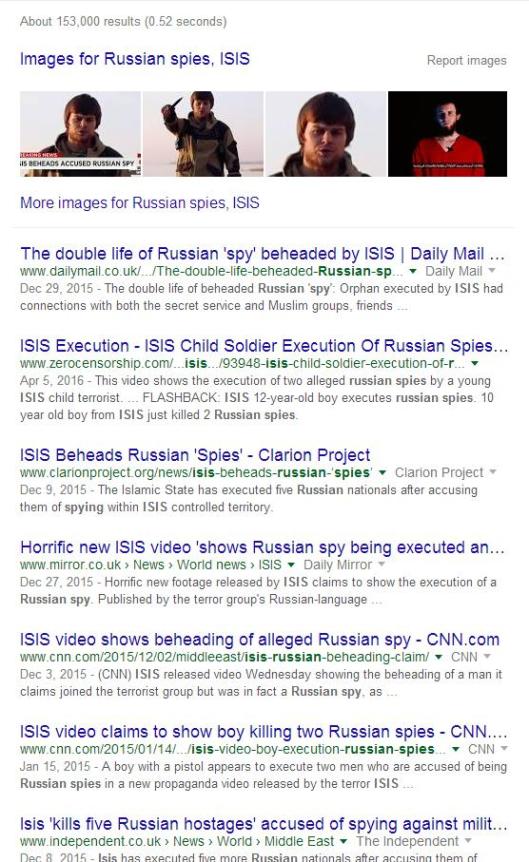
Reports of ISIS beheading Russian spies surfaced in several news reports in December 2015, and similar reportage continued into April 2016.
Apparently, Russian spies inserted into ISIS may have both signaled ISIS positions to Russian air power as well as warned ISIS troops of impending strikes.
Of BackChannels’ several inventions in political psychology, the “Paranoid Delusional Narcissistic Reflection of Motivation” might apply best to President Putin’s way of looking at western liberalism, developing cause to consider it threatening, and then, at last, accusing the west of possessing his own true motives as regards political control through disinformation, force, and manipulation.
For history, start with Czar Nicholas III’s “Okhrana“, the political secret police tasked with influencing and shaping the Czar’s own opposition — Ayatollah or Emperor, why not play both sides of the chessboard? The political theater is either yours or it’s not — prove it’s yours: put on a play; give the opposition its head; slip it a script; settle back and enjoy the show.
Of course, there’s more to the story of Russia’s romance with autocracy, state-controlled information and the perversions that are disinformation and propaganda, and secret political police. What follows on this post is an afternoon’s brief compilation of articles pertinent to the challenge posed today by Putin’s approach to throwing the wool over so many eyes, including, possibly, his own.
In general, the Russian media portrays anything going on from the point of view of Vladimir Putin. He has unlimited access to the media and they explain everything that’s going on according to his official statement. It doesn’t really matter if it’s a war in Syria or any other topic.
Russia today is the first intelligence dictatorship in history. It is a brand new form of totalitarianism, which we are not yet familiar with. Now the KGB, rechristened FSB, is openly running Russia.
BackChannels also possesses in its library a small “Russian Section” that boasts many volumes on the Russian experience in the 20th Century, on the Soviet, and on the transition from the Soviet to “Putin’s Kleptocracy”.
When the Soviet Union collapsed, its people had a unique opportunity to also cast off the country’s political police, that peculiarly Russian instrument of power created by the 16th century’s Ivan the Terrible, which had changed its name many times, from Okhrana to Cheka, to GPU, to OGPU, to NKVD, to NKGB, to MGB, to MVD, to KGB. Unfortunately, the Russian people were not yet ready — or able — to seize that opportunity.
The international community faces serious challenges arising from a new mode of information warfare, which Russia has deployed during the Russian-Ukrainian conflict in 2014-2015. This ongoing “propaganda war” is the most recent and frightening example of information warfare. It reflects the wide array of non-military tools used to exert pressure and influence the behaviour of countries. When skilfully combined, disinformation, malicious attacks on large-scale information and communication systems, psychological pressure, can be even more dangerous than traditional weapon systems, since they are extremely difficult to discover and combat.
The Kremlin’s disinformation campaign goes far beyond controlling its own media. It is aimed at nothing less than presenting a parallel version of reality and disseminating it as if it were news. The Kremlin’s goal is to make people question the value of media at all; to reject the idea of an absolute truth; and to persuade the public that “reality” is relative.
If someone—some lost, ersatz-port-begotten ghost—materializing before me at that moment, had told me that, thirty years later, I would be writing about Andropov’s death in English, in America, on the week when post-Soviet Russia’s ruling class—made up, to a considerable extent, of the old K.G.B. cadre—would be celebrating the hundredth anniversary of his birth with a large exhibit dedicated to his life, at whose opening a glowing telegram from his spiritual successor, President Vladimir Putin, would be read—well, I would have known for certain that I had finally and irrevocably, once and for all, lost my mind.
As a former KGB officer and head of the KGB’s successor agency, the FSB, Putin knows the value of information. His concept of the media, however, is a far cry from the First Amendment. For him, it’s a simple transactional equation: Whoever owns the media controls what it says.
“There should be patriotically minded people at the head of state information resources,” Putin told reporters at his 2013 annual news conference, “people who uphold the interests of the Russian Federation. These are state resources. That is the way it is going to be.”
Disinformation is always a conscious policy and part of a larger policy agenda. It is not simply dishonesty of this or that official in response to a particular event. It is implemented with a clear understanding that a combination of truth and falsehood is useful and effective. And it is pursued as long as it is effective, being sacrificed only when there are reasons to believe that either it is no longer necessary or it is no longer being accepted. All of those things have characterized Putin’s approach to information about Ukraine, a pattern that makes what Moscow is doing all the more disturbing.
Wikipedia. “Okhrana”. The following comes from the “Pre-1905” section of the Wikipedia entry:
While P.I. Rachkovsky, as head of the Okhrana’s Foreign Agency, had long ordered Okhrana agents to infiltrate and influence revolutionary movements abroad, Zubatov brought these tactics to a new level by creating Okhrana-controlled trade unions, the foundation of police socialism.

 BackChannels