” . . . the Safavid dynasty was not Iranian, it was a Turkish tribe from Lebanon who conquered Iran in 1499. Until then, Iran had no national religion dating back to the human rights proclamation of the Cyrus the Great and freedom of the Jews from Babylonian slavery, in 539 BCE. The Safavids were Shia, and upon their occupation they imported a group of Shia clerics, olima, from Lebanon — hence the connection of Iranian Shia establishment with the Hizb’allah — including the infamous Mohammad Baghir Madjlesi, the author of the rule of Jurisprudents, meaning the god-given rule of clerics, that Khomeini adopted 300 years later and implemented in Iran again in 1979.
The imported Shiite establishment overrode the Iranian culture and civilization of human rights, equal rights of women, freedom of worship and respect for all, dismissing it as pagan and enforcing a new culture of Islamic Sharia laws written by Madjlesi.”
The wealth tied into the feudalism that drives the middle east dispute may be difficult to imagine for most. On the Shiite side, Ali Khamenei and his brother control in private portfolio about $57 billion. Reuter’s “Assets of the Ayatollah” (easy lookup) tells how that came about. At least two of the Hamas leaders, Ismail Haniyeh and Khaled Mashaal, have developed reputations as billionaires also. Basically, “the terrorists” (the leaders) are not being spoiled: they are living the lifestyles to which they have become accustomed.
Israel’s medical ethic, which stems from the Hippocratic Oath, has been always to leave the politics at the door and attend to the needs of the injured and sick. I think that ability to separate issues and focus on challenges in separate dimensions may be expressive of the modern mind as the medieval appears less able to set abstract and just boundaries.
The feudal mode in thought and governance may also dominate Sunni politics, which is complex. Erdogan, the Turkish leader, has moved into his immense “White Palace” and proven reluctant to destroy ISIS at this time. He appears to prefer beating back Kurdish hopes for independence to stalling the ISIS project. He would (I believe) align with “Putin-Assad-Khamenei” if not for his Sunni identification. Still, overarching Putin, Assad, Khamenei, Erdogan, and some others is the devotion to “political absolutism” or the concentration of “absolute power” in a single leader. As much works against the democratic and humanist distribution of power throughout populations.
Stimulus: Israeli doctors have been treating an Hamas terrorist recently, and the poster had asked whether the modern workspace was luxurious enough to spoil him.
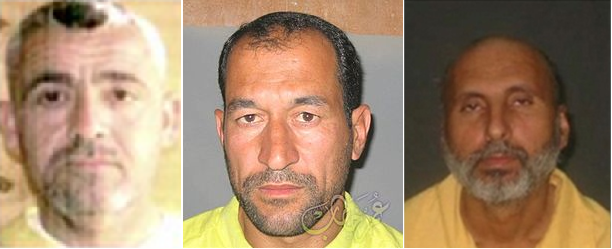
Left to Right: Abu Muslim al-Turkmani, Abu Abdulrahman al-Bilawi, Haji Bakr
Nearly a year ago I wrote that in crude terms the Islamic State’s (ISIS’s) “military strength comes from the remnants of Saddam Hussein’s military-intelligence apparatus and the Caucasus’ Salafi-jihadists.” Since then I have dug up some answers for why this is so that did not seem to be widely shared. This might be about to change.
The Machiavellian “behind the curtains” has been supplanted by “in the shadows” and into the shadows may be where mainstream media fears to tread.
Both the Bond movies and Le Carre novels, and I’ve enjoyed both in series, have reflected in fiction the issues (as well as atmosphere) of their day, each work of art in essence packaging up the look and spirit of a part of a decade using the secret world as its window. For the writers, intuitive exploration may turn out more secure than looking into essentially powerful secret societies. In fact, the possession of private power and wealth may be inseparable today from the control of political influence and movement in the mirrors of criminal and lawful worlds and the feudal and democratic ones in which the bad guys work in secrecy and the good guys do as well but, perhaps, differently.
In real life, someone leads an organization that kidnaps an Israeli Olympic team at the event — and someone else leads another organization that quietly hunts down the miscreants.
Must the journalists know all? And when? As history? As now?
Many stories emerge over time.
I haven’t yet watched _Kill the Messenger_ but from description it appears that it will fit with a stack of nonfiction histories about the security services of states. Whatever happened may be done, but the processes may not be done, and that’s where the public becomes curious in its own interest. However, journalism has also a politics of discretion belied by the terms of art “on the record” and “off the record” and the public may never know what has been imparted “off the record”, much less what has been sealed in the minds of agents and the vaults of the KGB/FSB and others.
I’m more inclined to trust The Washington Post than, say, Alex Jones 🙂 , but one may suspect that the Post must also keeps secrets.
With conventional warfare somewhat nulled by the immense firepower developed by would-be adversaries, the twists that are “low-intensity conflict”, “hybrid warfare”, “war by proxy” and so on depend on mafia-type arrangements and relationships to produce activity (or perhaps as much has been always the way of the street in which conflicts are conceived and worked into reality).
Posted to YouTube 12/1/2014.
In books available through Amazon and in videos on YouTube, there’s a surfeit of material covering the history of spying, from The Bible, no less, and forward. One has only to look. Of historic interest and, perhaps, contemporary curiosity, may be the depth of control and integration a state has with its people along this axis. From the 20th Century experience, the mere mention of “Gestapo”, “STASI”, and “KGB” summon the vision of totalitarian police states operated by political elites with security forces sufficiently populated to reach down through their societies to the extent that even children are made into informants.
When Mr. Putin and company set out to preserve the privileges of the Soviet without the Soviet (reference: Karen Dawisha’s book, Putin’s Kleptocracy), the drive appears to have been developed precisely for interest already established within the KGB and Party to preserve power and wealth and the ability to distribute the same to similar favored elites. As a king to knights and lords, so has Putin been to his “new nobility” (another title in the Russian Section of this blog’s library).
Do the services of western powers mirror the security systems that maintain Russia’s neo-feudal governance (yes/no?) and, if so, democracy by democracy, how? What’s similar? What’s different?
I’d rather imagine the answers and work in fiction — and may, for this lonesome blogger is not The Washington Post or The New York Times, and even the “best and brightest” in those companies may choose — or have long chosen — to exercise discretion.
“Kritarchy”? “Caliphate” in other words? From Afghanistan to Yemen, how is that working out?
The “Communities of freedom to live the way they want to live” needs to cover about 7,000 living language cultures, Including Arabic and Hebrew cultures while not excluding any of the 6,998 others who have evolved in their own ways. Those 7,000 are distinctly speaking peoples distributed across about 40 major religions and Thousands of subsets and cults, cults including idolatrous ones like ISIS.
Shouldn’t we all just get along?
I advocate for geospatial ethnolinguistic cultural concentration and separation attenuated by forgiving and largely secular margins and mutually respectful cultural diaspora.
None of us, individually or culturally, are all that special on any physical or metaphysical basis; however, each of us as persons and as parts of uniquely evolved cultures, is precious. Perhaps we should think about that in place of supremacism.
Ismail Haniyeh: Billionaire Khaled Mashaal: Billionaire Ali Khamenei and his brother: between the two of them, $57 billion in private portfolio.
The only “powers” occupying the Arab communities of Greater Israel or potential Palestinian suzerainty remain the PLO, Hamas, and powerful Palestinian families expert at getting others to die or suffer for their greed.
The official needs of the Arabs abandoned in now multiple wars and made to serve as goads to Israel and the west are as bottomless as the souls of their leaders have proven empty. Their claims to nobility — as suggested by the full pockets known to Arafat, Haniyeh, and Mashaal — have turned out over generations the proven claims of thieves and murderers. Hamas + human rights; Hamas + human shields; Hamas + millionaires: after a while, such searches tell a whole political story. Fatah has done less well in some regards. Black September is history. What Fatah and Hamas appear to have to offer their own, much less Israel or anyone else, appears to be their tired old jaws and their continuing violence or threat of it against their own constituents as well as Israel.
Related Reference
Bar-Zohar, Michael and Eitan Haber. The Quest for the Red Prince. New York: William Morrow & Company, Inc., 1983.


 BackChannels