September and October — flak jackets on and hunker down: We’ll have the election in November; Putin will have more assembled in Syria and Crimea and, in general, who knows what on behalf of the world’s other dictators; Erdogan will have sorted out Turkey HIS way with NATO at this moment deeply compromised by dissolving or near dissolving of the Turkish military (accompanied by the rise of a Turkish police state). As weakness invites war, expect “fireworks” this fall.
I don’t want to shout “the sky is falling too often”, but just this once, take a look at the total state of foreign affairs. American appears to be between presidents and the politics are hardly bringing us together.
These “rigs” in relationships have survived the Obama Administration: Putin-Assad-Khamenei; Putin-Orban; Putin-Erdogan.
The Russian Army claiming retreat in Syria has instead ramped up its basing and technology there; in Crimea, it still has Ukrainians fighting one another while Russian Orthodox Christians in the state march on Kiev. In the west, its “investment” in ISIS has paid off handsomely as goading populations toward or into defensive nationalist postures themselves. “BREXIT” was not a win for the UK or Europe: it was helpful to Russia in its efforts to destabilize the region, i.e., weaken its enemies. Or, taken this other way, because it thinks so much of itself — superior Russian soul and culture and all that — the manipulation proves to itself its own mastery over the world.
Russia’s message has changed with revolution and dissolution, but perhaps its medieval essentials have not: secret police, an all powerful head of state, a patronized aristocracy: they are all there on this day. And those who might take advantage of heightened east-west, medieval-modern, despotic-democratic tensions breaking out into conflict, they’re getting into position.
Even sitting at a desktop with few distractions (from political chatter, at last), once cannot “cover it all” — not China in the South China Sea, not North Korea, which has effectively updated its war footing with Washington, not Syria, not Crimea. Overviewed, however, an image seems to emerge. For BackChannels, it has been that of accentuation or amplification along Red, Brown, and Green — Old Communists, New Nationalists, and Islamists — lines sufficient to weaken the west and make way for the greater establishment of authoritarian / despotic governance and all that may be implied by that.
In BackChannels’ opinion, the coup — the real one — has been successful.
At the end of an interview (published July 15) with Slate contributor Isaac Chotiner, Jenny White, a professor at Stockholm University’s Institute for Turkish Studies, notes, “In previous coups the army took over because they thought institutions were not working properly or being populated with Islamists. But the institutions were still there. This time, the institutions themselves have been destroyed.”
Here follow a passel of factual and more recent reporting on the countercoup as President Erdogan consolidates his Putinesque domination (“different talks — same walk”) of Turkish politics.
Before the vote, Deputy Prime Minister Numan Kurtulmus said that once emergency measures are invoked, the country would suspend its participation in the European Convention of Human Rights. He said the move was justified under a convention article allowing for such a suspension in times of emergency.
The detentions reported by Anadolu news agency come hours after President Recep Tayyip Erdogan declared a three-month state of emergency that is expected to expand the crackdown.
Already, nearly 10,000 people have been arrested while hundreds of schools have been closed. And nearly 60,000 civil service employees have been dismissed from their posts since the failed coup Friday.
Nearly one-third of Turkey’s roughly 360 serving generals have been detained. The Defense Ministry is investigating all military judges and prosecutors and has suspended 262 of them, broadcaster NTV reported, while 900 police officers in Ankara were also suspended on July 20.
Turkey’s education system has been hit particularly hard during the ongoing crackdown. The Education Ministry on July 20 added more than 6,500 new names to the list of 15,200 school employees suspended, state media reported.
They think of it as recalibrating democracy, but they can’t get rid of pandering to religion because people are conservative. And Erdogan’s Justice and Development Party (AKP) managed to pull that off to such an extent that they now have half the population, in part because that part of the population has been constantly pushed back and disrespected.
The 1997 “postmodern” coup that deposed Erdogan’s political mentor, Prime Minister Necmettin Erbakan, and led to Erdogan’s subsequent imprisonment and suspension from politics for religious incitement only reinforced the notion among non-elite Turks that the old secular establishment, of which the army was the cornerstone, would never fully cede power.
It was only when Erdogan and his Justice and Development Party (AKP) co-founder Abdullah Gül won their 2007 stare-down with the military over Gül’s candidacy for president (which the army opposed because Gül’s wife wore a headscarf), that Erdogan seemed to gain the upper hand and be in position to alter the balance of power with the army for good.
The religious affairs directorate removed another 620 staff including preachers and instructors in the Koran on Tuesday, bringing to more than 1,100 the number of people it has purged since the July 15 coup attempt.
“My philosophy, inclusive and pluralist Islam dedicated to serve to human beings from every faith is antithetical to armed rebellion,” wrote the 75-year-old cleric, a former Erdogan ally who has been living in self-imposed exile in the eastern U.S. state of Pennsylvania since 1999.
Earlier this year some 2,000 academics signed a petition calling for an end to the conflict with Kurdish militants in Turkey’s southeast. Dozens of signatories were sacked and many were investigated for spreading what the government called terrorist propaganda.
Odman says in a militarized society, no one is safe from eruptions of violence.
Turkey on Wednesday deepened a crackdown on suspected followers of a U.S.-based cleric it blames for a failed coup, dismissing nearly 1,700 military personnel and shutting 131 media outlets, moves that may spark more concern among its Western allies.
The leader of HDP, the pro-Kurdish parliamentary party that Erdogan has accused of terrorism, and the CHP – the Kemalist party traditionally closest to the military – denounced the coup.
Now, looking back, questions abound. Whose coup was it anyway and were ‘the people’ in fact organised mobs of Erdogan supporters, pre-warned and ready to take control of the streets? Why did the junta take control of the bridges and airports of Istanbul and various government institutions in Ankara while leaving the President free to call for supporters to fill the public squares to defy the tanks and defend democracy?
Let me suggest this: we see opposed medieval forces in “Russia vs Turkey” but we don’t so easily discern “Medieval vs Modern” in Russia and Turkey vs NATO (I know Turkey is a NATO member but it may no longer be what a NATO member should be — distributed power, secular, reasoning).
Peacocks vs The People
While NATO focuses on the military defense of the democratic open societies of the west, its opposition, including NATO members Hungary and Turkey, appear to focus on authoritarianism, corruption (encouraged), cults of personality, and the greater encouragement of medieval conflicts involving modern weapon systems.
Troika Putin-Assad-Khamenei-(Baghdadi) have produced a whole theater of politics and combat (BackChannels titles the production “Assad vs The Terrorists”, also “The Syrian Tragedy”), and while the analyst’s perception may be that of a wickedly callous totalitarian and tyrannical bid to control the public perception of events, the public appears to be buying it: those who have incubated ISIS have now to enjoy the glory of destroying it over as long a period of time as may please them.
With Putin having extracted an apology from Erdogan over the Turkish response to aggressive Russian piloting (akin to Netanyahu’s apologizing for the defense of Israel against the Gaza Flotilla and weapons stored aboard the Mavi Marmara), Erdogan has appeared to stiffen his resolve to destroy democracy in Turkey and replace it with himself.
However, it will still be free and fair with an entire electorate free to publish and speak as it may, demonstrate where it may wish (with equal and fair permitting and wondrous order, for the most part, considering the emotions involved), and talk itself through its own national issues and sense of purpose, which is not to “rule the world” but perhaps produce a world less given to self-aggrandizing tyrants.
I’ve reserved “Fascist” from “Nationalism” with Trump because . . . he’s an American: BackChannels expects him to reject his role in the development of his own idolatrous cult of personality and to put Americans first in the representation of the many cultures, manners, and personalities that have co-produced America’s magnificent tapestry and its related wealth.
The failed coup attempt in Turkey led by a faction of the military seeking the overthrow of President Recep Tayyip Erdogan citing the leader’s abysmal record on free speech, democratic freedoms, and human rights may be the final death knell for both NATO and the European Union who are holding onto the increasingly undemocratic leader for dear life.
Again, Russia (okay: Moscow-Damascus-Tehran) kills it (if it’s moving) in the Syrian Tragedy, the world’s most magnificent display — from Assad’s barrel bombs to Baghdadi’s beheadings — of contemporary barbarism.
As perhaps echoes the Egyptian experience with Islamism in force, factions of the Turkish military may have harbored more of the values of modern and democratic life than the democratically elected “malignant narcissist” brought into power and attempted a coup (if the situation was not manipulated by Erdogan himself to strain out of the military the last of his opposition in that estate). Quite unlike the Egyptian experience, which appeared to have brought the very nation out into the streets in support of its military, the Turkish coup has failed, giving Russia finger-wagging power to point to NATO’s support of a dictatorship not unlike Russia’s own.
Putin’s Russian Nationalism : Erdogan’s Sunni Islamism: Different Talks – Same Walk.
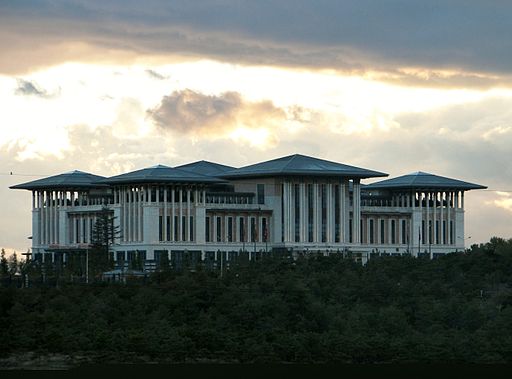
“White Palace” – “Presidential Palace”, Ankara, 2014 – by Ex13, Wikimedia Commons.
“Not long after his initial election, Erdoğan’s agents embarked on a large and sinister campaign to destroy his political opponents, jailing hundreds—journalists, university rectors, military officers, aid workers—on trumped-up charges and fabricated evidence,” Filkins wrote — and wrote some more about the arrests of journalists, the taking over of opposition press, the delivery of arms to Jabhat al-Nusra (an al-Qaeda affiliate), the easy go with ISIS in favor of unleashing his military against Kurdish interests.
Other journalists have weighed in with similarly cogent observations.
Not surprisingly, once Erdogan assumed the Presidency, he continued to chair cabinet meetings and even established a shadow cabinet with a handful of trusted advisers. He pointedly sidelined Davutoglu, who quietly resented Erdogan’s usurpation of the role and responsibility of the prime minister as if nothing had changed.
The premiership became a ceremonial post and the ceremonial presidency became the all-powerful office without a formal constitutional amendment to legally grant him the absolute authority he is now exercising.
A Turkish court on Wednesday sentenced a female teacher to almost a year in prison for making a rude gesture at President Tayyip Erdogan at a political rally in 2014, local media reports said on Wednesday.
Insulting public officials is a crime in Turkey, and Erdogan, the country’s most popular but most divisive politician, is seen by his critics as intolerant of dissent and quick to take legal action over perceived slurs.
Breaking in Fox News: “Detention orders were filed for 53 more judges and prosecutors while 52 military officers were rounded up for their alleged roles in the plot, Turkey’s state-run Anadolu news agency reported.”
If there’s the sniff of a Clinton tie to corruption and crime, the conservative press will find it. In the listings below, The Daily Caller shouts on that.
For any interested (including the FBI) in Fethullah Gulen, BackChannels has visited the presentation of the personality in online news at least twice (as listed) and somewhere on this blog there’s a related poem involving “winks ‘n’ nods” (you’ll appreciate it more if you find it on your own). 🙂
Erdogan the Malignant with the White Palace?
BackChannels has had some say (also as listed).
Psychological alignment: Erdogan along with Orban may share more with Putin as personalities than they may with other NATO leaders and the leaders of westward-leaning former Soviet states or clients.
That’s life with “malignant narcissists”.
Their people will be beaten up for a buck; their manipulated constituencies will drift toward fascist nationalism or some near equivalent (on this blog, keep in mind “Syndicate Red Brown Green“); but they will be glorious in wealth and treasure plundered from state coffers — just as Putin would have it (and has as much for himself as regards kleptocracy and absolute power).
Americans, often written off as being more concerned with Kardashians and sports scores, probably should immerse for a brief spell in Cold War and post-Soviet history, so as to get a grip not only on machinations driving contemporary foreign affairs but to check the state’s own Machiavellian preference for developing perhaps too much business and politics “behind the curtains”.
Putin’s clawing into NATO, and he’s going to use Erdogan, a natural authoritarian (with his own White Palace) to further establish “absolutism” around a feudal Russian core.
In the today’s news:
The Kremlin accepted a letter from Turkish President Recep Tayyip Erdogan as an apology this week.
Mr Putin spoke to Mr Erdogan by phone on Wednesday, telling him he planned to lift the travel sanctions.
The lifting of non-travel trade sanctions will depend on the outcome of the trade talks, the Russian leader said in his decree.
In news analysis appearing in The Atlantic about three years ago:
The Turks suffer from a deep-rooted, historic reluctance to confront the Russians. The humming Turkish economy is woefully dependent on Russian energy exports: More than half of Turkey’s natural gas consumption comes from Russia. Consequently, Turkey is unlikely to confront Moscow even when Russia undermines Turkey’s interests, such as in Syria where Russia is supporting the Assad regime, even as Ankara tries to depose it.
Historically, the Turks have always feared the Russians . . . .
Moscow has so far been able to separate itself from such wondrous moves as the incubation of ISIS (through “deselection” for bombing and combat early in the Syrian Tragedy) and the related development of Syrian mass migration, and with Turkey and the latest airport bombing — and where the terrorists come from but Russia, Uzbekistan, and Kyrgyzstan — the same channeling applies and to similar effect: Russia has been channeling its extremists to ISIS, and when they do what they do in the NATO community, it may lay claim to being tough on the same.
If terrorists should wreak havoc on a renewed Russian flight to Turkey, well then: Moscow and Washington may then mutually share sorrows and perhaps move toward rapprochement (on counterterrorism cooperation, say) while Assad the Tyrant and the familiar Soviet / post-Soviet (now neo-feudal) arrangements remain in place.
There’s a greater problem with such a rosey “what-if” or outcome, and that is the modern world’s ceding itself to the sustained “feudal absolute power” that today, as in medieval days, lends itself to despotism, kleptocracy, and the war of all against all without end. Unfortunately, “Red Brown Green” applies: to have within NATO nationalist or Islamist authoritarians (Hungary’s Orban, Turkey’s Erdogan, for starters) lends itself to Russia’s feudal revanch and its imperial ends.
From the early sacking of the generals accustomed to the state that Kemal Ataturk bequeathed to the Turks to the latest and disingenuous assaults on the Kurdish People under the cover of fighting terrorism accompanied by something like the resurrection of the Kurdish PKK, a Marxist-infused movement dating back to the 1970s and long stalled in its ideological tracks but naturally mixed back into Kurdish politics, Turkish President Tayyip Recep Erdogan has pursued a course in action, behavior, and language more familiar to Moscow than to Washington.
Add in that grandiose residence, the “White Palace”, a mixed development Versailles, but with its private residential part supporting some 250 rooms set on a landscape dotted with at least a few $10,000 trees imported from Italy.
On this post, the related and additional reference sections and fair-use excerpts should provide plenty for reflection on Turkey as a NATO state that while fulfilling its military contract has drifted as a democracy far into authoritarianism. Although the Moscow-Tehran axis blocks any chance of an Erdogan-Putin political “bromance” like that between Putin and Hungary’s Orban, who despite his state’s NATO membership has displayed the same drift toward authoritarian rule, Erdogan’s path remains the one that leads to dictatorship.
Related Reference — Freedom of the Press
https://freedomhouse.org/report/freedom-press/2015/turkey – “Turkey: 5-Year Decline in Press Freedom”: “Conditions for media freedom in Turkey continued to deteriorate in 2014 after several years of decline. The government enacted new laws that expanded both the state’s power to block websites and the surveillance capability of the National Intelligence Organization (MİT). Journalists faced unprecedented legal obstacles as the courts restricted reporting on corruption and national security issues. The authorities also continued to aggressively use the penal code, criminal defamation laws, and the antiterrorism law to crack down on journalists and media outlets.”
http://www.dw.com/en/security-for-turkeys-erdogan-scuffles-with-journalists-in-washington/a-19157072 – “Security for Turkey’s Erdogan scuffles with journalists in Washington”: “The president’s security detail removed one opposition Turkish reporter from the speech room, kicked another and threw a third to the ground outside the Brookings Institution, in a melee that provided Washington’s foreign policy elite a firsthand glimpse at the state of the press in Turkey.” Note: In the United States, Secret Service details protect foreign heads of state. However, it appears that Brookings, Erdogan’s own security detail may have made moves against would-be Erdogan critics.
. . . Erdogan has used his strong Islamic credentials to project himself as a pious leader, when in fact he consistently engaged in favoritism, granting huge government contracts to those who supported him and to his family members, irrespective of conflicts of interest and the corruption that ensued as a result.
The breakdown in 2015 of the government-initiated peace process with Abdullah Öcalan, the imprisoned leader of the armed Kurdistan Workers’ Party (PKK), has been accompanied by an increase in violent attacks, armed clashes, and serious human rights violations since summer 2015. The latter includes violations of the right to life and mass displacement of residents in eight southeastern towns where the security forces and PKK-affiliated youth groups have engaged in armed clashes, as well as denial of access to basic services including healthcare, food and education for residents placed under blanket curfew conditions for extended periods and in some cases months at a time. The past eight months have seen hundreds of security personnel, Kurdish armed fighters and civilians killed, with almost no government acknowledgement of the civilian death toll estimated at between 200 and 300 in this period. The renewed violence has provided the context too for numerous arrests of political activists and alleged armed youth on terrorism charges and ill-treatment of detainees.
See Richard Spencer’s piece, listed below, for an estimation of a changed PKK politics within the Kurdish effort to eject ISIS, where the Kurds of produced the most effective ground fighting force since the Syrian Tragedy took hold in 2011, and otherwise establish and sustain their autonomy despite their historic four-state division and subsequent treatment as an ethnic suzerainty.
“The PKK has become part of the people. You can’t separate them anymore,” said Zubeyde Zumrut (in Diyarbakir), co-chair of BDP, which won control of one hundred municipalities in the southeast of Turkey in the 2009 local elections and thirty-six parliamentary seats in the June 2011 national elections. “Which means if you want to solve this problem, you need to take the PKK into account.”
President Recep Tayyip Erdoğan’s recent attack against academics – who signed a petition condemning military operations in Kurdish cities and calling for peace and negotiations – is yet another banal expression of the authoritarian politics that have long prevailed in Turkey under Justice and Development Party (AKP) rule. All authoritarian regimes are anti-intellectual and this tendency intensifies when they are in trouble. So it is not surprising that Turkey’s president and his party look for scapegoats to blame for their domestic and foreign policy failures. Indeed, authoritarianism is rarely a reflection of political power; rather, in most cases it is a result of weakness.
We joined the agency in January, hired to edit English-language news, but quickly found ourselves becoming English-language spin-doctors. The agency’s editorial line on its domestic politics – and Syria, in particular – was so intently pro-government that we might as well have been writing press releases. Two months into the job, we listened to Deputy Prime Minister Bülent Arınç talking bollocks about press freedom from an event at London’s Chatham House, downplaying the number of imprisoned journalists in Turkey.
SPIEGEL: The government says it is exclusively pursuing terrorists.
Demirtas: The war is primarily focused on civilians that Erdogan suspects of supporting the PKK. Almost 400,000 people have had to leave their homes. The southeast of Turkey resembles Syria.
What has happened is that Turkey has decided to allow Iraqi Kurdistan’s army, the Peshmerga, to join the YPG, the PKK’s Syrian affiliate, in defending Kobane.
The Kurds of south-east Turkey cheering the Peshmerga convoy as it passes are of course hoping they will save their fellow Kurds in Kobane. But they are also cheering the new-found unity of the Kurdish cause. For once, the faction-fighting of their leaders has been set aside in a common purpose, and the Kurd in the street feels anything is now possible.
The Turkish PM is on a roll: About 10% of the country’s top brass are in jail, awaiting trial for allegedly plotting against him. Voters have given him a mandate to rewrite the country’s constitution, produced under the shadow of a 1980 military coup and that allowed the military to interfere in the process of governance.
But there are suspicions the evidence against the officers was fabricated and the moves are intended to silence the opposition. Numerous journalists and academics are being held on similar charges.