Tags
Democratic Party Far Left, mafia state, medieval v modern, Regime Change, Russia, Soviet / Post-Soviet Foreign Policy, Tulsi Gabbard, Venezuela
–33–

07 Thursday Feb 2019
02 Saturday Feb 2019
Tags
Elections 2019, Foremost Political Personalities, medieval v modern, Nigeria, Nigeria's Foremost Political Personalities, Nigerian Elections 2019
Lagos, Nigeria (CNN)Nigerian President Muhammadu Buhari has come under intense scrutiny for suspending his country’s Chief Justice just weeks before a general election, a move that critics have attacked as tyrannical and unconstitutional.
Buhari defended his decision on Twitter, saying corruption allegations against Chief Justice Walter Onnoghen — who has been accused of failing to disclose bank accounts in foreign currencies — are “grievous.”
https://www.cnn.com/2019/01/26/africa/buhari-nigeria-judge-elections-intl/index.html
But the move was labelled a “coup against democracy” by the President of the Nigerian Senate, and prompted an outcry from the country’s major opposition party, which halted its presidential election campaign temporarily in protest.
And so Nigeria’s lawyers staged a two-day strike against President Buhari’s thoroughly autocratic judgment, decision, and exercise of seemingly unquestionable power.
In addition to the latest imbroglio involving Nigeria’s chief justice, a matter not overlooked by the U.S. State Department, Buhari has been accused of permitting Fulani gang raids against Christian farming villages (whose firearms have been confiscated in advance by the state — in Nigeria, urban thugs may own arms illegally — who’s to know? — while farmers are made to provide easy targets for burn-and-shoot raiders armed with AK-47s and gasoline) and of packing his highest-level security offices with Muslims, and so in essence channeling power and wealth to the Muslim community while slowly displacing Christian power.
BackChannels asked its Nigerian source for suggestion as to who would make a better — more balanced, higher integrity — politician, now or in the future, for Nigeria’s leadership. The names returned were Fela Durotoye, Jimi Agbaje, Kingsley Moghalu, and Oby Ezekwasili. The Nobel Prize-winning writer Wole Soyinka was mentioned as well, but BackChannels suggested he may well remain Nigeria’s soul in letters and perhaps the natoin’s most influential intellectual. With context, here is what Soyinka had to say (in the Daily Nation) about this month’s Nigerian Presidential Elections (February 16):
Mr Buhari, 76, came to power in 2015 and is seeking a second term in the February 16 vote. His main challenger is 72-year-old Atiku Abubakar, a former vice president.
“For the avoidance of doubt, let me make my position quite clear because I don’t want any ambiguity; I, Wole Soyinka, will not be voting for either,” he was quoted in local media as saying on Thursday at a forum in Lagos.
https://www.nation.co.ke/news/africa/Wole-Soyinka-asks-Nigerians-to-reject-Buhari/1066-4961610-bmjkxhz/index.html – Daily Nation, February 1, 2019.
Herewith some starting reference to good-for-Nigeria political personalities as mentioned by BackChannel’s source. The bolded names have been linked to their respective Wikipedia pages; tweets, news, and news headers remain recent; note: Oby Ezekwasili has dropped out of the Presidential race to help swing her fan base vote to a candidate better positioned, perhaps, to beat the incumbent President Buhari; Omoyele Sowore, not mentioned in casual conversation, has been added by BackChannels for showing up fast on this subject — Nigeria’s upcoming elections — on the web.
On Facebook: https://www.facebook.com/feladurotoye/
Twitter: https://twitter.com/jimiagbaje
Facebook: https://www.facebook.com/OfficialJimiAgbaje/
In a 2013 interview with The Punch Newspaper, Agbaje talked about how he began in politics: “It had to do with the Moshood Abiola/Bashir Tofa presidential election”, he said. “I saw the annulment as a personal insult and an assault on the Nigerian people. This led to my first entry into what I would call activism, working with other concerned professionals” such as Prof. Pat Utomi, Dr Ayo Ighodaro, Asue Ighodalo, Billy Lawson, Oby Ezekwesili, Tola Mobolurin and Hassan Odukale.[8][9] Jimi was in one form of resistance group or the other which ultimately led him to join the socio-political organization, Afenifere where he served as national treasurer.[10]
https://en.wikipedia.org/wiki/Jimi_Agbaje
The campaign convoy was on its way out of the palace, when the hoodlums, numbering about 40, chased and threw stones at Agbaje’s vehicles.
There were minor injuries involving shattered vehicle window glass, and tear gas was used to disperse the mob according to the above piece published yesterday in Sahara Reporters. How the hoodlums were organized and by whom? That would be something to know and report. For the time being, the news tells of the tone of elections in a wealthy oil producing nation sadly rife with corruption.
Kingsley Moghalu
https://kingsleycmoghalu.com/
Former Candidate’s Profile and Record
BackChannels has referred here and there to corruption as the cancer of states. Where the Transnational Crime Organizations are strongest and bribes to the powerful would seem to be working, the money gets laundered and into the topside economy, which essentially may make the public unwittingly dependent on a growing criminal sector. Around the world, for better or worse because it’s just a fact of life at this point, public money that may be quietly, surreptitiously pried into private pockets would seem to be moved away from public community development and other services. The only way to get the brakes on nefarious processes — organized crime, embezzlement, and skimming — is to bring to power more modern politicians and their better associates in military and paramilitary services.
That’s it.
In one direction, the state sinks, and the end — or political hell — will look something like Venezuela at this hour, i.e., broken, starving, beneath common dignity and freedom; and in the better direction, the state grows a healthy economy, ordered and with funds available for all ordinary operations and the most helpful of public and social services. One may hope for Nigeria that the personalities who would be most ambitious and competent on the public’s behalf will rise to their occasions and prevail over the unerringly corrupt, nepotistic, and toadying of the breed.
–33–
22 Tuesday Jan 2019
Inspiration for the post: a conversation about women in combat roles and the relative physical advantage men have as regards the demands and energy required by related combat training programs and evaluations.
Problem: there may be more required across the “combat” or war fighting spectrum than the agility and strength so tested in training — and at times demonstrated in the field — as well as admired for entertainment and, perhaps, general cultural inspiration.
Variable not mentioned in this lopsided patch of talk: the span of combat mission roles. Regarding the “grunt” – okay, that’s the old industrial steel-driving guy at war and in the mess in big numbers.
This is for fun:
But this has been perhaps the changing face of war:
https://www.bbc.com/news/world-asia-45295212 (On Japan’s first female combat pilot).
The real question for the west . . . perhaps for western men and women . . . is how fast does everyone want to skidaddle back into the medieval world and its competitive frames?
Assignment / mission definition may be more the controlling variable for who goes where, not for who has ability, agility, ambition, courage, determination, discipline, etc. under stress of battle.
At the moment, the modern enemies are medieval scourges, i.e., feudal absolute powers (like Assad) and their manipulated hornets (like ISIS).
I hesitate on posting because I know (confession: from the armchair) that “field operations” have been complex as well as irrevocably changed by technologies, assets, and strategies (and politics) throughout. Is the drone’s remote jockey in front line combat? With relation to terrorist “actions”, where isn’t the front? For that matter, what isn’t combat in the age of “Hybrid Warfare” and “Information Warfare”?
–33–
14 Monday Jan 2019
Tags
activism, Eman al-Nafjan, feminism, human rights, imprisonment, International Culture, Internet Culture, medieval v modern, Saudi Arabia, web culture
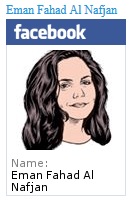
Blogger; mother of four; B.A., English, University of Birmingham; M.A., English as a Second Language; post-graduate Ph.D. field: linguistics; religion: Wahabbi Muslim.
Present Location: Dhaban Central Prison, Jiddah, Saudi Arabia.
Disclosure: BackChannel’s editor’s Facebook friendship and correspondence with Eman Fahad Al Nafjan dates back to May 12, 2011.
The editor’s last note to Eman — it was a long time ago given the richness of the Internet experience: August 16, 2016 — contained reference to a Muslim Matters piece, “World’s Largest Women’s University Opens in Saudi Arabia” (May 31, 2011), and had to do with Princess Noura bint Abdulrahman Women’s University, Riyadh. The find had to do with work on a BackChannels’ piece: “Sixteen Women — The Kingdom’s Most Powerful.” November 2, 2016.
The Kingdom had to have seen this greater day coming, “greater” for connecting the privileged of Saudi Arabia with the full breadth of the world’s English-speaking and other intelligentsia, i.e., the broad if thin international band of cosmopolitan, engaged, informed, and rapidly “chatyping” personalities. Nafjan has not only fit right in with the world’s intellectual class, she appears to be in trouble with the medieval kingdom for having been raised for the modernizing path and role taken.
What is it about feudal / medieval / tribal peacocks that so sustains contempt and fear in relation to women that the royal response to mild challenge, criticism, and practical reasoning comes to a still barbarous demand: “Lock her up!”
NEW YORK—PEN America announced today that it will award the 2019 PEN/Barbey Freedom to Write Award to journalist, blogger, and activist Nouf Abdulaziz, activist and social media commentator Loujain Al-Hathloul, and blogger, columnist, and activist Eman Al-Nafjan—three Saudi women imprisoned for challenging, through their writing and their activism, therestrictive guardianship system that governs Saudi women and limits theirability to travel, marry, work, or receive education and healthcare without approval from a male guardian. Abdulaziz, Al-Hathloul, and Al-Nafjan each used their digital and news-reporting platforms to speak out on women’s rights and other forms of human rights repression in Saudi Arabia, including the long-standing ban on women driving. The ban was lifted in June 2018, yet immediately thereafter, many of those who had advocated for this change were arrested. Today these three writer-activists are among those still incarcerated for their dissent, reportedly facing torture, isolation, and threats of rape. In early March, Saudi authorities announced that they are planning to indict a number of those detained on national security-related charges; initial hearings in the trials of Loujain Al-Hathloul and Eman Al-Nafjan began March 13.
Pen America. “Pen America to Honor Imprisoned Saudi Writer-Activist and Woman’s Rights Champions Nouf Abdulaziz, Loujain al-Hathloul, and Eman al-Nafjan with the Pen/Barbey Freedom to Write Award at 2019 Literary Gala”. Press Release, March 14, 2019.
Those under arrest have been branded threats to national security and have been accused of being foreign agents. They face up to 20 years in prison if convicted.
Human Rights Watch (HRW) said that the reason for the arrest is to silence the women and prevent others from participating in activism.
Rights organisations and governments around the world have called on the Saudi authorities to release all political prisoners, but to no avail.
Al-Nafjan, Eman. “Saudi Arabia, My Changing Home.” The New York Times, June 8, 2012. –>
Most people in the West, naturally enough, get their ideas about Saudi life from the media. They learn that women here are forbidden to drive, that they must be almost completely covered up when they appear in public, that unmarried women and girls can’t appear in public unaccompanied by family members.
All of this is more or less true, but it omits the reality that, for the average middle class Saudi woman who comes from a healthy family background, life is pretty good.
When everything is in place, a Saudi woman can live a comfortable life. A respectable husband is arranged for her to marry; she typically has a driver, servants and an extended family ready to give her financial and emotional support. All that’s expected of her is to have babies and fulfill social obligations.
Amnesty. “Saudi Arabia: Release Women’s Human Rights Defenders Immediately!” June 21, 2018. –>
Official statements in state media accused Loujain al-Hathloul, Iman al-Nafjan and Aziza al-Youssef of forming a “cell,” posing a threat to state security for their “contact with foreign entities with the aim of undermining the country’s stability and social fabric.” A related hashtag describing them as “Agents of Embassies”, along with a graphic showing the six activists’ faces, have also been circulating on social media and Saudi Arabian print and broadcast media. Amnesty International is concerned that if charged, the activists could face up to 20 years in prison. Now is the time to take action and defend these brave activists, who are some of the most prominent heroines of the human rights movement in Saudi Arabia.
As the world praises Saudi Arabia for recent “reforms” – including allowing women to drive – we must raise the alarm for these imprisoned defenders who have fought tirelessly for years for women’s rights in the Kingdom.
According to three separate testimonies obtained by the organization, the activists were repeatedly tortured by electrocution and flogging, leaving some unable to walk or stand properly. In one reported instance, one of the activists was made to hang from the ceiling, and according to another testimony, one of the detained women was reportedly subjected to sexual harassment, by interrogators wearing face masks.
Committee to Protect Journalists. “Saudi blogger Eman Al Nafjan detained.” May 22, 2018.
Fahim, Kareem. “Jailed Saudi women’s rights activists said to face electric shocks, beatings and other abuse.” The Washington Post, November 20, 2018.
Human Rights Watch. “Saudis Arrest 7 Women’s Rights Activists who had Upstaged Crown Prince on Driving.” Reposted by Juan Cole in Informed Comment, May 19, 2018. HRW Location.
The Guardian. “Eman Al Nafjan”. Profile and authored stories.
The Kingdom’s brand for the Kingdom’s best: “Traitor”.
Author of the tweet: Jamal Khashoggi.
—33-
29 Saturday Dec 2018
Tags
dictatorship, feudal absolute power v democratic distribution, feudal political absolutism, medieval v modern, Omar al-Bashir, Phantoms of the Soviet, responsive and responsible governance, Sudan, Sudan protests, tyranny, Ukraine and Sudan
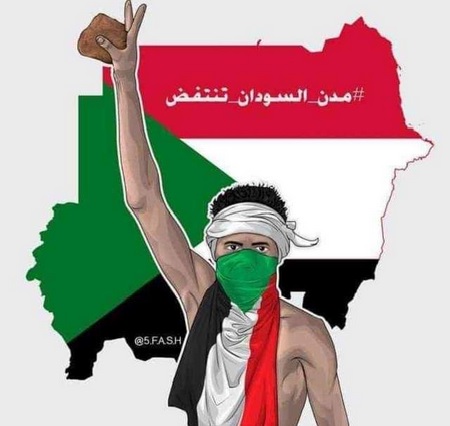
The Sudanese have only to look toward Syria to know how bad revolution before a tyrant may become. While the spectacle of the Syrian Tragedy may have been expected to quell enthusiasm for a similarly motivated revolution in Sudan, it appears to BackChannels at this hour that caught between starvation and a tyrant, the Sudanese motivation — and perhaps the motivation of the military as well — may grow the violence and the level of direct threat encountered by President(-for-Life) Omar al-Bashir.
One blogger, Martha Leah Nangalama, has already picked up on a Middle East Monitor post reporting today Bashir’s evacuation from a mosque.
Of particular and peculiar interest in that story may be the bonding expressed between dictatorships
In Ankara, deputy chairperson of the ruling Justice and Development party Cevdet Yilmaz also expressed support for Al-Bashir’s government after a meeting with the Sudanese ambassador on Wednesday
“We support the legitimate government of Sudan. Turkey has faced similar ploys many times,” Yilmaz said, adding that Turkey is confident that the government is sensitive to the demands of the Sudanese people and would avoid violence.
Although Erdogan’s Turkey exploits NATO for its military defense from Russian aggression in that dimension, it has effectively destroyed democracy in the state and bonded with Russia — or leveraged itself — with the “Turkish Stream” energy project. Basically for the Turks, liberal democracy and freedom have died in their homeland, and they have become part of an increasingly family-run business masquerading some as a sultanate.
DW has placed emphasis on “anger over dictatorship, not bread” in its handling of the story:
“In most of Sudan’s almost 170 cities and big towns, someone has been shot. In some of them, more than 15 people have been shot. The shooting is happening through unofficial types of militia that the regime is using,” says Khansaa Al Kaarib, a Sudanese human rights lawyer and activist.
“For 30 years, this is what the Sudanese people have been getting from Bashir: Killing, killing, killing and more killing. People are simply fed up with this and they want to change this regime. They want to get out of the perception of a people lying under an ICC-wanted criminal, as soon as possible.”
The Sudanese story has had a similar start with a modest protest driven by hunger — i.e., economic protest with ecological variables in play — met by escalating means of repression, including live fire that taken or produced martyrs that in turn have become the focus of additional protests.
For Sudanese now active in shutting down Bashir’s goverment and replacing with a government more modern, responsive, and responsible, here is the voice from that other protest against continued (and Russian) feudal political absolutism as once represented by the corrupt and thuggish Viktor Yanukovych:
BackChannels awaits the Sudanese version: “I am Sudanese, and we have tired of the war criminal in Khartoum . . . .
Abadian, Ramin Hossein. “Bread revolution in Sudan.” MEHR News Agency, December 26, 2018.
DW. “Anger over dictatorship, not bread, fueling Sudan uprising.” December 29, 2018.
El- Affendi, Abdelwahab. “Sudan protests: How did we get here?” Al Jazeera, December 28, 2018.
Channel 4’s retelling has a biblical sound to it: “Beatings. Mass arrests. Teargassing . . . .”
Sadly, BackChannels may be able to add the additional seven plagues to what has most recently been ascribed to the less than beloved dictator Omar al-Bashir.
“Death squads” have been given mention as well.
Six more plagues to go.
And God is Greater.
–33–
24 Saturday Nov 2018
Tags
absolutism v democratic distribution, feudal political absolutism, feudalism v democracy, Medieval Political Absolutism, medieval v modern, middle east conflict, middle east politics, Post-Apartheid South Africa, post-Cold War History and Politics, Soviet / post-Soviet history, State Sovereignty and Land Base, terrorism
BackChannels believes that at the end of WWII, Stalin acquired some part of the middle east that Hitler and the Ottoman Empire had lost. There must have been Nazi agents waiting for arrest or work or both. There had been certainly Arab families or powers who had been aligned with Hitler through Amin al-Husseini, and with the big war over and a two-state offer for the Palestinians and Israel on the table, the same were presented with a choice: peace (and responsible governance) or war focused on the destruction of Israel.
Whether the Soviet Union believed its own rants about the Jews or just wanted to sell and increase its influence through the promotion of anti-Semitic invective pleasing to some Arab ears, BackChannels doesn’t know.
What BackChannels does know is that Soviet arms and diplomacy helped maneuver the Arab states into a disastrous war, after which it had to keep its hooks in the region. Pan-Arab Nationalism got its strong bump up (1950s) , and the dictatorships served to block the spread of democratic western liberalism into the region (as much advanced by Israel’s establishment). The KGB’s grooming of Arafat, the establishing of the PLO, and Arafat’s rise from within would follow in the 1960s as would the wholesale development of “state-sponsored terrorism” through the Andropov years.
Fly over all that history, and we’re here today with the same “gift” from Russia, the Soviet Era and once Soviet-engineered “Middle East Conflict” that has for remnant the wreckage of old middle east dictatorships — Iraq and Libya at least — and the horror of what has been left — Syria in flames and ruins, ALL of it at the hands of its own leader; Iran environmentally damaged (it did that itself) and economically crippled by way of its own aggression and medieval barbarism.
So this morning started with a comment about moderate and peace-seeking Israelis and Palestinians approaching these issues but with the politically repressive elements born in the Soviet Era or conveyed by it through time armed, entrenched, and powerfully intimidating. The conversational partner noted that for the many participating in the talk, ” . . . place and time are all wrong . . . .”
The morning’s first response:
One may recognize “too soon” but those with casualties may be more sensitive to “too late”.
So, forward in this conversation.
Given the so many Jews involved in middle east peace activities, the onlooking Palestinian Diaspora of the west, the truth about the Moscow business plainly spreading across the web (the story of Russian Influence through Disinformation is just moving across the web these days), you would think someone would figure out that “the west” was not quite the enemy as promoted in the imagination).
Three things make us feel better — basic income; close family — and if not the one in which we’re born, then the friends we make; and general and personal security. Perhaps the Israelis and Palestinians who understand that have mutual regard and a few old problems in common.
Next: a rhetoric assertion to the effect that multiculturalism has died (in South Africa) and with the implication that the medieval divisions having to do with race and religion — and by extension clans, tribes, and states — were resurgent and, by inference, all that the world has to look forward to is the greater chaos and misery of war already too well known.
Response:
The “Rainbow Dream” that Mandela had has NOT died in South Africa!
White South Africa left a legacy of now archaic land ownership arrangements, and some are upset about the state’s update or reforms to allow the state to implement policies beneficial to all South Africans.
The state’s related economics — there are too many poor! — and extended state security resources have produced conditions for brigandage — theft and murder — at least, and the aggrieved cast that in racial terms.
To better manage its issues, the people of South Africa recently ejected another corrupt communist aristocrat — the kind that take money from their people and immensely aggrandize themselves in the manners known to dictators.
From The Guardian, here’s a glimpse into how Jacob Zuma “managed” South Africa:
https://www.theguardian.com/world/zuma
Cheer up: South Africa may avoid the Zimbabwean meltdown at the hands of a nominally communist narcissist (Robert Mugabe, who has been deposed in the past year or so by his own military) and continue its independent development as a modern multi-racial, multi-tribal democracy.
Humankind may never see an end to war, but it may see it diminished. The drawing down would be a real gift to Israelis and Palestinians alike.
This coming December 25 will mark the 26th year out from the dissolving of the Soviet Union (1991) toward a feudal and perhaps Orwellian politics (i.e., continuous war between three nuclear-armed giants and proxies within their spheres of influence all the way down — or, alternatively, the day may be closer to the end of the end of a long argument between the medieval world habituated to “absolute power” — power unquestionable with its brutality — especially toward the innocent — exercised with impunity — and the modern one in which democratic power is so for being checked, subject to criticism, distributed and balanced structurally (Administrations; Courts, Legislatures) and popularly (via free and fair elections).
–33–
18 Sunday Nov 2018
“The barbaric and feudal politics of the world’s civilizational past would seem to be getting its claws into the world’s future and dragging it backward.”
https://www.unian.info/world/10340964-russian-official-may-become-interpol-s-next-president.html
One of the two candidates in the upcoming vote by Interpol’s 192 member states, is from Russia despite allegations that Moscow has used Interpol’s procedures to pursue political enemies.
Banks, as founder of Leave.EU, wanted Bannon’s data firm Cambridge Analytica to devise a plan in late 2015 for raising funds in the US that would support the unofficial Brexit campaign, according to the correspondence.
The emails are likely to be scrutinised in the US where Robert Mueller, the special counsel investigating possible collusion between the Trump campaign and Russia, has interviewed Bannon a number of times.
It would seem all paths back toward the renewal of feudal political absolutism in the authentically democratic free world lead back to Moscow (and now perhaps Beijing as well).
Without Putin’s permit, Assad’s Sadnaya Prison would not exist. The memory of that obscenity will burn in history long after the “eye doctor” has succeeded in more fully destroying his own estate.
The Interpol stories involving Russia and China: which despot would wish himself to be policed?
Which despotic elite should be entrusted with the coordination policy of the world’s basic global policing element?
And how well will the west stand when it has itself been riven by the renewal of feudal governance?
https://www.unian.info/world/10341087-eu-may-impose-sanctions-against-hungary-mp-ariev.html.
The EU may impose sanctions on Hungary for adopting laws against the development of civic society, that’s according to MP Volodymyr Ariev, who is also vice-president of the Parliamentary Assembly of the Council of Europe, chairman of the PACE Committee on Culture, Education, Science and Media.”In Hungary there are very serious problems with the European Union, with Brussels. They stem from those very anti-democratic laws that were passed by the Hungarian authorities, in particular against civic society, against the Soros University, public organizations, and not only that. Now the EU is on the path toward imposing sanctions on Hungary,” Ariev told Pryamiy TV channel.
EU / NATO has effectively lost Turkey as a partner for democracy, and it has seen democracy seriously degraded in Hungary as well. While BackChannels has thought it politic to lay off the United States in similar regard, the “Fake News!” President has made that tack similarly difficult. He has degraded the media (for many, America’s “Fourth Estate”); taken a hard run at the Department of Justice (Comey firing; effort to degrade or derail the Mueller Investigation; the out-of-order appointment of Matthew Whittaker as Acting Attorney General); and packed the court with the appointment of an at best marginally acceptable (Senate confirmation vote: 50 to 48) “old boy” of a lawyer.
Politics Medieval v Politics Modern and Democratic?
The barbaric and feudal politics of the world’s civilizational past would seem to be getting its claws into the world’s future and dragging it backward.
Steve Bannon, former political strategist for Donald Trump, said he plans to work closely with the Hungarian prime minister Viktor Orban in the run-up to next year’s European Parliament elections.
https://www.independent.co.uk/news/world/europe/steve-bannon-viktor-orban-hungary-budapest-european-parliament-elections-a8638591.html. (11/17/2018)
Mr Bannon revealed that he had visited Budapest to speak to the far-right leader and his aides in meetings not previously made public.
The political operative also suggested Hungary would make an ideal home for “The Movement” – his new campaign group aimed at electing right-wing nationalists in Europe.
–33–
13 Tuesday Nov 2018
After 70+ years of Arab apartheid — separation in camps; separate diminished treatment — deep political control and suppression (from Human Rights Watch: https://www.hrw.org/news/2018/10/23/palestine-authorities-crush-dissent), this may be the beginning for the Palestinian People. No longer Jordanian; no longer Egyptian; no longer Ottoman; no longer anything that has been before but a part of everything that has crossed through the middle east, there’s definitely a population that has been in modern times isolated in time and space, i.e., A People!
Flip the baby over and let it be born and breath refreshed and new.
https://conflict-backchannels.com/2018/11/01/a-jot-on-the-palestinians/
https://conflict-backchannels.com/2016/09/23/ftac-these-too-are-palestinians/
Posted this morning —
The Palestinian People may be so only as consequence of more than 70 years of Arab Apartheid, i.e., separation in the camps of Lebanon, Jordan, Syria, and Egypt. They will learn that they have been duped as well by the PLO and, later, Hamas — and ultimately by Moscow.
http://www.hup.harvard.edu/catalog.php?isbn=9780674768048
How is it that today you hate Israel?
The real revolution in the Middle East may be normalization — peaceful Palestinian democracy in Gaza and the West Bank; citizenship and inclusion with full return of state rights in Lebanon, Jordan, Syria, and Egypt, albeit slowly to fade the Soviet Era’s poison from the system.
https://conflict-backchannels.com/2016/09/23/ftac-these-too-are-palestinians/
The Palestinians may be many people — they may be even a little bit of all of the people whose cultures and languages and lives have cross-crossed that small patch of earth for millennia.
–33–
 BackChannels